FIRST FLIGHT
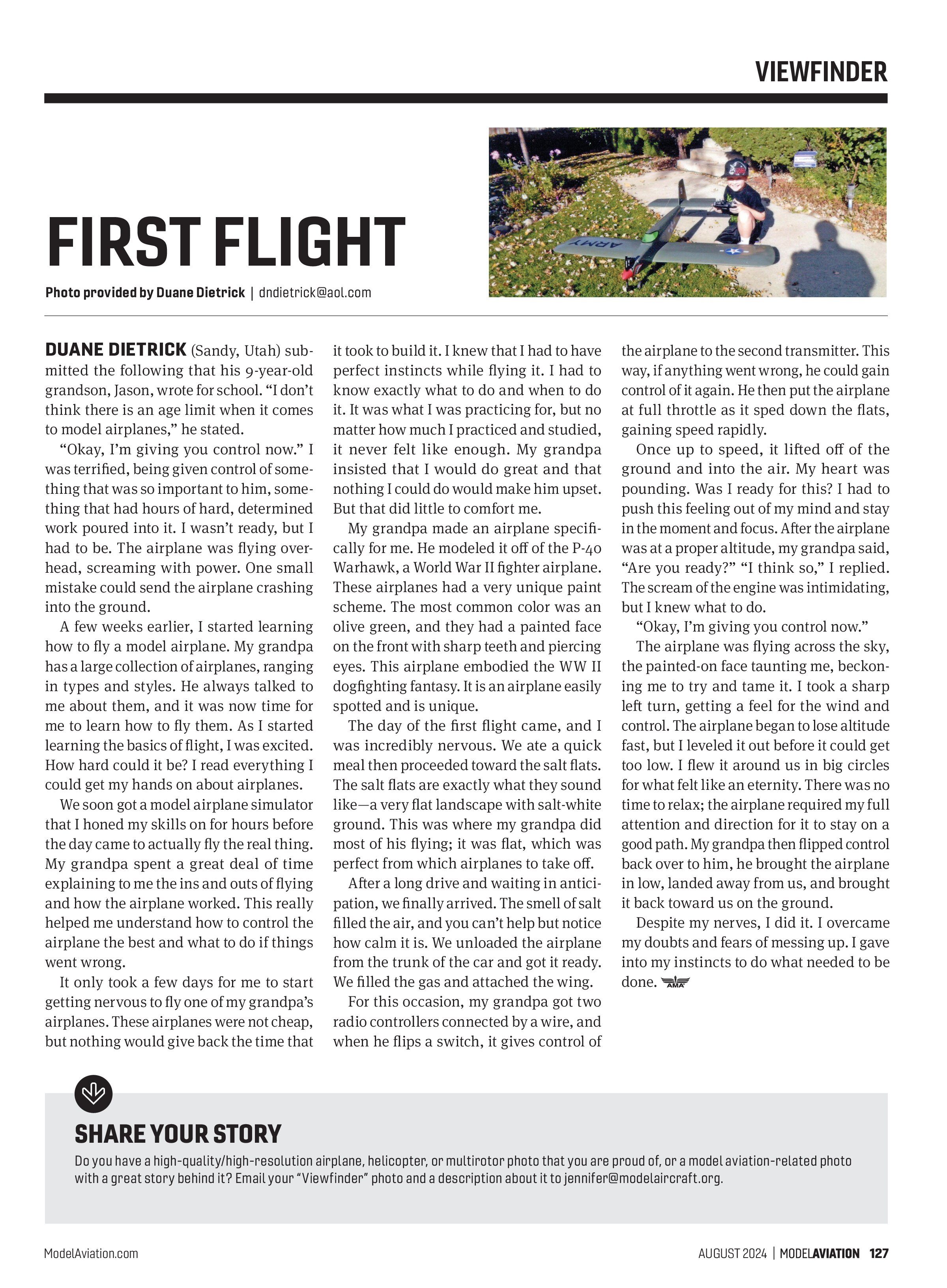
Photo provided by Duane Dietrick | dndietrick@aol.com

DUANE DIETRICK (Sandy, Utah) submitted the following that his 9-year-old grandson, Jason, wrote for school. “I don’t think there is an age limit when it comes to model airplanes,” he stated.
“Okay, I’m giving you control now.” I was terrified, being given control of something that was so important to him, something that had hours of hard, determined work poured into it. I wasn’t ready, but I had to be. The airplane was flying overhead, screaming with power. One small mistake could send the airplane crashing into the ground.
A few weeks earlier, I started learning how to fly a model airplane. My grandpa has a large collection of airplanes, ranging in types and styles. He always talked to me about them, and it was now time for me to learn how to fly them. As I started learning the basics of flight, I was excited. How hard could it be? I read everything I could get my hands on about airplanes.
We soon got a model airplane simulator that I honed my skills on for hours before the day came to actually fly the real thing. My grandpa spent a great deal of time explaining to me the ins and outs of flying and how the airplane worked. This really helped me understand how to control the airplane the best and what to do if things went wrong.
It only took a few days for me to start getting nervous to fly one of my grandpa’s airplanes. These airplanes were not cheap, but nothing would give back the time that it took to build it. I knew that I had to have perfect instincts while flying it. I had to know exactly what to do and when to do it. It was what I was practicing for, but no matter how much I practiced and studied, it never felt like enough. My grandpa insisted that I would do great and that nothing I could do would make him upset. But that did little to comfort me.
My grandpa made an airplane specifically for me. He modeled it off of the P-40 Warhawk, a World War II fighter airplane. These airplanes had a very unique paint scheme. The most common color was an olive green, and they had a painted face on the front with sharp teeth and piercing eyes. This airplane embodied the WW II dogfighting fantasy. It is an airplane easily spotted and is unique.
The day of the first flight came, and I was incredibly nervous. We ate a quick meal then proceeded toward the salt flats. The salt flats are exactly what they sound like—a very flat landscape with salt-white ground. This was where my grandpa did most of his flying; it was flat, which was perfect from which airplanes to take off.
After a long drive and waiting in anticipation, we finally arrived. The smell of salt filled the air, and you can’t help but notice how calm it is. We unloaded the airplane from the trunk of the car and got it ready. We filled the gas and attached the wing.
For this occasion, my grandpa got two radio controllers connected by a wire, and when he flips a switch, it gives control of the airplane to the second transmitter. This way, if anything went wrong, he could gain control of it again. He then put the airplane at full throttle as it sped down the flats, gaining speed rapidly.
Once up to speed, it lifted off of the ground and into the air. My heart was pounding. Was I ready for this? I had to push this feeling out of my mind and stay in the moment and focus. After the airplane was at a proper altitude, my grandpa said, “Are you ready?” “I think so,” I replied. The scream of the engine was intimidating, but I knew what to do.
“Okay, I’m giving you control now.”
The airplane was flying across the sky, the painted-on face taunting me, beckoning me to try and tame it. I took a sharp left turn, getting a feel for the wind and control. The airplane began to lose altitude fast, but I leveled it out before it could get too low. I flew it around us in big circles for what felt like an eternity. There was no time to relax; the airplane required my full attention and direction for it to stay on a good path. My grandpa then flipped control back over to him, he brought the airplane in low, landed away from us, and brought it back toward us on the ground.
Despite my nerves, I did it. I overcame my doubts and fears of messing up. I gave into my instincts to do what needed to be done.
SHARE YOUR STORY
Do you have a high-quality/high-resolution airplane, helicopter, or multirotor photo that you are proud of, or a model aviation-related photo with a great story behind it? Email your “Viewfinder” photo and a description about it to jennifer@modelaircraft.org.