SMALL-FIELD FLYING
POLYSPAN: WHICH IS THE INSIDE, AND WHICH IS THE OUTSIDE?
By Pat Tritle | patscustommodels@gmail.com

A COUPLE OF INTERESTING things have happened throughout the last couple of months that I want to share. It’s pouring rain and I can’t do anything outdoors anyway, so let’s dive right in.
First up, with the availability of lightweight iron-on covering materials on the decline, the old-school techniques of using tissue or silkspan have become a little more common among builders in recent years. I like them all in their proper context, although, in the larger RC park flyer realm, my favorite is still Polyspan and dope.
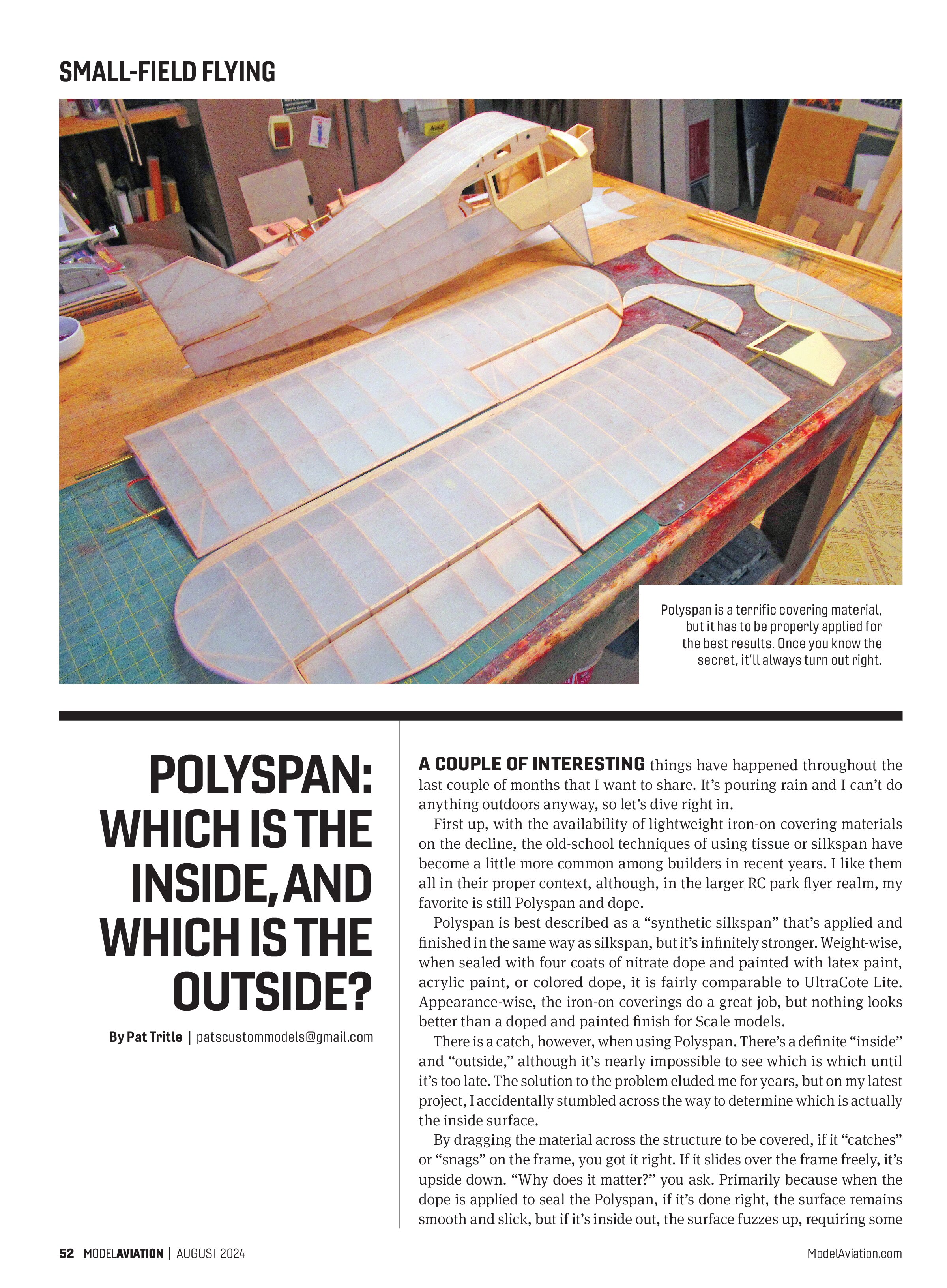
Polyspan is best described as a “synthetic silkspan” that’s applied and finished in the same way as silkspan, but it’s infinitely stronger. Weight-wise, when sealed with four coats of nitrate dope and painted with latex paint, acrylic paint, or colored dope, it is fairly comparable to UltraCote Lite. Appearance-wise, the iron-on coverings do a great job, but nothing looks better than a doped and painted finish for Scale models.
There is a catch, however, when using Polyspan. There’s a definite “inside” and “outside,” although it’s nearly impossible to see which is which until it’s too late. The solution to the problem eluded me for years, but on my latest project, I accidentally stumbled across the way to determine which is actually the inside surface.
By dragging the material across the structure to be covered, if it “catches” or “snags” on the frame, you got it right. If it slides over the frame freely, it’s upside down. “Why does it matter?” you ask. Primarily because when the dope is applied to seal the Polyspan, if it’s done right, the surface remains smooth and slick, but if it’s inside out, the surface fuzzes up, requiring some delicate sanding to remove the fuzz or it will show poorly when painted. Another reason is that the “fuzzy” inside surface attaches more securely to the frame than the slick side.
When building an RC model, accurate hinge slotting can be slightly challenging as well. Once again, good tools go a long way toward keeping that task not only safer but also more accurate.
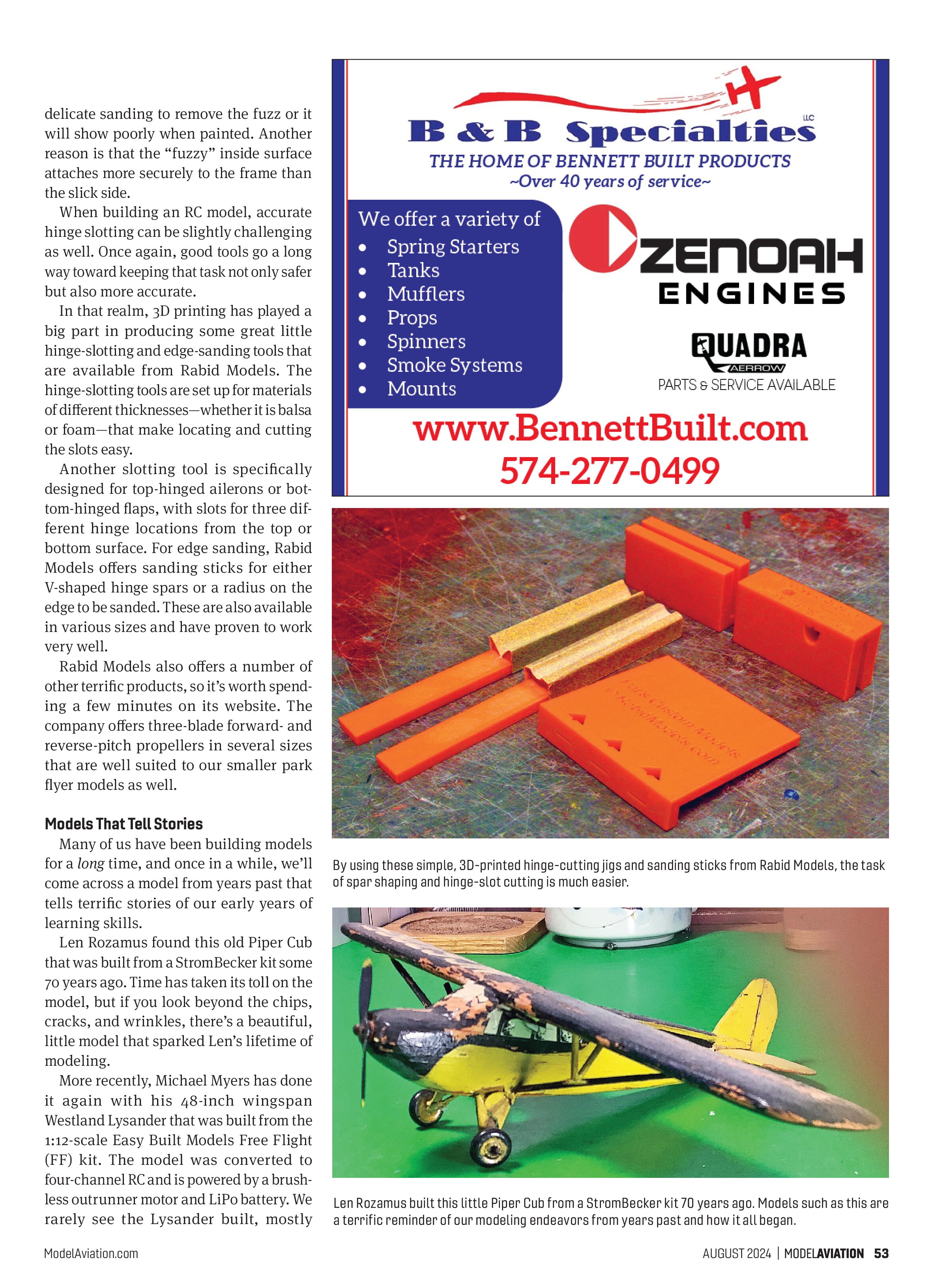
In that realm, 3D printing has played a big part in producing some great little hinge-slotting and edge-sanding tools that are available from Rabid Models. The hinge-slotting tools are set up for materials of different thicknesses—whether it is balsa or foam—that make locating and cutting the slots easy.
Another slotting tool is specifically designed for top-hinged ailerons or bottom-hinged flaps, with slots for three different hinge locations from the top or bottom surface. For edge sanding, Rabid Models offers sanding sticks for either V-shaped hinge spars or a radius on the edge to be sanded. These are also available in various sizes and have proven to work very well.
Rabid Models also offers a number of other terrific products, so it’s worth spending a few minutes on its website. The company offers three-blade forward-and reverse-pitch propellers in several sizes that are well suited to our smaller park flyer models as well.
Models That Tell Stories
Many of us have been building models for a long time, and once in a while, we’ll come across a model from years past that tells terrific stories of our early years of learning skills.
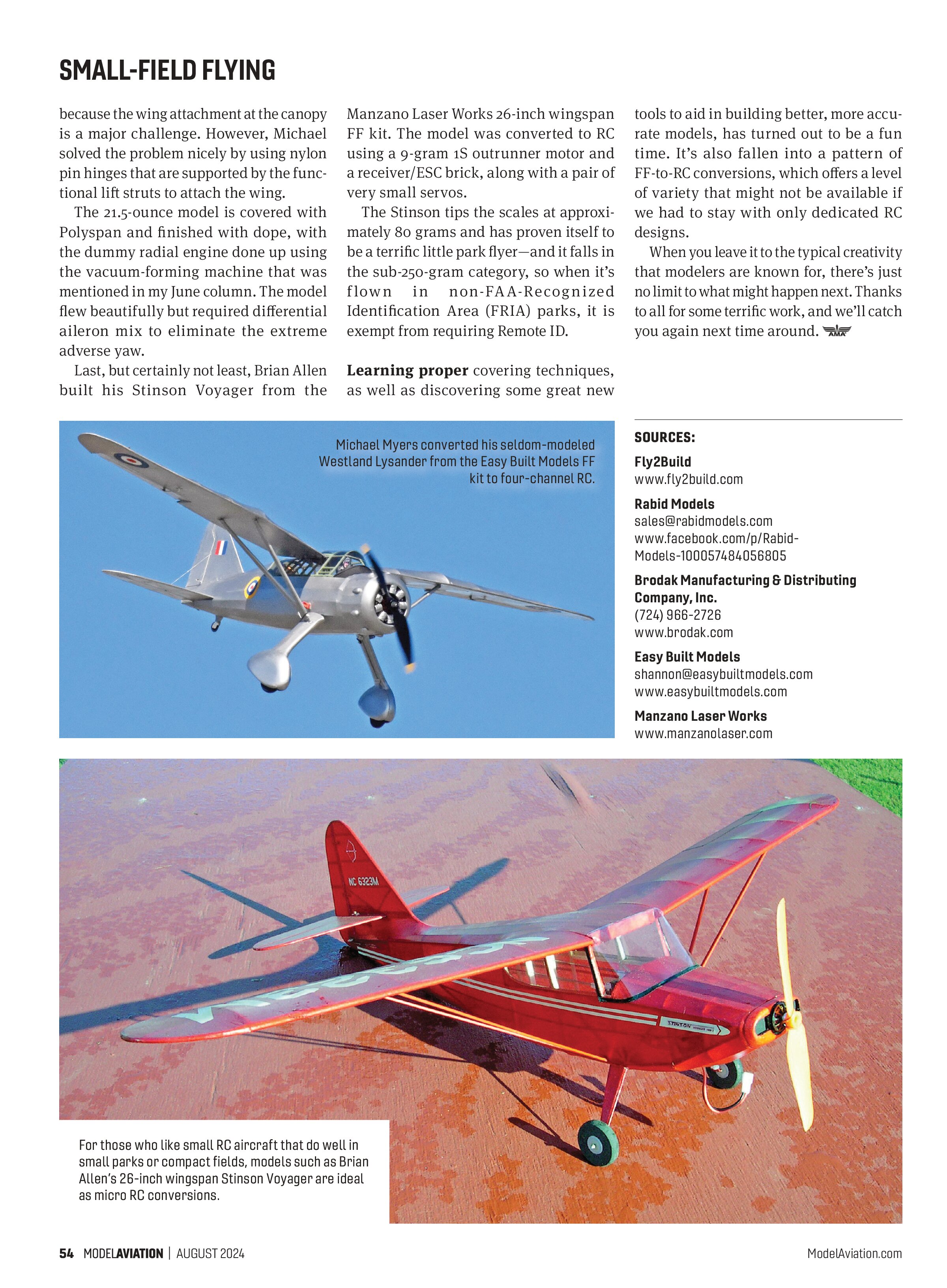
Len Rozamus found this old Piper Cub that was built from a StromBecker kit some 70 years ago. Time has taken its toll on the model, but if you look beyond the chips, cracks, and wrinkles, there’s a beautiful, little model that sparked Len’s lifetime of modeling.

More recently, Michael Myers has done it again with his 48-inch wingspan Westland Lysander that was built from the 1:12-scale Easy Built Models Free Flight (FF) kit. The model was converted to four-channel RC and is powered by a brushless outrunner motor and LiPo battery. We rarely see the Lysander built, mostly

because the wing attachment at the canopy is a major challenge. However, Michael solved the problem nicely by using nylon pin hinges that are supported by the functional lift struts to attach the wing.
The 21.5-ounce model is covered with Polyspan and finished with dope, with the dummy radial engine done up using the vacuum-forming machine that was mentioned in my June column. The model flew beautifully but required differential aileron mix to eliminate the extreme adverse yaw.
Last, but certainly not least, Brian Allen built his Stinson Voyager from the Manzano Laser Works 26-inch wingspan FF kit. The model was converted to RC using a 9-gram 1S outrunner motor and a receiver/ESC brick, along with a pair of very small servos.
The Stinson tips the scales at approximately 80 grams and has proven itself to be a terrific little park flyer—and it falls in the sub-250-gram category, so when it’s flown in non-FAA-Recognized Identification Area (FRIA) parks, it is exempt from requiring Remote ID.
Learning proper covering techniques, as well as discovering some great new tools to aid in building better, more accurate models, has turned out to be a fun time. It’s also fallen into a pattern of FF-to-RC conversions, which offers a level of variety that might not be available if we had to stay with only dedicated RC designs.
When you leave it to the typical creativity that modelers are known for, there’s just no limit to what might happen next. Thanks to all for some terrific work, and we’ll catch you again next time around.

SOURCES:
Fly2Build
www.fly2build.com
Rabid Models
sales@rabidmodels.com
www.facebook.com/Rabid-Models-100057484056805
Brodak Manufacturing & Distributing Company, Inc.
(724) 966-2726
www.brodak.com
Easy Built Models
shannon@easybuiltmodels.com
www.easybuiltmodels.com
Manzano Laser Works
www.manzanolaser.com