RC SLOPE SOARING

WIND VOICES
By Greg Schutte | gshouty@yahoo.com
THERE IS NOTHING like waking up to wind chimes that are singing in the morning. The RC airplanes in the garage started to talk to me. To make sure that I was not losing my mind, I opened the door and checked the garage. They were all quiet, but I could tell by their puppy dog eyes and quivering lower lips that they needed attention. I better get them on the chargers. They seemed happy as I walked back into the house. Later that day, I loaded them up and we headed to the place where the magic happens—Pickle Butte, south of Nampa, Idaho.
As I drove to Pickle, the airplanes and I talked about the wind and the possible maneuvers that they wanted to perform. They seemed impatient. I told them that I was not going to speed to get us there. My truck even tried to speed a couple of times, so I set the cruise control to be safe.
We turned onto the access road for the ridge and determined that the south launch was the best place for the current conditions. The road was full of moon dust, as always, so we held our breath—we did not want to start sneezing. My pickup was mad about getting dirty.
We parked and I checked the wind. It was 15 to 20 knots, blowing almost straight in. It was midday, so there were thermal gusts moving through pretty frequently. As I walked back to the truck, I could see my airplanes looking through the window with smiles on their faces. We decided that the Sparrow would go first, then the A-10, and, finally, the Alula. With this being the Alula’s first trip to Pickle, it only seemed logical, but I detected a little concern in its voice.

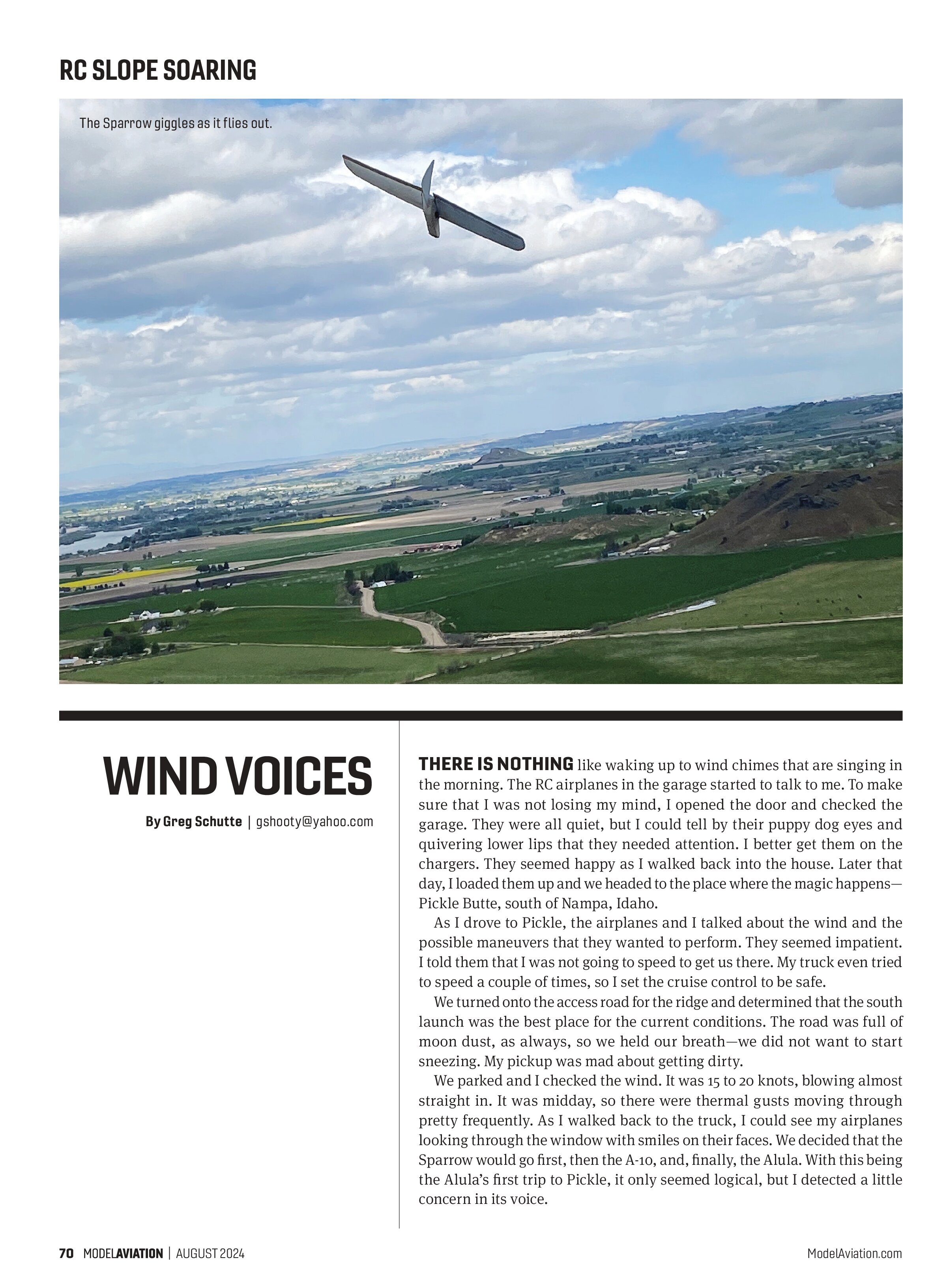
I grabbed the Sparrow and checked to make sure that the controls were still in correct working order. We walked out to the ridge, and I steadied it into the wind. It gave me a wink and I gave it a toss. I could hear it screaming with joy as it flew away. Even with the wind blowing in my ears, I could still hear the Sparrow laughing and giggling every time it flew by. The barrel rolls and loops all seemed to make it happy.
We flew for about 20 minutes. I was starting to get a little chilled. The Sparrow did not want to land, so I reminded it that there were other airplanes that also wanted to fly. It reluctantly agreed and I brought it in to land.
Now, the west launch at Pickle has a pretty nasty rotor. I brought the Sparrow in close to the ridge and it came in and did a little bonk to fully stop. I ran over to make sure that it was okay. It had a little road rash on the nose, but you could hardly see it from the ear-to-ear grin. The Sparrow reassured me that it was okay. On the way back to the truck, it was talking at 500 mph. It had fun.
Upon reaching the pickup, my A-10 was almost drooling to get into the air. The A-10 requires more wind than the Sparrow. Thankfully, the ridge was still producing good lift. I gave the A-10 a quick preflight like I did with the Sparrow and we headed to the ridge. I could hear my Sparrow talking with the Alula about how fun it was and what to expect when it was its turn.
I steadied my A-10 into the wind, and it gave me the “All clear!” I nodded and firmly carrier-launched it into the wind. It climbed away like an old war dog and began numerous barrel rolls, strafing runs, and loops. The high whistle it made as it went by reminded me of its real-life counterpart.
During the A-10’s flight, it shared the air with some local pilots. A crow and an eagle came in to see what was up. It also flew for about 20 minutes. I was getting cold again and decided that it was time to land. The wind had started to pick up, so it was really flying well, which meant that landing next to the ridge would be a “Mr. Toad’s Wild Ride” event. I walked behind the ridge approximately 75 yards and, with some

altitude, I brought it in. The A-10 likes to come in fast for plenty of control and tends to slide some upon touching the ground. I did my best to find a soft spot, but it contacted a rock and broke the main gun on the nose. As we walked back to the truck, I promised that I would get a new one.
As I got the Alula ready to fly, I could tell it was nervous. With the Sparrow talking 500 mph about its flight, and then the A-10 coming in with a broken nose gun, the Alula seemed uneasy. I assured it that it would be fine.
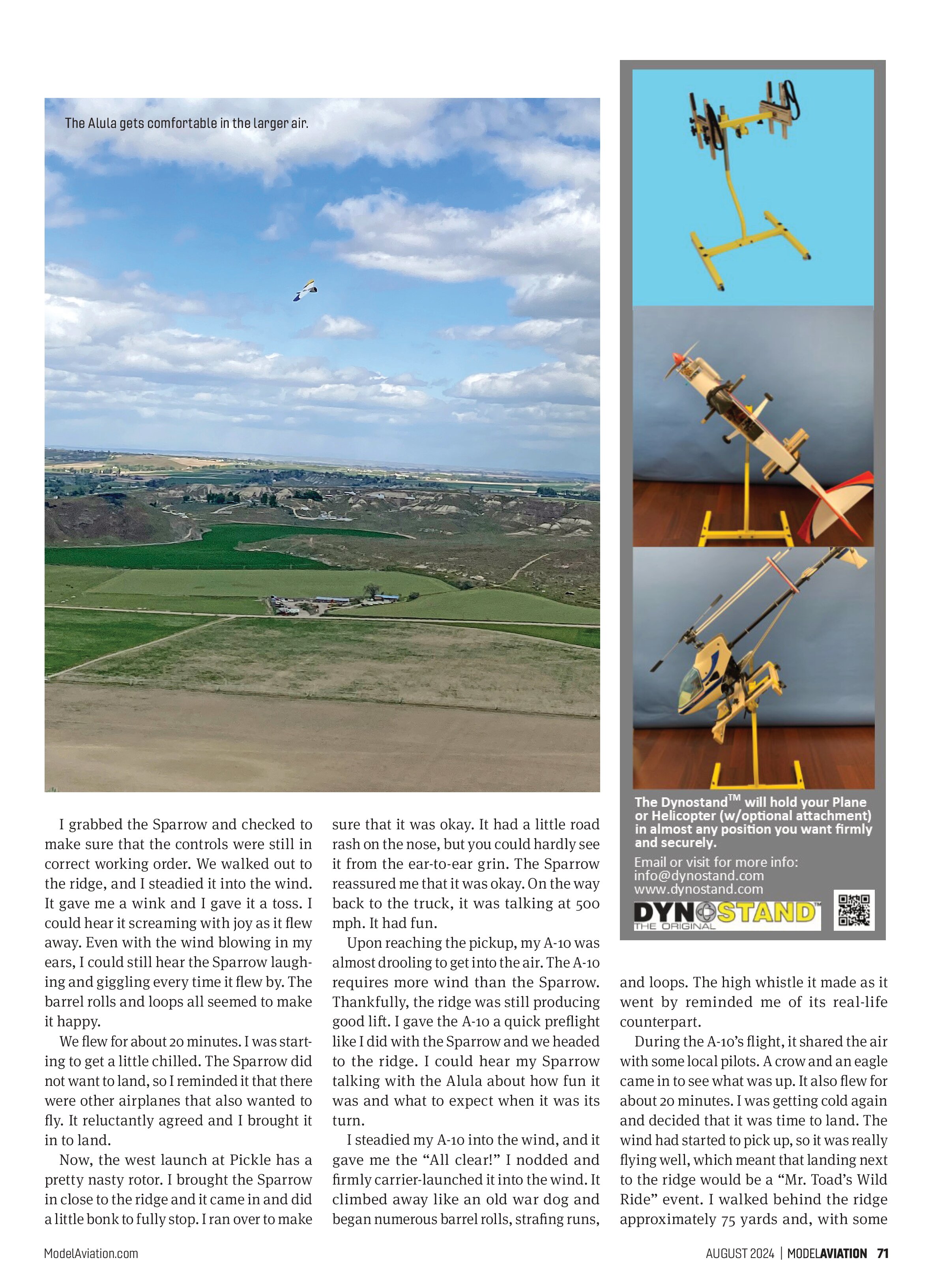
When I was doing my check, I realized that I had forgotten to bring tape to secure the Alula’s wing. I was thinking about not flying it, but it let me know that it was ready and would take it easy. As I got close to the edge, its eyes got big. This ridge was larger than what it had flown before. I smiled and turned the Alula into the wind, which it took a couple of minutes to feel. With a loud voice, it yelled, “Let’s fly!” and I let it go. It went out straight and true.
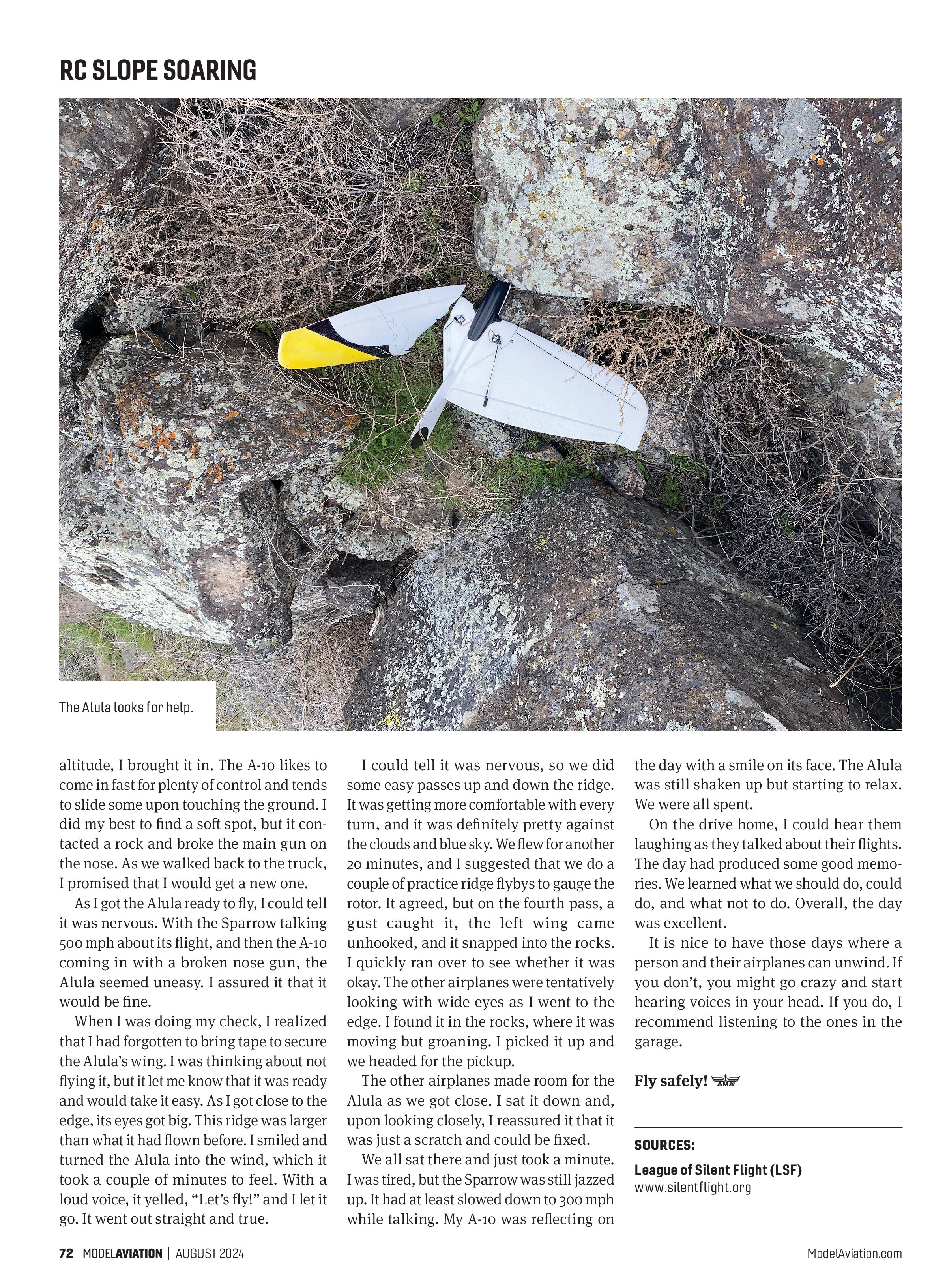
I could tell it was nervous, so we did some easy passes up and down the ridge. It was getting more comfortable with every turn, and it was definitely pretty against the clouds and blue sky. We flew for another 20 minutes, and I suggested that we do a couple of practice ridge flybys to gauge the rotor. It agreed, but on the fourth pass, a gust caught it, the left wing came unhooked, and it snapped into the rocks. I quickly ran over to see whether it was okay. The other airplanes were tentatively looking with wide eyes as I went to the edge. I found it in the rocks, where it was moving but groaning. I picked it up and we headed for the pickup.
The other airplanes made room for the Alula as we got close. I sat it down and, upon looking closely, I reassured it that it was just a scratch and could be fixed.
We all sat there and just took a minute. I was tired, but the Sparrow was still jazzed up. It had at least slowed down to 300 mph while talking. My A-10 was reflecting on the day with a smile on its face. The Alula was still shaken up but starting to relax. We were all spent.
On the drive home, I could hear them laughing as they talked about their flights. The day had produced some good memories. We learned what we should do, could do, and what not to do. Overall, the day was excellent.
It is nice to have those days where a person and their airplanes can unwind. If you don’t, you might go crazy and start hearing voices in your head. If you do, I recommend listening to the ones in the garage.
Fly safely!
SOURCES:
League of Silent Flight (LSF)
www.silentflight.org