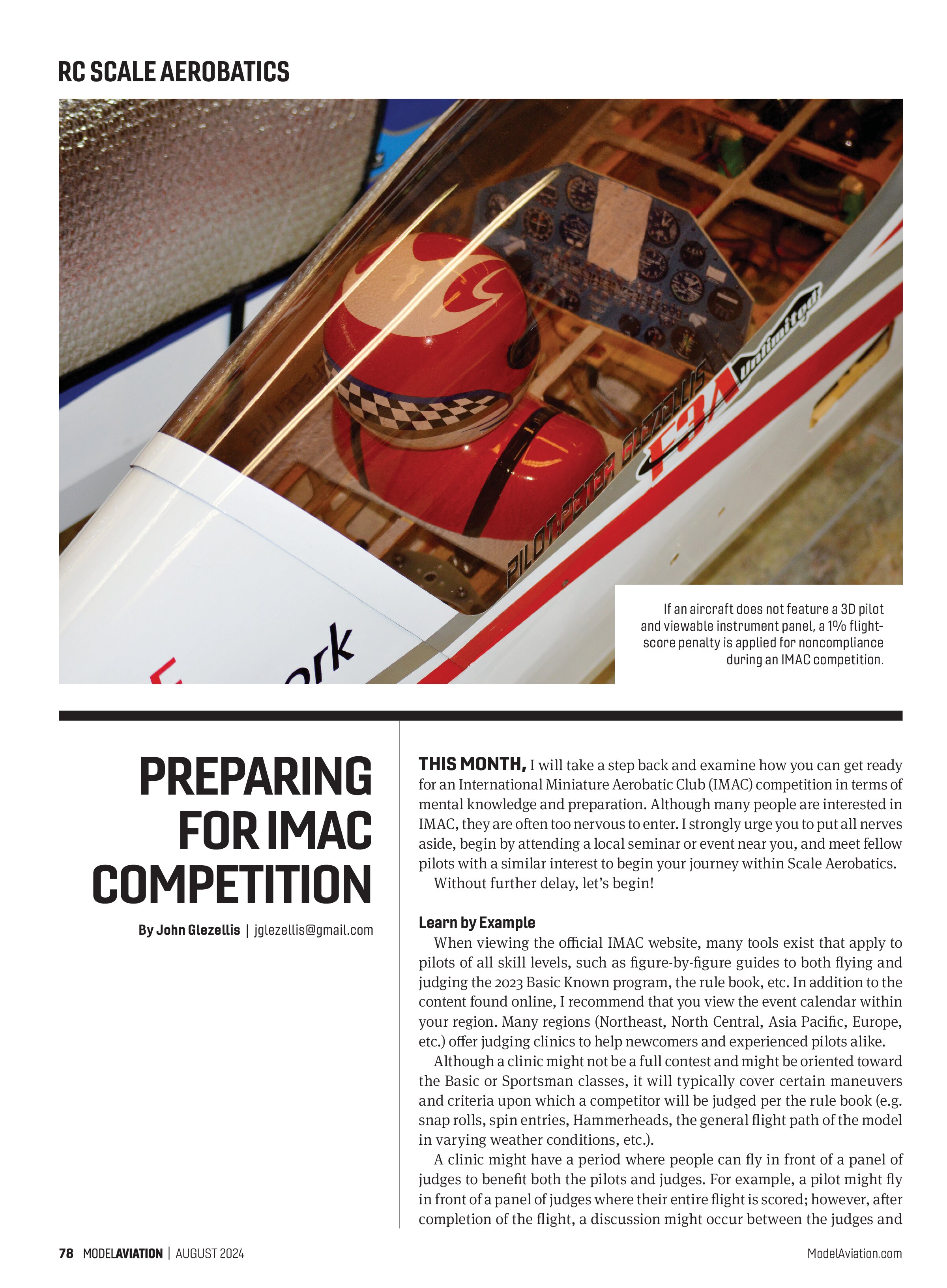
PREPARING
FOR IMAC
COMPETITION
By John Glezellis | jglezellis@gmail.com

THIS MONTH, I will take a step back and examine how you can get ready for an International Miniature Aerobatic Club (IMAC) competition in terms of mental knowledge and preparation. Although many people are interested in IMAC, they are often too nervous to enter. I strongly urge you to put all nerves aside, begin by attending a local seminar or event near you, and meet fellow pilots with a similar interest to begin your journey within Scale Aerobatics. Without further delay, let’s begin!
Learn by Example
When viewing the official IMAC website, many tools exist that apply to pilots of all skill levels, such as figure-by-figure guides to both flying and judging the 2023 Basic Known program, the rule book, etc. In addition to the content found online, I recommend that you view the event calendar within your region. Many regions (Northeast, North Central, Asia Pacific, Europe, etc.) offer judging clinics to help newcomers and experienced pilots alike.
Although a clinic might not be a full contest and might be oriented toward the Basic or Sportsman classes, it will typically cover certain maneuvers and criteria upon which a competitor will be judged per the rule book (e.g. snap rolls, spin entries, Hammerheads, the general flight path of the model in varying weather conditions, etc.).
A clinic might have a period where people can fly in front of a panel of judges to benefit both the pilots and judges. For example, a pilot might fly in front of a panel of judges where their entire flight is scored; however, after completion of the flight, a discussion might occur between the judges and the pilot. Scores will be discussed, as well as where certain downgrades occurred, so that all judges can align themselves on the criteria required and the reasoning behind each score.
The pilot is a part of this process to observe, learn about the areas that require improvement, and review the criteria found per the rule book. Attending a clinic is also a great way to learn about the general schedule of a contest while receiving constructive feedback, so that a pilot can then return to their home field and practice proper flight techniques. Often, a judge will not only point out certain mistakes made but will also give feedback on what you can do to correct them.
With respect to classes, although a pilot might consider themselves an advanced Scale Aerobatics pilot, it does not necessarily mean that they should start off in the Advanced or Unlimited categories. I first became interested in aerobatics through RC Aerobatics (Pattern) before attending my first IMAC event. At that time, which I believe was around 1998, I flew in the Pattern Masters category, and for my first IMAC event, I started in Sportsman, then transitioned to Advanced, and then Unlimited. I later attended numerous invitational events.
It is important to learn about the figures being flown, understand the criteria per the rule book, and learn how to set up a given aircraft to accommodate your preferences. That knowledge comes with time

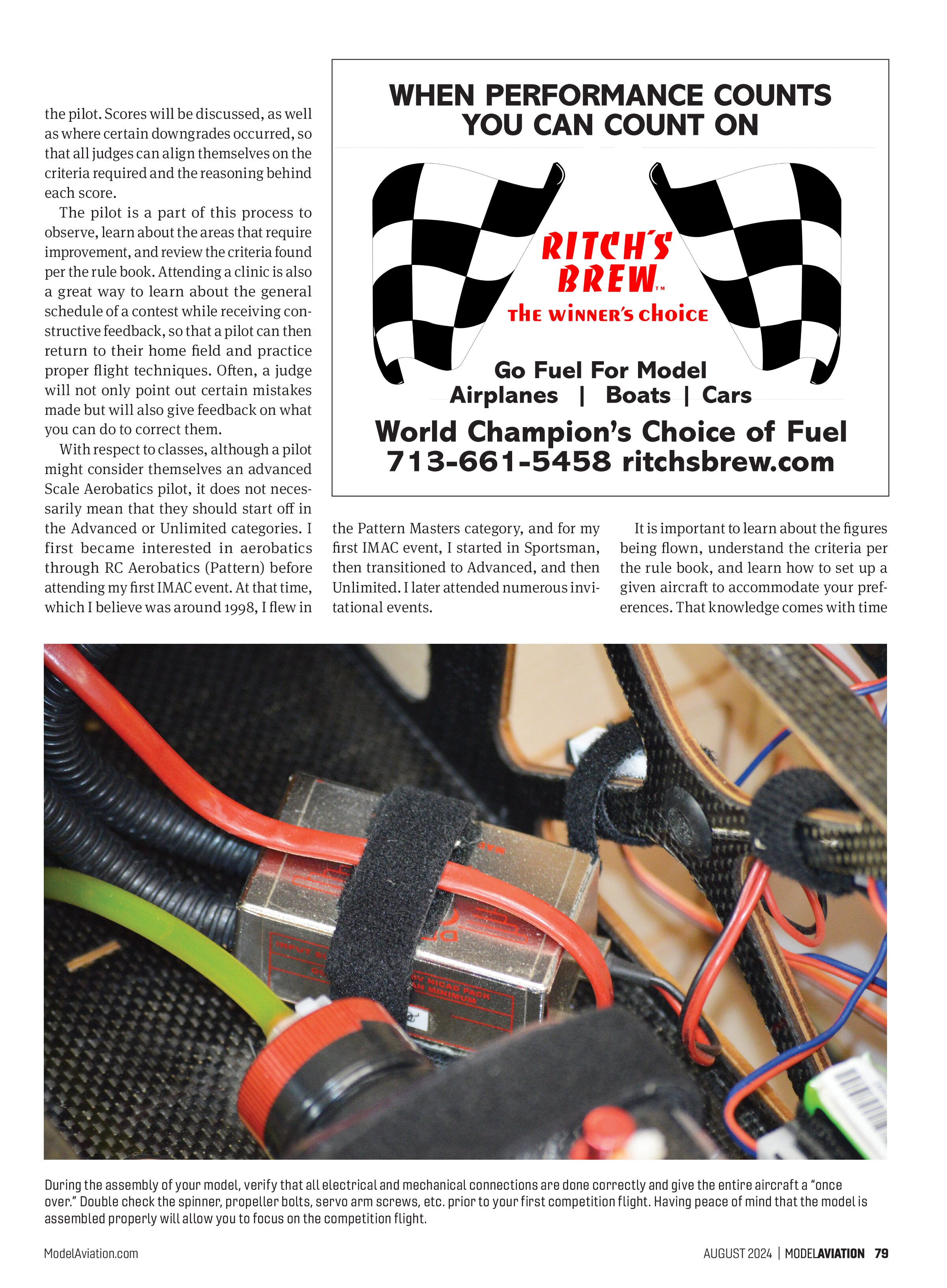
During the assembly of your model, verify that all electrical and mechanical connections are done correctly and give the entire aircraft a “once over.” Double check the spinner, propellor bolts, servo arm screws, etc. prior to your first competition flight. Having peace of mind that the model is assembled properly will allow you to focus on the competition flight.

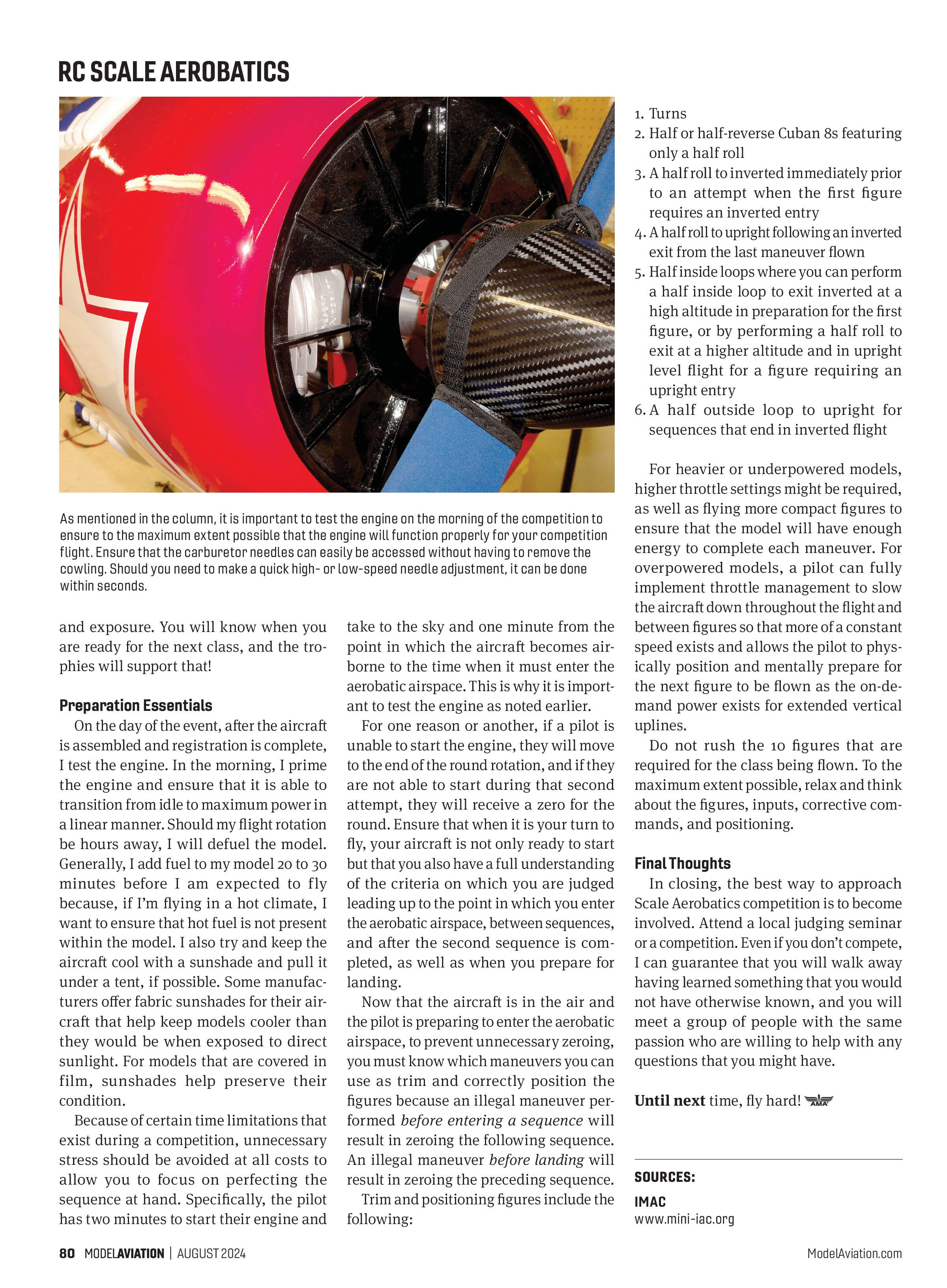
As mentioned in the column, it is important to test the engine on the morning of the competition to ensure to the maximum extent possible that the engine will function properly for your competition flight. Ensure that the carburetor needles can easily be accessed without having to remove the cowling. Should you need to make a quick high- or low-speed needle adjustment, it can be done within seconds.
and exposure. You will know when you are ready for the next class, and the trophies will support that!
Preparation Essentials
On the day of the event, after the aircraft is assembled and registration is complete, I test the engine. In the morning, I prime the engine and ensure that it is able to transition from idle to maximum power in a linear manner. Should my flight rotation be hours away, I will defuel the model. Generally, I add fuel to my model 20 to 30 minutes before I am expected to fly because, if I’m flying in a hot climate, I want to ensure that hot fuel is not present within the model. I also try and keep the aircraft cool with a sunshade and pull it under a tent, if possible. Some manufacturers offer fabric sunshades for their aircraft that help keep models cooler than they would be when exposed to direct sunlight. For models that are covered in film, sunshades help preserve their condition.
Because of certain time limitations that exist during a competition, unnecessary stress should be avoided at all costs to allow you to focus on perfecting the sequence at hand. Specifically, the pilot has two minutes to start their engine and take to the sky and one minute from the point in which the aircraft becomes airborne to the time when it must enter the aerobatic airspace. This is why it is important to test the engine as noted earlier.
For one reason or another, if a pilot is unable to start the engine, they will move to the end of the round rotation, and if they are not able to start during that second attempt, they will receive a zero for the round. Ensure that when it is your turn to fly, your aircraft is not only ready to start but that you also have a full understanding of the criteria on which you are judged leading up to the point in which you enter the aerobatic airspace, between sequences, and after the second sequence is completed, as well as when you prepare for landing.
Now that the aircraft is in the air and the pilot is preparing to enter the aerobatic airspace, to prevent unnecessary zeroing, you must know which maneuvers you can use as trim and correctly position the figures because an illegal maneuver performed before entering a sequence will result in zeroing the following sequence. An illegal maneuver before landing will result in zeroing the preceding sequence. Trim and positioning figures include the following:
- Turns
- Half or half-reverse Cuban 8s featuring only a half roll
- A half roll to inverted immediately prior to an attempt when the first figure requires an inverted entry
- A half roll to upright following an inverted exit from the last maneuver flown
- Half inside loops where you can perform a half inside loop to exit inverted at a high altitude in preparation for the first figure, or by performing a half roll to exit at a higher altitude and in upright level flight for a figure requiring an upright entry
- A half outside loop to upright for sequences that end in inverted flight
For heavier or underpowered models, higher throttle settings might be required, as well as flying more compact figures to ensure that the model will have enough energy to complete each maneuver. For overpowered models, a pilot can fully implement throttle management to slow the aircraft down throughout the flight and between figures so that more of a constant airspeed exists and allows the pilot to physically position and mentally prepare for the next figure to be flown as the on-demand power exists for extended vertical uplines.
Do not rush the 10 figures that are required for the class being flown. To the maximum extent possible, relax and think about the figures, inputs, corrective commands, and positioning.
Final Thoughts
In closing, the best way to approach Scale Aerobatics competition is to become involved. Attend a local judging seminar or a competition. Even if you don’t compete, I can guarantee that you will walk away having learned something that you would not have otherwise known, and you will meet a group of people with the same passion who are willing to help with any questions that you might have.
Until next time, fly hard!
SOURCES:
IMAC
www.mini-iac.org