FUTABA CGY770
PROGRAMMING
BOX AND
UR MODE
Tim DiPeri | timdperi@caseco-inc.com
FOR COMPLETE TRANSPARENCY, I have been flying Futaba electronics for decades and am a proud member of Team Futaba USA. I have used every model flight controller that Futaba has produced, and have tested other brands of gyros as well. My main level of interest, within model helicopters, is precision (F3C) flying and aerobatics.
Nearly everyone who reads this article has the idea that model helicopters have almost always relied on electric gyros for successful flight. Today, the three-axis flight controller is the heart of a model helicopter, and these little and powerful gems are ever-evolving to improve our experiences in flying.
As an electrical engineer, I am interested in the evolution of this technology. I remember that the first flybarless controllers to come onto the market many years ago relied on hollow tubes (to gather airspeed information), as well as other electronics, to allow a model helicopter to be stable without using a flybar mechanical system. So much has changed—and things keep changing!
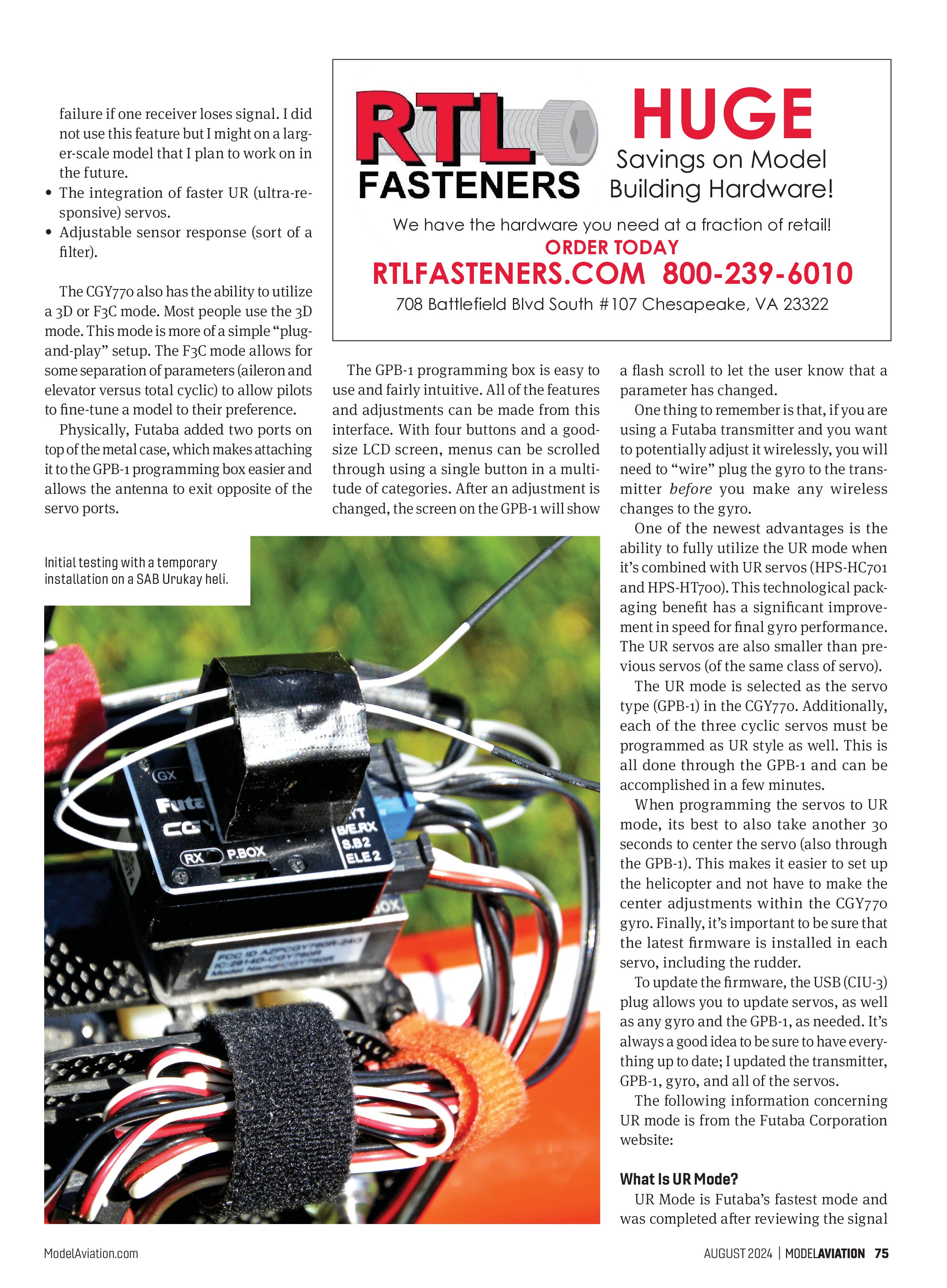
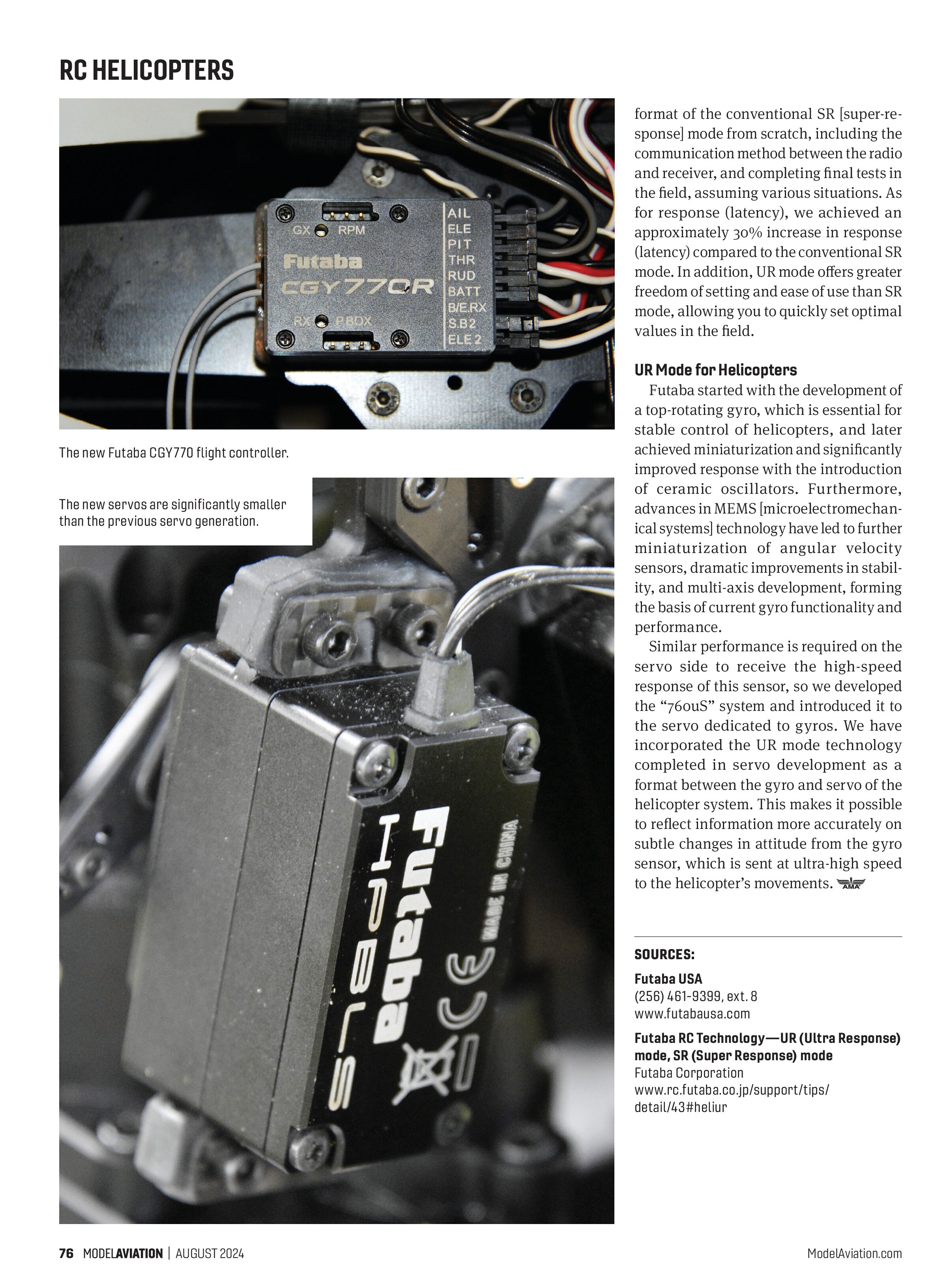
I received the Futaba CGY770 helicopter gyro early in 2024. The overall shape and size is similar to the CGY760, and the menus are familiar as well.
Some of the features that really interested me include the following:
- The ability to program the gyro through the GPB-1 programming box that is wired to the gyro or is wireless to the transmitter (if it’s a higher-end Futaba system). This allows a multitude of interface options, regardless of the radio system.
- Multi-receiver operation allows the use of an additional receiver to add the benefit of a more control-reliable operation—it’s not a catastrophic failure if one receiver loses signal. I did not use this feature but I might on a larger-scale model that I plan to work on in the future.
- The integration of faster UR (ultra-responsive) servos.
- Adjustable sensor response (sort of a filter).
The CGY770 also has the ability to utilize a 3D or F3C mode. Most people use the 3D mode. This mode is more of a simple “plug-and-play” setup. The F3C mode allows for some separation of parameters (aileron and elevator versus total cyclic) to allow pilots to fine-tune a model to their preference.
Physically, Futaba added two ports on top of the metal case, which makes attaching it to the GPB-1 programming box easier and allows the antenna to exit opposite of the servo ports.
The GPB-1 programming box is easy to use and fairly intuitive. All of the features and adjustments can be made from this interface. With four buttons and a good-size LCD screen, menus can be scrolled through using a single button in a multitude of categories. After an adjustment is changed, the screen on the GPB-1 will show a flash scroll to let the user know that a parameter has changed.
One thing to remember is that, if you are using a Futaba transmitter and you want to potentially adjust it wirelessly, you will need to “wire” plug the gyro to the transmitter before you make any wireless changes to the gyro.
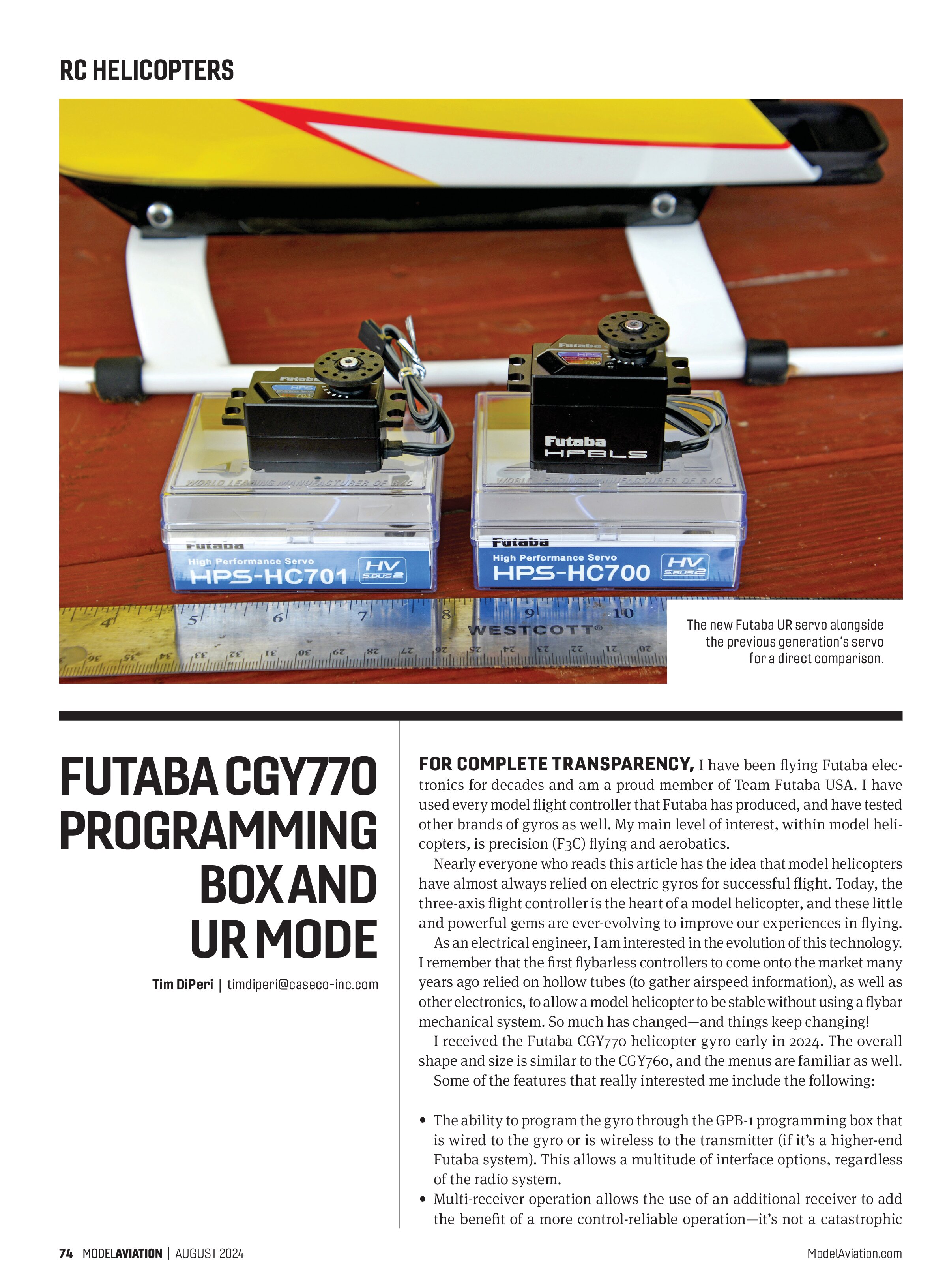
One of the newest advantages is the ability to fully utilize the UR mode when it’s combined with UR servos (HPS-HC701 and HPS-HT700). This technological packaging benefit has a significant improvement in speed for final gyro performance. The UR servos are also smaller than previous servos (of the same class of servo).
The UR mode is selected as the servo type (GPB-1) in the CGY770. Additionally, each of the three cyclic servos must be programmed as UR style as well. This is all done through the GPB-1 and can be accomplished in a few minutes.
When programming the servos to UR mode, its best to also take another 30 seconds to center the servo (also through the GPB-1). This makes it easier to set up the helicopter and not have to make the center adjustments within the CGY770 gyro. Finally, it’s important to be sure that the latest firmware is installed in each servo, including the rudder.
To update the firmware, the USB (CIU-3) plug allows you to update servos, as well as any gyro and the GPB-1, as needed. It’s always a good idea to be sure to have everything up to date; I updated the transmitter, GPB-1, gyro, and all of the servos.
The following information concerning UR mode is from the Futaba Corporation website:
What Is UR Mode?
UR Mode is Futaba’s fastest mode and was completed after reviewing the signal.
Initial testing with a temporary installation on a SAB Urukay heli.


The new Futaba CGY770 flight controller.
The new servos are significantly smaller than the previous servo generation.

format of the conventional SR [super-response] mode from scratch, including the communication method between the radio and receiver, and completing final tests in the field, assuming various situations. As for response (latency), we achieved an approximately 30% increase in response (latency) compared to the conventional SR mode. In addition, UR mode offers greater freedom of setting and ease of use than SR mode, allowing you to quickly set optimal values in the field.
UR Mode for Helicopters
Futaba started with the development of a top-rotating gyro, which is essential for stable control of helicopters, and later achieved miniaturization and significantly improved response with the introduction of ceramic oscillators. Furthermore, advances in MEMS [microelectromechanical systems] technology have led to further miniaturization of angular velocity sensors, dramatic improvements in stability, and multi-axis development, forming the basis of current gyro functionality and performance.
Similar performance is required on the servo side to receive the high-speed response of this sensor, so we developed the “760us” system and introduced it to the servo dedicated to gyros. We have incorporated the UR mode technology completed in servo development as a format between the gyro and servo of the helicopter system. This makes it possible to reflect information more accurately on subtle changes in attitude from the gyro sensor, which is sent at ultra-high speed to the helicopter’s movements.
SOURCES:
Futaba USA
(256) 461-9399, ext. 8
www.futabausa.com
Futaba RC Technology—UR (Ultra Response) mode, SR (Super Response) mode
Futaba Corporation
www.rc.futaba.co.jp/support/tips/detail/43#heliur