RC GIANT SCALE

TOP RC MODEL ZERO
By Sal Calvagna | rcgiants@optonline.net
WELCOME BACK. Summer is in full swing, so now is a great time to visit a local flying event and catch up with old friends.
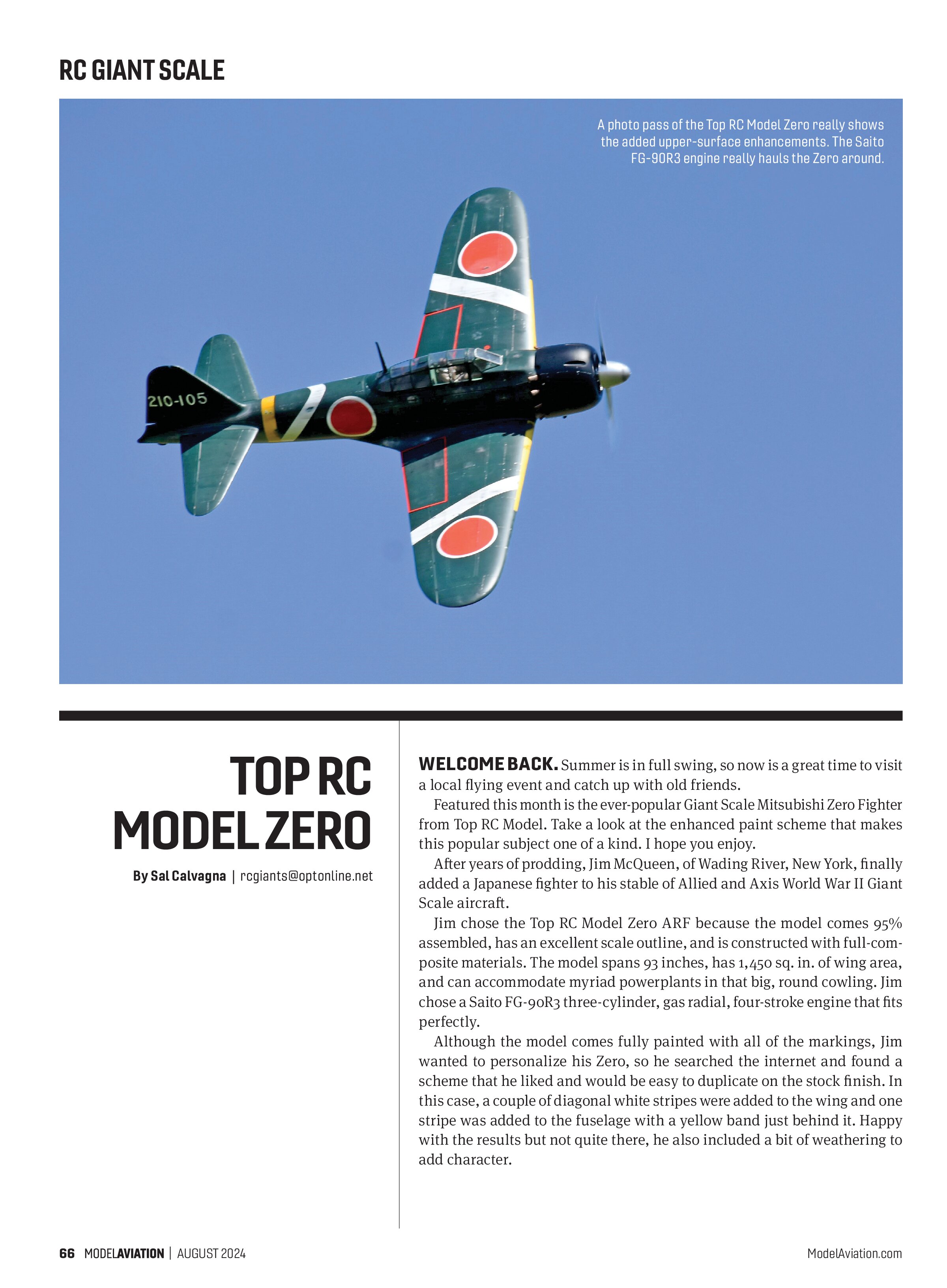
Featured this month is the ever-popular Giant Scale Mitsubishi Zero Fighter from Top RC Model. Take a look at the enhanced paint scheme that makes this popular subject one of a kind. I hope you enjoy.
After years of prodding, Jim McQueen, of Wading River, New York, finally added a Japanese fighter to his stable of Allied and Axis World War II Giant Scale aircraft.
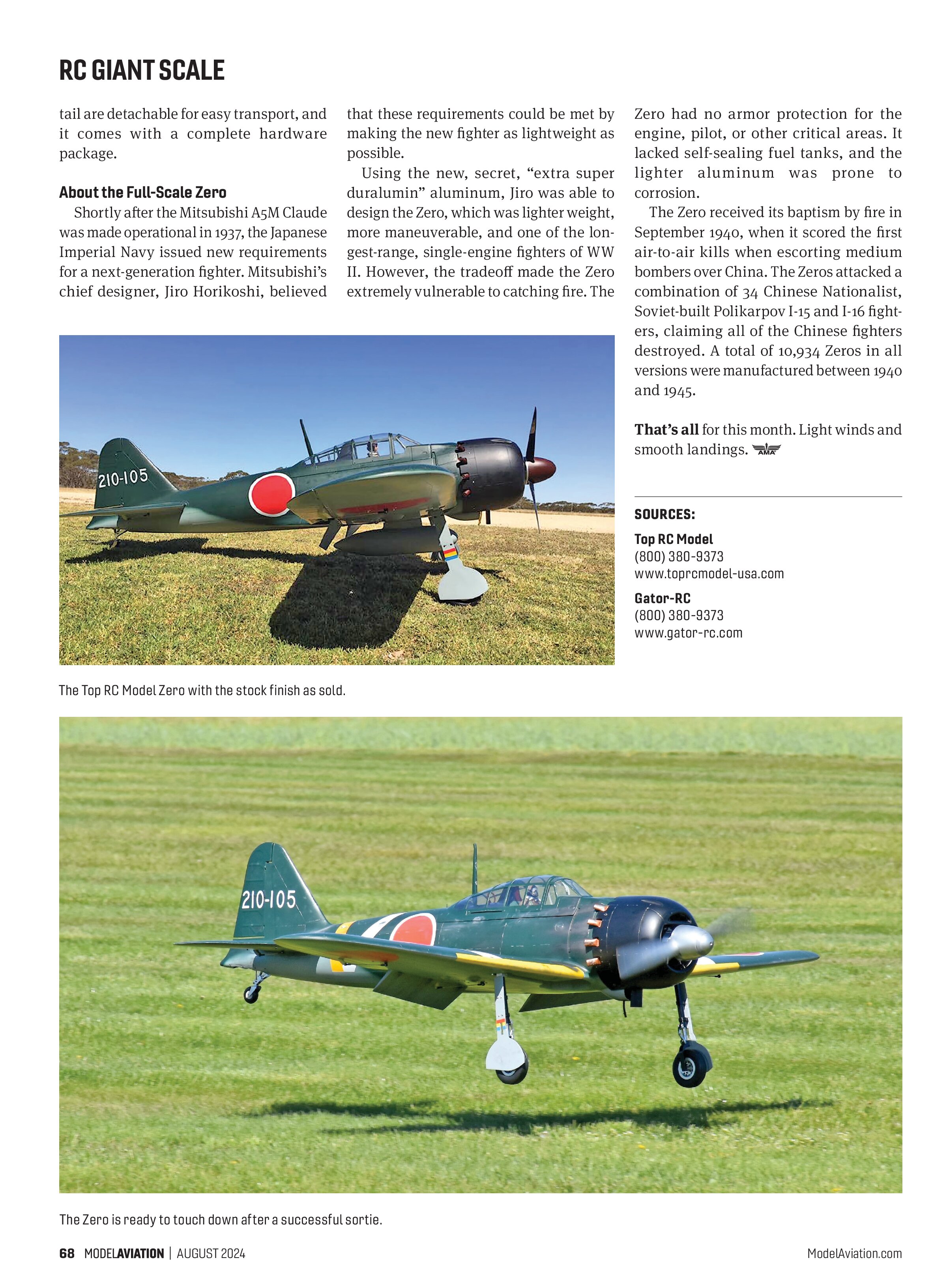
Jim chose the Top RC Model Zero ARF because the model comes 95% assembled, has an excellent scale outline, and is constructed with full-composite materials. The model spans 93 inches, has 1,450 sq. in. of wing area, and can accommodate myriad powerplants in that big, round cowling. Jim chose a Saito FG-90R3 three-cylinder, gas radial, four-stroke engine that fits perfectly.
Although the model comes fully painted with all of the markings, Jim wanted to personalize his Zero, so he searched the internet and found a scheme that he liked and would be easy to duplicate on the stock finish. In this case, a couple of diagonal white stripes were added to the wing and one stripe was added to the fuselage with a yellow band just behind it. Happy with the results but not quite there, he also included a bit of weathering to add character.
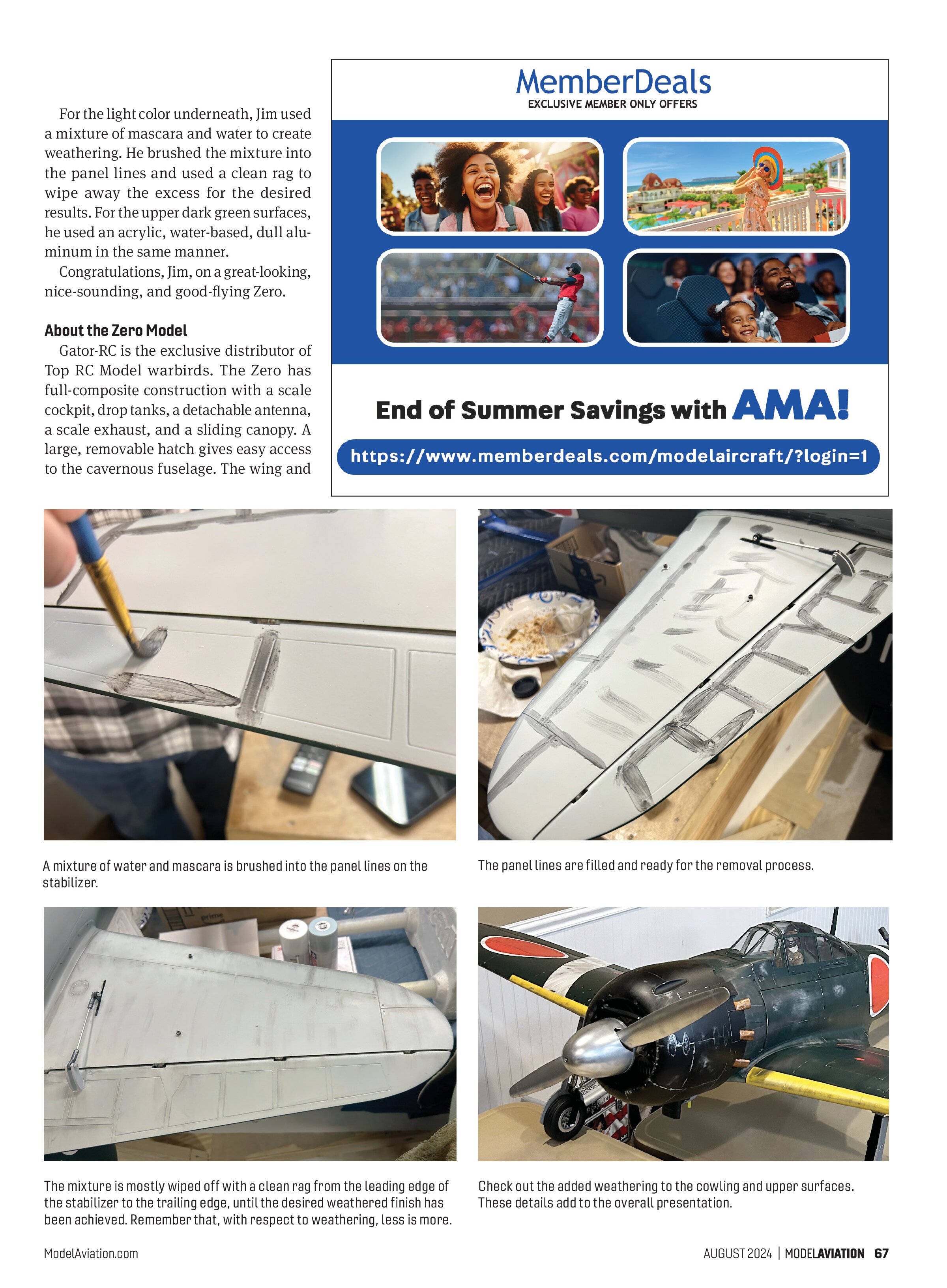
For the light color underneath, Jim used a mixture of mascara and water to create weathering. He brushed the mixture into the panel lines and used a clean rag to wipe away the excess for the desired results. For the upper dark green surfaces, he used an acrylic, water-based, dull aluminum in the same manner.
Congratulations, Jim, on a great-looking, nice-sounding, and good-flying Zero.
About the Zero Model
Gator-RC is the exclusive distributor of Top RC Model warbirds. The Zero has full-composite construction with a scale cockpit, drop tanks, a detachable antenna, a scale exhaust, and a sliding canopy. A large, removable hatch gives easy access to the cavernous fuselage. The wing and


tail are detachable for easy transport, and it comes with a complete hardware package.
About the Full-Scale Zero
Shortly after the Mitsubishi A5M Claude was made operational in 1937, the Japanese Imperial Navy issued new requirements for a next-generation fighter. Mitsubishi’s chief designer, Jiro Horikoshi, believed
that these requirements could be met by making the new fighter as lightweight as possible. Using the new, secret, “extra super duralumin” aluminum, Jiro was able to design the Zero, which was lighter weight, more maneuverable, and one of the longest-range, single-engine fighters of WW II. However, the tradeoff made the Zero extremely vulnerable to catching fire. The

Zero had no armor protection for the engine, pilot, or other critical areas. It lacked self-sealing fuel tanks, and the lighter aluminum was prone to corrosion. The Zero received its baptism by fire in September 1940, when it scored the first air-to-air kills when escorting medium bombers over China. The Zeros attacked a combination of 34 Chinese Nationalist, Soviet-built Polikarpov I-15 and I-16 fighters, claiming all of the Chinese fighters destroyed. A total of 10,934 Zeros in all versions were manufactured between 1940 and 1945.
That’s all for this month. Light winds and smooth landings. AMA
SOURCES:
Top RC Model
(800) 380-9373
www.toprcmodel-usa.com
Gator-RC
(800) 380-9373
www.gator-rc.com