SUCCESSFUL HAND-LAUNCHING
By Heath Bartel | heath.bartel@gmail.com

WHILE THE RULES FOR MOST CLASSES of streamer RC Combat allow for landing gear, removing the increased weight and drag from the model often provides a competitive edge. Additionally, not having landing gear allows the airplane to be flown, even if the grass is not trimmed short or the flying field is not perfectly flat. As a result, most streamer Combat airplanes are not equipped with landing gear.
The most common way to get an airplane without landing gear into the air is to hand-launch it. Hand-launching a nimble airplane on a windy day while towing a streamer is an exciting challenge. With the correct technique and practice, successful hand-launching can consistently get your aircraft into the hunt.
Streamer Combat aircraft tend to be easy to hand-launch because they have a good thrust-to-weight ratio and light wing loading. However, most do not have the thrust to accelerate vertically from a standing start, so a throw is needed to get them moving.
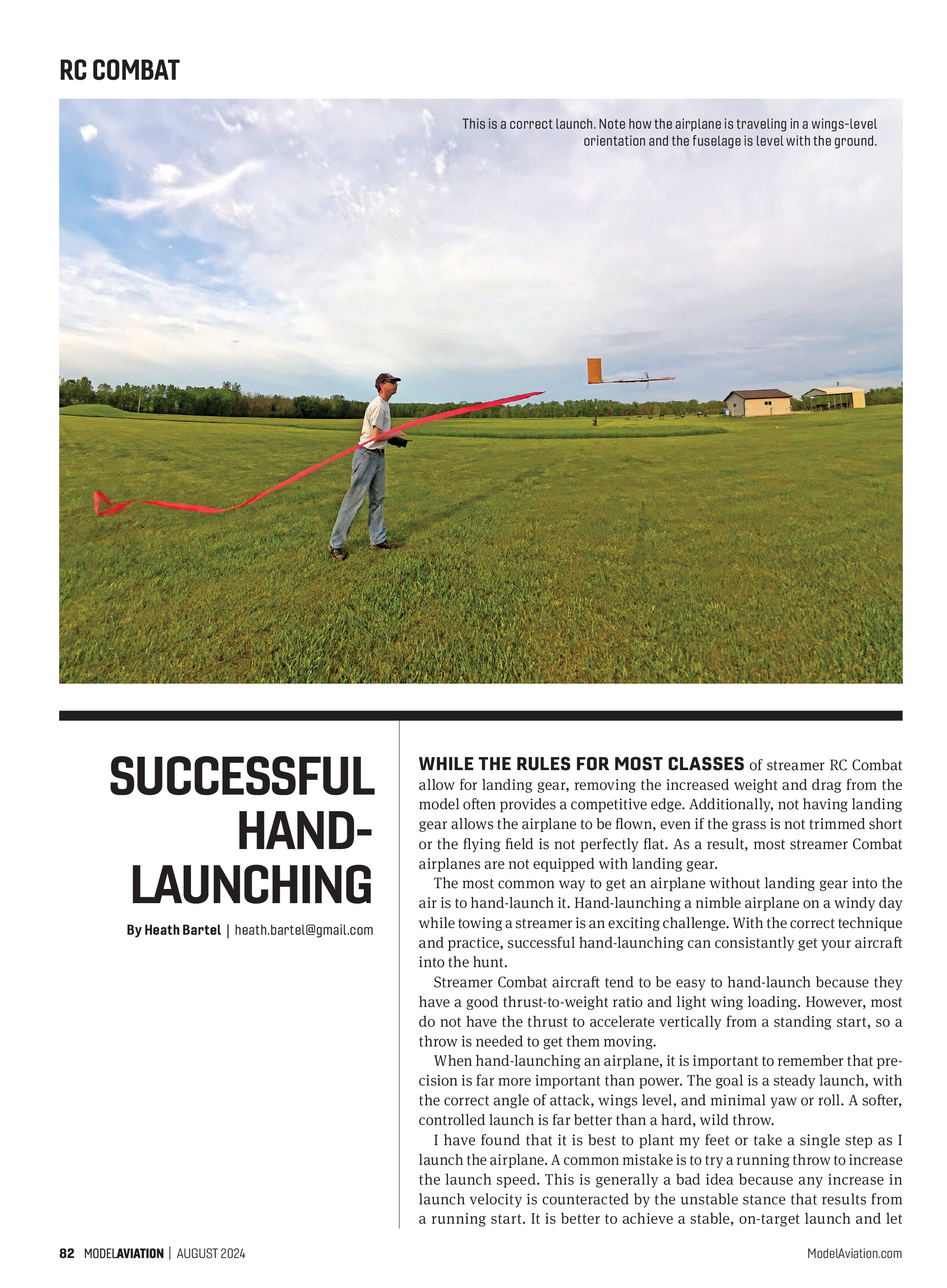
When hand-launching an airplane, it is important to remember that precision is far more important than power. The goal is a steady launch, with the correct angle of attack, wings level, and minimal yaw or roll. A softer, controlled launch is far better than a hard, wild throw.
I have found that it is best to plant my feet or take a single step as I launch the airplane. A common mistake is to try a running throw to increase the launch speed. This is generally a bad idea because any increase in launch velocity is counteracted by the unstable stance that results from a running start. It is better to achieve a stable, on-target launch and let the motor do the work of accelerating the airplane.
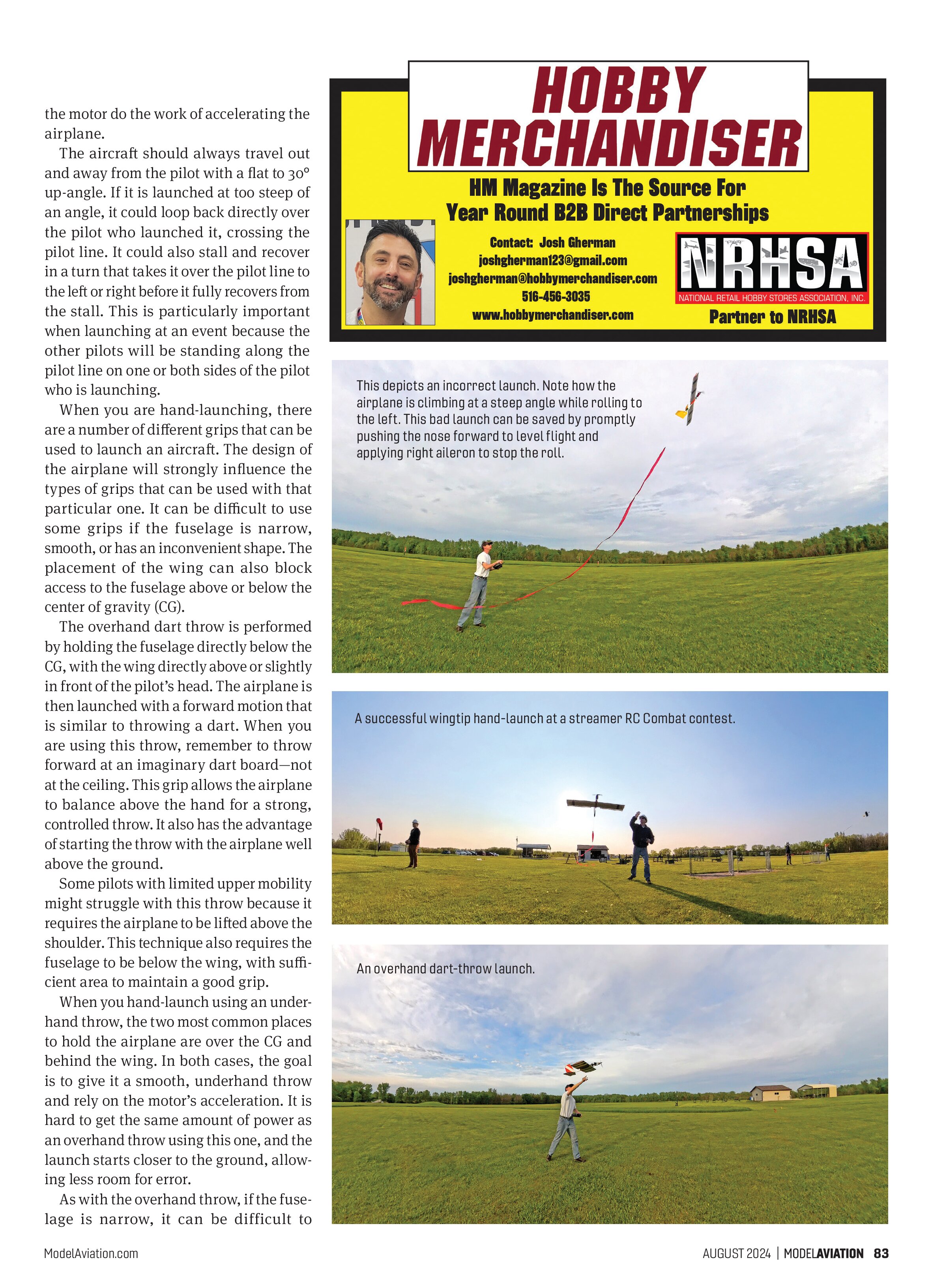
The aircraft should always travel out and away from the pilot with a flat to 30° up-angle. If it is launched at too steep of an angle, it could loop back directly over the pilot who launched it, crossing the pilot line. It could also stall and recover in a turn that takes it over the pilot line to the left or right before it fully recovers from the stall. This is particularly important when launching at an event because the other pilots will be standing along the pilot line on one or both sides of the pilot who is launching.
When you are hand-launching, there are a number of different grips that can be used to launch an aircraft. The design of the airplane will strongly influence the types of grips that can be used with that particular one. It can be difficult to use some grips if the fuselage is narrow, smooth, or has an inconvenient shape. The placement of the wing can also block access to the fuselage above or below the center of gravity (CG).
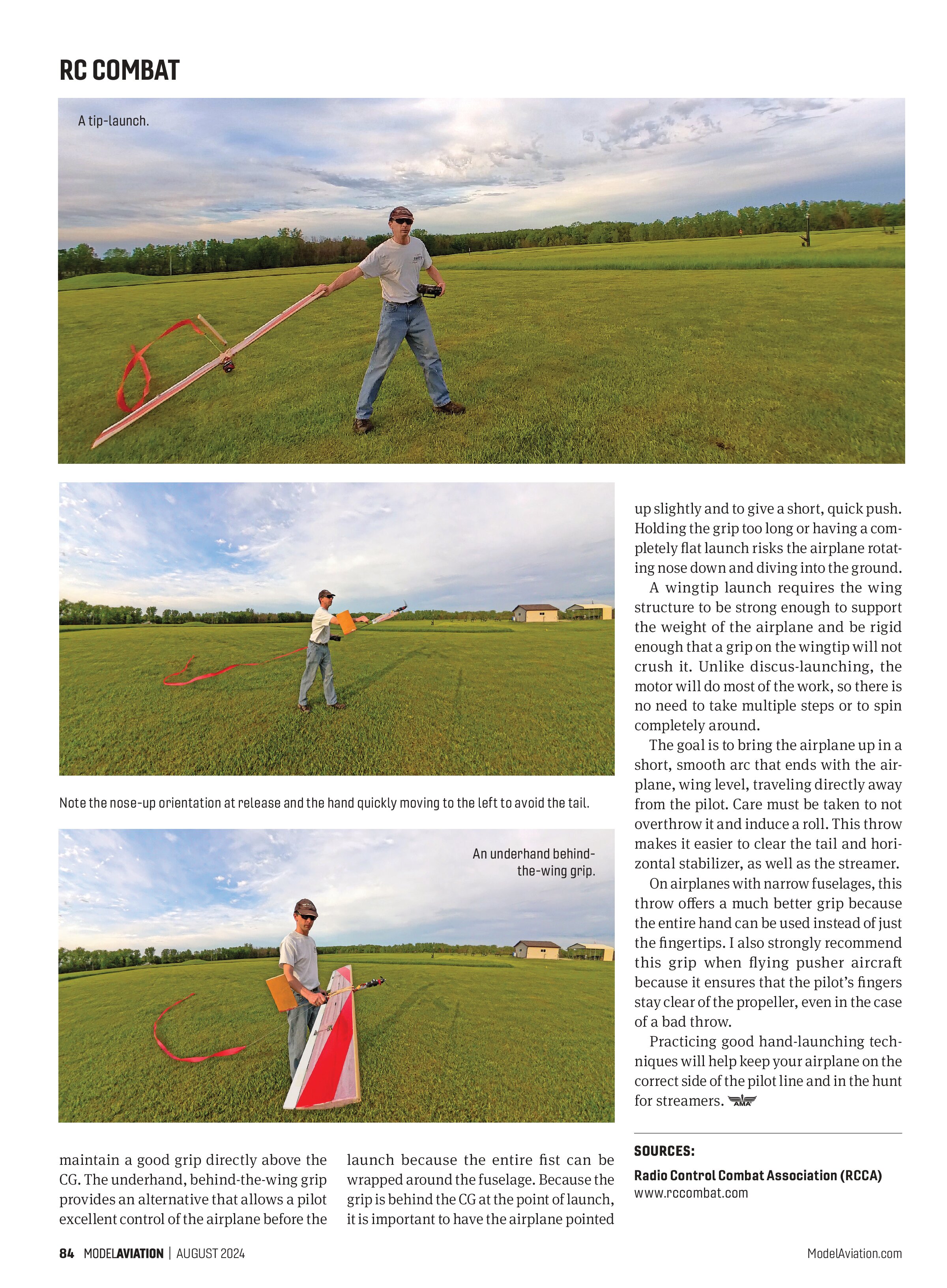
The overhand dart throw is performed by holding the fuselage directly below the CG, with the wing directly above or slightly in front of the pilot’s head. The airplane is then launched with a forward motion that is similar to throwing a dart. When you are using this throw, remember to throw forward at an imaginary dart board—not at the ceiling. This grip allows the airplane to balance above the hand for a strong, controlled throw. It also has the advantage of starting the throw with the airplane well above the ground.
Some pilots with limited upper mobility might struggle with this throw because it requires the airplane to be lifted above the shoulder. This technique also requires the fuselage to be below the wing, with sufficient area to maintain a good grip.
When you hand-launch using an underhand throw, the two most common places to hold the airplane are over the CG and behind the wing. In both cases, the goal is to give it a smooth, underhand throw and rely on the motor’s acceleration. It is hard to get the same amount of power as an overhand throw using this one, and the launch starts closer to the ground, allowing less room for error.
As with the overhand throw, if the fuselage is narrow, it can be difficult to


maintain a good grip directly above the CG. The underhand, behind-the-wing grip provides an alternative that allows a pilot excellent control of the airplane before the launch because the entire fist can be wrapped around the fuselage. Because the grip is behind the CG at the point of launch, it is important to have the airplane pointed up slightly and to give a short, quick push.
Holding the grip too long or having a completely flat launch risks the airplane rotating nose down and diving into the ground.
A wingtip launch requires the wing structure to be strong enough to support the weight of the airplane and be rigid enough that a grip on the wingtip will not crush it. Unlike discus-launching, the motor will do most of the work, so there is no need to take multiple steps or to spin completely around.
The goal is to bring the airplane up in a short, smooth arc that ends with the airplane, wing level, traveling directly away from the pilot. Care must be taken to not overthrow it and induce a roll. This throw makes it easier to clear the tail and horizontal stabilizer, as well as the streamer.
On airplanes with narrow fuselages, this throw offers a much better grip because the entire hand can be used instead of just the fingertips. I also strongly recommend this grip when flying pusher aircraft because it ensures that the pilot’s fingers stay clear of the propeller, even in the case of a bad throw.
Practicing good hand-launching techniques will help keep your airplane on the correct side of the pilot line and in the hunt for streamers.
SOURCES:
Radio Control Combat Association (RCCA)
www.rccombat.com