CROSSOVERS
By Rob Caso | quack916@aol.com
I HAVE ALWAYS felt that the skills needed to work on cars, motorcycles, houses, furniture—whatever—are interchangeable with those that are needed to build a scalelike flying model. Certainly, with Scale, you have to be a builder, a designer, a detailer, an engineer, an aerodynamicist, and, to a certain extent, an artist. Being a plastic modeler also helps. While I can only skim the surface—if at all—on each of these disciplines, serious Scale modeling is clearly a multifaceted endeavor. It’s not simply “build, cover, and fly,” which is why it’s so difficult.
A parallel here might be offered in respect to the components that go into a Scale model. For me, these come from everywhere, which brings me to the crux of this article. I always try not to confine myself to only the “RC components” world when working with Scale, especially when it comes to detailing. An internet search for the RC stuff will generate a lot of hits, but many sources are, or can be, “crossovers” from other hobbies or crafts.
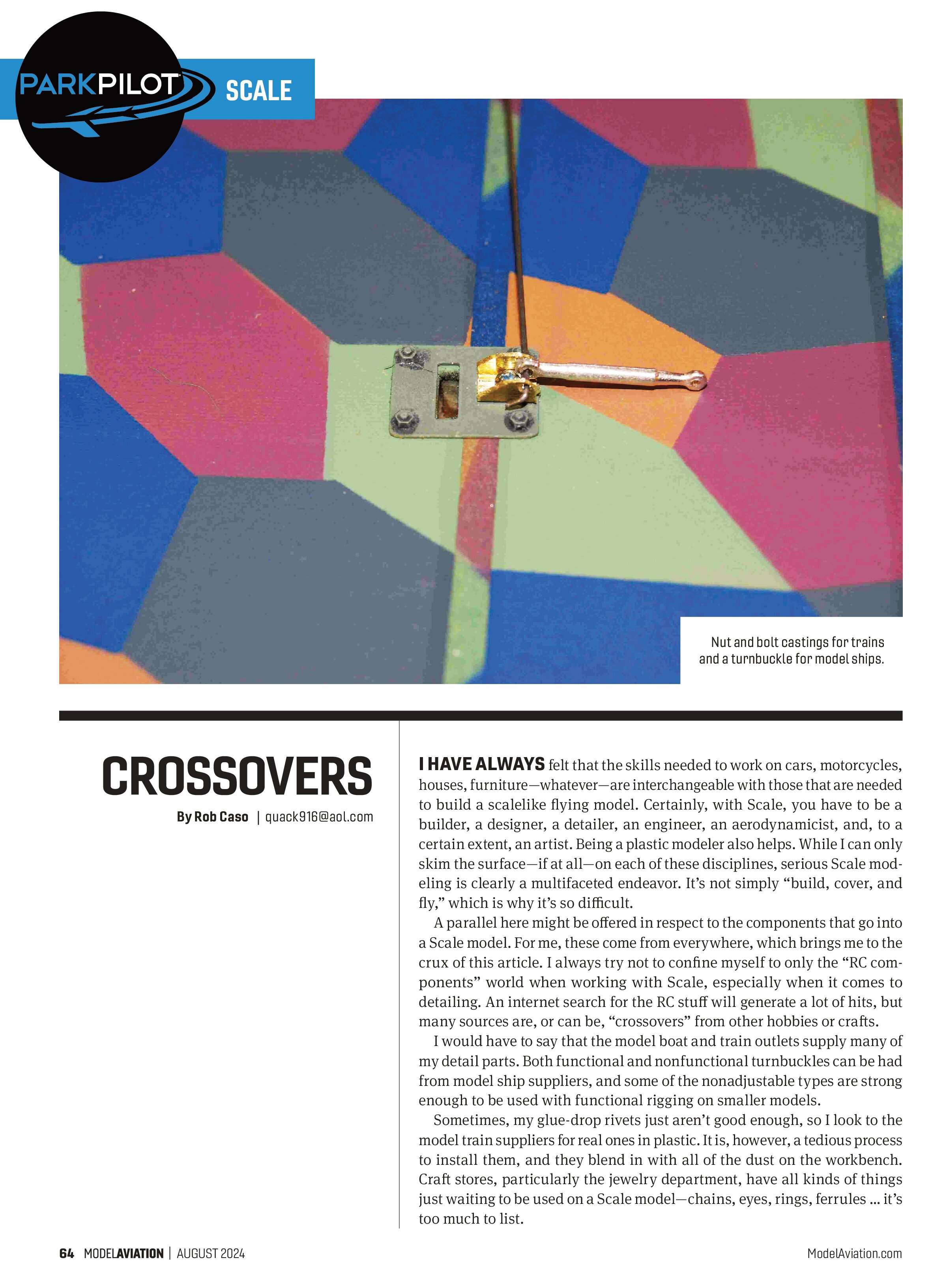
I would have to say that the model boat and train outlets supply many of my detail parts. Both functional and nonfunctional turnbuckles can be had from model ship suppliers, and some of the nonadjustable types are strong enough to be used with functional rigging on smaller models.
Sometimes, my glue-drop rivets just aren’t good enough, so I look to the model train suppliers for real ones in plastic. It is, however, a tedious process to install them, and they blend in with all of the dust on the workbench. Craft stores, particularly the jewelry department, have all kinds of things just waiting to be used on a Scale model—chains, eyes, rings, ferrules ... it’s too much to list.

Coated fishing line from outdoors stores is perfect for rigging, as are the crimps to hold it on a turnbuckle. You don’t trust the crimp? “Around the Patch” columnist Thayer Syme recommends twisting the line, and then heating the twist with a lighter to create a permanent bond. Avoid burning a hole in your wing with an aluminum foil shield.

Speaking of aluminum foil, use it as a general-area paint mask when spraying. Paint can’t get through and it forms around anything. My wife thinks I do the shopping only for food!
I use Kevlar thread for rigging, wrapping plywood or carbon-fiber parts, and for detailing. It’s incredibly strong, is sold as sewing thread, and is available in a number of gauges. Thin CA glue holds a wrap together well.

Using whatever works is the key to making Scale models. I hope I have sparked a few ideas with this article. Think “out of the box!”

SOURCES:
Model Expo
www.modelexpo-online.com
Bluejacket Shipcrafters
(800) 448-5567
www.bluejacketinc.com
San Juan Details
(303) 284-5072
www.sanjuandetails.com
MP Jet
mpjet@mpjet.com
www.mpjet.com/shop/gb
Tichy Train Group
(336) 329-9038
www.tichytraingroup.com
The Thread Exchange
(800) 915-2320
www.thethreadexchange.com
Michaels
(800) 642-4235
www.michaels.com
GasPatch Models
info@gaspatchmodels.com
www.gaspatchmodels.com