OLD-TIMERS

OLD
MAGAZINES
AND ENGINES
By Bob Angel | samrcflier@verizon.net
FOR A FEW OF US, reading has recently taken up about as much spare time as building and flying models. I joined the hobby when spark-ignition engines were soon to be replaced by glow engines. Those loud, old sparkers attracted me as much or more as the aircraft themselves.
Old model magazines from the 1930s and ’40s contained a wide variety of advertisements and subject material, some of which was unrelated to either full-scale or model aircraft material, but almost all of it was of interest to young guys.
Arnold Bloomer, one of my flying buddies, lived in a big, old multistory house with a finished attic that contained stacks of early model magazines and little else. I’d haunt the place for hours, paging through the articles, pictures, and advertisements. Of particular interest were the engine ads, often listing 30 or more different engines in a tall column.
Shortly after the end of World War II, our local hobby shop had a long, glass showcase with a couple of dozen engines on display. I knew little about their relative performance, but I wished I could have afforded them all. The owner probably had to wipe nose prints off of the glass after each of my visits.
Later in life, I discovered engine collecting, and I soon acquired examples of most of the common engines that I’d coveted. Many collectors specialize in engines of a certain brand, size, or type. I became more of an accumulator, just wanting to have as much variety as possible.
I moved away after high school but kept in touch with Arnold, who later disclosed that he’d tossed out all of those great, old magazines. It was like a kick in the stomach! I would have gladly provided them with a home.
That’s when I decided that I was also an old magazine accumulator. Fortunately, we can now find electronic copies of most of the old magazines (check the “Sources” section), which fits in better with today’s sized-down lifestyle, but it’s still interesting to keep a few old magazines around just to page through.
Modern Engine Collecting
Most of us old-timers realize that you can’t take it with you, so there’s no shortage of available engines in the Model Engine Collectors Association (MECA) bulletin or on eBay, although current prices are all over the place. I’ve weaned myself from buying engines, but I decided to take clues from the electronic magazine offerings. I now collect photos of engines, which take up practically no storage space and require no investment for my offspring to try to recoup later.
Early Magazines
Let’s page through history via a random sample of one of those early magazines.
The March 1937 issue of Air Trails magazine advertised on the cover that it had “the largest circulation of any aviation magazine.” The cover price was 15¢.
A full-page ad for Fleischmann’s Yeast appeared as a cure for teenage acne. It was presented in comic style, in which a young


man complained to his mother about his pimples. Throughout the space of just six comic panels, we learned that Fleischmann’s quickly cured the pimples and that he lived happily ever after.
Next was an ad for a correspondence school that, for most, was more affordable than regular college. It advertised good, high-paying jobs as a reward for mailing off an application and money. There were numerous such schools at the time, with many specializing in aviation-related courses. One of those ads also used the comic format. It cited opportunities in the fast-growing aviation industry, where one could earn $40, $60, or even $75 a week!
The first item on the contents page listed a Bill Barnes air novel, “The Purple Fez,” which was one of his monthly series. Bill was a pilot who flew an elegant, custom-type airplane called the Lancer. It carried machine guns, a couple of small cannons, and even small bombs. Bill himself packed a pistol.
All of that armament came into use just as in today’s action movies. In fact, Bill could easily be replaced by James Bond because the movie featured car, motorcycle, and airplane chases; shootouts; dodging pistol shots during a downhill skiing escape; etc. A deadly serum injection could only be counteracted by tracking down the secret antidote. The action was carried out across many locations, including an exotic island. The mysterious Purple Fez Society was a group of Asian bad guys who, of course, had to be defeated in the end in order for Bill to return the following month.
There were three other equally adventuresome air fiction stories, collectively occupying much of the magazine space. Oddly, for the times, I was surprised to see some mild profanity used.
There were columns carrying current news articles about full-scale aircraft. One was titled “This Winged World,” and another was titled “Air Progress.” They covered air races and many new speed records, plus improvements in deicing, firefighting, and other safety innovations. Amphibious aircraft seemed to be more numerous, especially before more airports were built.
One report mentioned the LZ-129 Hindenburg airship, which was scheduled to make 18 round trips between Germany and Lakehurst, New Jersey, that year after 10 trips the previous year. The item appeared in the March magazine issue, but those trips were cut short on May 6, 1937, when the disastrous hydrogen fire destroyed the Hindenburg while docking in Lakehurst, causing the loss of many lives.
Elsewhere in that same issue, an LZ-130 sister ship to the Hindenburg was pictured under construction. It was probably never completed. I wonder whether the idea of using hydrogen stored under very high pressure in automotive fuel tanks might have faded away after reassessing the lesson of the Hindenburg.
The model building section began on page 41 and included approximately 25 pages collectively of model building articles and ads scattered through the rest of the 100 total pages.
Only the front and rear covers were in color at the time. The March 1937 back cover featured a full-page ad for Chesterfield cigarettes. Railway Express had become the primary agency for air shipments. T.P. Wright, of Curtiss-Wright, opined that, in 10 years, air transport would be cruising at 300 mph.
An ad appeared for a floor model broadcast radio in a walnut cabinet. A 30-day free, in-home trial was offered. It sold directly from the factory for $29.95. The radio featured 14 tubes for the price of eight! I’m not sure that more tubes were an improvement because reception periodically became weak and you’d then have to remove and test more tubes by using a local store’s tube checker to locate those that needed replacement.
This brief summary covers just a fraction of one magazine’s contents. This period in history (in my opinion) probably saw some of the greatest progress in air flight over the shortest time.
SAM Champs
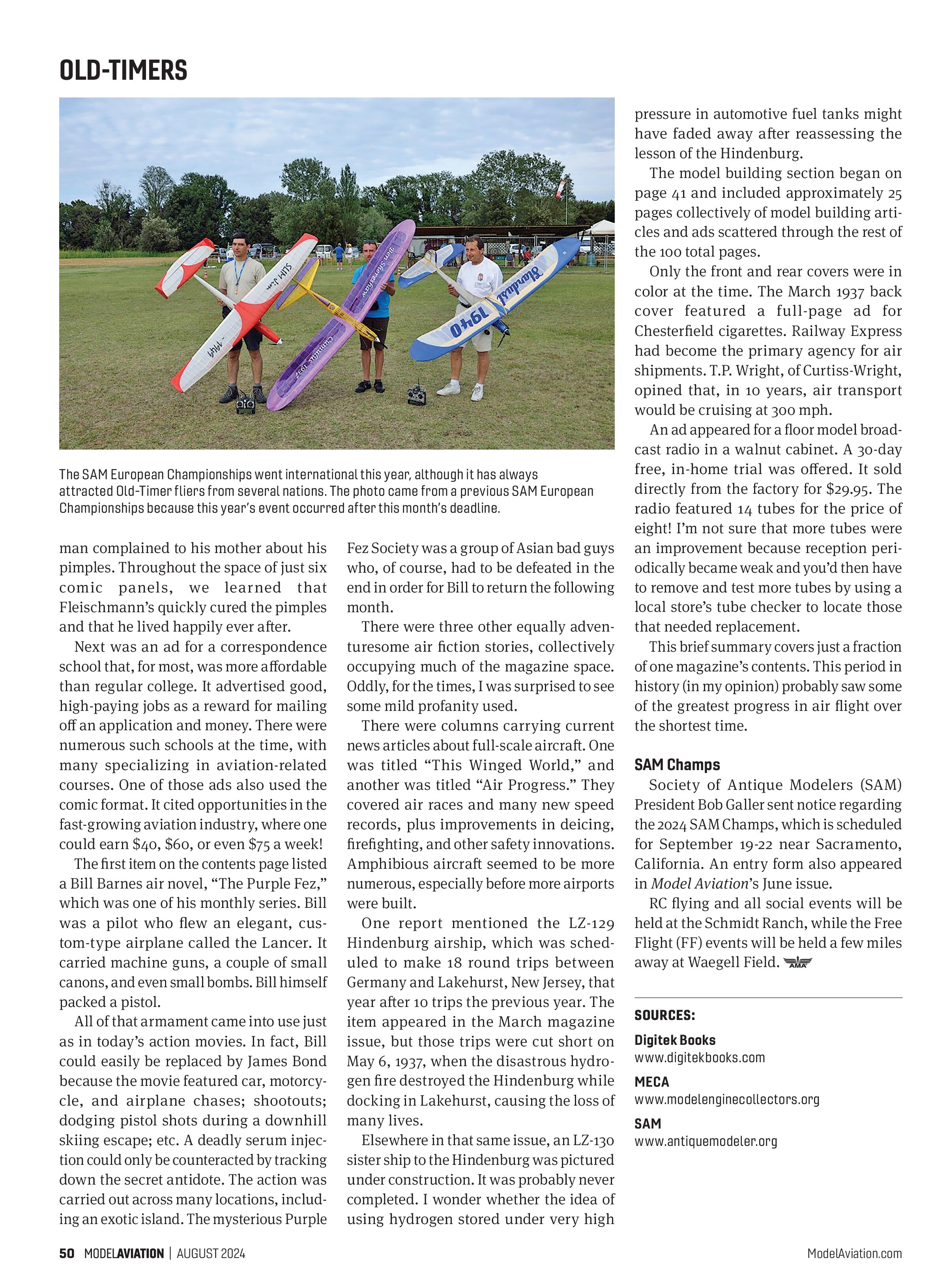
Society of Antique Modelers (SAM) President Bob Galler sent notice regarding the 2024 SAM Champs, which is scheduled for September 19-22 near Sacramento, California. An entry form also appeared in Model Aviation’s June issue.
RC flying and all social events will be held at the Schmidt Ranch, while the Free Flight (FF) events will be held a few miles away at Waegell Field.
SOURCES:
Digitek Books
www.digitekbooks.com