I AM THE AMA

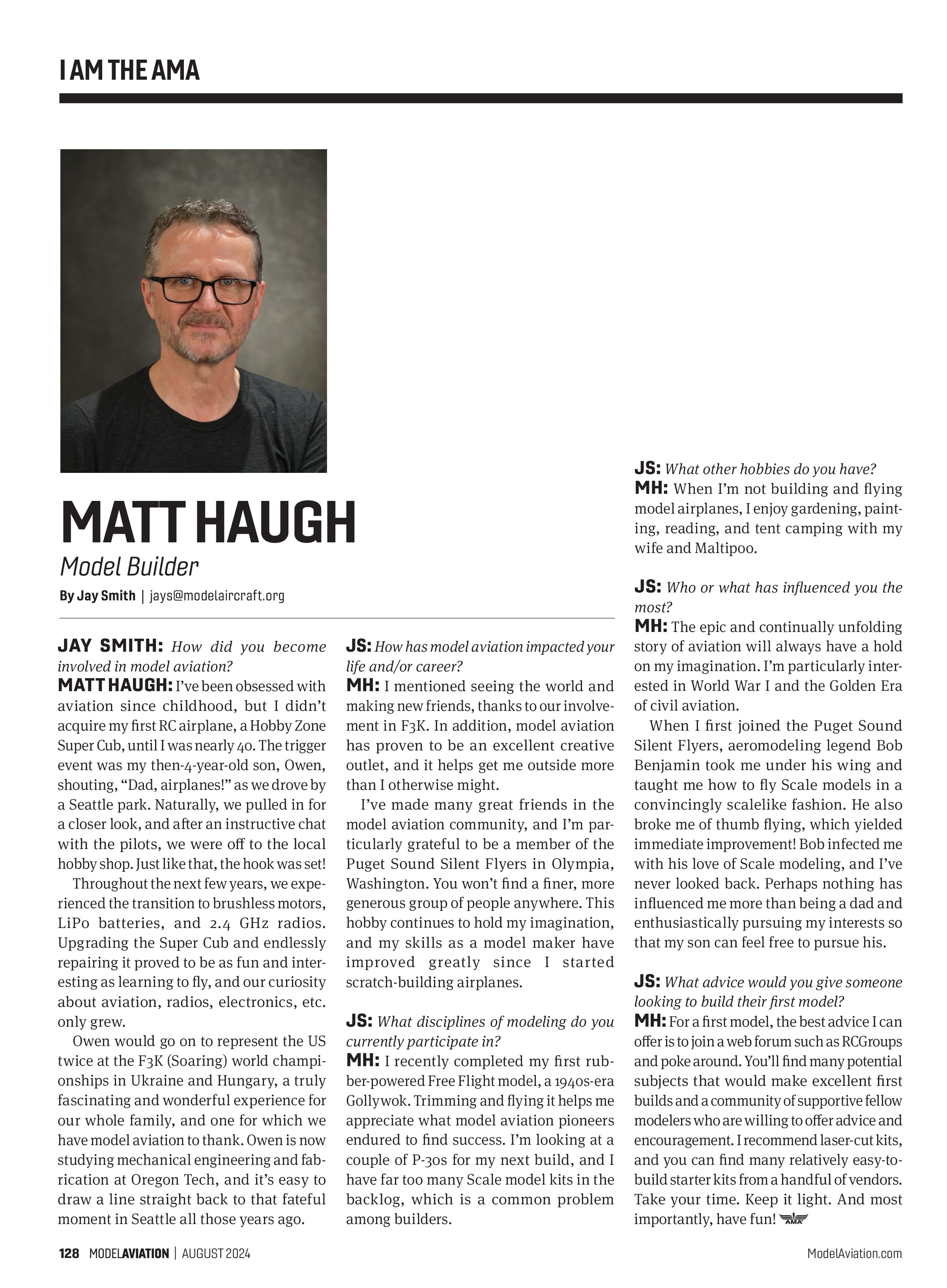
MATT HAUGH
Model Builder
By Jay Smith | jays@modelaircraft.org
JAY SMITH: How did you become involved in model aviation?
MATT HAUGH: I’ve been obsessed with aviation since childhood, but I didn’t acquire my first RC airplane, a Hobby Zone Super Cub, until I was nearly 40. The trigger event was my then-4-year-old son, Owen, shouting, “Dad, airplanes!” as we drove by a Seattle park. Naturally, we pulled in for a closer look, and after an instructive chat with the pilots, we were off to the local hobby shop. Just like that, the hook was set!
Throughout the next few years, we experienced the transition to brushless motors, LiPo batteries, and 2.4 GHz radios. Upgrading the Super Cub and endlessly repairing it proved to be as fun and interesting as learning to fly, and our curiosity about aviation, radios, electronics, etc. only grew.
Owen would go on to represent the US twice at the F3K (Soaring) world championships in Ukraine and Hungary, a truly fascinating and wonderful experience for our whole family, and one for which we have model aviation to thank. Owen is now studying mechanical engineering and fabrication at Oregon Tech, and it’s easy to draw a line straight back to that fateful moment in Seattle all those years ago.
JS: How has model aviation impacted your life and/or career?
MH: I mentioned seeing the world and making new friends, thanks to our involvement in F3K. In addition, model aviation has proven to be an excellent creative outlet, and it helps get me outside more than I otherwise might.
I’ve made many great friends in the model aviation community, and I’m particularly grateful to be a member of the Puget Sound Silent Flyers in Olympia, Washington. You won’t find a finer, more generous group of people anywhere. This hobby continues to hold my imagination, and my skills as a model maker have improved greatly since I started scratch-building airplanes.
JS: What disciplines of modeling do you currently participate in?
MH: I recently completed my first rubber-powered Free Flight model, a 1940s-era Gollywok. Trimming and flying it helps me appreciate what model aviation pioneers endured to find success. I’m looking at a couple of P-30s for my next build, and I have far too many Scale model kits in the backlog, which is a common problem among builders.
JS: What other hobbies do you have?
MH: When I’m not building and flying model airplanes, I enjoy gardening, painting, reading, and tent camping with my wife and Maltipoo.
JS: Who or what has influenced you the most?
MH: The epic and continually unfolding story of aviation will always have a hold on my imagination. I’m particularly interested in World War I and the Golden Era of civil aviation.
When I first joined the Puget Sound Silent Flyers, aeromodeling legend Bob Benjamin took me under his wing and taught me how to fly Scale models in a convincingly scalelike fashion. He also broke me of thumb flying, which yielded immediate improvement! Bob infected me with his love of Scale modeling, and I’ve never looked back. Perhaps nothing has influenced me more than being a dad and enthusiastically pursuing my interests so that my son can feel free to pursue his.
JS: What advice would you give someone looking to build their first model?
MH: For a first model, the best advice I can offer is to join a web forum such as RCGroups and poke around. You’ll find many potential subjects that would make excellent first builds and a community of supportive fellow modelers who are willing to offer advice and encouragement. I recommend laser-cut kits, and you can find many relatively easy-to-build starter kits from a handful of vendors. Take your time. Keep it light. And most importantly, have fun!