
POWERING THE ELECTROSTREAK
By Terry Dunn | terrydunn74@gmail.com
IN THE JUNE EDITION of this column, I announced the completion of my plans-built Electrostreak. I also shared information about some E-streaks that were being built by readers, including one from Bill Smith. You might recall that Bill used 3D-printed wing ribs and modified his model to incorporate a V-tail.
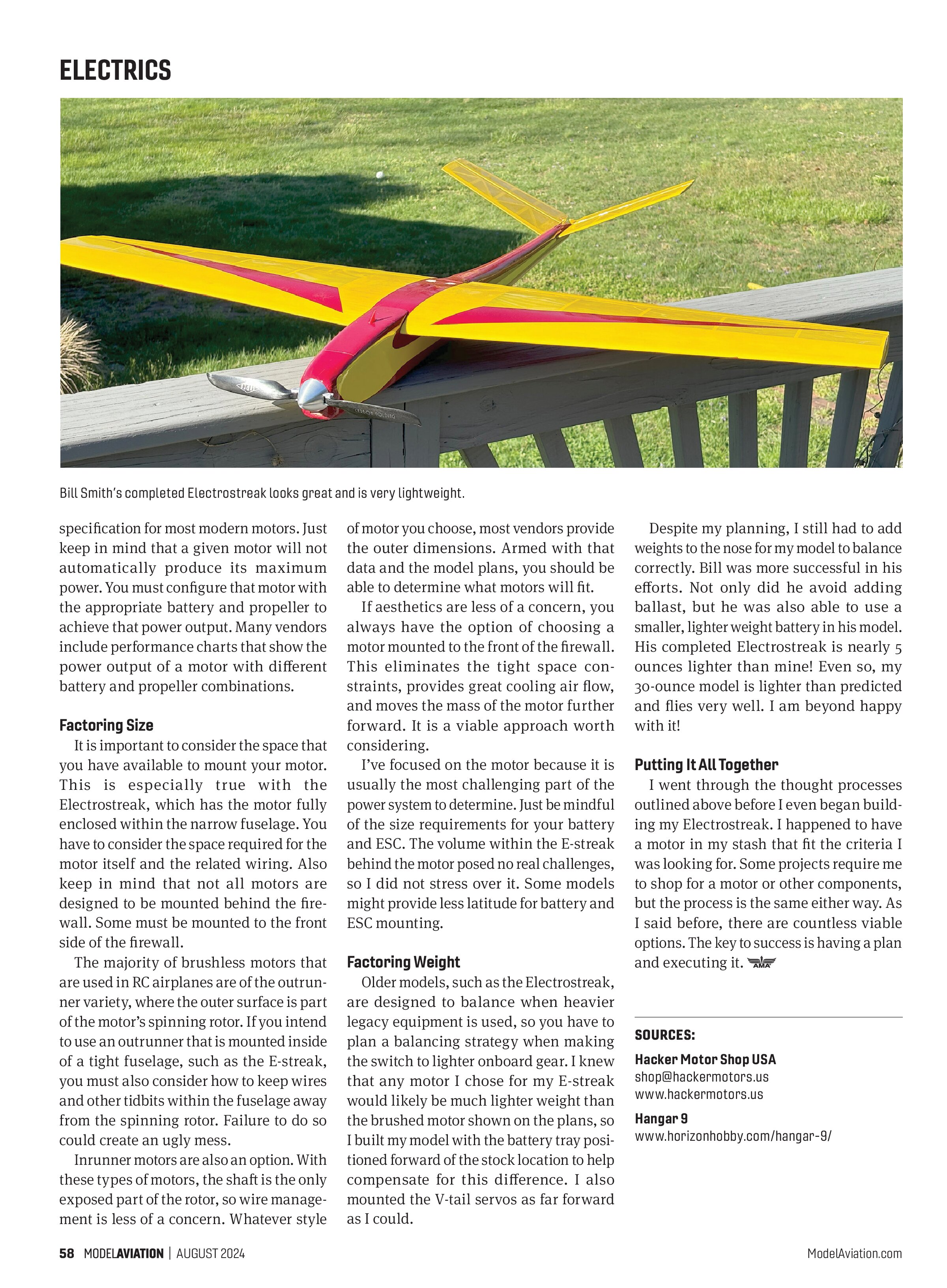
Bill’s model is now complete and has been flown. I must admit that his execution of the V-tail modification is much more elegant than my own. I will let Bill fill in the other details:
“I finished my V-tail Electrostreak and I am quite pleased with it. It is covered with Hangar 9 ParkLite film and uses a three-cell 1,300 mAh LiPo battery. The all-up weight is 25.6 ounces.
“I lightened the tail and moved the electronics forward so that it balances with no added weight. The maiden flight was nearly perfect, with the exception of aileron throws being too extreme. The roll rate on this thing is quick! I guess the 3D-printed skeleton ribs make the wing light, which would help the roll rate.
“With the Hacker A30-28 motor and 10 x 6 folding propeller, this thing is very fast. The 5-minute maiden flight was all done at 25% to 75% throttle and it still felt overpowered. The battery was still at a 70% charge after 5 minutes of moderate flying.”
I love that Bill updated this classic electric model with a modern power system and contemporary building techniques. The results are fantastic. Nice job, Bill!
Tough Choices
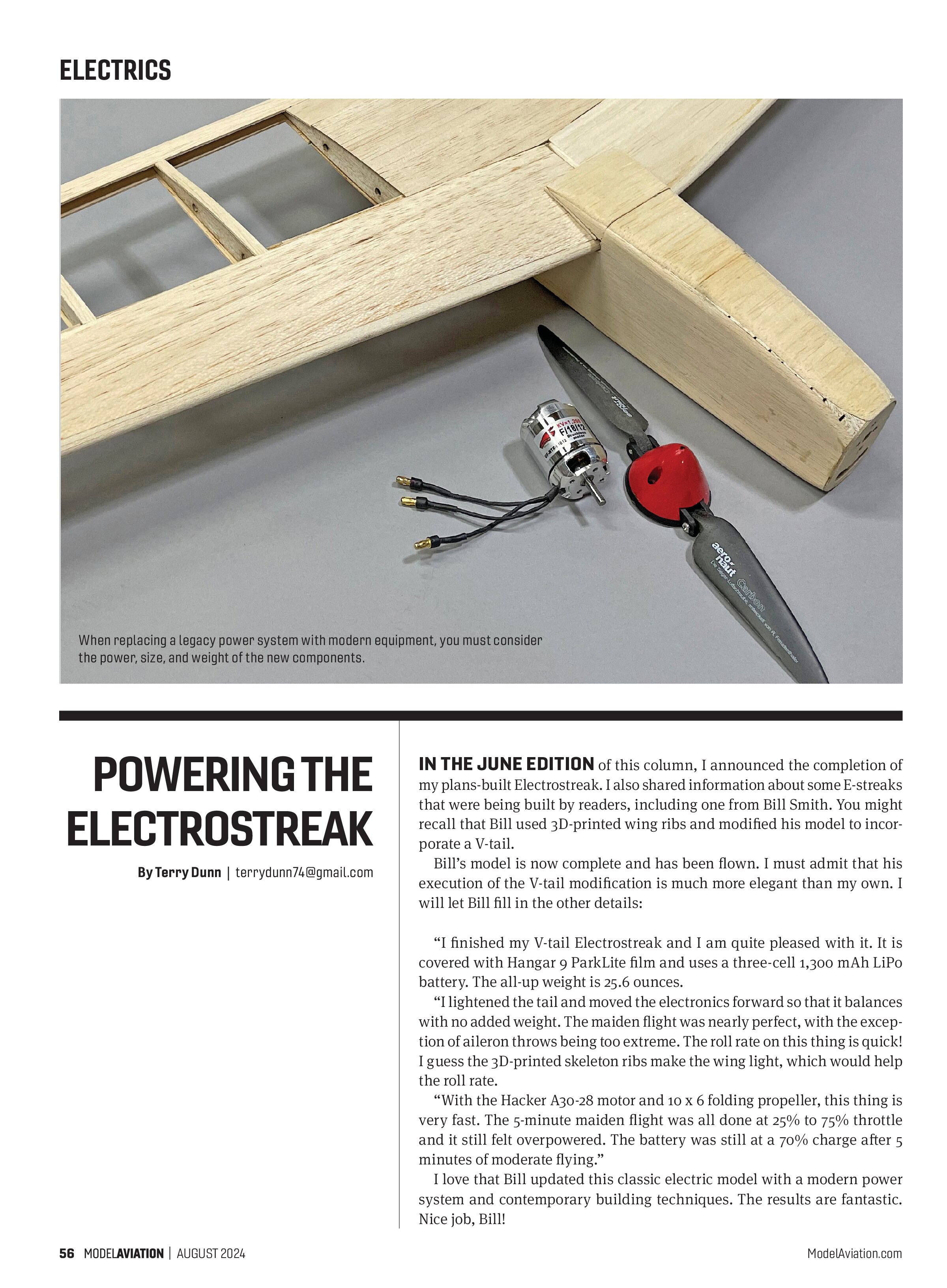
The power system in my Electrostreak consists of an Ultrafly F/18/12 outrunner brushless motor, an Aeronaut 9.5 x 5 folding propeller, a Castle Creations Phoenix 35 ESC, and a three-cell 2,200 mAh LiPo battery. Many of you asked me why I chose these particular components. The truth is that there are countless options that would work well in this model, so I will provide a basic overview of my selection process.
The Electrostreak was originally designed to use a brushed motor and NiCd batteries. Although modern power systems with brushless motors and LiPo batteries have the potential to offer far greater power and efficiency with lighter weight, the transition is not necessarily a slam dunk. There are a few basic elements that you must consider in order to make your modernization efforts successful: power, size, and weight. The earlier in the build process that you factor these elements and choose your components, the more flexibility you will have.
Factoring Power
I think that the most dependable way to estimate the flight performance of an electric model is to calculate the power-to-weight ratio. This is often referred to as “power loading.” In the US, we use units of watts per pound. More specifically, we want to compare the power output of the motor at full throttle to the total flying weight of the model.
With most of my sport models and warbirds, I aim for a power loading of at least 100 watts per pound. Airplanes can certainly fly at a much lower power loading, but I think that 100 watts per pound provides a safe target with easy math—and I like my models to have a little extra “oomph.”
For high-performance aerobatic models, such as the Electrostreak, I often target a power loading of at least 150 watts per pound. EDFs are usually rather inefficient compared with propeller-driven models, so I look to have at least 200 watts per pound on my EDF-powered aircraft.
Often, the most difficult part of predicting the power loading of an incomplete model is estimating the total flying weight. Do your best, but try not to worry about it too much. The beauty of the power-loading technique is that it is useful despite its lack of precision. In the case of my Electrostreak, I used the flying weight range shown on the plans (32 ounces to 38 ounces). Knowing that I would be using a lighter weight battery and lighter weight servos than what is shown in the plans, I used the bottom number as an estimate for the flying weight of my completed model.
Starting with my estimated flying weight of 32 ounces (2 pounds) and a target power loading of 150 watts per pound, I knew that I wanted to use a motor capable of producing at least 300 watts of power. The maximum power value is an easily found

specification for most modern motors. Just keep in mind that a given motor will not automatically produce its maximum power. You must configure that motor with the appropriate battery and propeller to achieve that power output. Many vendors include performance charts that show the power output of a motor with different battery and propeller combinations.
Factoring Size
It is important to consider the space that you have available to mount your motor. This is especially true with the Electrostreak, which has the motor fully enclosed within the narrow fuselage. You have to consider the space required for the motor itself and the related wiring. Also keep in mind that not all motors are designed to be mounted behind the firewall. Some must be mounted to the front side of the firewall.
The majority of brushless motors that are used in RC airplanes are of the outrunner variety, where the outer surface is part of the motor’s spinning rotor. If you intend to use an outrunner that is mounted inside of a tight fuselage, such as the E-streak, you must also consider how to keep wires and other tidbits within the fuselage away from the spinning rotor. Failure to do so could create an ugly mess.
Inrunner motors are also an option. With these types of motors, the shaft is the only exposed part of the rotor, so wire management is less of a concern. Whatever style of motor you choose, most vendors provide the outer dimensions. Armed with that data and the model plans, you should be able to determine what motors will fit.
If aesthetics are less of a concern, you always have the option of choosing a motor mounted to the front of the firewall. This eliminates the tight space constraints, provides great cooling air flow, and moves the mass of the motor further forward. It is a viable approach worth considering.
I’ve focused on the motor because it is usually the most challenging part of the power system to determine. Just be mindful of the size requirements for your battery and ESC. The volume within the E-streak behind the motor posed no real challenges, so I did not stress over it. Some models might provide less latitude for battery and ESC mounting.
Factoring Weight
Older models, such as the Electrostreak, are designed to balance when heavier legacy equipment is used, so you have to plan a balancing strategy when making the switch to lighter onboard gear. I knew that any motor I chose for my E-streak would likely be much lighter weight than the brushed motor shown on the plans, so I built my model with the battery tray positioned forward of the stock location to help compensate for this difference. I also mounted the V-tail servos as far forward as I could.
Despite my planning, I still had to add weights to the nose for my model to balance correctly. Bill was more successful in his efforts. Not only did he avoid adding ballast, but he was also able to use a smaller, lighter weight battery in his model. His completed Electrostreak is nearly 5 ounces lighter than mine! Even so, my 30-ounce model is lighter than predicted and flies very well. I am beyond happy with it!
Putting It All Together
I went through the thought processes outlined above before I even began building my Electrostreak. I happened to have a motor in my stash that fit the criteria I was looking for. Some projects require me to shop for a motor or other components, but the process is the same either way. As I said before, there are countless viable options. The key to success is having a plan and executing it.
SOURCES:
Hacker Motor Shop USA
shop@hackermotors.us
www.hackermotors.us
Hangar 9
www.horizonhobby.com/hangar-9/