American Radio Control Competition Helicopter Society
A new AMA SIG for
helicopters
By Tim DiPeri
timd iperi@caseco-inc.com
Photos by the author
Model helicopters have been a part of the RC hobby/sport for decades. I began seeing them in the mid-1970s in a small capacity at local flying fields and at events in New York. At that time, simply having a model helicopter lift off under its own power was impressive.
Nearly 50 years after seeing my first helicopter model (sort-of) fly, technology (electrical and mechanical) has evolved into literal works of art, capable of performance that Igor Sikorsky could not have imagined!
If any of us just visit a flying event or look up model helicopters online, we are likely to see a medley of flying commonly referred to as 3D—a style that rapidly displays the flight envelope of modern model helicopters—some of which are unimaginable!
The American Radio Control Competition Helicopter Society (ARCCHS) is a new AMA Special Interest Group (SIG). Many of the model aviation disciplines have developed their own groups to best support their modeling communities and provide AMA a conduit to that group. Although it’s uncommon for a model aviation “area of interest” to have more than a single SIG, it is not unheard of.
I’m honored to be able to interview the leadership of ARCCHS. I have known all of the members of the inaugural team for decades and I find them to be dedicated to the advancement of model helicopter competition. The members of the board of directors have been kind enough to answer a few questions.

TIM DIPERI: Because it is a little out of the norm for a model aviation community to have more than a single SIG, can you tell us what the differences are between the International Radio Controlled Helicopter Association (IRCHA) and ARCCHS? Do they work independently or is one a parent organization?
ARCCHS: IRCHA was formed in 1989 and has been the SIG to AMA for helicopters since AMA started its SIG program. IRCHA started with mostly competition pilots, such as Don Chapman, the founder of IRCHA. As with any organization, IRCHA has focused its efforts to service most of its membership, which has evolved to the 3D style of helicopters. IRCHA and ARCCHS are separate organizations, and we will have a great relationship with each other because of our mutual desire to see model helicopters continue to grow.
TD: Who started ARCCHS?
ARCCHS: Tom Dooley established the group. The ARCCHS board saw that the competitive side of the hobby was shrinking and wanted to step up and reinvigorate this part of our hobby. From Tom’s perspective, the competition side has provided him with lifelong friends and enjoyment, and it just seemed right to try to restart the competition side so that more people can enjoy a similar experience.
TD: Who is on the board of the ARCCHS?
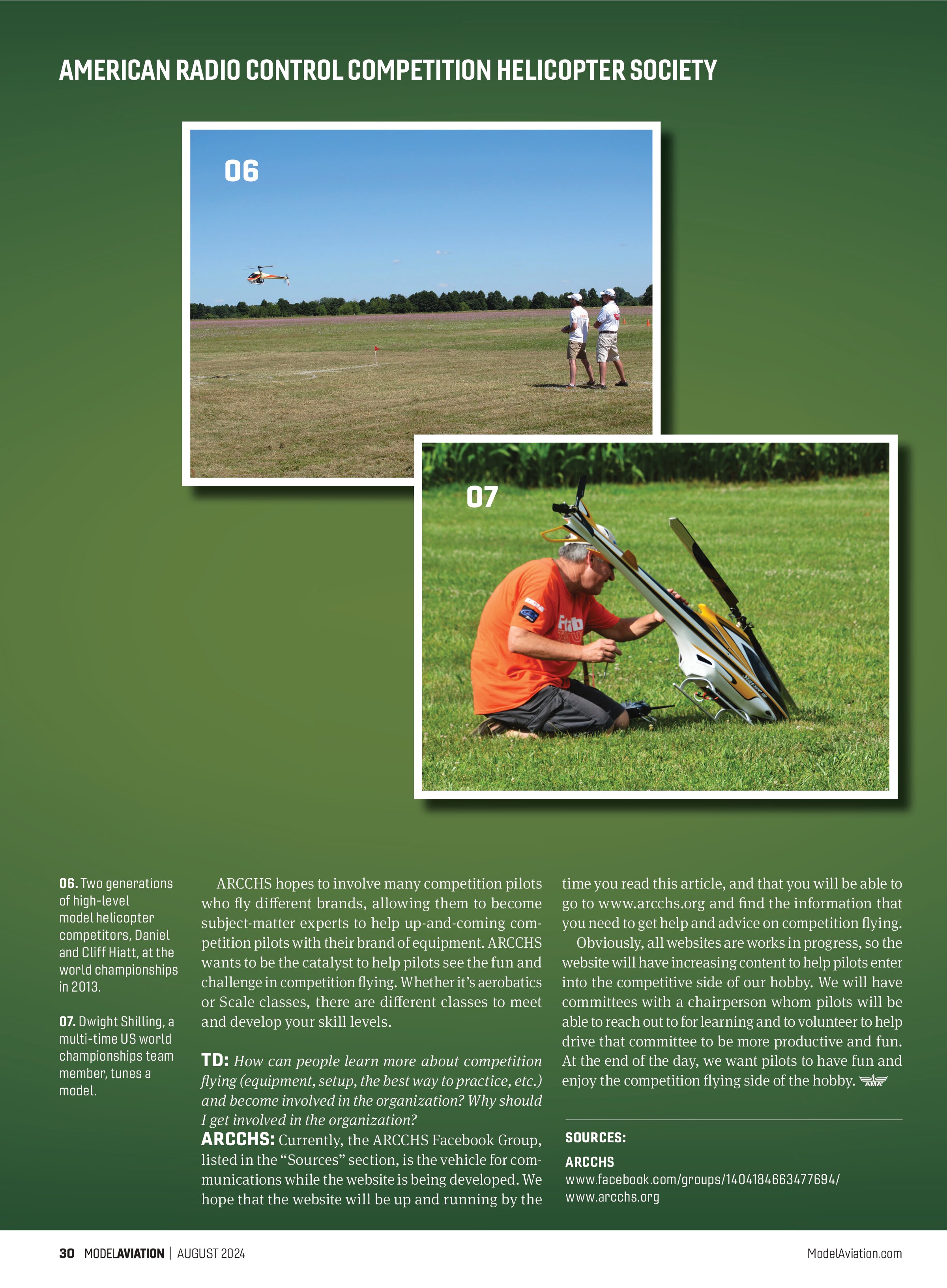
ARCCHS: The board is composed of Tom Dooley (president), Mike Goza (vice president), Nick Maxwell (secretary), and Cliff Hiat (treasurer). All of the members of the board have been on US Fédération Aéronautique Internationale (FAI) World Championships teams, with most having represented the US multiple times. Many of the members of the board have also served as team managers for various US FAI teams. Everyone on the board has a strong passion for the competitive side of the hobby.
TD: What disciplines does competition include for your AMA SIG?
ARCCHS: ARCCHS is a SIG for AMA and has responsibility for AMA Precision Aerobatics classes, AMA


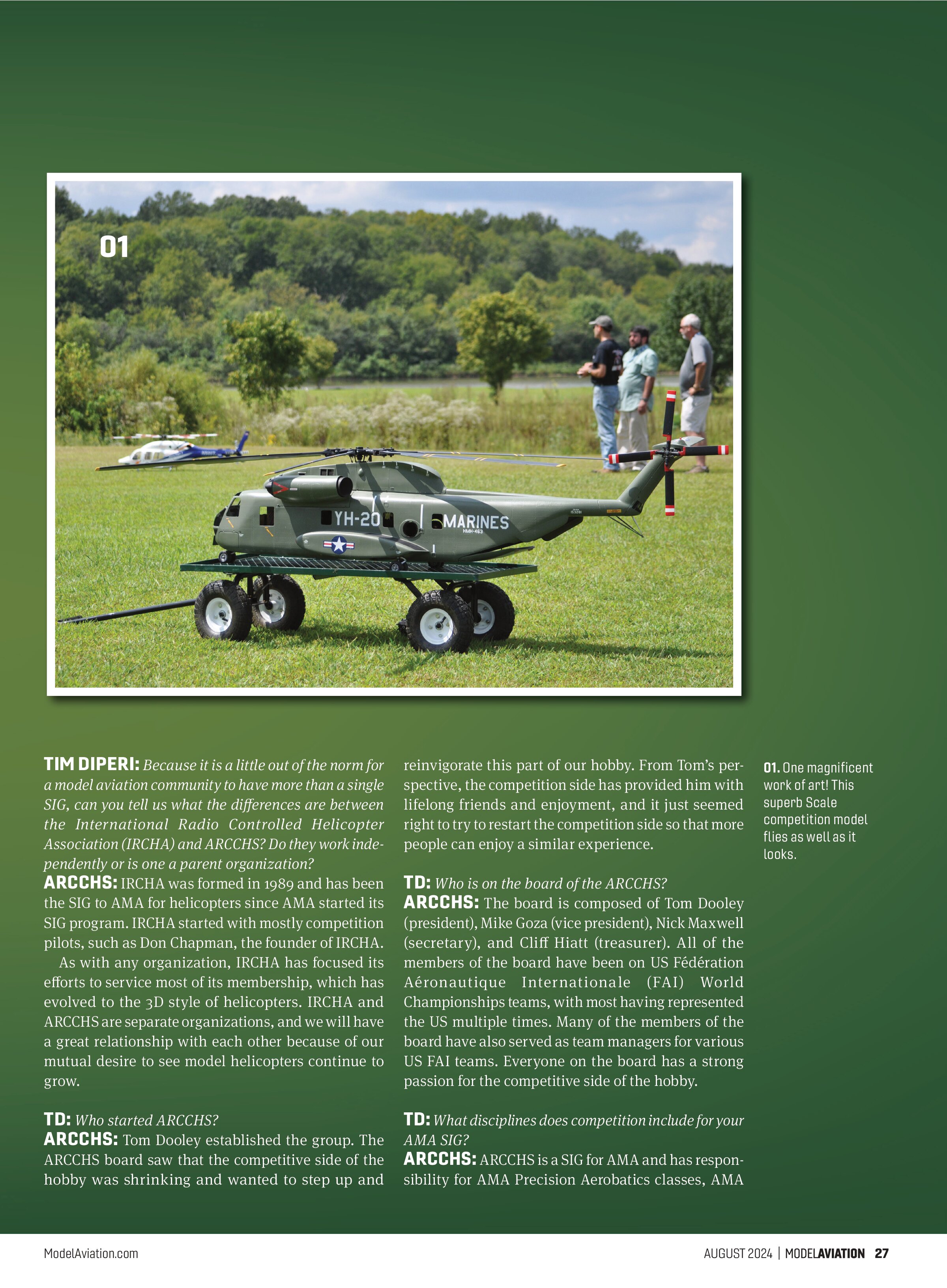
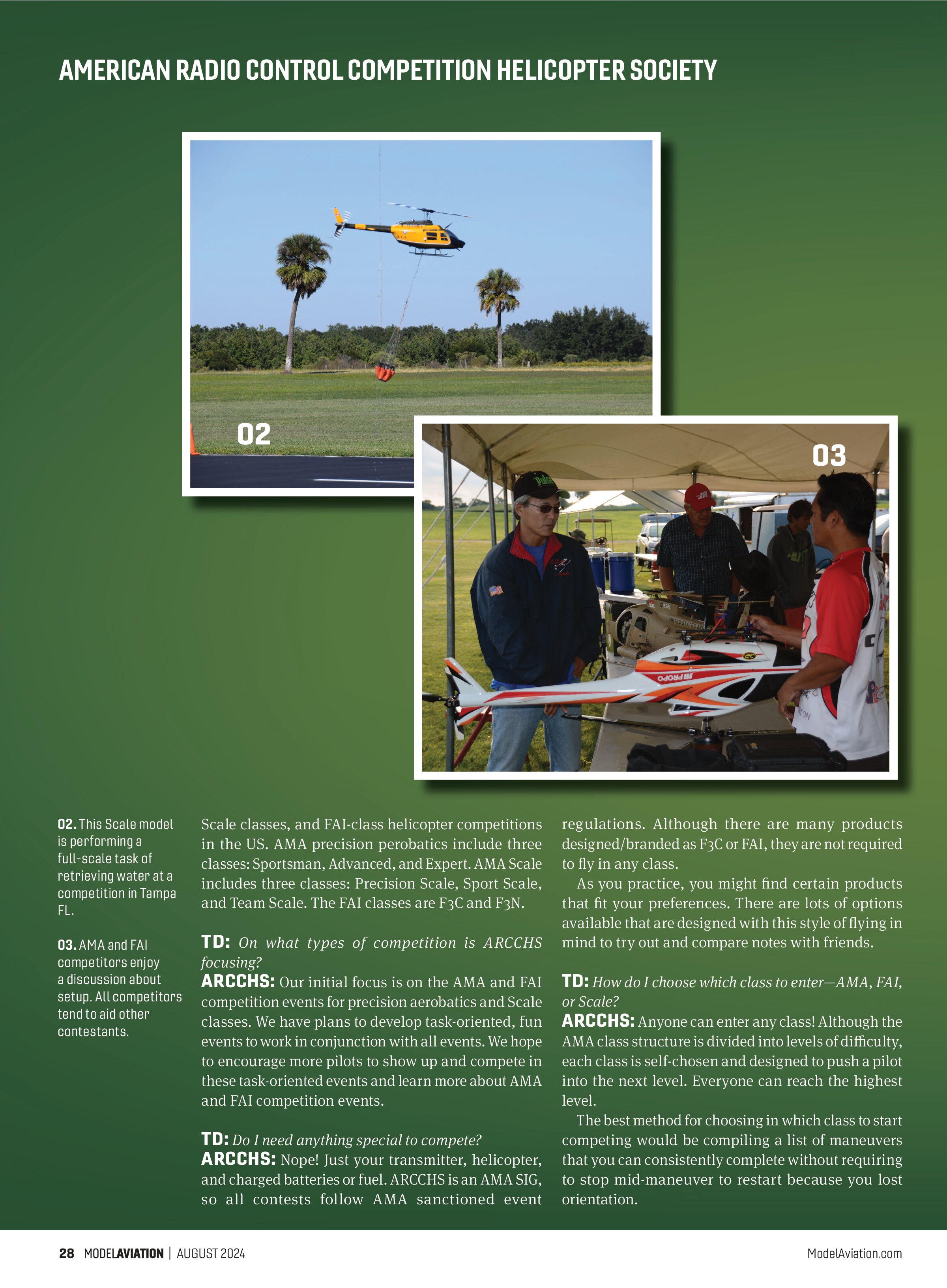
Scale classes, and FAI-class helicopter competitions in the US. AMA precision aerobatics include three classes: Sportsman, Advanced, and Expert. AMA Scale includes three classes: Precision Scale, Sport Scale, and Team Scale. The FAI classes are F3C and F3N.
TD: On what types of competition is ARCCHS focusing?
ARCCHS: Our initial focus is on the AMA and FAI competition events for precision aerobatics and Scale classes. We have plans to develop task-oriented, fun events to work in conjunction with all events. We hope to encourage more pilots to show up and compete in these task-oriented events and learn more about AMA and FAI competition events.
TD: Do I need anything special to compete?
ARCCHS: Nope! Just your transmitter, helicopter, and charged batteries or fuel. ARCCHS is an AMA SIG, so all contests follow AMA sanctioned event regulations. Although there are many products designed/branded as F3C or FAI, they are not required to fly in any class.
As you practice, you might find certain products that fit your preferences. There are lots of options available that are designed with this style of flying in mind to try out and compare notes with friends.
TD: How do I choose which class to enter—AMA, FAI, or Scale?
ARCCHS: Anyone can enter any class! Although the AMA class structure is divided into levels of difficulty, each class is self-chosen and designed to push a pilot into the next level. Everyone can reach the highest level.
The best method for choosing in which class to start competing would be compiling a list of maneuvers that you can consistently complete without requiring to stop mid-maneuver to restart because you lost orientation.


TD: What is the initial focus of ARCCHS?
ARCCHS: The critical foundation pieces, such as making sure that the organization is properly registered and is in compliance with the state and federal agencies, as well as being able to do business with needed services, such as banking, are all in place, so now we can shift our focus to the fun parts, such as flying, but we won’t forget to maintain the administrative side.
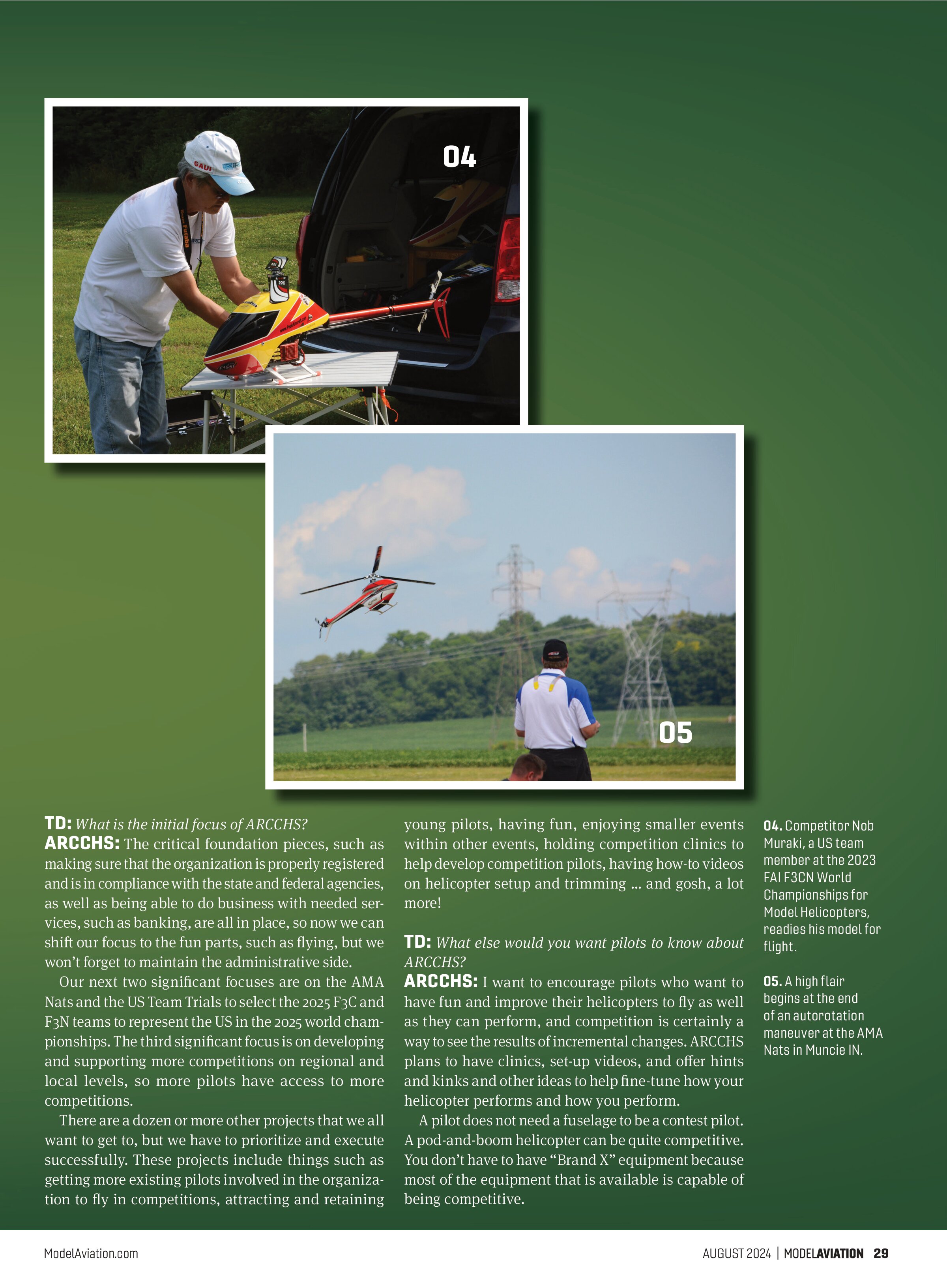
Our next two significant focuses are on the AMA Nats and the US Team Trials to select the 2025 F3C and F3N teams to represent the US in the 2025 world championships. The third significant focus is on developing and supporting more competitions on regional and local levels, so more pilots have access to more competitions.
There are a dozen or more other projects that we all want to get to, but we have to prioritize and execute successfully. These projects include things such as getting more existing pilots involved in the organization to fly in competitions, attracting and retaining young pilots, having fun, enjoying smaller events within other events, holding competition clinics to help develop competition pilots, having how-to videos on helicopter setup and trimming ... and gosh, a lot more!
TD: What else would you want pilots to know about ARCCHS?
ARCCHS: I want to encourage pilots who want to have fun and improve their helicopters to fly as well as they can perform, and competition is certainly a way to see the results of incremental changes. ARCCHS plans to have clinics, set-up videos, and offer hints and kinks and other ideas to help fine-tune how your helicopter performs and how you perform.
A pilot does not need a fuselage to be a contest pilot. A pod-and-boom helicopter can be quite competitive. You don’t have to have “Brand X” equipment because most of the equipment that is available is capable of being competitive.


ARCCHS hopes to involve many competition pilots who fly different brands, allowing them to become subject-matter experts to help up-and-coming competition pilots with their brand of equipment. ARCCHS wants to be the catalyst to help pilots see the fun and challenge in competition flying. Whether it’s aerobatics or Scale classes, there are different classes to meet and develop your skill levels.
TD: How can people learn more about competition flying (equipment, setup, the best way to practice, etc.) and become involved in the organization? Why should I get involved in the organization?
ARCCHS: Currently, the ARCCHS Facebook Group, listed in the “Sources” section, is the vehicle for communications while the website is being developed. We hope that the website will be up and running by the time you read this article, and that you will be able to go to www.arcchs.org and find the information that you need to get help and advice on competition flying.
Obviously, all websites are works in progress, so the website will have increasing content to help pilots enter into the competitive side of our hobby. We will have committees with a chairperson whom pilots will be able to reach out to for learning and to volunteer to help drive that committee to be more productive and fun. At the end of the day, we want pilots to have fun and enjoy the competition flying side of the hobby.
SOURCES:
ARCCHS
www.facebook.com/groups/1404184663477694/
www.arcchs.org