SAFETY COMES FIRST

DRONE DILEMMA!
By Dave Gee | safetycolumn@cs.com
I’M JUST NOT that interested in drones. Sorry. However, I’ve taken and passed The Recreational UAS Safety Test (TRUST) and am currently certified to operate a hobby-type drone. Why would I do that?
If you read this magazine, you’re probably aware of the battle over our rights to fly RC drones for sport. There are some who want this hobby outlawed, but AMA representatives have been very successful in preserving the tradition of safely operating recreational model aircraft in public airspace. I see it as a legislative “domino” issue, where drones would be eliminated first, but other types would soon follow.
We need to be fully aware of the latest rules, and our certifications (if needed) must be current. Having an up-to-date FAA drone qualification supports AMA in its lobbying work, and it would be great if all modelers signed up. I assure you that if I can pass this test, any AMA member can do so.
Flying a drone for sport, recreation, or competition is treated differently from operating one for commercial purposes. I recently met a pilot who operates a drone for a major utility company in California. She was displaying the quadcopter at a safety exposition and was happy to discuss the current FAA rules for the commercial use of RC unmanned aircraft.
Her machine is used to inspect pipelines and radio towers, saving lots of money for the company. The drone is considered small by industry standards, but it looked big and powerful to me! The pilot said to remind modelers that she holds a Remote Pilot Certificate and Part 107 certification for commercial drone operations in the less-than-55-pound category.
If you have any doubt as to whether your RC flying could be considered commercial, visit the FAA and AMA websites and make sure that you’re following the rules. It could be important for all of us!
Terrifying Technology
In a recent column, I discussed a vintage model that was propelled by an onboard CO2 cartridge. The CO2 caplet was punctured by a spring-loaded spike just before launch. My opinion was that such “hold my beer and watch this” techniques were not a good idea.
Mischievous reader John Roach responded with a photo of a genuine, commercially produced “puncture tool” from his collection of old, scary modeling items. This device confirms all of my fears about the whole scheme. Using it would combine the possibility of a gas-jet eye injury with the chance that the spike could be driven into someone’s finger instead of the CO2 cartridge. I’m sticking with less exciting power systems, thank you.
Hatch Havoc
Mike Morton sent me information about an eventful morning at his local RC field. He is an experienced and skilled pilot, but there are always lessons to be learned.
He had the battery door and the battery drop out of his Spektrum DX9 radio right at takeoff—not once but twice in one day! The failsafe on the receiver was set to a low throttle setting, but the 60-size P-47 was still going fast enough to ground loop on the pavement for approximately 2 seconds before it flipped over and killed the engine. The cause was a broken latch on the hatch cover. Such a tiny part caused so much trouble!
Mike suggests that, as a safety measure, pilots make sure to rebind the failsafe with the throttle in the cutoff position, and maybe even with the retracts in the up position, to help kill the engine. You should also examine your battery hatch carefully if it is causing a problem. If it drops out once, it will do it again. If your model is airborne when this happens, it could be a serious problem!
I appreciate that Mike shared this story. My habit has long been to put packing tape

over battery hatches. I have trust issues with tiny, fragile plastic tabs that could destroy my aircraft.

Keep Your Failsafe Safe Without Fail
Coincidentally, Dave Cook also mentioned failsafe settings in his email message. He has observed a number of incidents where these devices were not properly programmed. Finding this out in an emergency is not the best time!
First, Dave recommends that you use failsafe if you have it. This seems basic, but there are pilots who fly with this feature deactivated. What a waste of good technology! He says that we should think of failsafe as a ground safety issue rather than just an airborne safety issue. Models careening around on taxiways are inconvenient at best, and failsafe could prevent problems even before takeoff.
It’s true that setting up failsafe takes a bit of effort. You have to check each aircraft individually and they might have alternate channel assignments and directions. The instruction manuals can help, and other pilots have posted videos that are useful.
Most important of all, test your failsafe setup. With your aircraft fully restrained and supported, put the gear up, set the throttle to where it would run (with the propeller off of the airplane for safety), and hold the sticks in odd positions. Turn off the transmitter and make sure that everything goes to the right position.

Cement Mystery Airplane
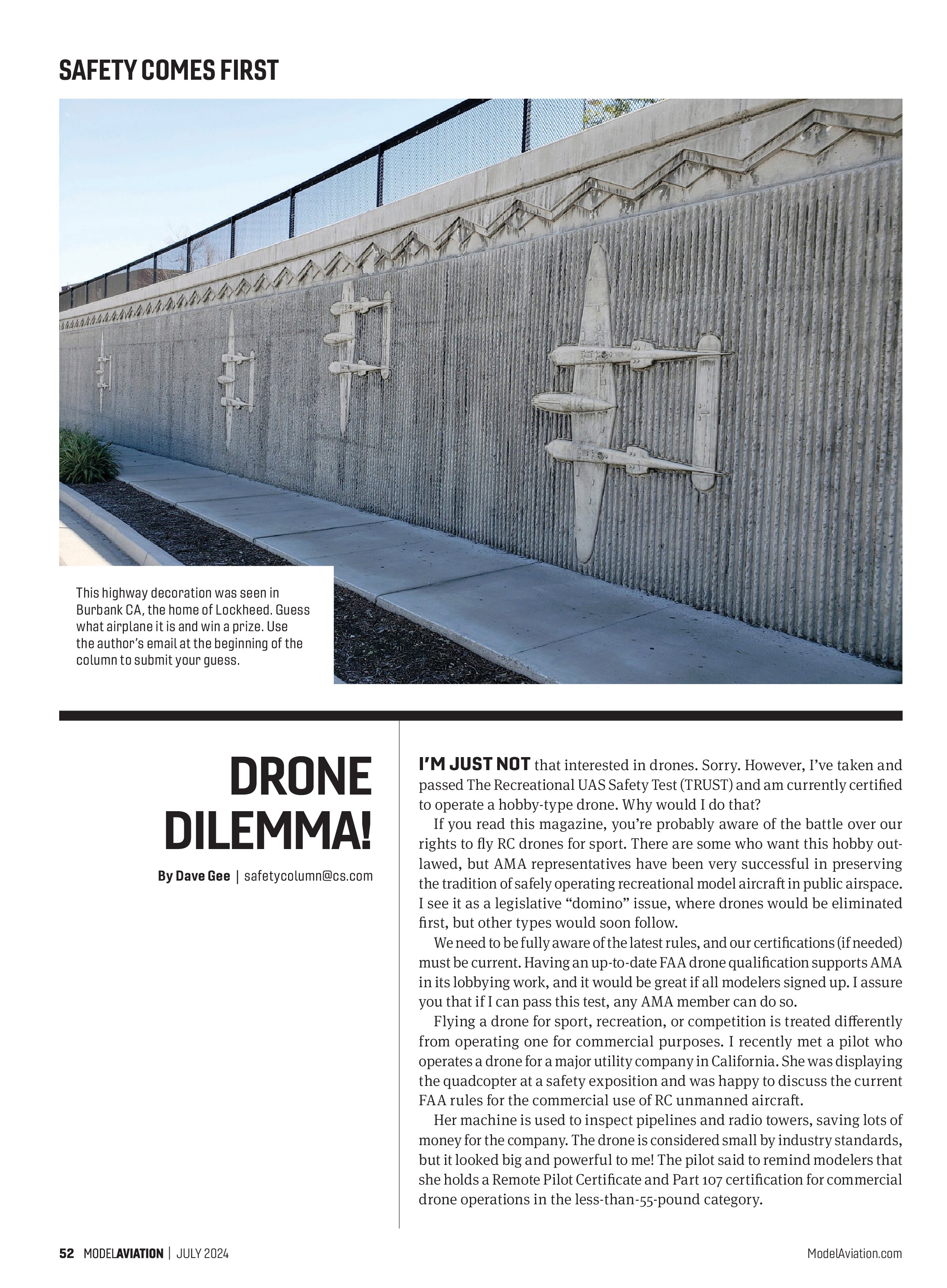
While driving through Burbank, California, I noticed some swell decorations on an underpass retaining wall. The city decided to brag about local aviation history by molding a famous record-setting airframe into the concrete. Some of my models come out a bit heavy, but this is ridiculous!
All readers who take a guess about the identity of this distinctive World War II fighter aircraft will receive (via email) special prize plans for two vintage models that are seldom seen nowadays.
Two Tiny Prizes
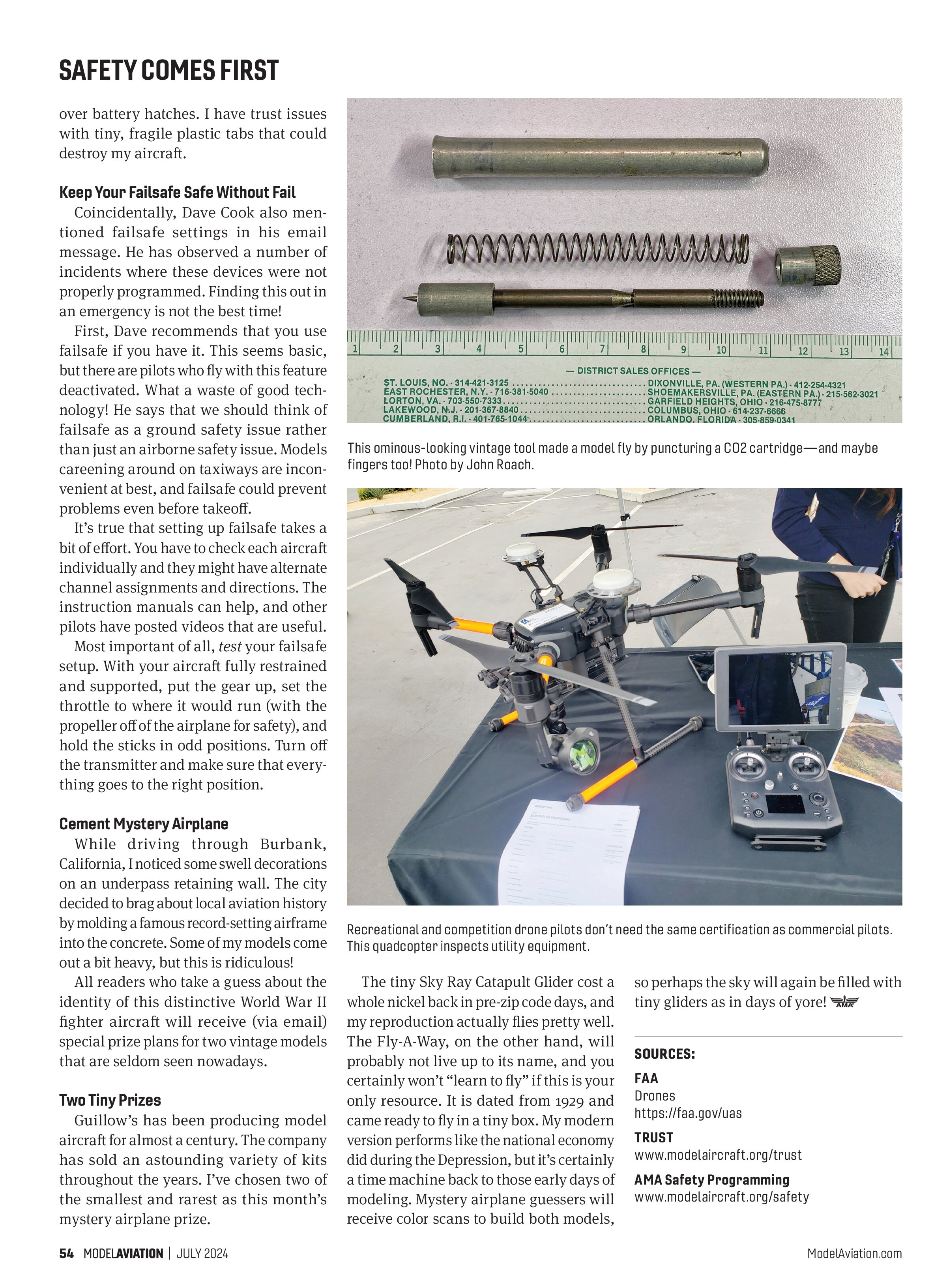
Guillow’s has been producing model aircraft for almost a century. The company has sold an astounding variety of kits throughout the years. I’ve chosen two of the smallest and rarest as this month’s mystery airplane prize.
The tiny Sky Ray Catapult Glider cost a whole nickel back in pre-zip code days, and my reproduction actually flies pretty well. The Fly-A-Way, on the other hand, will probably not live up to its name, and you certainly won’t “learn to fly” if this is your only resource. It is dated from 1929 and came ready to fly in a tiny box. My modern version performs like the national economy did during the Depression, but it’s certainly a time machine back to those early days of modeling. Mystery airplane guessers will receive color scans to build both models, so perhaps the sky will again be filled with tiny gliders as in days of yore!
SOURCES:
FAA
Drones
https://faa.gov/uas
TRUST
www.modelaircraft.org/trust
AMA Safety Programming
www.modelaircraft.org/safety