RC SOARING

2024 BUNGEE CHALLENGE
By Gordon Buckland | gordon@gatorf3b.com
THE LARGEST F3 RUDDER, Elevator, and Spoiler (F3 RES) contest in the US is chronicled by Jim Vanderzyl for your enjoyment.
String Fellows
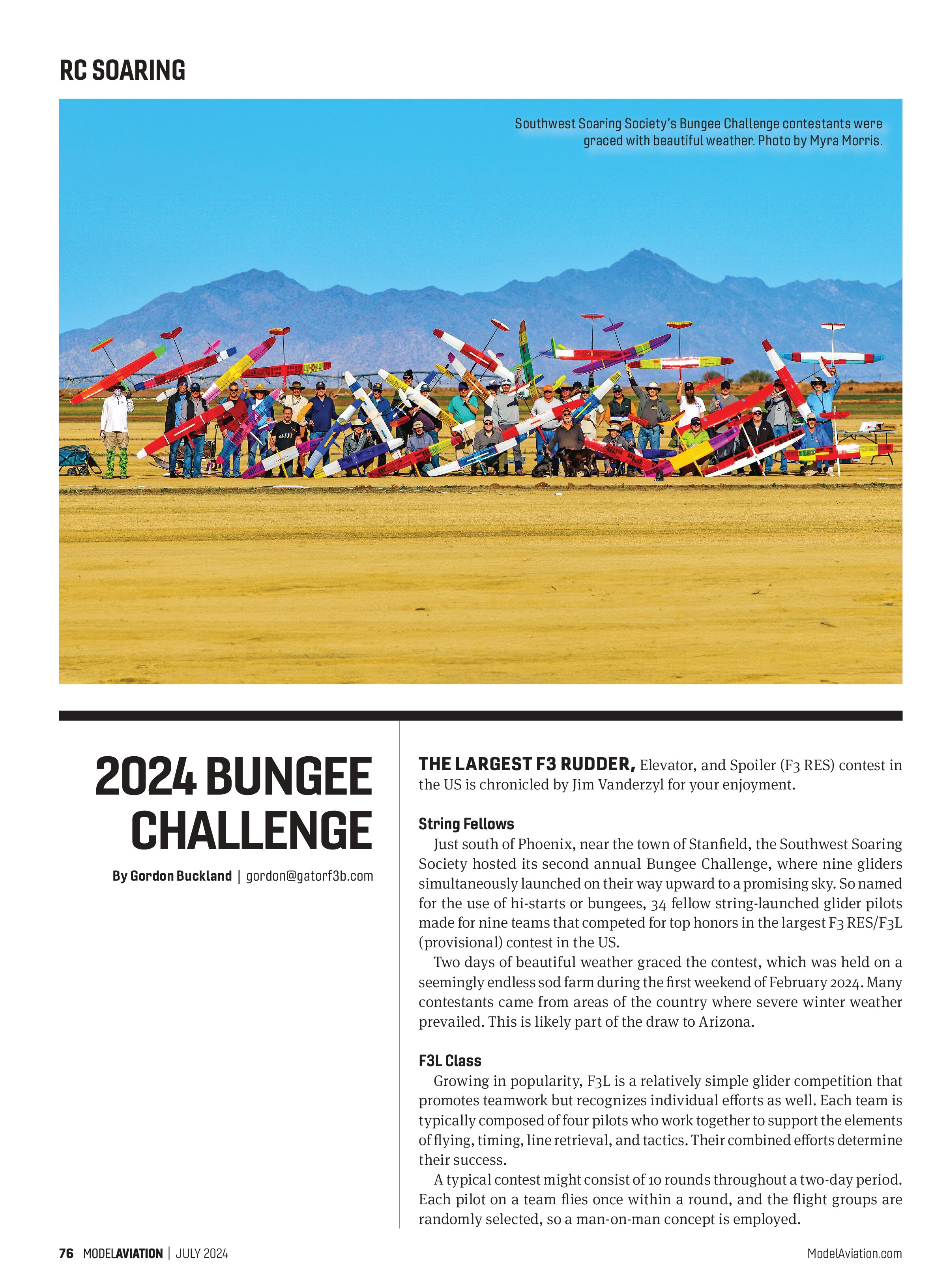
Just south of Phoenix, near the town of Stanfield, the Southwest Soaring Society hosted its second annual Bungee Challenge, where nine gliders simultaneously launched on their way upward to a promising sky. So named for the use of hi-starts or bungees, 34 fellow string-launched glider pilots made for nine teams that competed for top honors in the largest F3 RES/F3L (provisional) contest in the US.
Two days of beautiful weather graced the contest, which was held on a seemingly endless sod farm during the first weekend of February 2024. Many contestants came from areas of the country where severe winter weather prevailed. This is likely part of the draw to Arizona.
F3L Class
Growing in popularity, F3L is a relatively simple glider competition that promotes teamwork but recognizes individual efforts as well. Each team is typically composed of four pilots who work together to support the elements of flying, timing, line retrieval, and tactics. Their combined efforts determine their success.
A typical contest might consist of 10 rounds throughout a two-day period. Each pilot on a team flies once within a round, and the flight groups are randomly selected, so a man-on-man concept is employed.
The objective for scoring is to fly as precisely as possible to a 6-minute flight and, for additional points, make a landing on a rather generously graduated landing tape. Each flight group has a 9-minute working period to record an official flight, and multiple launches (relaunches) are common.
Only the last flight and landing count for scoring, so choosing to relaunch (or not) is often an intriguing tactical decision. The top-scoring pilot of that flight group receives 1,000 points and the other pilots’ scores are then normalized.
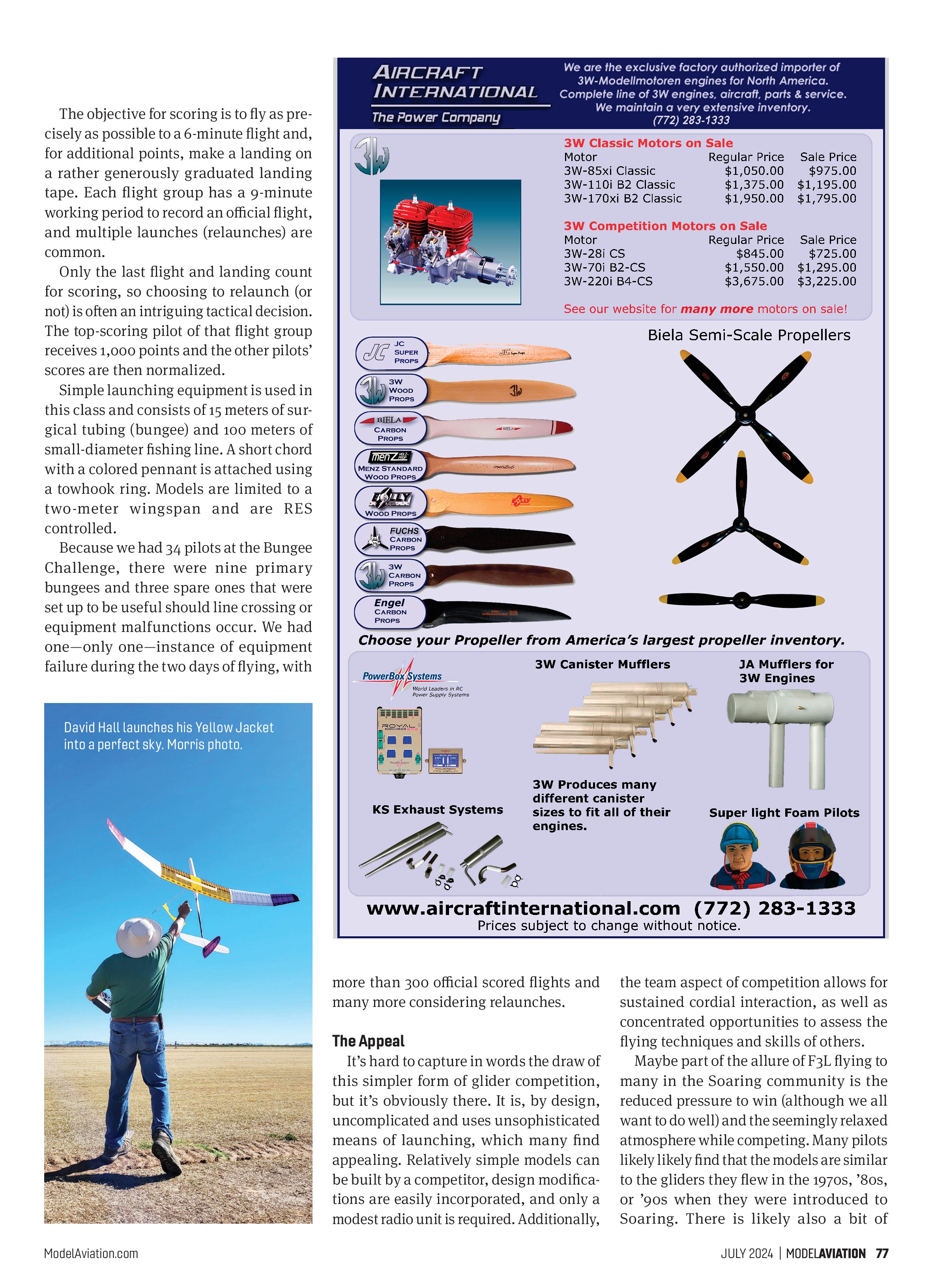
Simple launching equipment is used in this class and consists of 15 meters of surgical tubing (bungee) and 100 meters of small-diameter fishing line. A short chord with a colored pennant is attached using a towhook ring. Models are limited to a two-meter wingspan and are RES controlled.
Because we had 34 pilots at the Bungee Challenge, there were nine primary bungees and three spare ones that were set up to be useful should line crossing or equipment malfunctions occur. We had one—only one—instance of equipment failure during the two days of flying, with

more than 300 official scored flights and many more considering relaunches.
The Appeal
It’s hard to capture in words the draw of this simpler form of glider competition, but it’s obviously there. It is, by design, uncomplicated and uses unsophisticated means of launching, which many find appealing. Relatively simple models can be built by a competitor, design modifications are easily incorporated, and only a modest radio unit is required. Additionally,
the team aspect of competition allows for sustained cordial interaction, as well as concentrated opportunities to assess the flying techniques and skills of others.
Maybe part of the allure of F3L flying to many in the Soaring community is the reduced pressure to win (although we all want to do well) and the seemingly relaxed atmosphere while competing. Many pilots likely likely find that the models are similar to the gliders they flew in the 1970s, ’80s, or ’90s when they were introduced to Soaring. There is likely also a bit of

nostalgia residing within. New glider pilots are now afforded an organized class of models that can be an inexpensive introduction to the Soaring community.
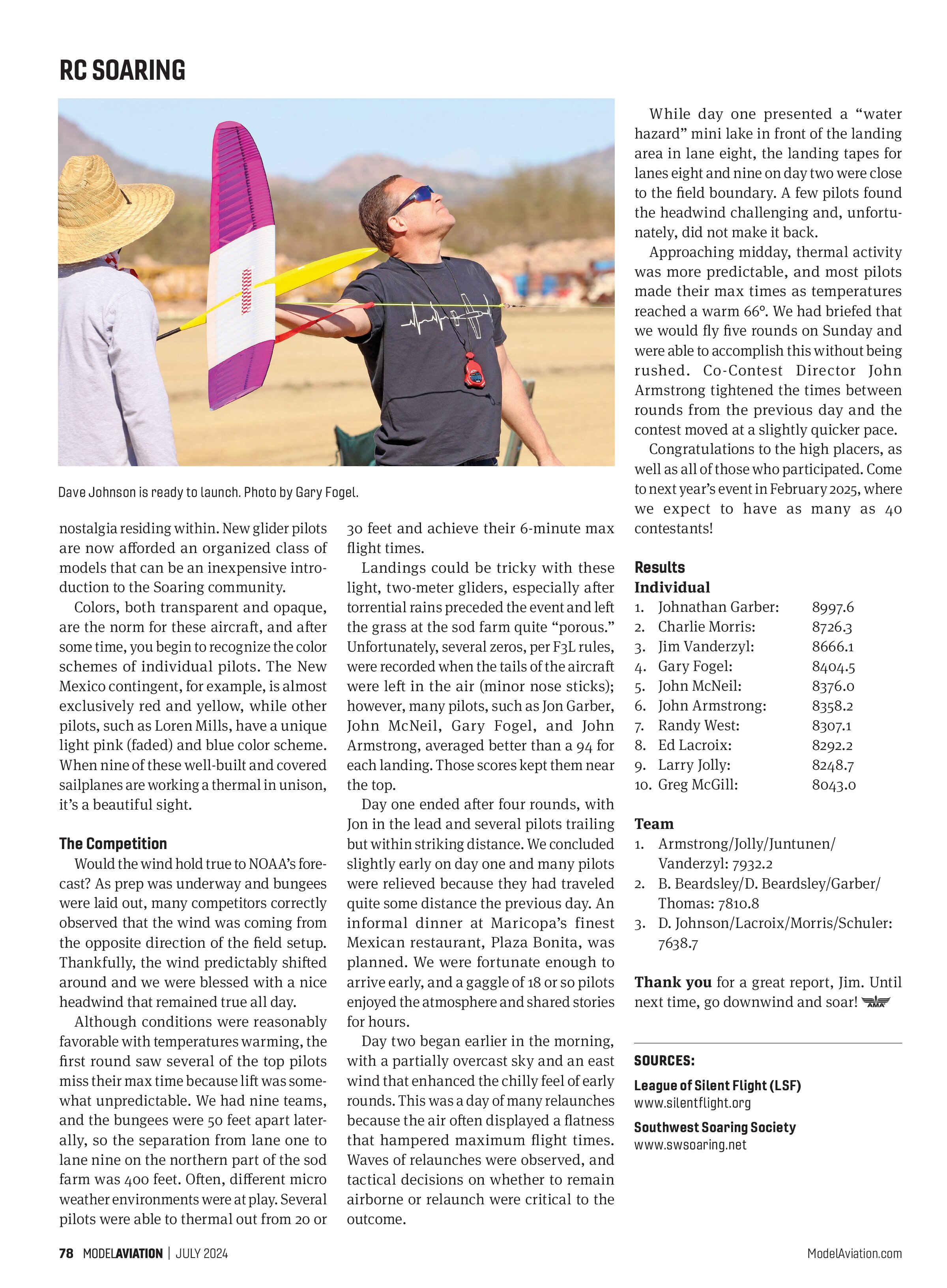
Colors, both transparent and opaque, are the norm for these aircraft, and after some time, you begin to recognize the color schemes of individual pilots. The New Mexico contingent, for example, is almost exclusively red and yellow, while other pilots, such as Loren Mills, have a unique light pink (faded) and blue color scheme. When nine of these well-built and covered sailplanes are working a thermal in unison, it’s a beautiful sight.
The Competition
Would the wind hold true to NOAA’s forecast? As prep was underway and bungees were laid out, many competitors correctly observed that the wind was coming from the opposite direction of the field setup. Thankfully, the wind predictably shifted around and we were blessed with a nice headwind that remained true all day.
Although conditions were reasonably favorable with temperatures warming, the first round saw several of the top pilots miss their max time because lift was somewhat unpredictable. We had nine teams, and the bungees were 50 feet apart laterally, so the separation from lane one to lane nine on the northern part of the sod farm was 400 feet. Often, different micro weather environments were at play. Several pilots were able to thermal out from 20 or
30 feet and achieve their 6-minute max flight times.
Landings could be tricky with these light, two-meter gliders, especially after torrential rains preceded the event and left the grass at the sod farm quite “porous.” Unfortunately, several zeros, per F3L rules, were recorded when the tails of the aircraft were left in the air (minor nose sticks); however, many pilots, such as Jon Garber, John McNeil, Gary Fogel, and John Armstrong, averaged better than a 94 for each landing. Those scores kept them near the top.
Day one ended after four rounds, with Jon in the lead and several pilots trailing but within striking distance. We concluded slightly early on day one and many pilots were relieved because they had traveled quite some distance the previous day. An informal dinner at Maricopa’s finest Mexican restaurant, Plaza Bonita, was planned. We were fortunate enough to arrive early, and a gaggle of 18 or so pilots enjoyed the atmosphere and shared stories for hours.
Day two began earlier in the morning, with a partially overcast sky and an east wind that enhanced the chilly feel of early rounds. This was a day of many relaunches because the air often displayed a flatness that hampered maximum flight times. Waves of relaunches were observed, and tactical decisions on whether to remain airborne or relaunch were critical to the outcome.
While day one presented a “water hazard” mini lake in front of the landing area in lane eight, the landing tapes for lanes eight and nine on day two were close to the field boundary. A few pilots found the headwind challenging and, unfortunately, did not make it back.
Approaching midday, thermal activity was more predictable, and most pilots made their max times as temperatures reached a warm 66°. We had briefed that we would fly five rounds on Sunday and were able to accomplish this without being rushed. Co-Contest Director John Armstrong tightened the times between rounds from the previous day and the contest moved at a slightly quicker pace.
Congratulations to the high placers, as well as all of those who participated. Come to next year’s event in February 2025, where we expect to have as many as 40 contestants!
Results
Individual
- Johnathan Garber: 8997.6
- Charlie Morris: 8726.3
- Jim Vanderzyl: 8666.1
- Gary Fogel: 8404.5
- John McNeil: 8376.0
- John Armstrong: 8358.2
- Randy West: 8307.1
- Ed Lacroix: 8292.2
- Larry Jolly: 8248.7
- Greg McGill: 8043.0
Team
- Armstrong/Jolly/Juntunen/Vanderzyl: 7932.2
- B. Beardsley/D. Beardsley/Garber/Thomas: 7810.8
- D. Johnson/Lacroix/Morris/Schuler: 7638.7
Thank you for a great report, Jim. Until next time, go downwind and soar!
SOURCES:
League of Silent Flight (LSF)
www.silentflight.org
Southwest Soaring Society
www.swsoaring.net