RC PYLON RACING STARTING PROCEDURES AND RULES
By Tim Lampe | tim.lampe@hotmail.com

I’VE OVERHEARD—and occasionally participated in—discussion on the internet and in person about the starting procedures and rules for RC Pylon Racing. This is a bit of a hot topic in some Pylon Racing circles.
To that, below is everything that I could find regarding anything related to the starting procedure in the AMA Radio Control Pylon Racing 2024–2025 Competition Regulations.
- 4.4. Authority of the Starter: The starter acts for the contest director (CD) in all matters arising on the racecourse. Unless overruled by the CD, the starter’s actions and decisions concerning the start, finish, and operation of each heat are final.
- 13.1.7.: Each heat race begins with the aircraft stationary at or behind the start/finish line.
- 13.1.12.: Pilots whose callers push off before their launch signal shall receive a cut for that heat. A blatant early push is a black flag offense.
Dan Kane also told me about the old National Miniature Pylon Racing Association (NMPRA) procedure guide that has been rolled into an addendum at the end of the AMA rules, titled “Addendum A: Racecourse Personnel and Their Duties.” Although not implicit rules, the addendum seems to be a description of the rules in a procedural and descriptive format.
Aircraft-Grade Epoxy
In the March 2021 column, I did a write-up about Loctite 9462 epoxy for gluing in firewalls and anything else critically structural in our Pylon Racing models. I had favored 9462, but, over time, I found out about epoxies specifically intended for the lamination and construction of wood and composite aircraft in the full-scale aviation industry.
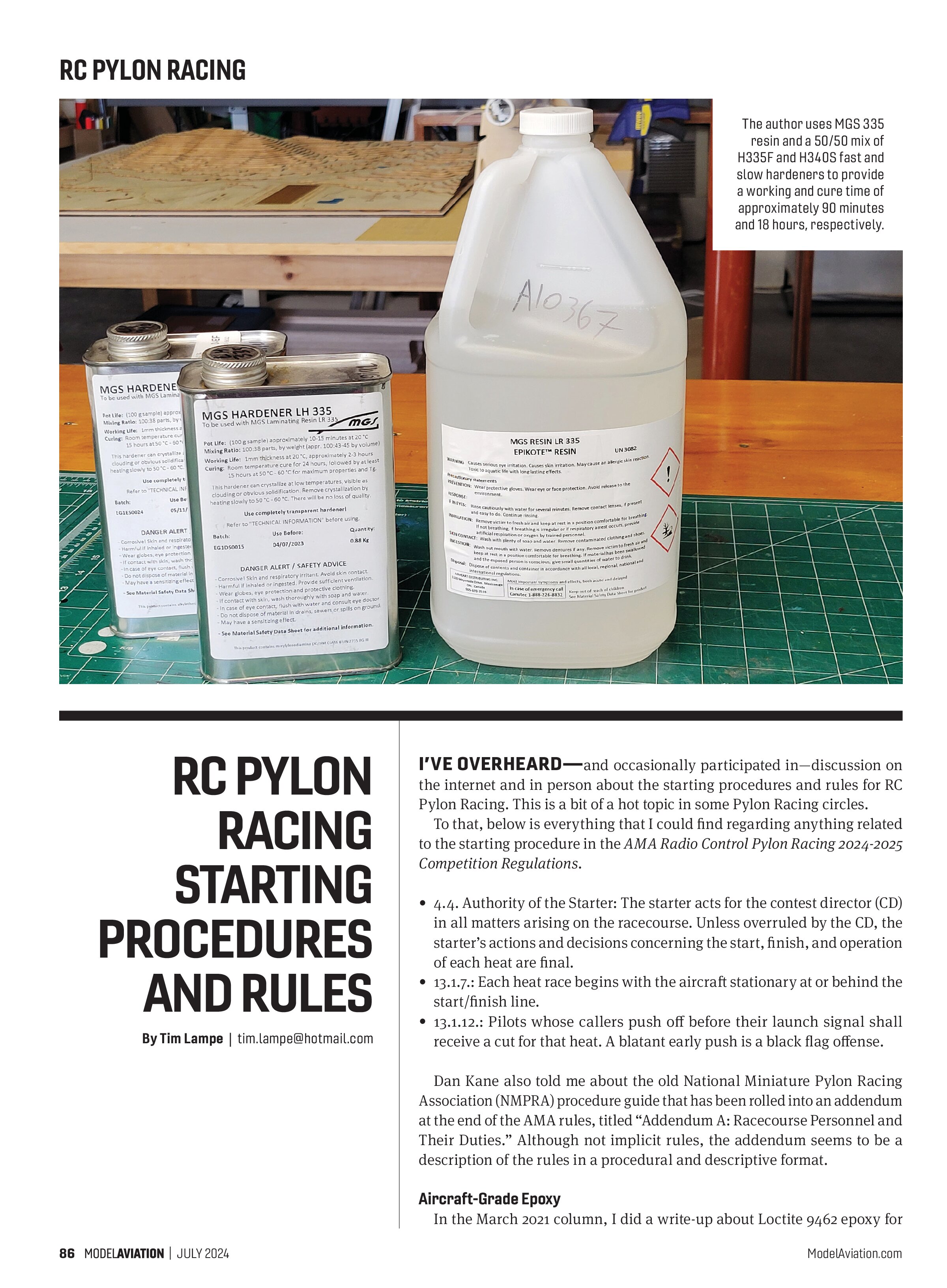
Occasionally, I would get a glimpse of some of this “aircraft-grade” epoxy in the engine compartment or a repair job of someone else’s Pylon Racing airplane. This kind of epoxy seemed rock hard, adhered extremely well, and didn’t seem to age. After asking around and doing some internet research, I learned that MGS (Hexion) is among the most favored of these aircraft epoxies.
One of my first and best sources was a man named Tom Siler, who is a leader in the Discus-Launch Glider community and also builds full-scale aircraft. I even met up with Tom at his home in Ohio, where he gave me a small amount of epoxy to get started. Epoxy can be a fairly technical subject and, as I’ve said in the past, I’m not attempting to present myself as an expert. I’ve simply done some research and have had enough experience to compose interesting subject material and a little food for thought.
Typically, aircraft-grade epoxy is sold in large quantities, such as gallon jugs of resin and quart cans of hardener. Furthermore, there can be additional hazardous materials shipping charges that make buying this kind of epoxy impractical for the interested individual. People who use this typically “go in” on a purchase together and share it amongst themselves.
I bought some MGS from Aircraft Spruce & Specialty Co., which I proceeded to package and sell in small quantities to recoup my investment, but that proved to be a bit of a fail.
In addition to being fuelproof and exceptionally strong structurally, another advantage of aircraft epoxy is extended working times. Most of the hobby-grade epoxy I’ve come across has a working time of approximately 30 to 45 minutes maximum. Sometimes this is enough, but when you are performing a critical operation, such as installing a wood firewall in a composite fuselage, most of us—myself for sure—require extended working time to get it perfect. You don’t want to find yourself in a rush as the epoxy begins to thicken! Additionally, working and curing times can be modified by mixing different proportions of fast and slow hardener.
Most versions of aircraft epoxy are formulated for laminating and are therefore not viscous enough to be used as a structural adhesive because they would flow

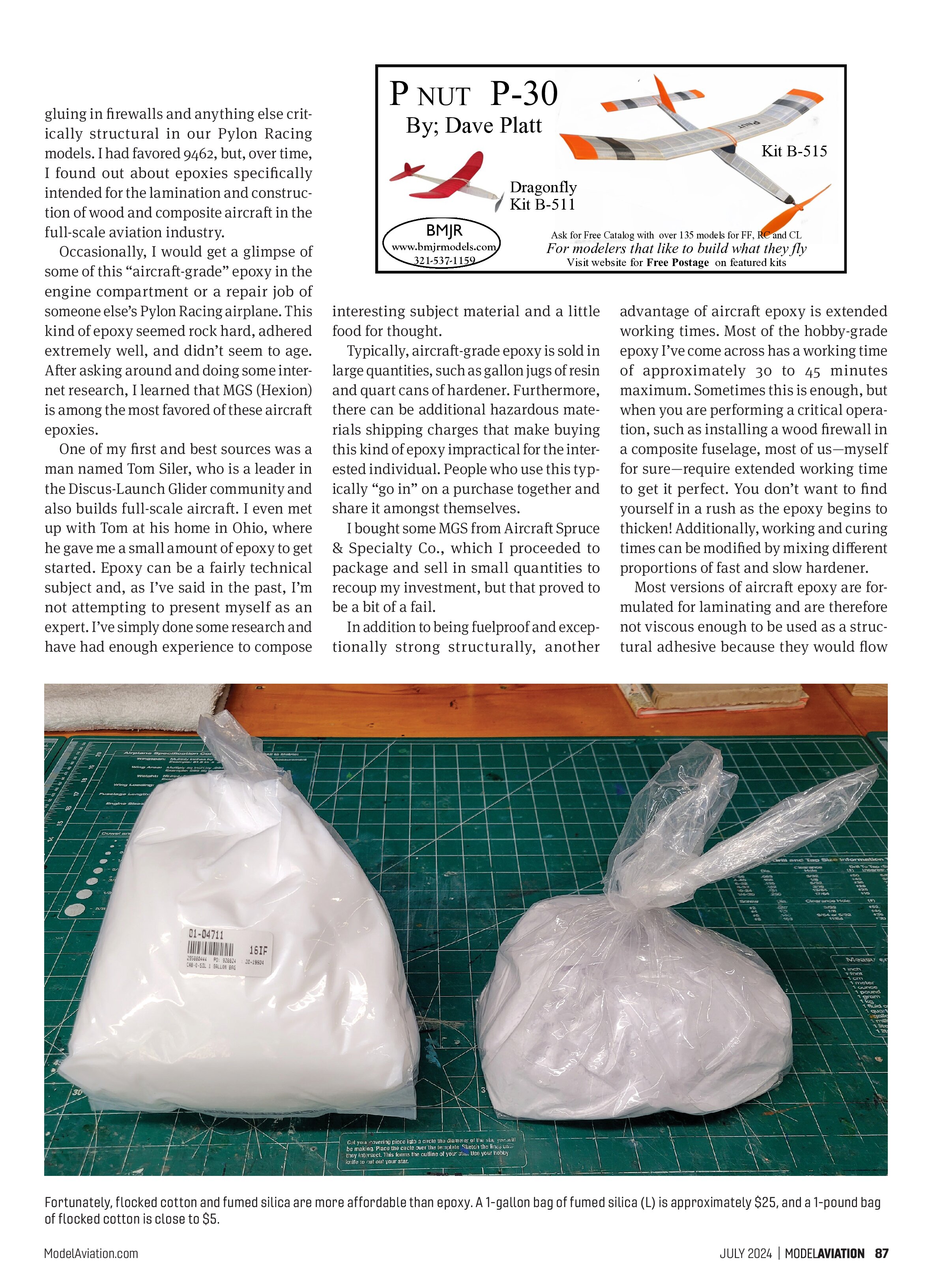
Fortunately, flocked cotton and fumed silica are more affordable than epoxy. A 1-gallon bag of fumed silica (L) is approximately $25, and a 1-pound bag of flocked cotton is close to $5.

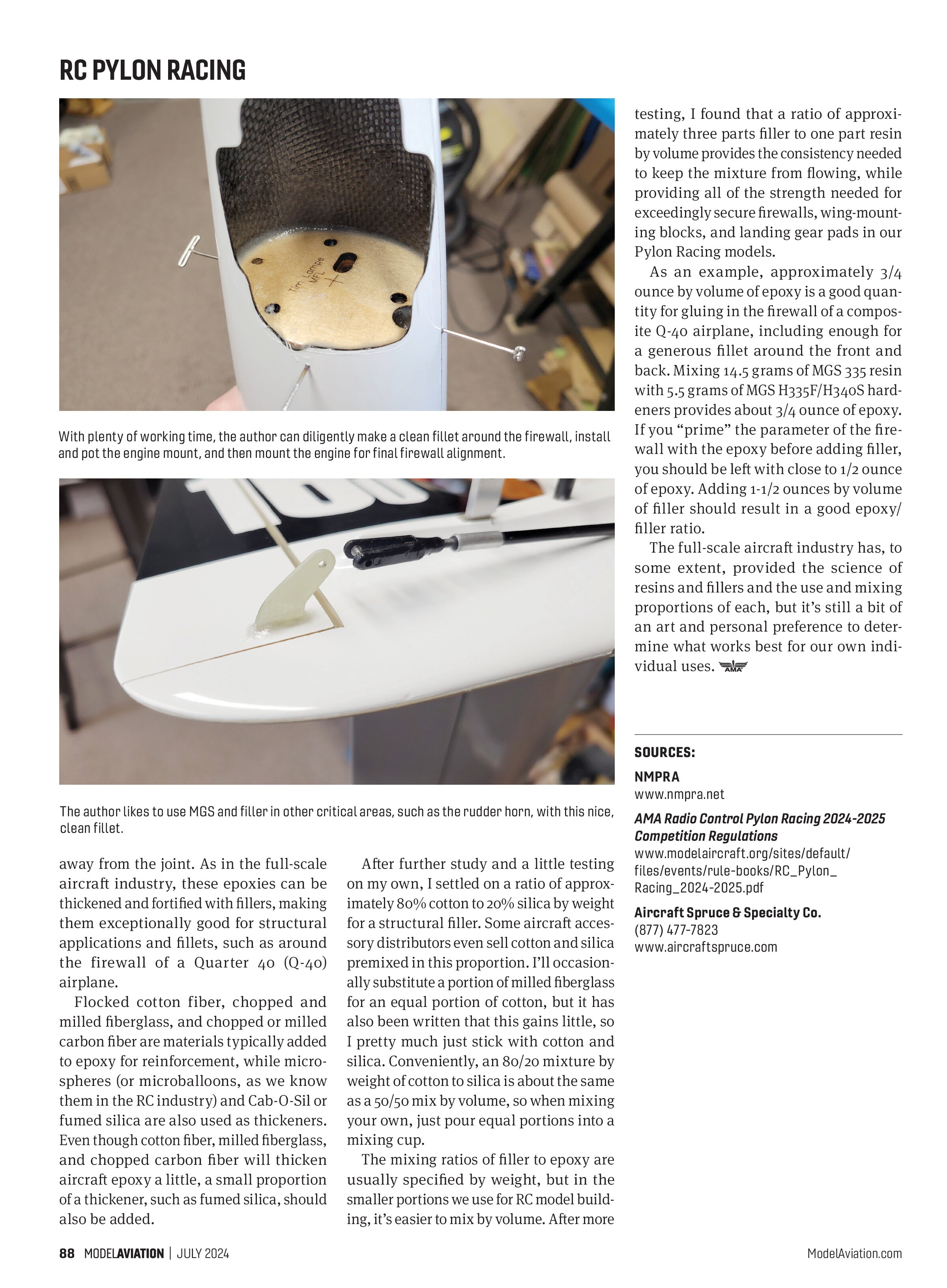
With plenty of working time, the author can diligently make a clean fillet around the firewall, install and pot the engine mount, and then mount the engine for final firewall alignment.

The author likes to use MGS and filler in other critical areas, such as the rudder horn, with this nice, clean fillet.
testing, I found that a ratio of approximately three parts filler to one part resin by volume provides the consistency needed to keep the mixture from flowing, while providing all of the strength needed for exceedingly secure firewalls, wing-mounting blocks, and landing gear pads in our Pylon Racing models.
As an example, approximately 3/4 ounce by volume of epoxy is a good quantity for gluing in the firewall of a composite Q-40 airplane, including enough for a generous fillet around the front and back. Mixing 14.5 grams of MGS 335 resin with 5.5 grams of MGS H335F/H340S hardeners provides about 3/4 ounce of epoxy. If you “prime” the parameter of the firewall with the epoxy before adding filler, you should be left with close to 1/2 ounce of epoxy. Adding 1-1/2 ounces by volume of filler should result in a good epoxy/filler ratio.
The full-scale aircraft industry has, to some extent, provided the science of resins and fillers and the use and mixing proportions of each, but it’s still a bit of an art and personal preference to determine what works best for our own individual uses.
away from the joint. As in the full-scale aircraft industry, these epoxies can be thickened and fortified with fillers, making them exceptionally good for structural applications and fillets, such as around the firewall of a Quarter 40 (Q-40) airplane.
Flocked cotton fiber, chopped and milled fiberglass, and chopped or milled carbon fiber are materials typically added to epoxy for reinforcement, while microspheres (or microballoons, as we know them in the RC industry) and Cab-O-Sil or fumed silica are also used as thickeners. Even though cotton fiber, milled fiberglass, and chopped carbon fiber will thicken aircraft epoxy a little, a small proportion of a thickener, such as fumed silica, should also be added.
After further study and a little testing on my own, I settled on a ratio of approximately 80% cotton to 20% silica by weight for a structural filler. Some aircraft accessory distributors even sell cotton and silica premixed in this proportion. I’ll occasionally substitute a portion of milled fiberglass for an equal portion of cotton, but it has also been written that this gains little, so I pretty much just stick with cotton and silica. Conveniently, an 80/20 mixture by weight of cotton to silica is about the same as a 50/50 mix by volume, so when mixing your own, just pour equal portions into a mixing cup.
The mixing ratios of filler to epoxy are usually specified by weight, but in the smaller portions we use for RC model building, it’s easier to mix by volume. After more testing, I found that a ratio of approximately three parts filler to one part resin by volume provides the consistency needed to keep the mixture from flowing, while providing all of the strength needed for exceedingly secure firewalls, wing-mounting blocks, and landing gear pads in our Pylon Racing models.
SOURCES:
NMPRA
www.nmpra.net
AMA Radio Control Pylon Racing 2024-2025 Competition Regulations
www.modelaircraft.org/sites/default/files/events/rule-books/RC_Pylon_Rac...
Aircraft Spruce & Specialty Co.
(877) 477-7823
www.aircraftspruce.com