WHAT MAKES
TURBINE JETS
UNIQUE?
By Jim Hiller | jetmodeler@earthlink.net

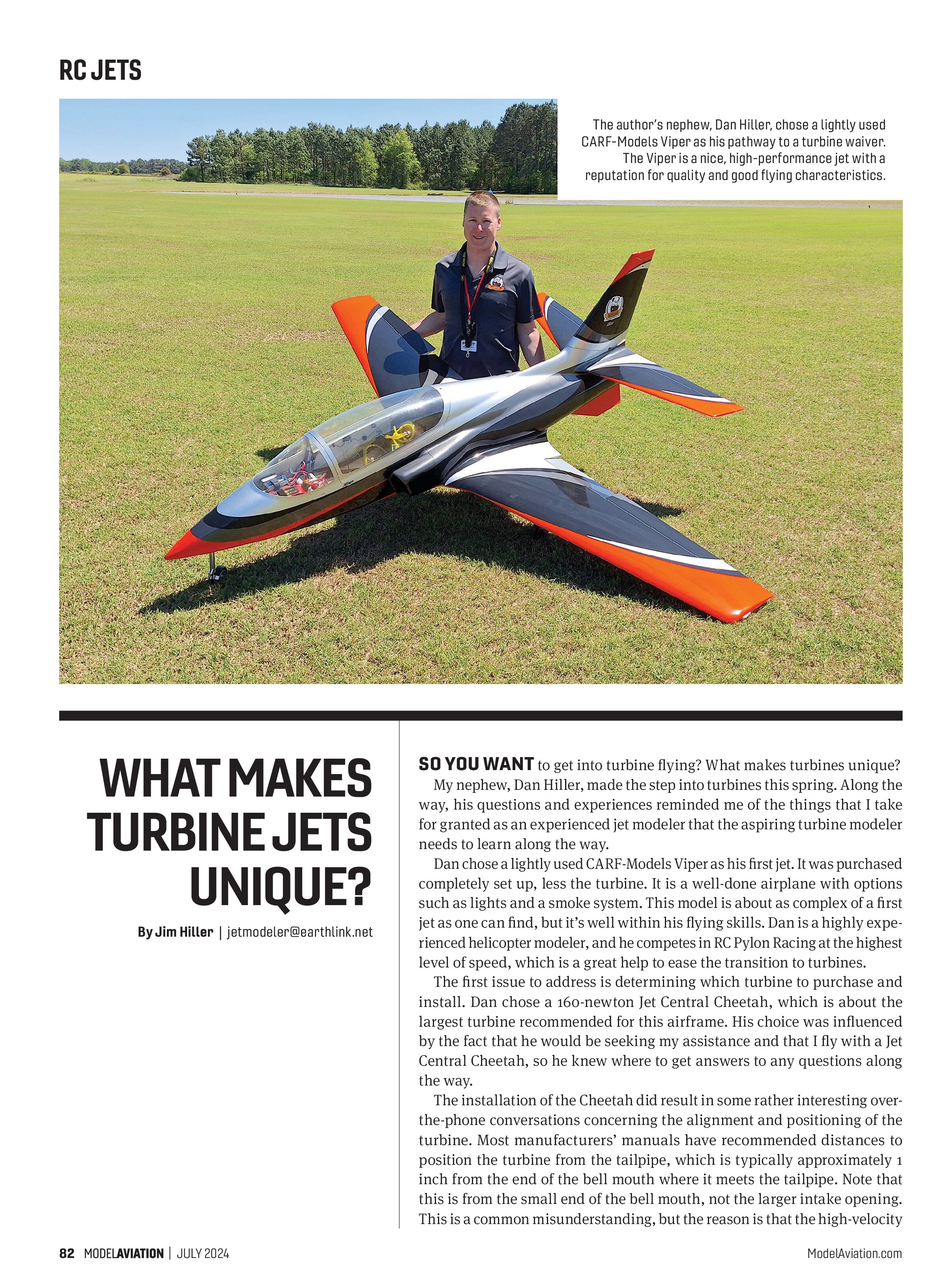
SO YOU WANT to get into turbine flying? What makes turbines unique? My nephew, Dan Hiller, made the step into turbines this spring. Along the way, his questions and experiences reminded me of the things that I take for granted as an experienced jet modeler that the aspiring turbine modeler needs to learn along the way.
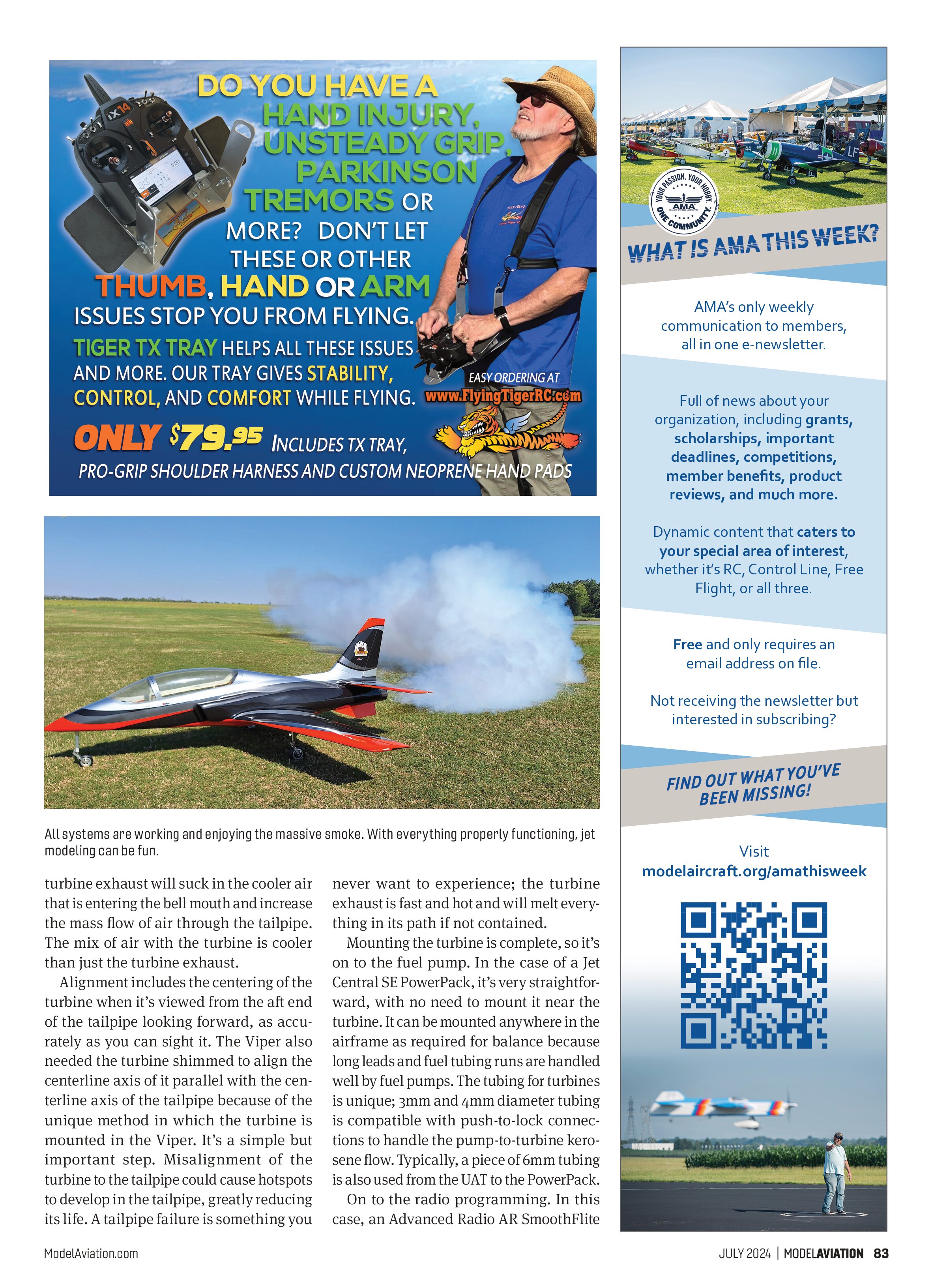
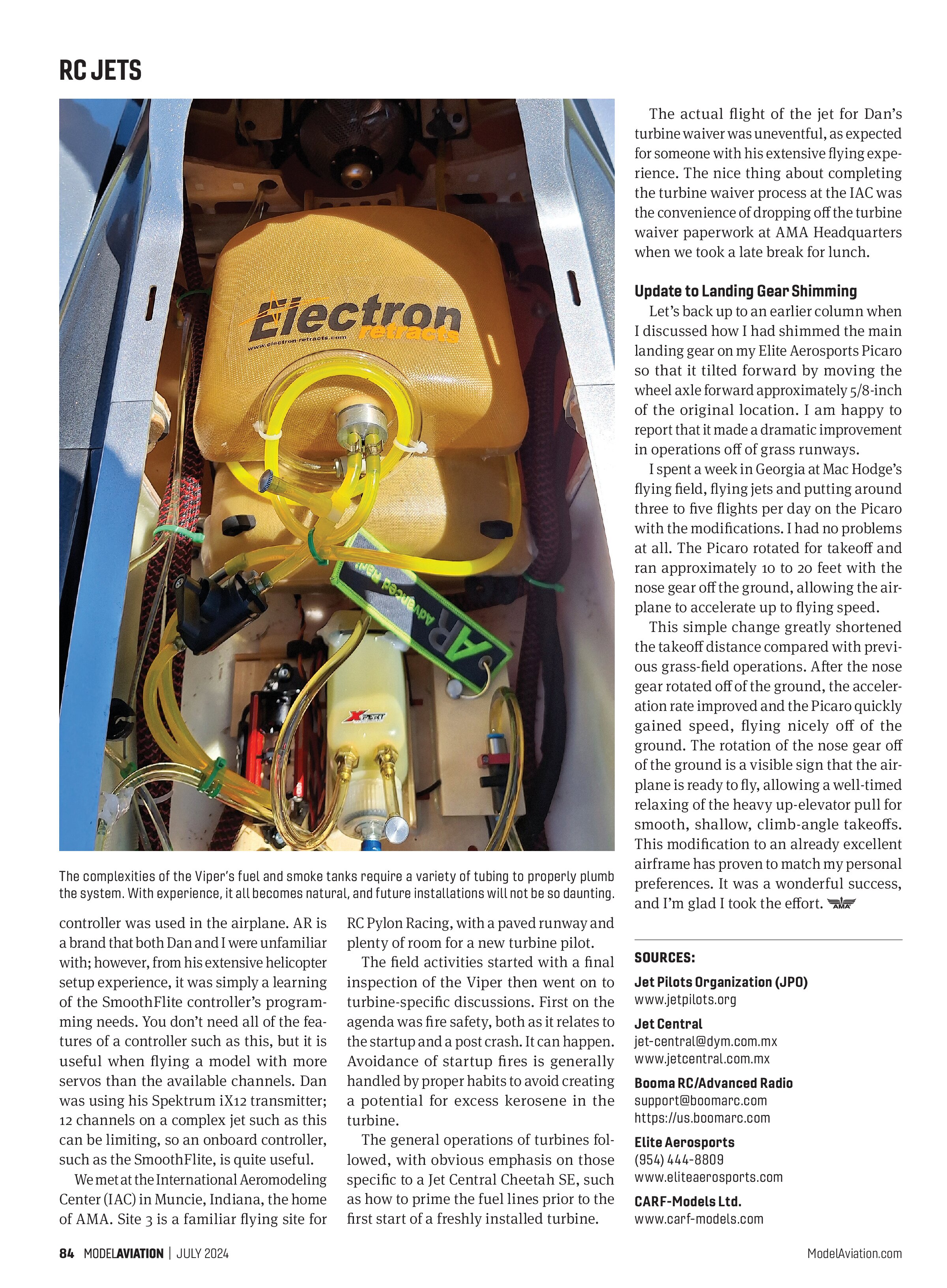
Dan chose a lightly used CARF-Models Viper as his first jet. It was purchased completely set up, less the turbine. It is a well-done airplane with options such as lights and a smoke system. This model is about as complex of a first jet as one can find, but it’s well within his flying skills. Dan is a highly experienced helicopter modeler, and he competes in RC Pylon Racing at the highest level of speed, which is a great help to ease the transition to turbines.
The first issue to address is determining which turbine to purchase and install. Dan chose a 160-newton Jet Central Cheetah, which is about the largest turbine recommended for this airframe. His choice was influenced by the fact that he would be seeking my assistance and that I fly with a Jet Central Cheetah, so he knew where to get answers to any questions along the way.
The installation of the Cheetah did result in some rather interesting over-the-phone conversations concerning the alignment and positioning of the turbine. Most manufacturers’ manuals have recommended distances to position the turbine from the tailpipe, which is typically approximately 1 inch from the end of the bell mouth where it meets the tailpipe. Note that this is from the small end of the bell mouth, not the larger intake opening. This is a common misunderstanding, but the reason is that the high-velocity turbine exhaust will suck in the cooler air that is entering the bell mouth and increase the mass flow of air through the tailpipe. The mix of air with the turbine is cooler than just the turbine exhaust.
Alignment includes the centering of the turbine when it’s viewed from the aft end of the tailpipe looking forward, as accurately as you can sight it. The Viper also needed the turbine shimmed to align the centerline axis of it parallel with the centerline axis of the tailpipe because of the unique method in which the turbine is mounted in the Viper. It’s a simple but important step. Misalignment of the turbine to the tailpipe could cause hotspots to develop in the tailpipe, greatly reducing its life. A tailpipe failure is something you never want to experience; the turbine exhaust is fast and hot and will melt everything in its path if not contained.
Mounting the turbine is complete, so it’s on to the fuel pump. In the case of a Jet Central SE PowerPack, it’s very straightforward, with no need to mount it near the turbine. It can be mounted anywhere in the airframe as required for balance because long leads and fuel tubing runs are handled well by fuel pumps. The tubing for turbines is unique; 3mm and 4mm diameter tubing is compatible with push-to-lock connections to handle the pump-to-turbine kerosene flow. Typically, a piece of 6mm tubing is also used from the UAT to the PowerPack.
On to the radio programming. In this case, an Advanced Radio AR SmoothFlite


controller was used in the airplane. AR is a brand that both Dan and I were unfamiliar with; however, from his extensive helicopter setup experience, it was simply a learning of the SmoothFlite controller’s programming needs. You don’t need all of the features of a controller such as this, but it is useful when flying a model with more servos than the available channels. Dan was using his Spektrum iX12 transmitter; 12 channels on a complex jet such as this can be limiting, so an onboard controller, such as the SmoothFlite, is quite useful.
We met at the International Aeromodeling Center (IAC) in Muncie, Indiana, the home of AMA. Site 3 is a familiar flying site for RC Pylon Racing, with a paved runway and plenty of room for a new turbine pilot.
The field activities started with a final inspection of the Viper then went on to turbine-specific discussions. First on the agenda was fire safety, both as it relates to the startup and a post crash. It can happen. Avoidance of startup fires is generally handled by proper habits to avoid creating a potential for excess kerosene in the turbine.
The general operations of turbines followed, with obvious emphasis on those specific to a Jet Central Cheetah SE, such as how to prime the fuel lines prior to the first start of a freshly installed turbine.
The actual flight of the jet for Dan’s turbine waiver was uneventful, as expected for someone with his extensive flying experience. The nice thing about completing the turbine waiver process at the IAC was the convenience of dropping off the turbine waiver paperwork at AMA Headquarters when we took a late break for lunch.
Update to Landing Gear Shimming
Let’s back up to an earlier column when I discussed how I had shimmed the main landing gear on my Elite Aerosports Picaro so that it tilted forward by moving the wheel axle forward approximately 5/8-inch of the original location. I am happy to report that it made a dramatic improvement in operations off of grass runways.
I spent a week in Georgia at Mac Hodge’s flying field, flying jets and putting around three to five flights per day on the Picaro with the modifications. I had no problems at all. The Picaro rotated for takeoff and ran approximately 10 to 20 feet with the nose gear off the ground, allowing the airplane to accelerate up to flying speed.
This simple change greatly shortened the takeoff distance compared with previous grass-field operations. After the nose gear rotated off of the ground, the acceleration rate improved and the Picaro quickly gained speed, flying nicely off of the ground. The rotation of the nose gear off of the ground is a visible sign that the airplane is ready to fly, allowing a well-timed relaxing of the heavy up-elevator pull for smooth, shallow, climb-angle takeoffs. This modification to an already excellent airframe has proven to match my personal preferences. It was a wonderful success, and I’m glad I took the effort.
SOURCES:
Jet Pilots Organization (JPO)
www.jetpilots.org
Jet Central
jet-central@dym.com.mx
www.jetcentral.com.mx
Booma RC/Advanced Radio
support@boomarc.com
https://us.boomarc.com
Elite Aerosports
(954) 444-8809
www.eliteaerosports.com
CARF-Models Ltd.
www.carf-models.com