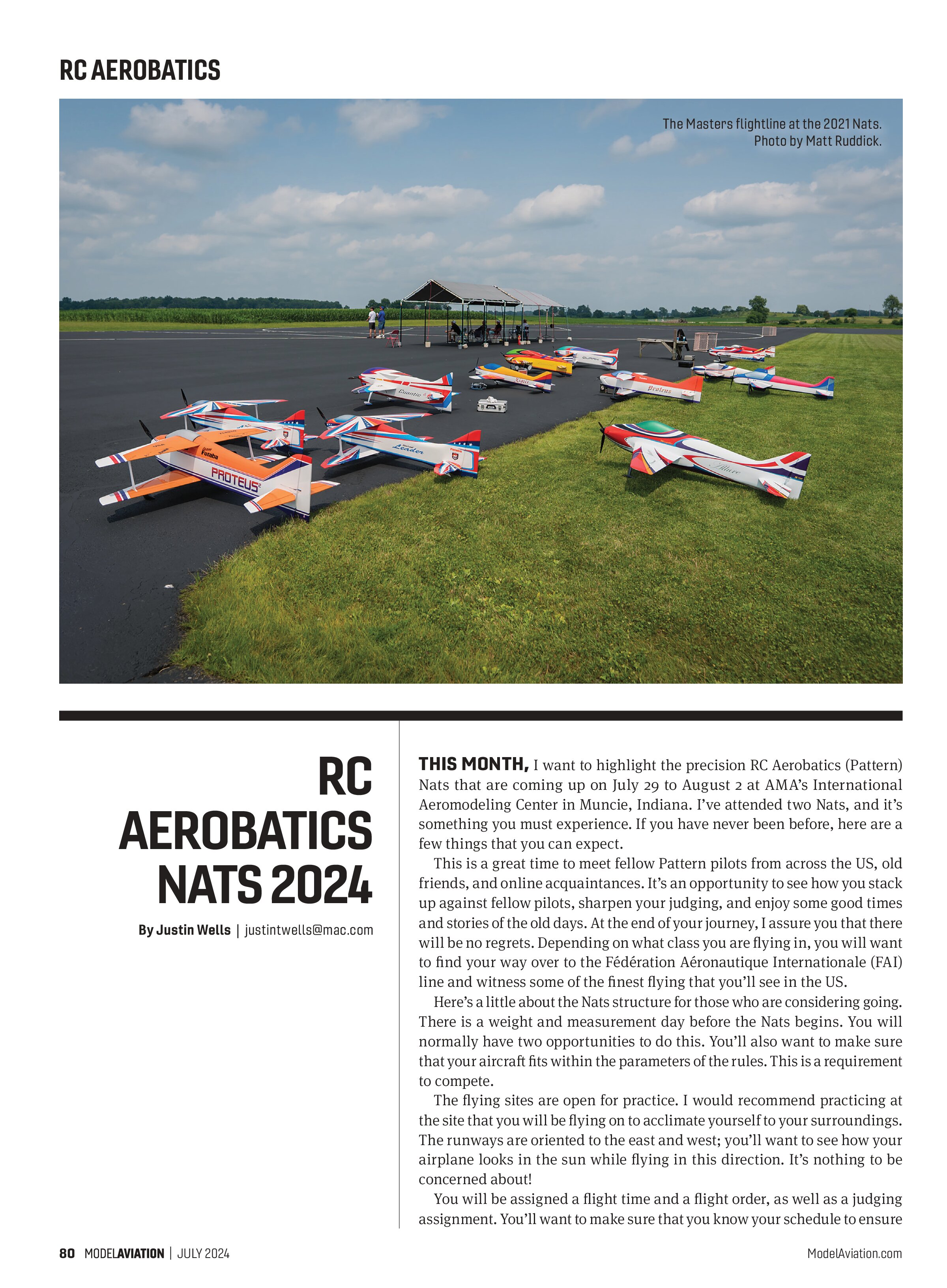
RC AEROBATICS NATS 2024
By Justin Wells | justinwells@mac.com

THIS MONTH, I want to highlight the precision RC Aerobatics (Pattern) Nats that are coming up on July 29 to August 2 at AMA’s International Aeromodeling Center in Muncie, Indiana. I’ve attended two Nats, and it’s something you must experience. If you have never been before, here are a few things that you can expect.
This is a great time to meet fellow Pattern pilots from across the US, old friends, and online acquaintances. It’s an opportunity to see how you stack up against fellow pilots, sharpen your judging, and enjoy some good times and stories of the old days. At the end of your journey, I assure you that there will be no regrets. Depending on what class you are flying in, you will want to find your way over to the Fédération Aéronautique Internationale (FAI) line and witness some of the finest flying that you’ll see in the US.
Here’s a little about the Nats structure for those who are considering going. There is a weight and measurement day before the Nats begins. You will normally have two opportunities to do this. You’ll also want to make sure that your aircraft fits within the parameters of the rules. This is a requirement to compete.
The flying sites are open for practice. I would recommend practicing at the site that you will be flying on to acclimate yourself to your surroundings. The runways are oriented to the east and west; you’ll want to see how your airplane looks in the sun while flying in this direction. It’s nothing to be concerned about!
You will be assigned a flight time and a flight order, as well as a judging assignment. You’ll want to make sure that you know your schedule to ensure that the event goes smoothly. This competition runs like a Swiss watch, so prepare to be impressed with how much organization takes place before you arrive.
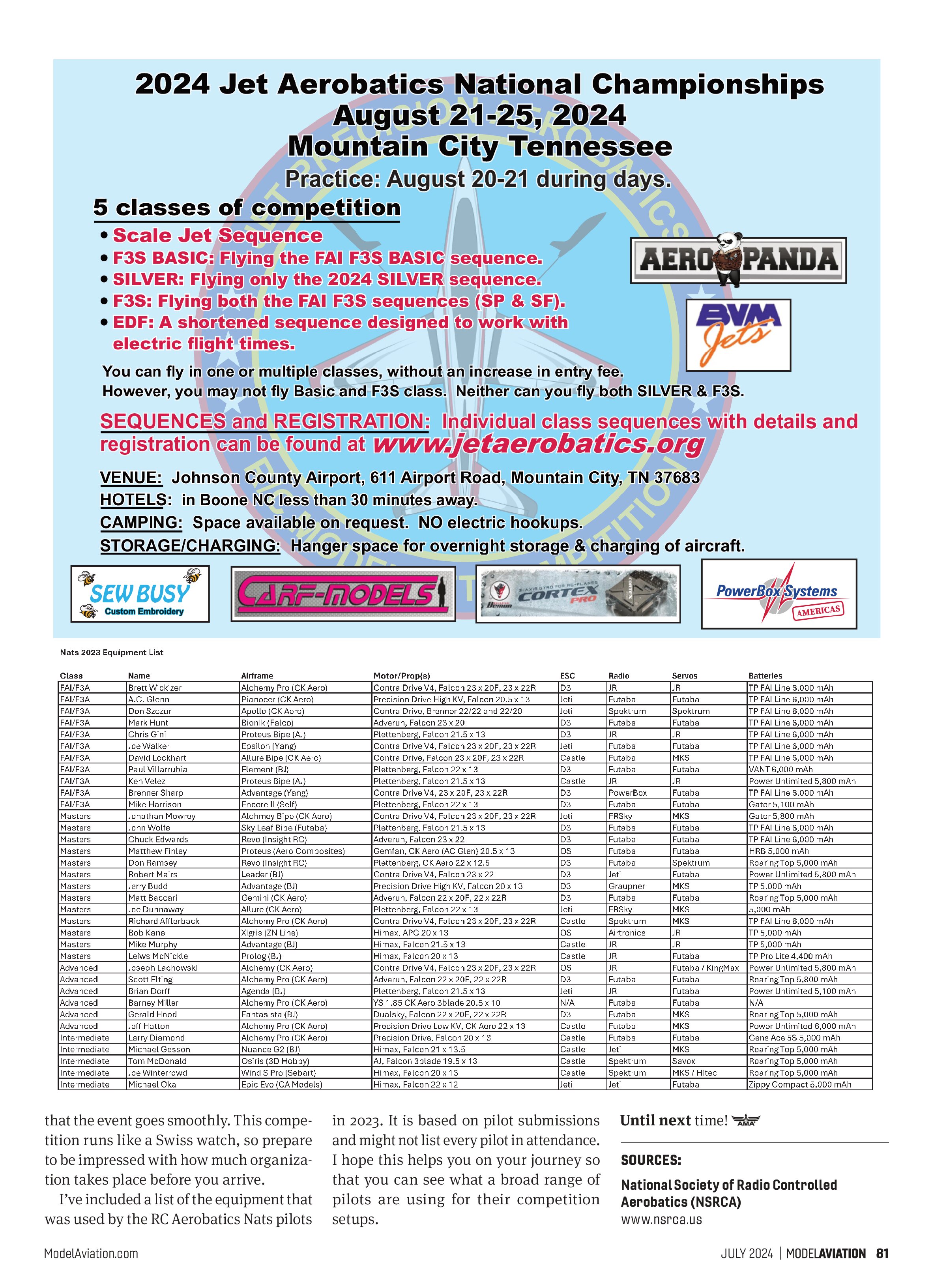
I’ve included a list of the equipment that was used by the RC Aerobatics Nats pilots in 2023. It is based on pilot submissions and might not list every pilot in attendance. I hope this helps you on your journey so that you can see what a broad range of pilots are using for their competition setups.

Until next time!
SOURCES:
National Society of Radio Controlled Aerobatics (NSRCA)
www.nsrca.us