MICRO-FLYING
NPMAC ANNUAL WINTER BLUES FUN-FLY
By Joe Malinchak | joemal@echoes.net

EVERY YEAR, I look forward to the Winter Blues Fun-Fly indoor event that is held at North Penn High School, located in Lansdale, Pennsylvania. Michael Voicheck Ed.D., the technology and engineering department chair and educator at North Penn High School, is the advisor for the North Penn Model Aviation Club (NPMAC). Every year, Michael, his students, and staff do a wonderful job of organizing and running the school’s annual indoor fun-fly.
The event was held on Saturday, March 2, 2024, in the school’s beautiful 175- x 105-foot gym. Tables and chairs were set up and provided for everyone to use. Time slots were dedicated to open flying, 3D, helicopters/multirotors, and micro aircraft.
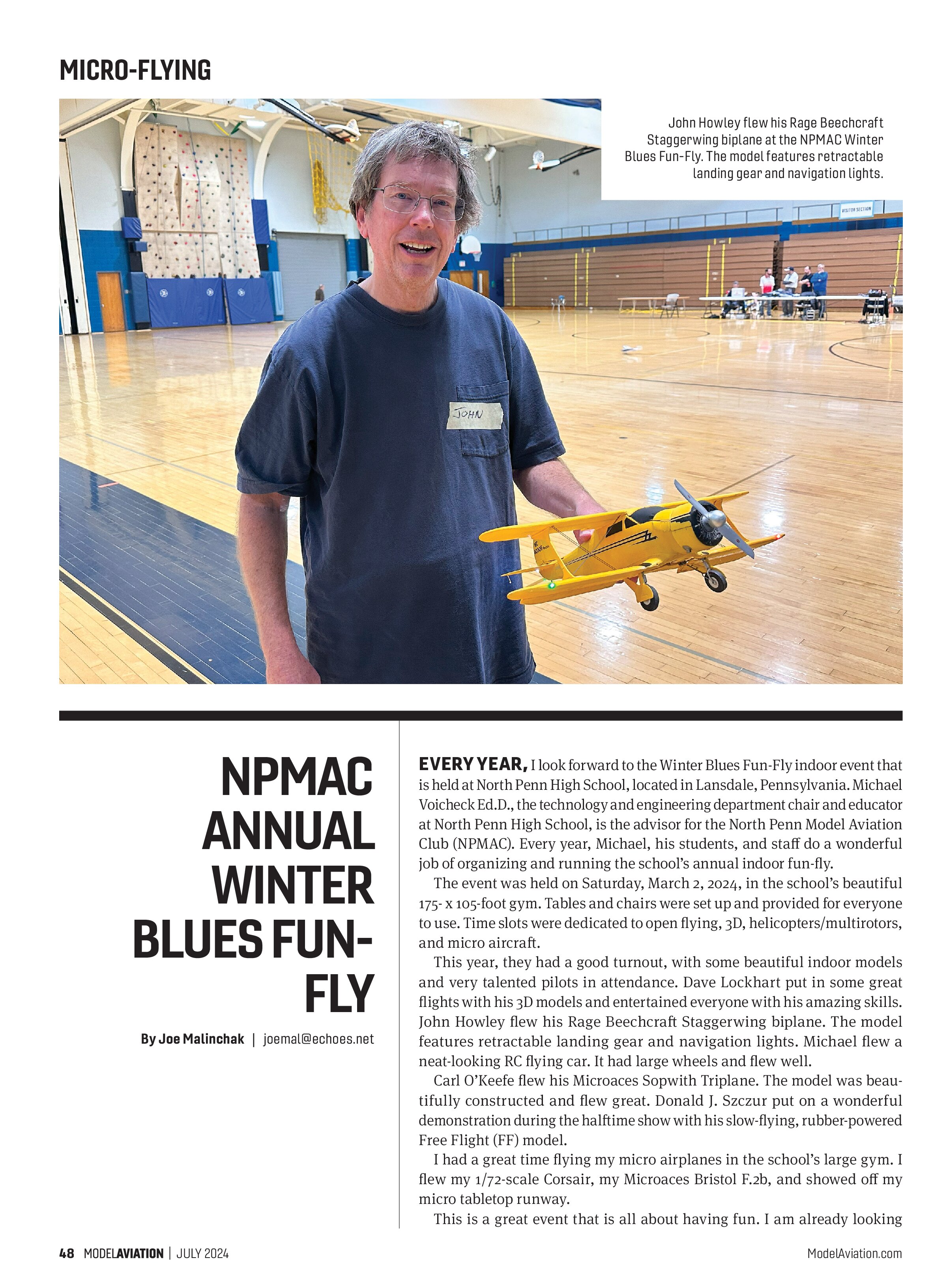
This year, they had a good turnout, with some beautiful indoor models and very talented pilots in attendance. Dave Lockhart put in some great flights with his 3D models and entertained everyone with his amazing skills. John Howley flew his Rage Beechcraft Staggerwing biplane. The model features retractable landing gear and navigation lights. Michael flew a neat-looking RC flying car. It had large wheels and flew well.
Carl O’Keefe flew his Microaces Sopwith Triplane. The model was beautifully constructed and flew great.

Donald J. Szczur put on a wonderful demonstration during the halftime show with his slow-flying, rubber-powered Free Flight (FF) model.

I had a great time flying my micro airplanes in the school’s large gym. I flew my 1/72-scale Corsair, my Microaces Bristol F.2b, and showed off my micro tabletop runway.
This is a great event that is all about having fun. I am already looking forward to attending next year’s fun-fly! You can see some video footage that I took on my YouTube channel, which is under my name and listed in “Sources.”
New Ice Cream Indoor Micro-RC Airplane
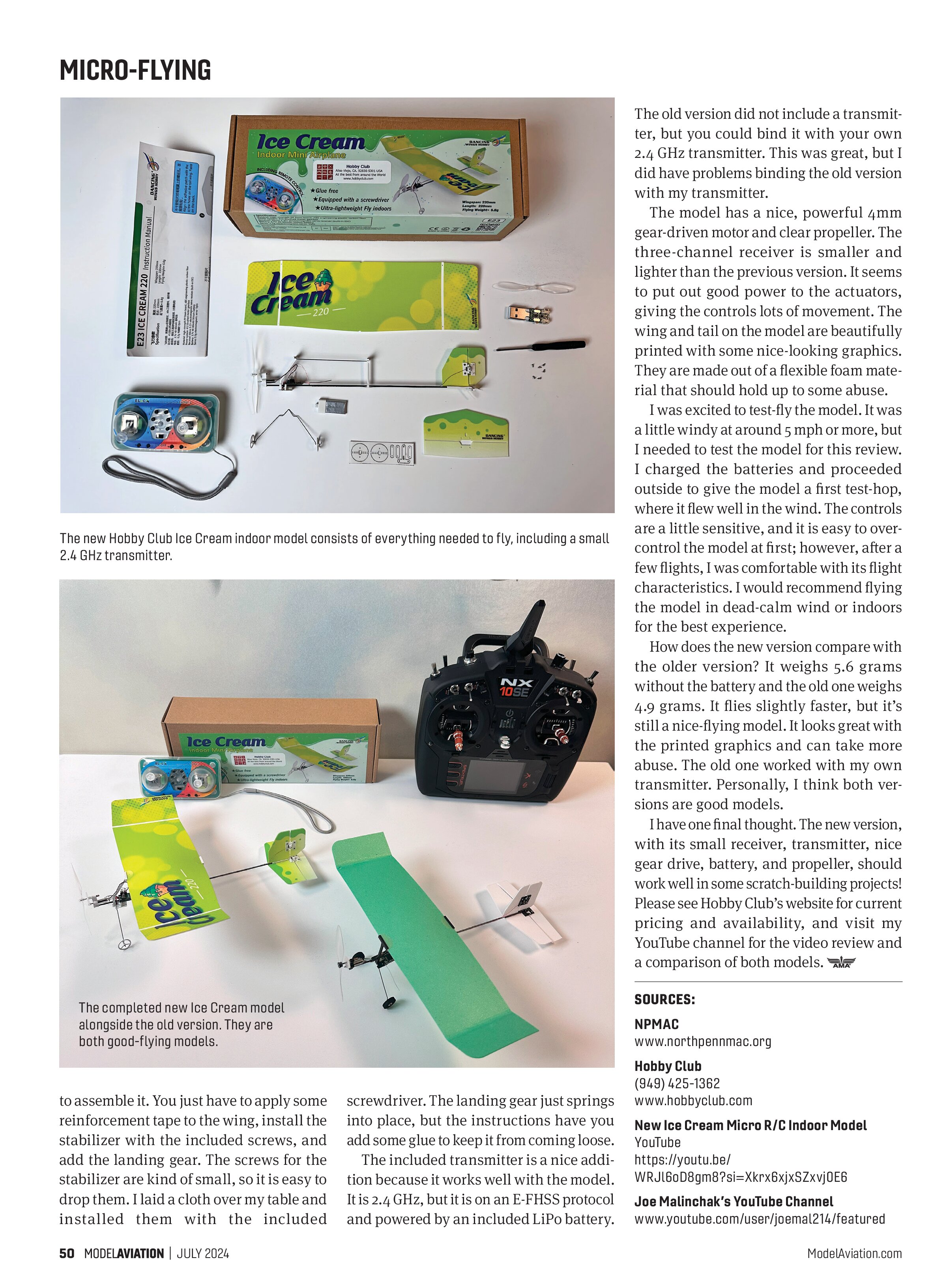
Hobby Club is distributing a new version of the popular Ice Cream indoor model airplane. It comes as an ARF with everything needed to fly the model, including a transmitter, 60 mAh LiPo battery, a charger, an extra propeller, landing gear, a printed foam wing and tail, instructions, and all of the parts needed to assemble the model. It only took me approximately 20 minutes
to assemble it. You just have to apply some reinforcement tape to the wing, install the stabilizer with the included screws, and add the landing gear. The screws for the stabilizer are kind of small, so it is easy to drop them. I laid a cloth over my table and installed them with the included screwdriver.

The landing gear just springs into place, but the instructions have you add some glue to keep it from coming loose. The included transmitter is a nice addition because it works well with the model. It is 2.4 GHz, but it is on an E-FHSS protocol and powered by an included LiPo battery.

The old version did not include a transmitter, but you could bind it with your own 2.4 GHz transmitter. This was great, but I did have problems binding the old version with my transmitter.
The model has a nice, powerful 4mm gear-driven motor and clear propeller. The three-channel receiver is smaller and lighter than the previous version. It seems to put out good power to the actuators, giving the controls lots of movement. The wing and tail on the model are beautifully printed with some nice-looking graphics. They are made out of a flexible foam material that should hold up to some abuse.
I was excited to test-fly the model. It was a little windy at around 5 mph or more, but I needed to test the model for this review. I charged the batteries and proceeded outside to give the model a first test-hop, where it flew well in the wind. The controls are a little sensitive, and it is easy to over-control the model at first; however, after a few flights, I was comfortable with its flight characteristics. I would recommend flying the model in dead-calm wind or indoors for the best experience.
How does the new version compare with the older version? It weighs 5.6 grams without the battery and the old one weighs 4.9 grams. It flies slightly faster, but it’s still a nice-flying model. It looks great with the printed graphics and can take more abuse. The old one worked with my own transmitter. Personally, I think both versions are good models.
I have one final thought. The new version, with its small receiver, transmitter, nice gear drive, battery, and propeller, should work well in some scratch-building projects! Please see Hobby Club’s website for current pricing and availability, and visit my YouTube channel for the video review and a comparison of both models.
SOURCES:
NPMAC
www.northpennmac.org
Hobby Club
(949) 425-1362
www.hobbyclub.com
New Ice Cream Micro R/C Indoor Model
YouTube
https://youtu.be/
WRJl6oD8gm8?si=Xkrx6xjxSZxvjOE6
Joe Malinchak’s YouTube Channel
www.youtube.com/user/joemal214/featured