FOCAL POINT
Interested in sharing your handiwork? Visit www.ModelAviation.com for submission guidelines.
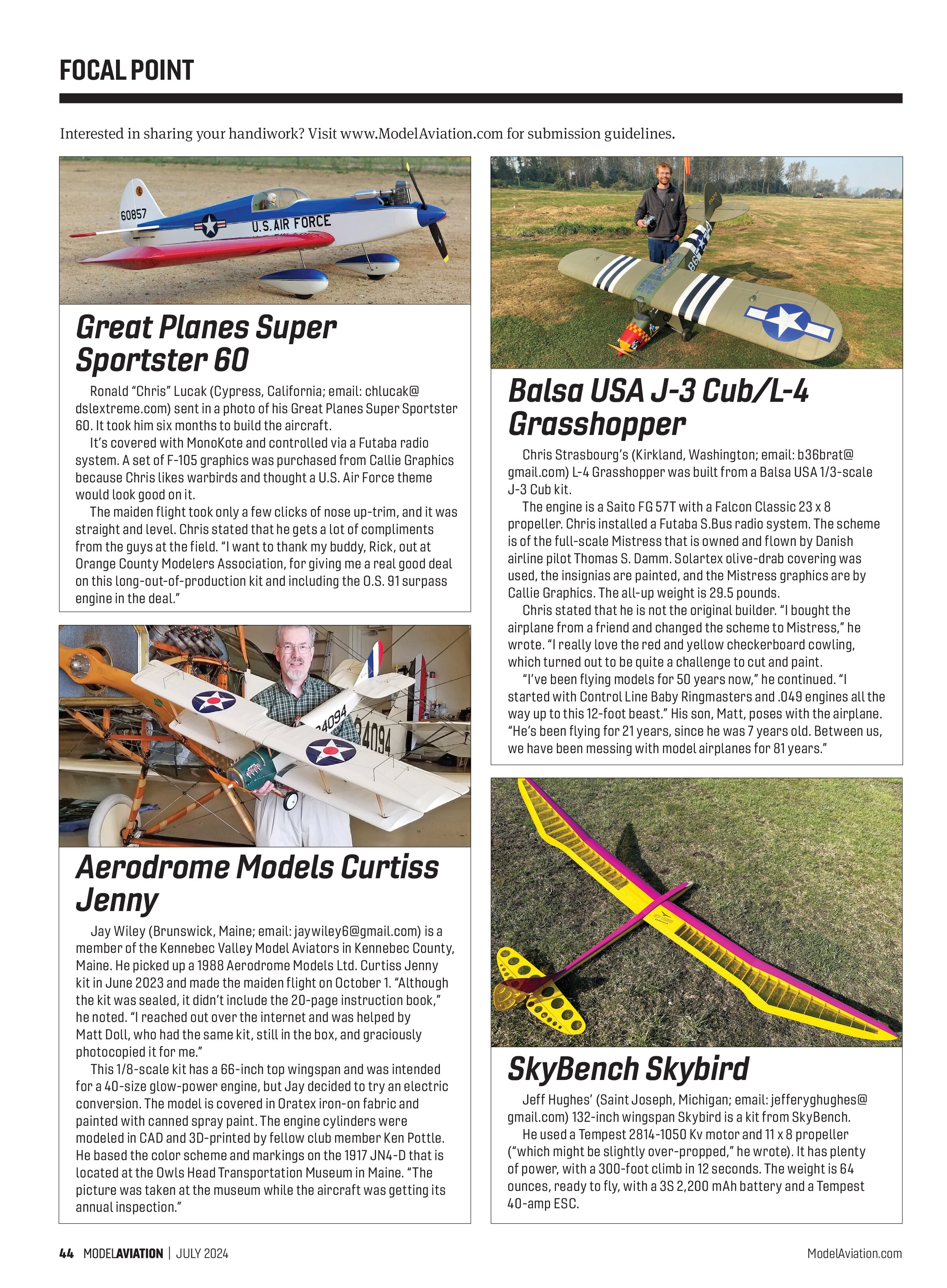
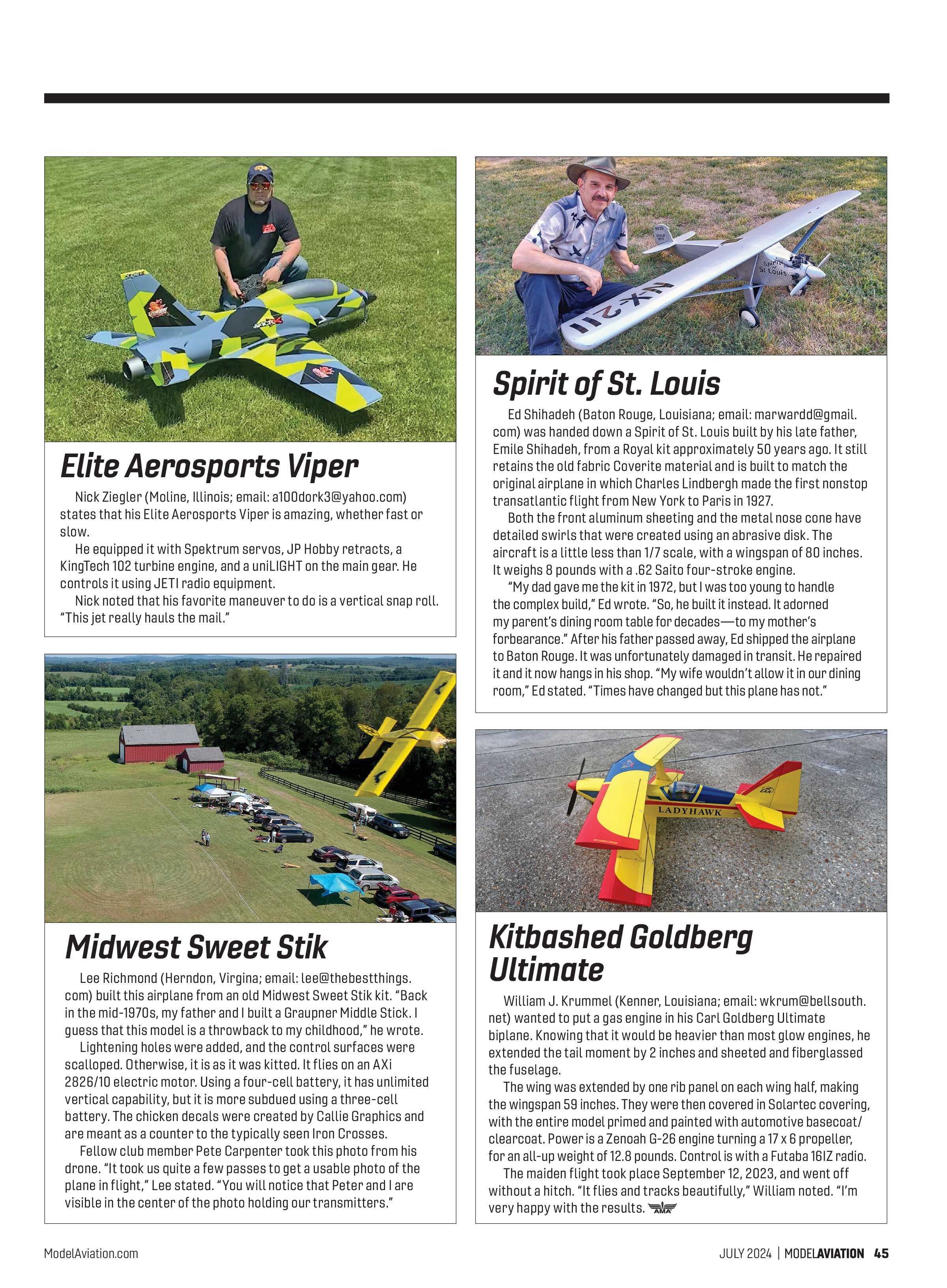
Great Planes Super Sportster 60

Ronald “Chris” Lucak (Cypress, California; email: chlucak@dslextreme.com) sent in a photo of his Great Planes Super Sportster 60. It took him six months to build the aircraft.
It’s covered with Monokote and controlled via a Futaba radio system. A set of F-105 graphics was purchased from Callie Graphics because Chris likes warbirds and thought a U.S. Air Force theme would look good on it.
The maiden flight took only a few clicks of nose up-trim, and it was straight and level. Chris stated that he gets a lot of compliments from the guys at the field. “I want to thank my buddy, Rick, out at Orange County Modelers Association, for giving me a real good deal on this long-out-of-production kit and including the O.S. 91 surpass engine in the deal.”
Aerodrome Models Curtiss Jenny

Jay Wiley (Brunswick, Maine; email: jaywiley6@gmail.com) is a member of the Kennebec Valley Model Aviators in Kennebec County, Maine. He picked up a 1988 Aerodrome Models Ltd. Curtiss Jenny kit in June 2023 and made the maiden flight on October 1. “Although the kit was sealed, it didn’t include the 20-page instruction book,” he noted. “I reached out over the internet and was helped by Matt Doll, who had the same kit, still in the box, and graciously photocopied it for me.”
This 1/8-scale kit has a 66-inch top wingspan and was intended for a 40-size glow-power engine, but Jay decided to try an electric conversion. The model is covered in Oratex iron-on fabric and painted with a canned spray paint. The engine cylinders were modeled in CAD and 3D-printed by fellow club member Ken Pottle. He based the color scheme and markings on the 1917 JN4-D that is located at the Owls Head Transportation Museum in Maine. “The picture was taken at the museum while the aircraft was getting its annual inspection.”
Balsa USA J-3 Cub/L-4 Grasshopper

Chris Strasbourg’s (Kirkland, Washington; email: b36brat@gmail.com) L-4 Grasshopper was built from a Balsa USA 1/3-scale J-3 Cub kit.
The engine is a Saito FG57T with a Falcon Classic 23 x 8 propeller. Chris installed a Futaba S.Bus radio system. The scheme is of the full-scale Mistress that is owned and flown by Danish airline pilot Thomas S. Damm. Solartex olive-drab covering was used, the insignias are painted, and the Mistress graphics are by Callie Graphics. The all-up weight is 29.5 pounds.
Chris stated that he is not the original builder. “I bought the airplane from a friend and changed the scheme to Mistress,” he wrote. “I really love the red and yellow checkerboard cowling, which turned out to be quite a challenge to cut and paint.
“I’ve been flying models for 50 years now,” he continued. “I started with Control Line Baby Ringmasters and .049 engines all the way up to this 12-foot beast.” His son, Matt, poses with the airplane. “He’s been flying for 21 years, since he was 7 years old. Between us, we have been messing with model airplanes for 81 years.”
SkyBench Skybird

Jeff Hughes’ (Saint Joseph, Michigan; email: jefferyhughes@gmail.com) 132-inch wingspan Skybird is a kit from SkyBench. He used a Tempest 2814-1050 Kv motor and 11 x 8 propeller (“which might be slightly over-propped,” he wrote). It has plenty of power, with a 300-foot climb in 12 seconds. The weight is 64 ounces, ready to fly, with a 3S 2,200 mAh battery and a Tempest 40-amp ESC.
Elite Aerosports Viper

Nick Ziegler (Moline, Illinois; email: a100dork3@yahoo.com) states that his Elite Aerosports Viper is amazing, whether fast or slow.
He equipped it with Spektrum servos, JP Hobby retracts, a KingTech 102 turbine engine, and a uniLIGHT on the main gear. He controls it using JETI radio equipment.
Nick noted that his favorite maneuver to do is a vertical snap roll. “This jet really hauls the mail.”
Midwest Sweet Stik

Lee Richmond (Herndon, Virginia; email: lee@thebestthings.com) built this airplane from an old Midwest Sweet Stik kit. “Back in the mid-1970s, my father and I built a Graupner Middle Stick. I guess that this model is a throwback to my childhood,” he wrote.
Lightening holes were added, and the control surfaces were scalloped. Otherwise, it is as it was kitted. It flies on an AXi 2826/10 electric motor. Using a four-cell battery, it has unlimited vertical capability, but it is more subdued using a three-cell battery. The chicken decals were created by Callie Graphics and are meant as a counter to the typically seen Iron Cross.
Fellow club member Pete Carpenter took this photo from his drone. “It took us quite a few passes to get a usable photo of the plane in flight,” Lee stated. “You will notice that Peter and I are visible in the center of the photo holding our transmitters.”
Spirit of St. Louis

Ed Shihadeh (Baton Rouge, Louisiana; email: marwardd@gmail.com) was handed down a Spirit of St. Louis built by his late father, Emile Shihadeh, from a Royal kit approximately 50 years ago. It still retains the old fabric Coverite material and is built to match the original airplane in which Charles Lindbergh made the first nonstop transatlantic flight from New York to Paris in 1927.
Both the front aluminum sheeting and the metal nose cone have detailed swirls that were created using an abrasive disk. The aircraft is a little less than 1/7 scale, with a wingspan of 80 inches. It weighs 8 pounds with a .62 Saito four-stroke engine.
“My dad gave me the kit in 1972, but I was too young to handle the complex build,” Ed wrote. “So, he built it instead. It adorned my parent’s dining room table for decades—to my mother’s forbearance.” After his father passed away, Ed shipped the airplane to Baton Rouge. It was unfortunately damaged in transit. He repaired it and it now hangs in his shop. “My wife wouldn’t allow it in our dining room,” Ed stated. “Times have changed but this plane has not.”
Kitbashed Goldberg Ultimate

William J. Krummel (Kenner, Louisiana; email: wkrum@bellsouth.net) wanted to put a gas engine in his Carl Goldberg Ultimate biplane. Knowing that it would be heavier than most glow engines, he extended the tail moment by 2 inches and sheeted and fiberglassed the fuselage.
The wing was extended by one rib panel on each wing half, making the wingspan 59 inches. They were then covered in Solartex covering, with the entire model primed and painted with automotive basecoat/clearcoat. Power is a Zenoah G-26 engine turning a 17 x 6 propeller, for an all-up weight of 12.8 pounds. Control is with a Futaba 16IZ radio.
The maiden flight took place September 12, 2023, and went off without a hitch. “It flies and tracks beautifully,” William noted. “I’m very happy with the results.”