Confidence at Your Fingertips
A Strategy to Promote Proficiency
By Dave Scott
1usrcfs@gmail.com

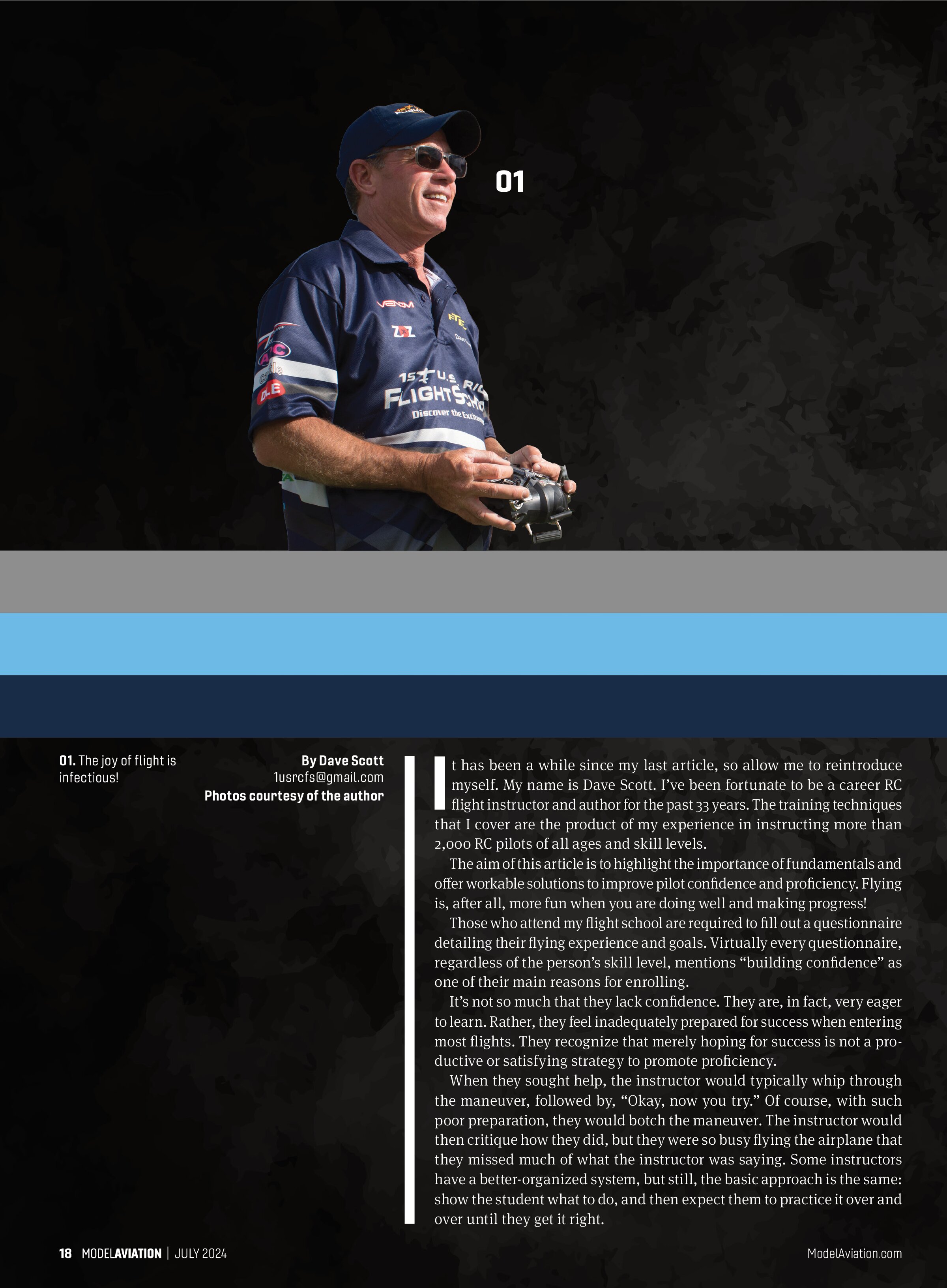
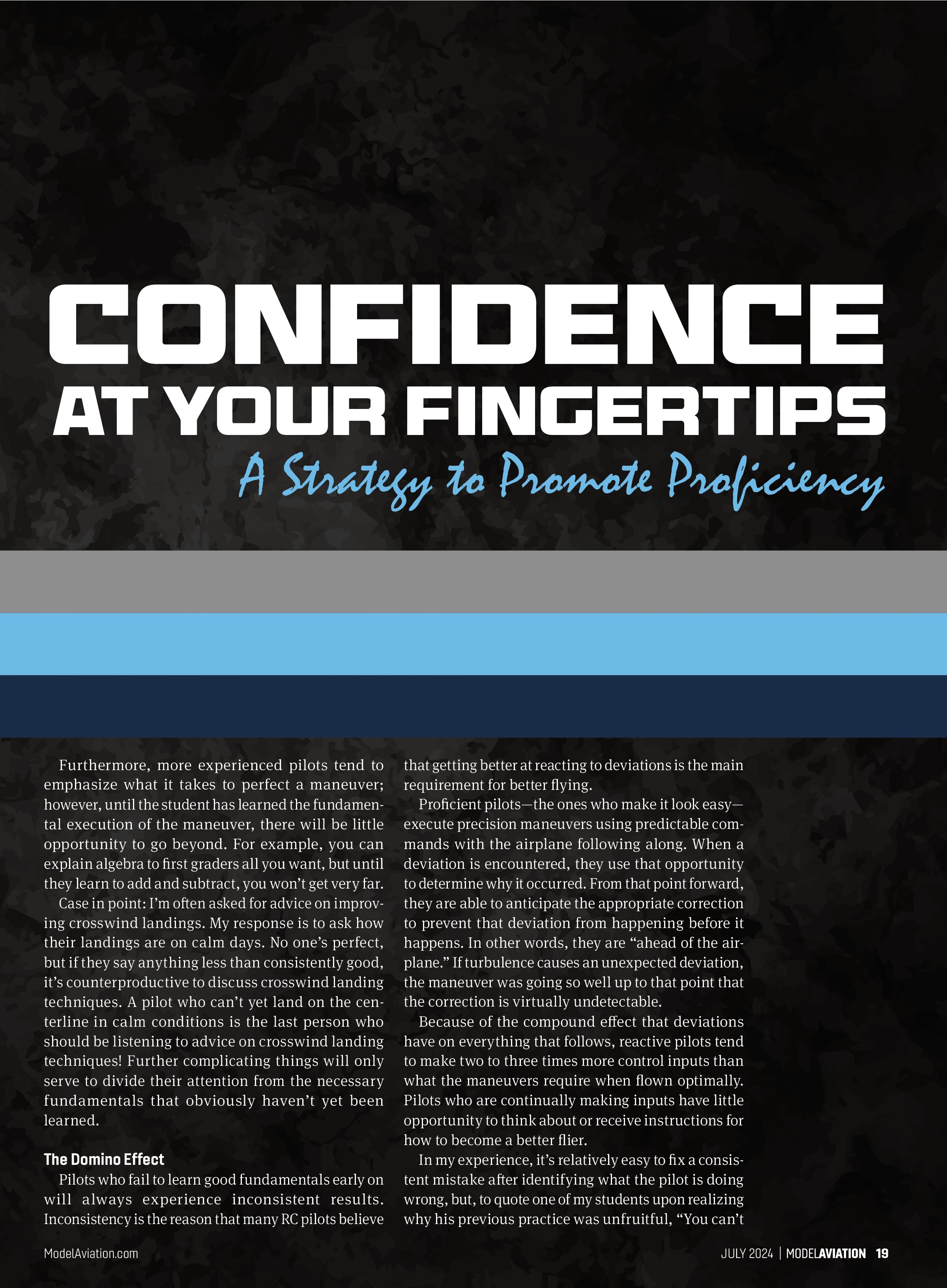
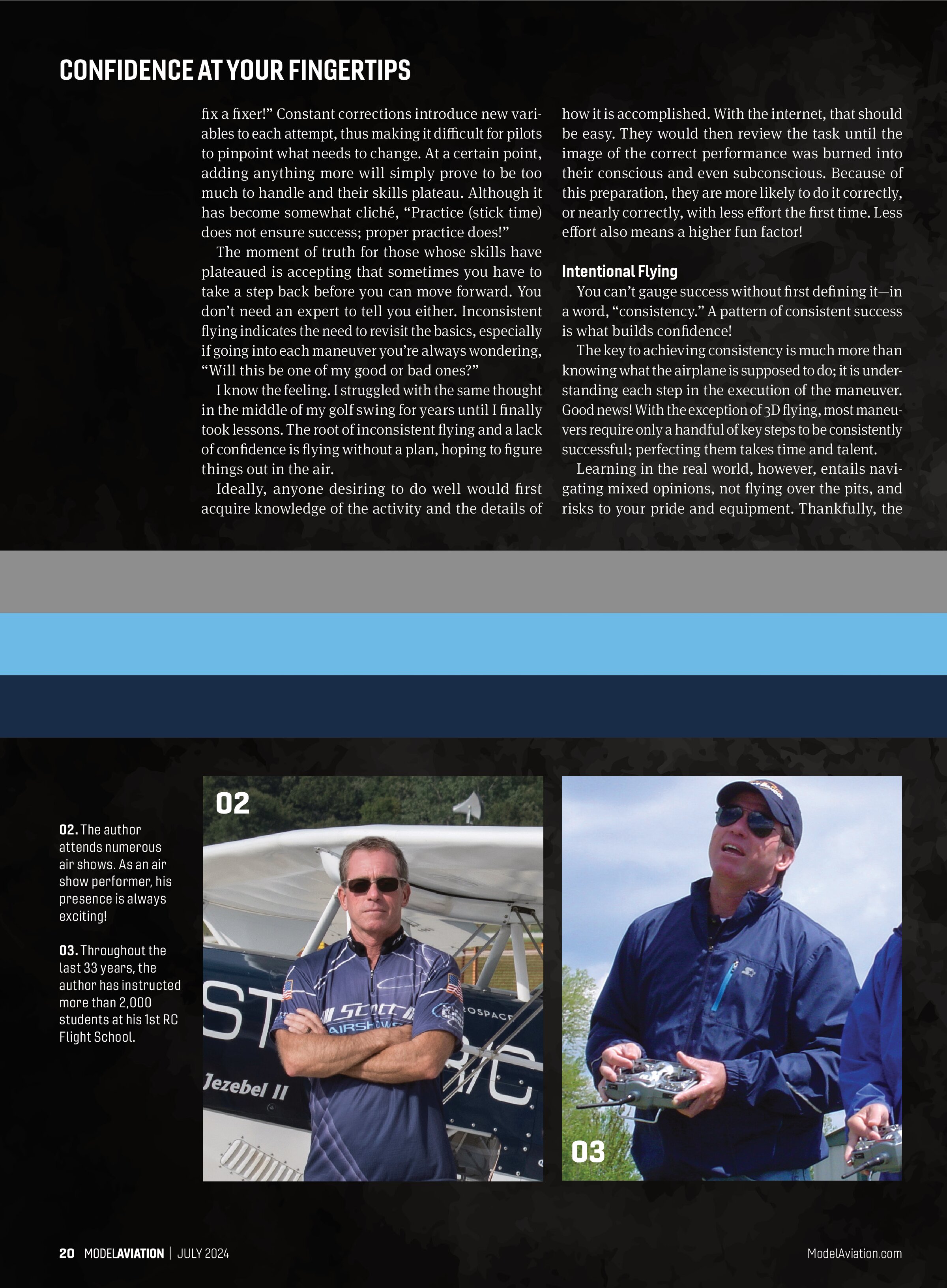
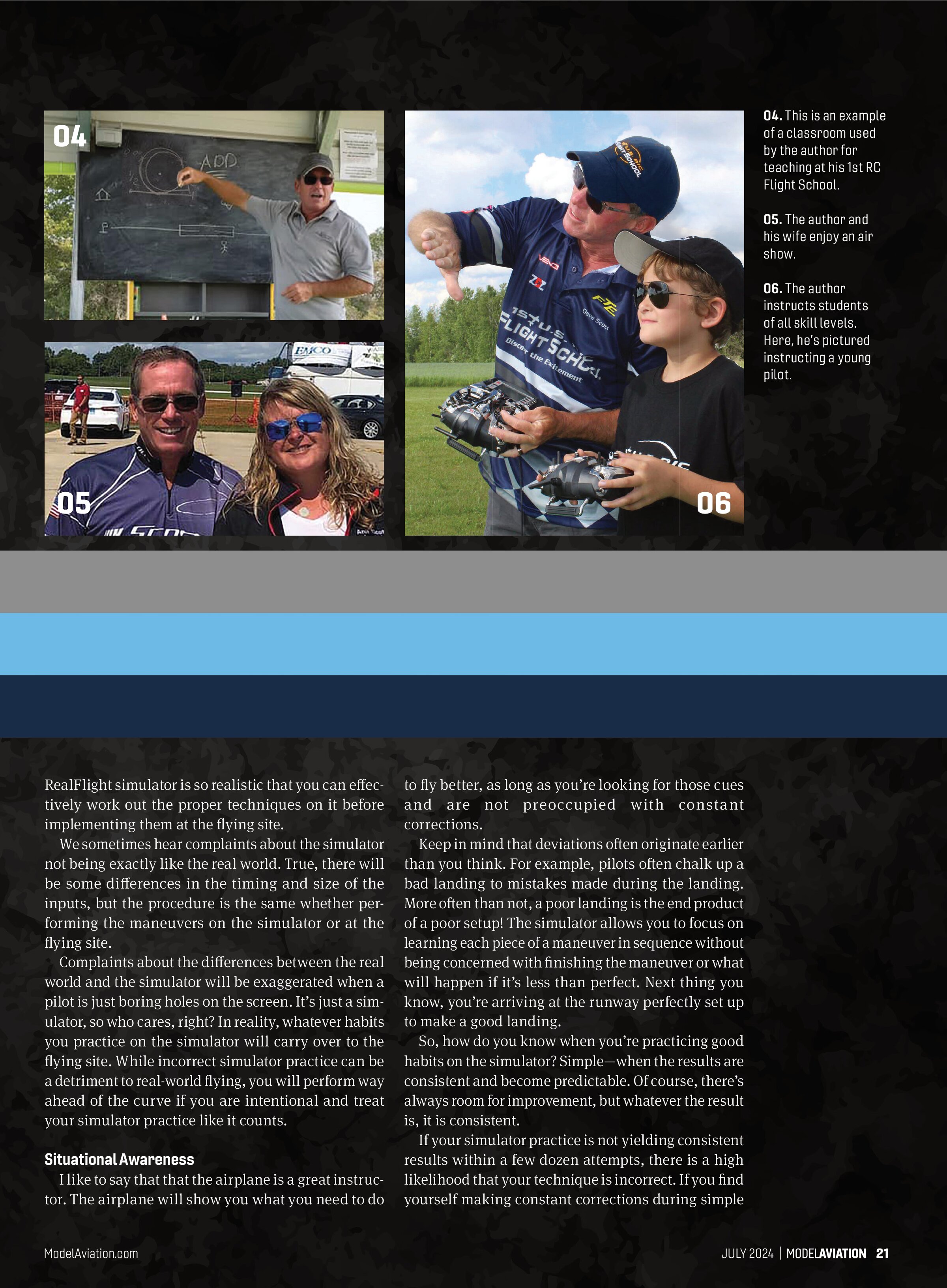
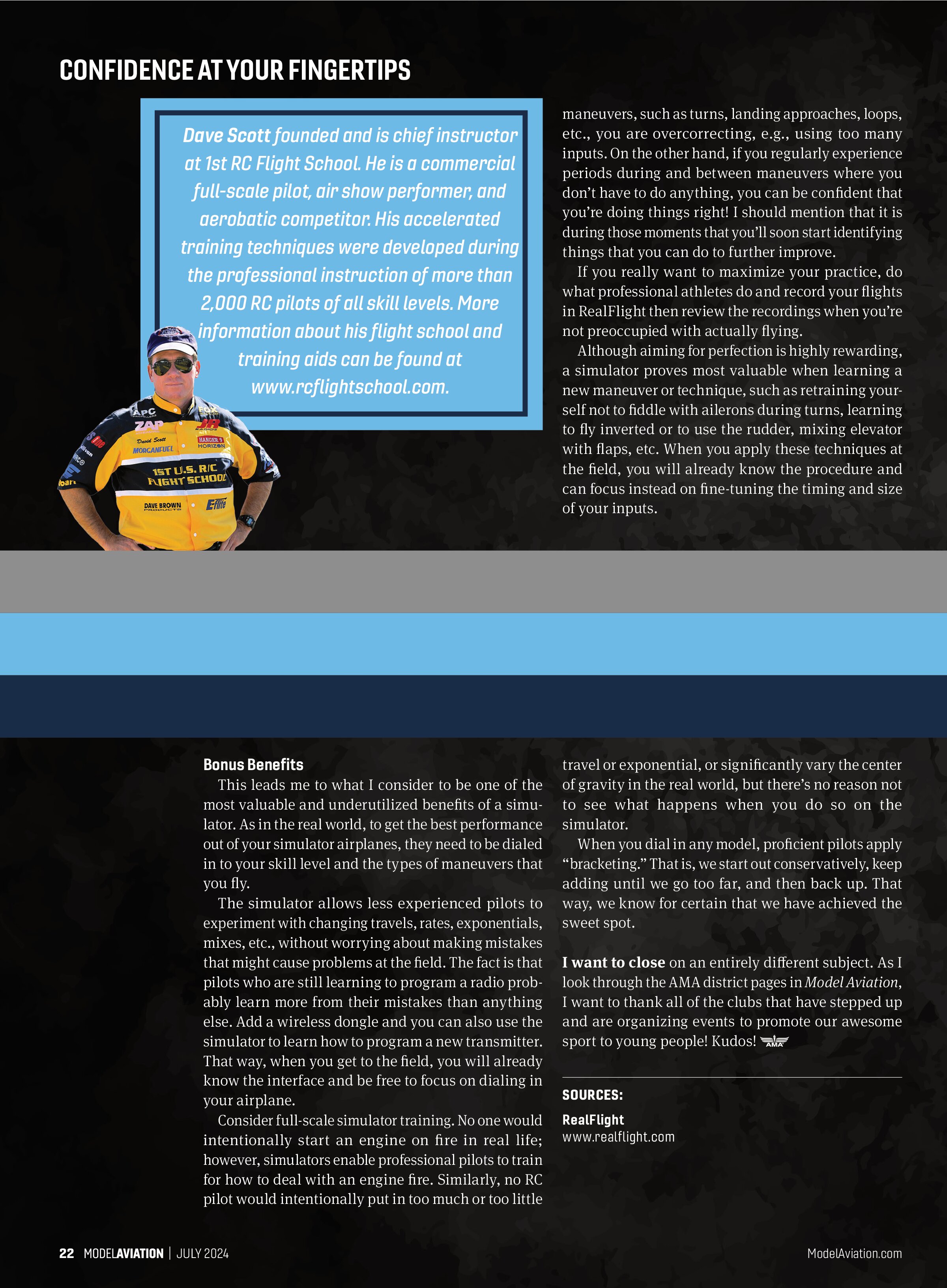
It has been a while since my last article, so allow me to reintroduce myself. My name is Dave Scott. I’ve been fortunate to be a career RC flight instructor and author for the past 33 years. The training techniques that I cover are the product of my experience in instructing more than 2,000 RC pilots of all ages and skill levels.
The aim of this article is to highlight the importance of fundamentals and offer workable solutions to improve pilot confidence and proficiency. Flying is, after all, more fun when you are doing well and making progress!
Those who attend my flight school are required to fill out a questionnaire detailing their flying experience and goals. Virtually every questionnaire, regardless of the person’s skill level, mentions “building confidence” as one of their main reasons for enrolling.
It’s not so much that they lack confidence. They are, in fact, very eager to learn. Rather, they feel inadequately prepared for success when entering most flights. They recognize that merely hoping for success is not a productive or satisfying strategy to promote proficiency.
When they sought help, the instructor would typically whip through the maneuver, followed by, “Okay, now you try.” Of course, with such poor preparation, they would botch the maneuver. The instructor would then critique how they did, but they were so busy flying the airplane that they missed much of what the instructor was saying. Some instructors have a better-organized system, but still, the basic approach is the same: show the student what to do, and then expect them to practice it over and over until they get it right.
Furthermore, more experienced pilots tend to emphasize what it takes to perfect a maneuver; however, until the student has learned the fundamental execution of the maneuver, there will be little opportunity to go beyond. For example, you can explain algebra to first graders all you want, but until they learn to add and subtract, you won’t get very far.
Case in point: I’m often asked for advice on improving crosswind landings. My response is to ask how their landings are on calm days. No one’s perfect, but if they say anything less than consistently good, it’s counterproductive to discuss crosswind landing techniques. A pilot who can’t yet land on the centerline in calm conditions is the last person who should be listening to advice on crosswind landing techniques! Further complicating things will only serve to divide their attention from the necessary fundamentals that obviously haven’t yet been learned.
The Domino Effect
Pilots who fail to learn good fundamentals early on will always experience inconsistent results. Inconsistency is the reason that many RC pilots believe that getting better at reacting to deviations is the main requirement for better flying.
Proficient pilots—the ones who make it look easy—execute precision maneuvers using predictable commands with the airplane following along. When a deviation is encountered, they use that opportunity to determine why it occurred. From that point forward, they are able to anticipate the appropriate correction to prevent that deviation from happening before it happens. In other words, they are “ahead of the airplane.” If turbulence causes an unexpected deviation, the maneuver was going so well up to that point that the correction is virtually undetectable.
Because of the compound effect that deviations have on everything that follows, reactive pilots tend to make two to three times more control inputs than what the maneuvers require when flown optimally. Pilots who are continually making inputs have little opportunity to think about or receive instructions for how to become a better flier.
In my experience, it’s relatively easy to fix a consistent mistake after identifying what the pilot is doing wrong, but, to quote one of my students upon realizing why his previous practice was unfruitful, “You can’t
fix a fixer?” Constant corrections introduce new variables to each attempt, thus making it difficult for pilots to pinpoint what needs to change. At a certain point, adding anything more will simply prove to be too much to handle and their skills plateau. Although it has become somewhat cliché, “Practice (stick time) does not ensure success; proper practice does!”
The moment of truth for those whose skills have plateaued is accepting that sometimes you have to take a step back before you can move forward. You don’t need an expert to tell you either. Inconsistent flying indicates the need to revisit the basics, especially if going into each maneuver you’re always wondering, “Will this be one of my good or bad ones?”
I know the feeling. I struggled with the same thought in the middle of my golf swing for years until I finally took lessons. The root of inconsistent flying and a lack of confidence is flying without a plan, hoping to figure things out in the air.
Ideally, anyone desiring to do well would first acquire knowledge of the activity and the details of how it is accomplished. With the internet, that should be easy. They would then review the task until the image of the correct performance was burned into their conscious and even subconscious. Because of this preparation, they are more likely to do it correctly, or nearly correctly, with less effort the first time. Less effort also means a higher fun factor!
Intentional Flying
You can’t gauge success without first defining it—in a word, “consistency.” A pattern of consistent success is what builds confidence!
The key to achieving consistency is much more than knowing what the airplane is supposed to do; it is understanding each step in the execution of the maneuver. Good news! With the exception of 3D flying, most maneuvers require only a handful of key steps to be consistently successful; perfecting them takes time and talent.
Learning in the real world, however, entails navigating mixed opinions, not flying over the pits, and risks to your pride and equipment. Thankfully, the


RealFlight simulator is so realistic that you can effectively work out the proper techniques on it before implementing them at the flying site.
We sometimes hear complaints about the simulator not being exactly like the real world. True, there will be some differences in the timing and size of the inputs, but the procedure is the same whether performing the maneuvers on the simulator or at the flying site.
Complaints about the differences between the real world and the simulator will be exaggerated when a pilot is just boring holes on the screen. It’s just a simulator, so who cares, right? In reality, whatever habits you practice on the simulator will carry over to the flying site. While incorrect simulator practice can be a detriment to real-world flying, you will perform way ahead of the curve if you are intentional and treat your simulator practice like it counts.
Situational Awareness
I like to say that that the airplane is a great instructor. The airplane will show you what you need to do to fly better, as long as you’re looking for those cues and are not preoccupied with constant corrections.
Keep in mind that deviations often originate earlier than you think. For example, pilots often chalk up a bad landing to mistakes made during the landing. More often than not, a poor landing is the end product of a poor setup! The simulator allows you to focus on learning each piece of a maneuver in sequence without being concerned with finishing the maneuver or what will happen if it’s less than perfect. Next thing you know, you’re arriving at the runway perfectly set up to make a good landing.
So, how do you know when you’re practicing good habits on the simulator? Simple—when the results are consistent and become predictable. Of course, there’s always room for improvement, but whatever the result is, it is consistent.
If your simulator practice is not yielding consistent results within a few dozen attempts, there is a high likelihood that your technique is incorrect. If you find yourself making constant corrections during simple

maneuvers, such as turns, landing approaches, loops, etc., you are overcorrecting, e.g., using too many inputs. On the other hand, if you regularly experience periods during and between maneuvers where you don’t have to do anything, you can be confident that you’re doing things right! I should mention that it is during those moments that you’ll soon start identifying things that you can do to further improve.
If you really want to maximize your practice, do what professional athletes do and record your flights in RealFlight then review the recordings when you’re not preoccupied with actually flying.
Although aiming for perfection is highly rewarding, a simulator proves most valuable when learning a new maneuver or technique, such as retraining yourself not to fiddle with ailerons during turns, learning to fly inverted or to use the rudder, mixing elevator with flaps, etc. When you apply these techniques at the field, you will already know the procedure and can focus instead on fine-tuning the timing and size of your inputs.
Bonus Benefits
This leads me to what I consider to be one of the most valuable and underutilized benefits of a simulator. As in the real world, to get the best performance out of your simulator airplanes, they need to be dialed in to your skill level and the types of maneuvers that you fly.
The simulator allows less experienced pilots to experiment with changing travels, rates, exponentials, mixes, etc., without worrying about making mistakes that might cause problems at the field. The fact is that pilots who are still learning to program a radio probably learn more from their mistakes than anything else. Add a wireless dongle and you can also use the simulator to learn how to program a new transmitter. That way, when you get to the field, you will already know the interface and be free to focus on dialing in your airplane.
Consider full-scale simulator training. No one would intentionally start an engine on fire in real life; however, simulators enable professional pilots to train for how to deal with an engine fire. Similarly, no RC pilot would intentionally put in too much or too little travel or exponential, or significantly vary the center of gravity in the real world, but there’s no reason not to see what happens when you do so on the simulator.
When you dial in any model, proficient pilots apply “bracketing.” That is, we start out conservatively, keep adding until we go too far, and then back up. That way, we know for certain that we have achieved the sweet spot.
I want to close on an entirely different subject. As I look through the AMA district pages in Model Aviation, I want to thank all of the clubs that have stepped up and are organizing events to promote our awesome sport to young people! Kudos! AMA
SOURCES:
RealFlight
www.realflight.com