AN ENTIRELY
DIFFERENT
KIND OF FLYING
ALTOGETHER!
By Patrick Sherman
lucidity@roswellflighttestcrew.com
EVEN REGULAR READERS can be forgiven for not realizing that my column is actually the “Advanced Flight Technologies” column. You don’t believe me? Look up there, in the corner of the page ...
It seems that I most often end up writing about safety—which is always an appropriate topic for discussion in aviation—or about teaching people how to fly. This column originated a decade ago when FPV flying and multirotor aircraft were still new and Model Aviation needed someone to explain it all.
Of course, these are familiar to nearly everyone by now, and while small UAS (sUAS) technology continues to develop apace, these days, progress is typically incremental—not groundbreaking—thus my shift away from the subject of technology, I suppose.
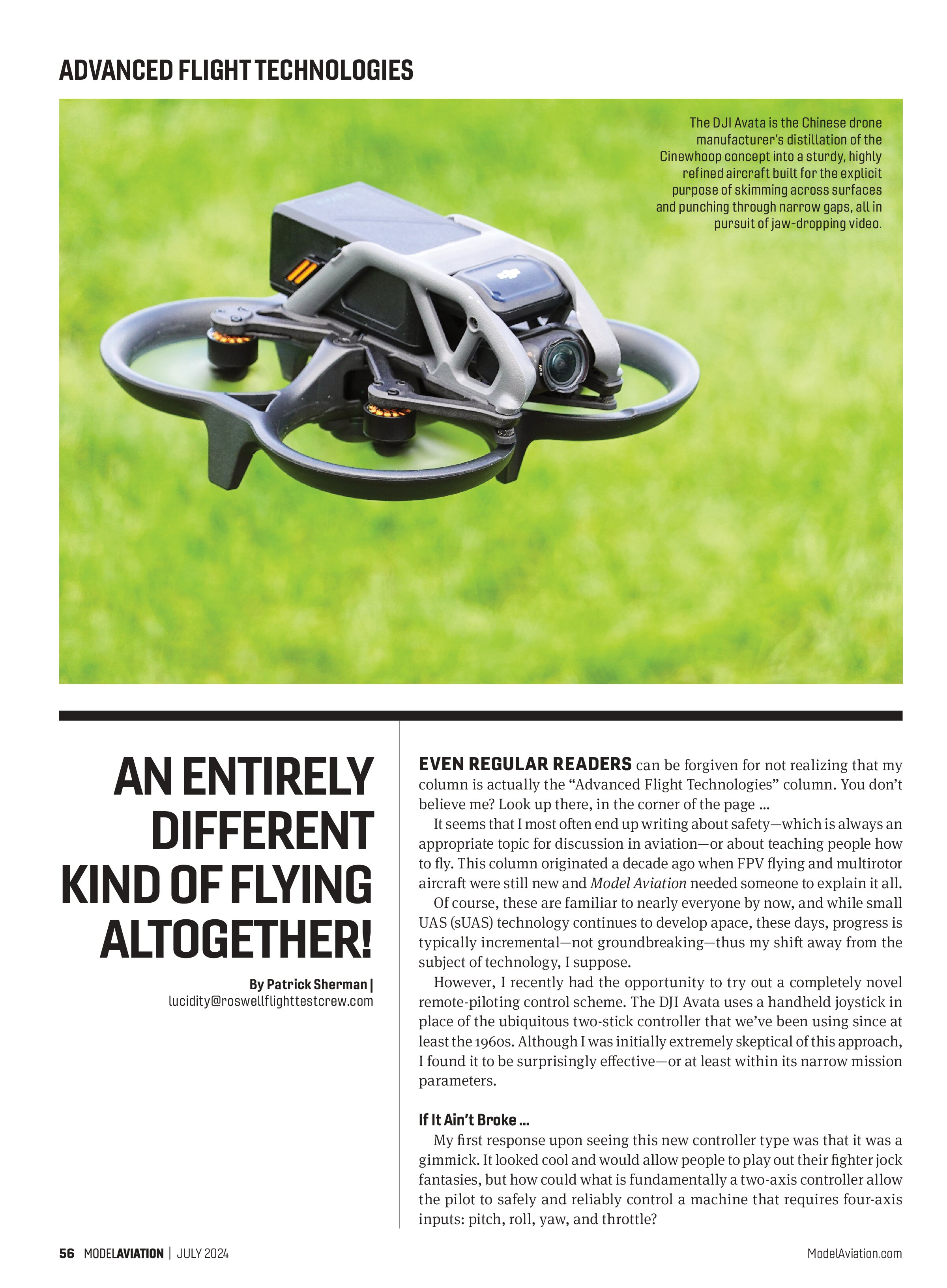
However, I recently had the opportunity to try out a completely novel remote-piloting control scheme. The DJI Avata uses a handheld joystick in place of the ubiquitous two-stick controller that we’ve been using since at least the 1960s. Although I was initially extremely skeptical of this approach, I found it to be surprisingly effective—or at least within its narrow mission parameters.
If It Ain’t Broke ...
My first response upon seeing this new controller type was that it was a gimmick. It looked cool and would allow people to play out their fighter jock fantasies, but how could what is fundamentally a two-axis controller allow the pilot to safely and reliably control a machine that requires four-axis inputs: pitch, roll, yaw, and throttle?
It turned out that my skepticism was entirely misplaced, at least when you are flying the Avata as DJI intended. This aircraft is essentially a highly refined—and very expensive—version of the Cinewhoop-type aircraft, which is itself a descent of the FPV racing drone (by way of the Tiny Whoop).
Of course, FPV racing drones are meant to be flown at warp speed, with the exclusive goal of being the first one across the finish line. It’s “like driving a hummingbird,” as one pilot memorably described the experience to me. However, more artistically inclined pilots discovered that they

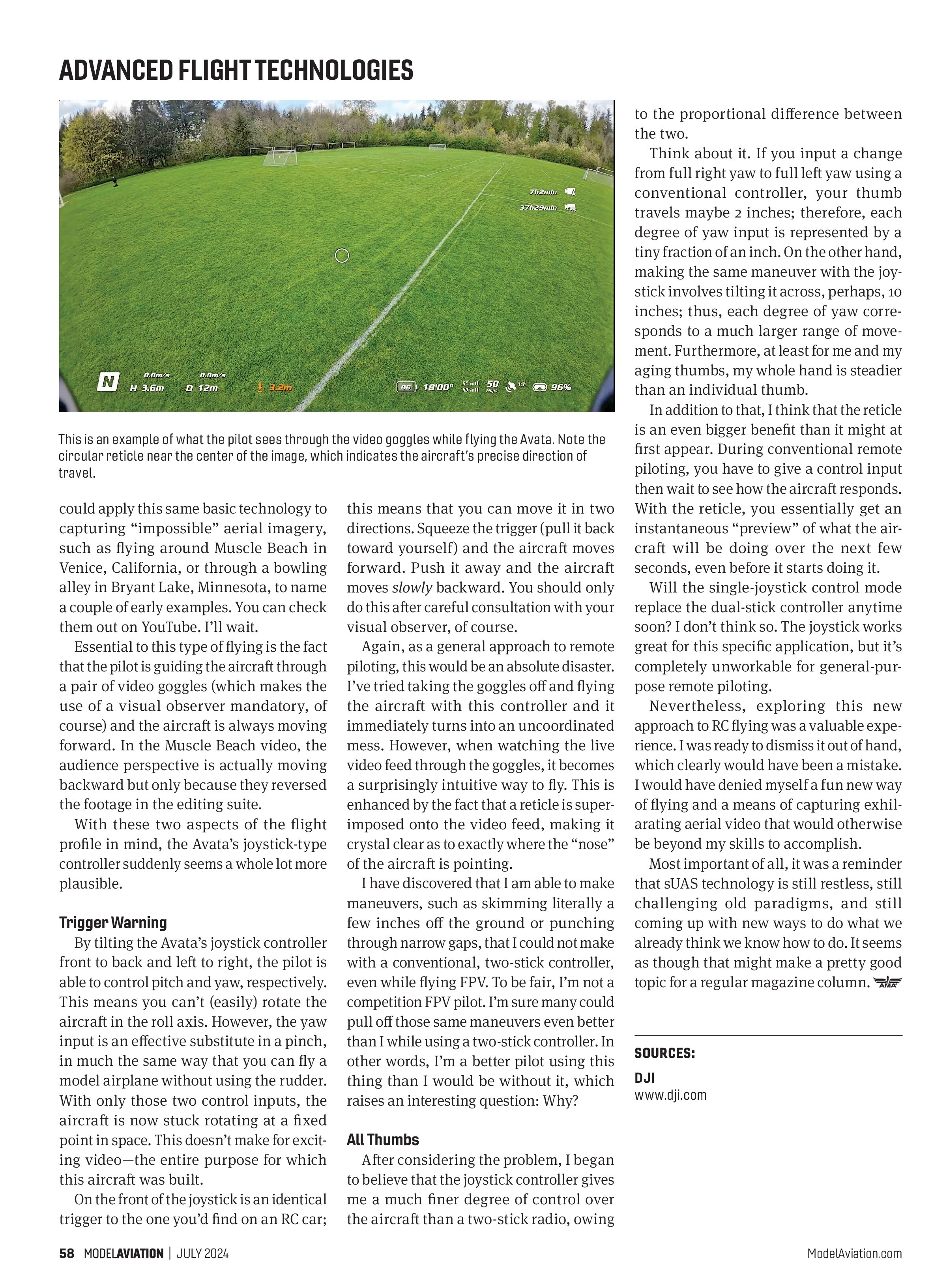
Using FPV goggles to fly means that you need to have an eagle-eyed visual observer to keep an eye on your aircraft and the surrounding airspace at all times—unless, of course, the aircraft is sitting on the hood of your car with its battery disconnected. Your visual observer can then turn around and take a picture of you looking like a world-class turbo nerd. Photo by James Galloway.
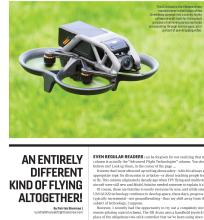
To control the Avata, a pilot relies on a single, handheld joystick that provides intuitive control of pitch and yaw inputs. The various buttons control other aircraft and camera functions, while the four-way hat switch provides direct control over the altitude and roll during takeoff, landing, and other conventional maneuvers.


could apply this same basic technology to capturing “impossible” aerial imagery, such as flying around Muscle Beach in Venice, California, or through a bowling alley in Bryant Lake, Minnesota, to name a couple of early examples. You can check them out on YouTube. I’ll wait.
Essential to this type of flying is the fact that the pilot is guiding the aircraft through a pair of video goggles (which makes the use of a visual observer mandatory, of course) and the aircraft is always moving forward. In the Muscle Beach video, the audience perspective is actually moving backward but only because they reversed the footage in the editing suite.
With these two aspects of the flight profile in mind, the Avata’s joystick-type controller suddenly seems a whole lot more plausible.
Trigger Warning
By tilting the Avata’s joystick controller front to back and left to right, the pilot is able to control pitch and yaw, respectively. This means you can’t (easily) rotate the aircraft in the roll axis. However, the yaw input is an effective substitute in a pinch, in much the same way that you can fly a model airplane without using the rudder. With only those two control inputs, the aircraft is now stuck rotating at a fixed point in space. This doesn’t make for exciting video—the entire purpose for which this aircraft was built.
On the front of the joystick is an identical trigger to the one you’d find on an RC car; this means that you can move it in two directions. Squeeze the trigger (pull it back toward yourself) and the aircraft moves forward. Push it away and the aircraft moves slowly backward. You should only do this after careful consultation with your visual observer, of course.
Again, as a general approach to remote piloting, this would be an absolute disaster. I’ve tried taking the goggles off and flying the aircraft with this controller and it immediately turns into an uncoordinated mess. However, when watching the live video feed through the goggles, it becomes a surprisingly intuitive way to fly. This is enhanced by the fact that a reticle is superimposed onto the video feed, making it crystal clear as to exactly where the “nose” of the aircraft is pointing.
I have discovered that I am able to make maneuvers, such as skimming literally a few inches off the ground or punching through narrow gaps, that I could not make with a conventional, two-stick controller, even while flying FPV. To be fair, I’m not a competition FPV pilot. I’m sure many could pull off those same maneuvers even better than I while using a two-stick controller. In other words, I’m a better pilot using this thing than I would be without it, which raises an interesting question: Why?
All Thumbs
After considering the problem, I began to believe that the joystick controller gives me a much finer degree of control over the aircraft than a two-stick radio, owing to the proportional difference between the two.
Think about it. If you input a change from full right yaw to full left yaw using a conventional controller, your thumb travels maybe 2 inches; therefore, each degree of yaw input is represented by a tiny fraction of an inch. On the other hand, making the same maneuver with the joystick involves tilting it across, perhaps, 10 inches; thus, each degree of yaw corresponds to a much larger range of movement. Furthermore, at least for me and my aging thumbs, my whole hand is steadier than an individual thumb.
In addition to that, I think that the reticle is an even bigger benefit than it might at first appear. During conventional remote piloting, you have to give a control input then wait to see how the aircraft responds. With the reticle, you essentially get an instantaneous “preview” of what the aircraft will be doing over the next few seconds, even before it starts doing it.
Will the single-joystick control mode replace the dual-stick controller anytime soon? I don’t think so. The joystick works great for this specific application, but it’s completely unworkable for general-purpose remote piloting.
Nevertheless, exploring this new approach to RC flying was a valuable experience. I was ready to dismiss it out of hand, which clearly would have been a mistake. I would have denied myself a fun new way of flying and a means of capturing exhilarating aerial video that would otherwise be beyond my skills to accomplish.
Most important of all, it was a reminder that sUAS technology is still restless, still challenging old paradigms, and still coming up with new ways to do what we already think we know how to do. It seems as though that might make a pretty good topic for a regular magazine column.
Sources:
DJI
www.dji.com