VESS BALANCE RING
Reduced vibration
means lower
airframe fatigue
By Eric Richardson
cxdriver@gmail.com
Photos provided by the author
and as noted
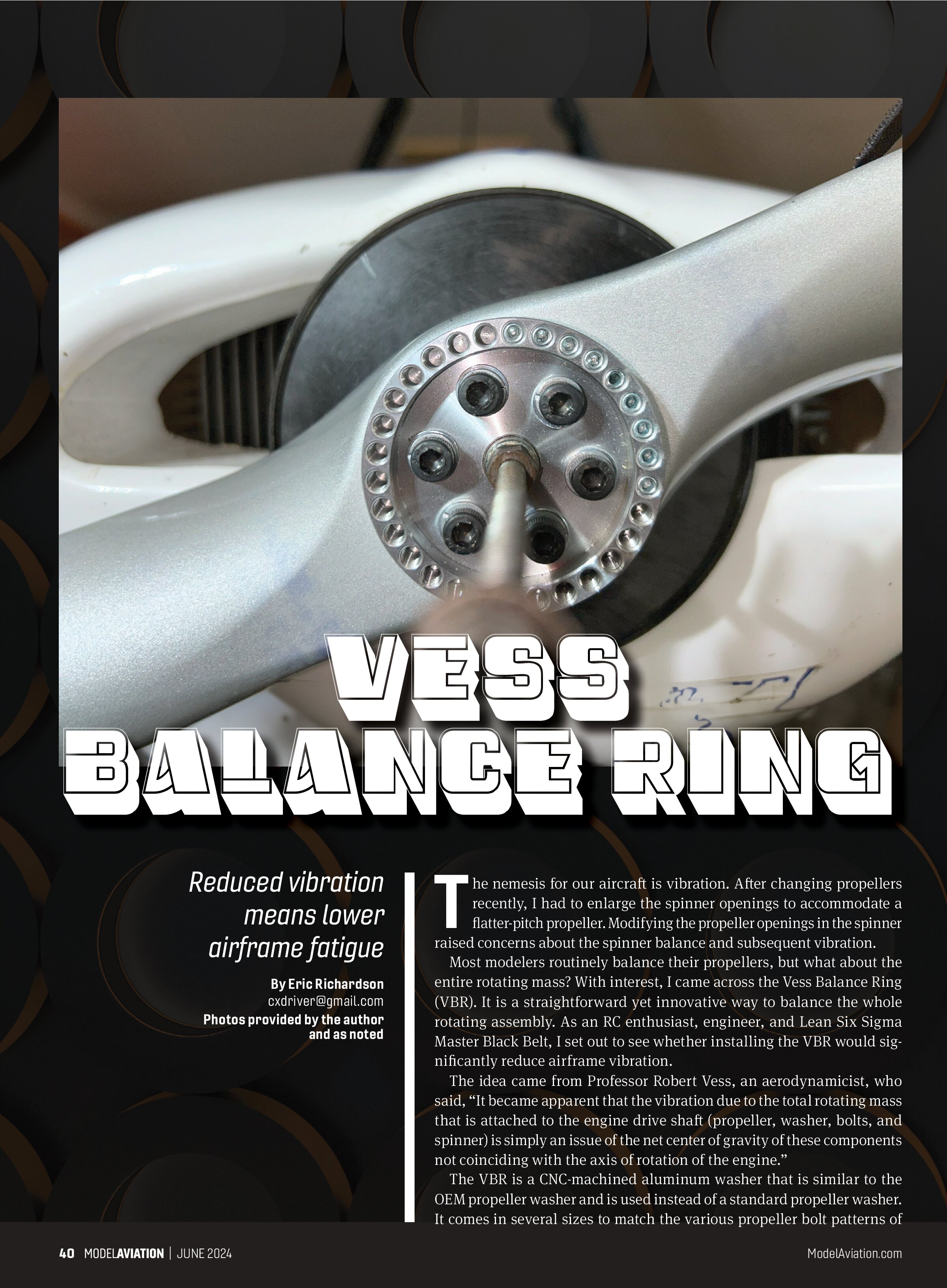
The nemesis for our aircraft is vibration. After changing propellers recently, I had to enlarge the spinner openings to accommodate a flatter-pitch propeller. Modifying the propeller openings in the spinner raised concerns about the spinner balance and subsequent vibration. Most modelers routinely balance their propellers, but what about the entire rotating mass? With interest, I came across the Vess Balance Ring (VBR). It is a straightforward yet innovative way to balance the whole rotating assembly. As an RC enthusiast, engineer, and Lean Six Sigma Master Black Belt, I set out to see whether installing the VBR would significantly reduce airframe vibration.
The idea came from Professor Robert Vess, an aerodynamicist, who said, “It became apparent that the vibration due to the total rotating mass that is attached to the engine drive shaft (propeller, washer, bolts, and spinner) is simply an issue of the net center of gravity of these components not coinciding with the axis of rotation of the engine.”
The VBR is a CNC-machined aluminum washer that is similar to the OEM propeller washer and is used instead of a standard propeller washer. It comes in several sizes to match the various propeller bolt patterns of different engines. The VBR fits engines from 50cc to 170cc in size.
Before, with only the propeller balanced, vibration data was taken at idle and 50% power. Not having access to a vibrometer, I found a free smartphone app vibration meter, Seismograph by ExaMobile S.A., that is designed to measure seismic events. It measures acceleration in the X, Y, and Z axes in meters/seconds. In aircraft terms, these axes correspond to the longitudinal, lateral, and yaw axes, respectively.
Test Airframes
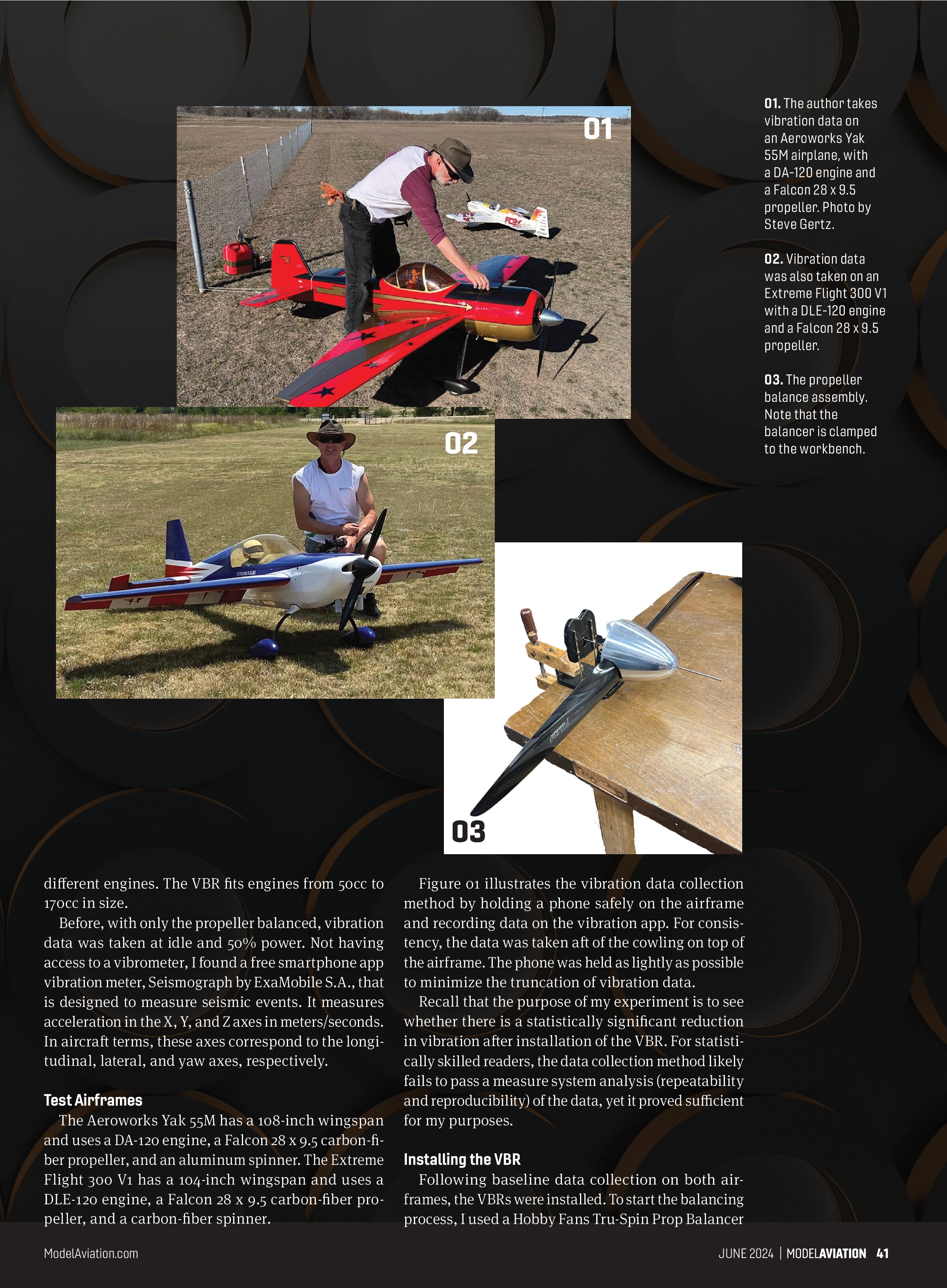
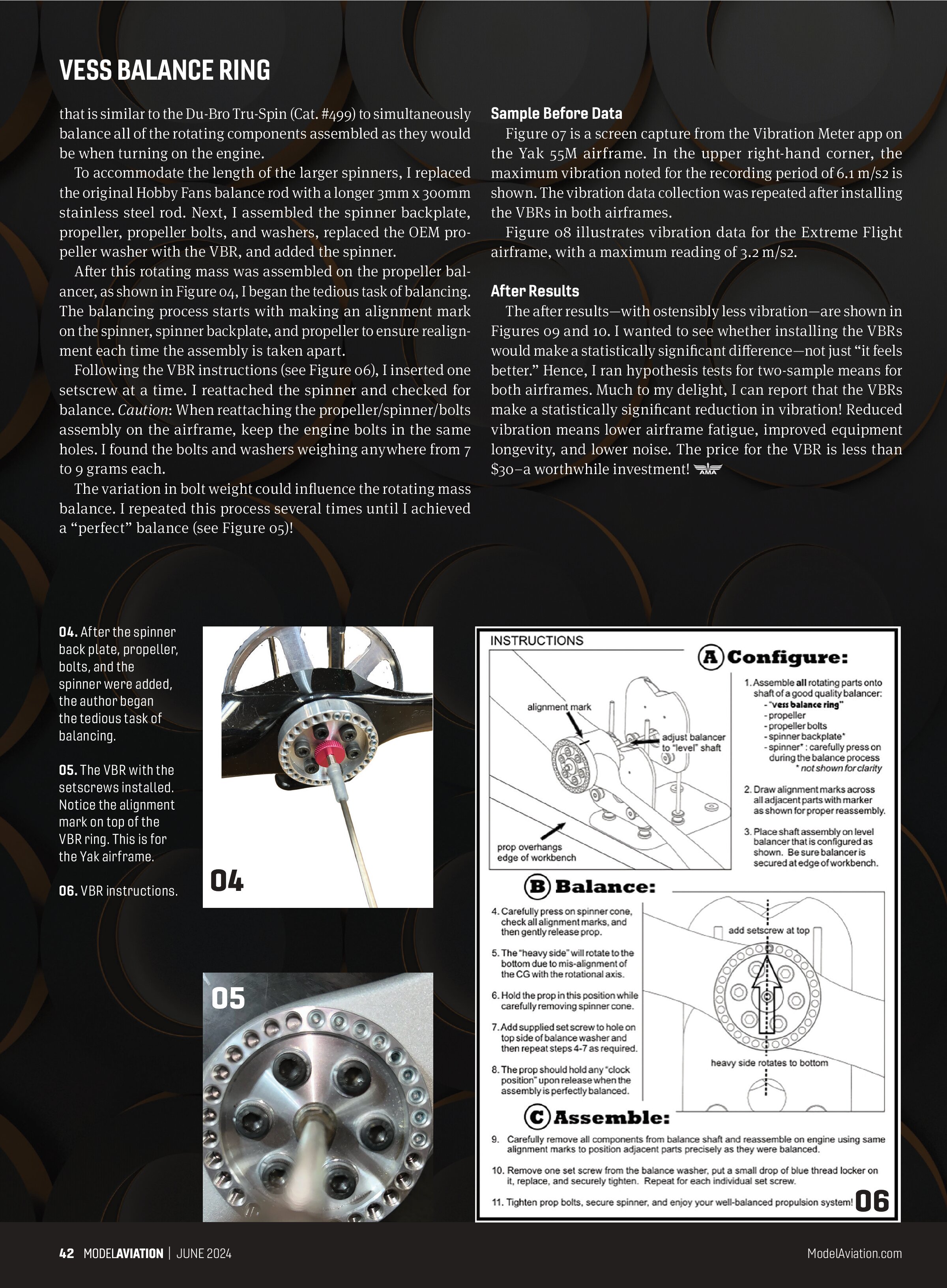
The Aeroworks Yak 55M has a 108-inch wingspan and uses a DA-120 engine, a Falcon 28 x 9.5 carbon-fiber propeller, and an aluminum spinner. The Extreme Flight 300 V1 has a 104-inch wingspan and uses a DLE-120 engine, a Falcon 28 x 9.5 carbon-fiber propeller, and a carbon-fiber spinner.


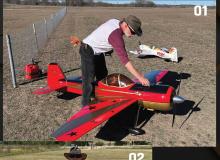
Figure 01 illustrates the vibration data collection method by holding a phone safely on the airframe and recording data on the vibration app. For consistency, the data was taken aft of the cowling on top of the airframe. The phone was held as lightly as possible to minimize the truncation of vibration data.
Recall that the purpose of my experiment is to see whether there is a statistically significant reduction in vibration after installation of the VBR. For statistically skilled readers, the data collection method likely fails to pass a measure system analysis (repeatability and reproducibility) of the data, yet it proved sufficient for my purposes.
Installing the VBR
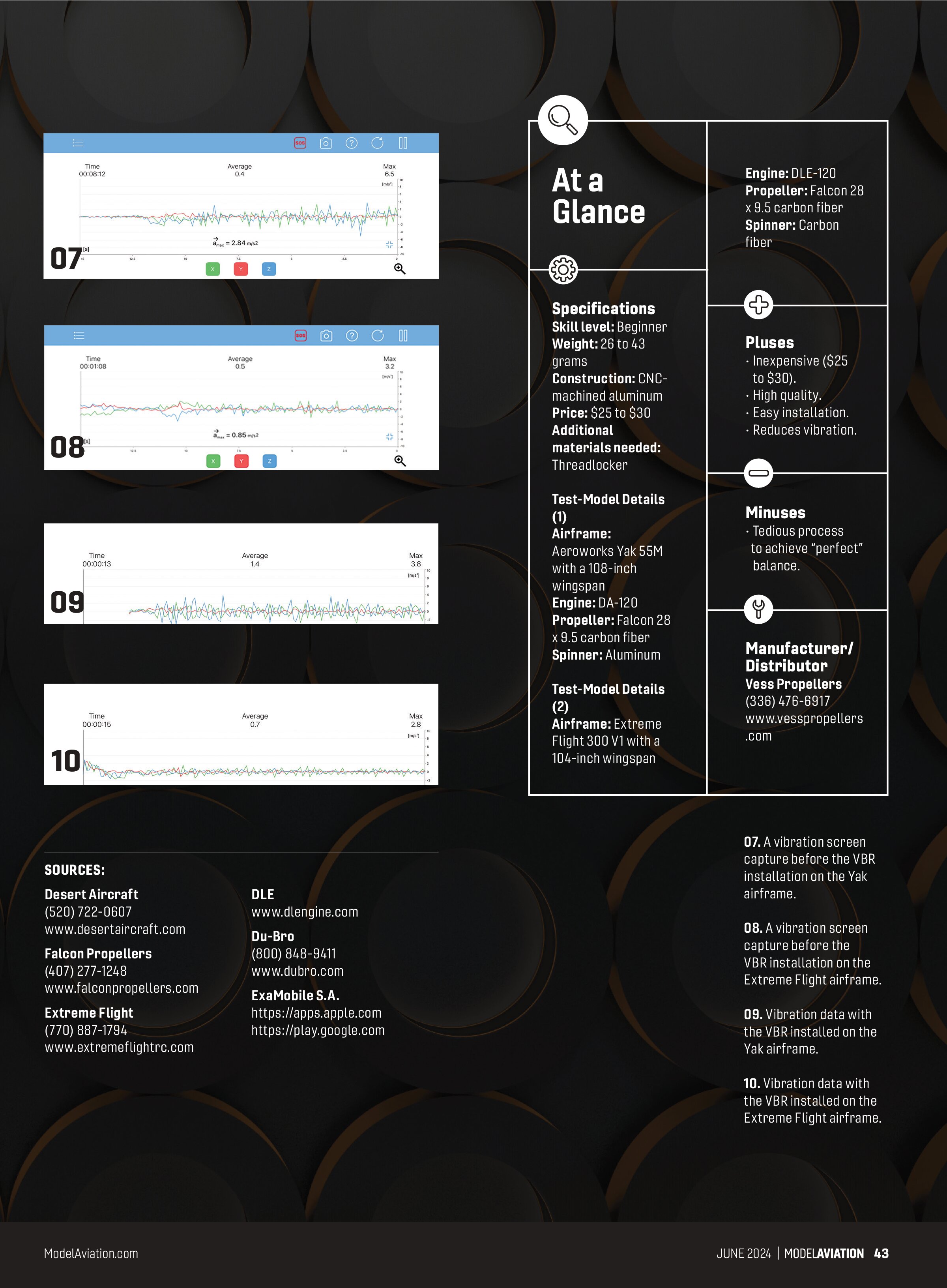
Following baseline data collection on both airframes, the VBRs were installed. To start the balancing process, I used a Hobby Fans Tru-Spin Prop Balancer
that is similar to the Du-Bro Tru-Spin (Cat. #499) to simultaneously balance all of the rotating components assembled as they would be when turning on the engine.
To accommodate the length of the larger spinners, I replaced the original Hobby Fans balance rod with a longer 3mm x 300mm stainless steel rod. Next, I assembled the spinner backplate, propeller, propeller bolts, and washers, replaced the OEM propeller washer with the VBR, and added the spinner.
After this rotating mass was assembled on the propeller balancer, as shown in Figure 04, I began the tedious task of balancing. The balancing process starts with making an alignment mark on the spinner, spinner backplate, and propeller to ensure realignment each time the assembly is taken apart.

Following the VBR instructions (see Figure 06), I inserted one setscrew at a time. I reattached the spinner and checked for balance. Caution: When reattaching the propeller/spinner/bolts assembly on the airframe, keep the engine bolts in the same holes. I found the bolts and washers weighing anywhere from 7 to 9 grams each.


The variation in bolt weight could influence the rotating mass balance. I repeated this process several times until I achieved a “perfect” balance (see Figure 05)!
Sample Before Data
Figure 07 is a screen capture from the Vibration Meter app on the Yak 55M airframe. In the upper right-hand corner, the maximum vibration noted for the recording period of 6.1 m/s2 is shown. The vibration data collection was repeated after installing the VBRs in both airframes.

Figure 08 illustrates vibration data for the Extreme Flight airframe, with a maximum reading of 3.2 m/s2.

After Results
The after results—with ostensibly less vibration—are shown in Figures 09 and 10. I wanted to see whether installing the VBRs would make a statistically significant difference—not just “it feels better.” Hence, I ran hypothesis tests for two-sample means for both airframes. Much to my delight, I can report that the VBRs make a statistically significant reduction in vibration! Reduced vibration means lower airframe fatigue, improved equipment longevity, and lower noise. The price for the VBR is less than $30—a worthwhile investment!


At a Glance
Engine: DLE-120
Propeller: Falcon 28 x 9.5 carbon fiber
Spinner: Carbon fiber
Specifications
Skill level: Beginner
Weight: 26 to 43 grams
Construction: CNC-machined aluminum
Price: $25 to $30
Additional materials needed: Threadlocker
Test-Model Details (1)
Airframe: Aeroworks Yak 55M with a 108-inch wingspan
Engine: DA-120
Propeller: Falcon 28 x 9.5 carbon fiber
Spinner: Aluminum
Test-Model Details (2)
Airframe: Extreme Flight 300 V1 with a 104-inch wingspan
Pluses
- Inexpensive ($25 to $30).
- High quality.
- Easy installation.
- Reduces vibration.
Minuses
- Tedious process to achieve “perfect” balance.
Manufacturer/Distributor
Vess Propellers
(336) 476-6917
www.vesspropellers.com
Sources:
Desert Aircraft
(520) 722-0607
www.desertaircraft.com
Falcon Propellers
(407) 277-1248
www.falconpropellers.com
Extreme Flight
(770) 887-1794
www.extremeflightrc.com
DLE
www.dlengine.com
Du-Bro
(800) 848-9411
www.dubro.com
ExaMobile S.A.
https://apps.apple.com
https://play.google.com