PROGRAMMABLE MIXES
By John Glezellis | jglezellis@gmail.com
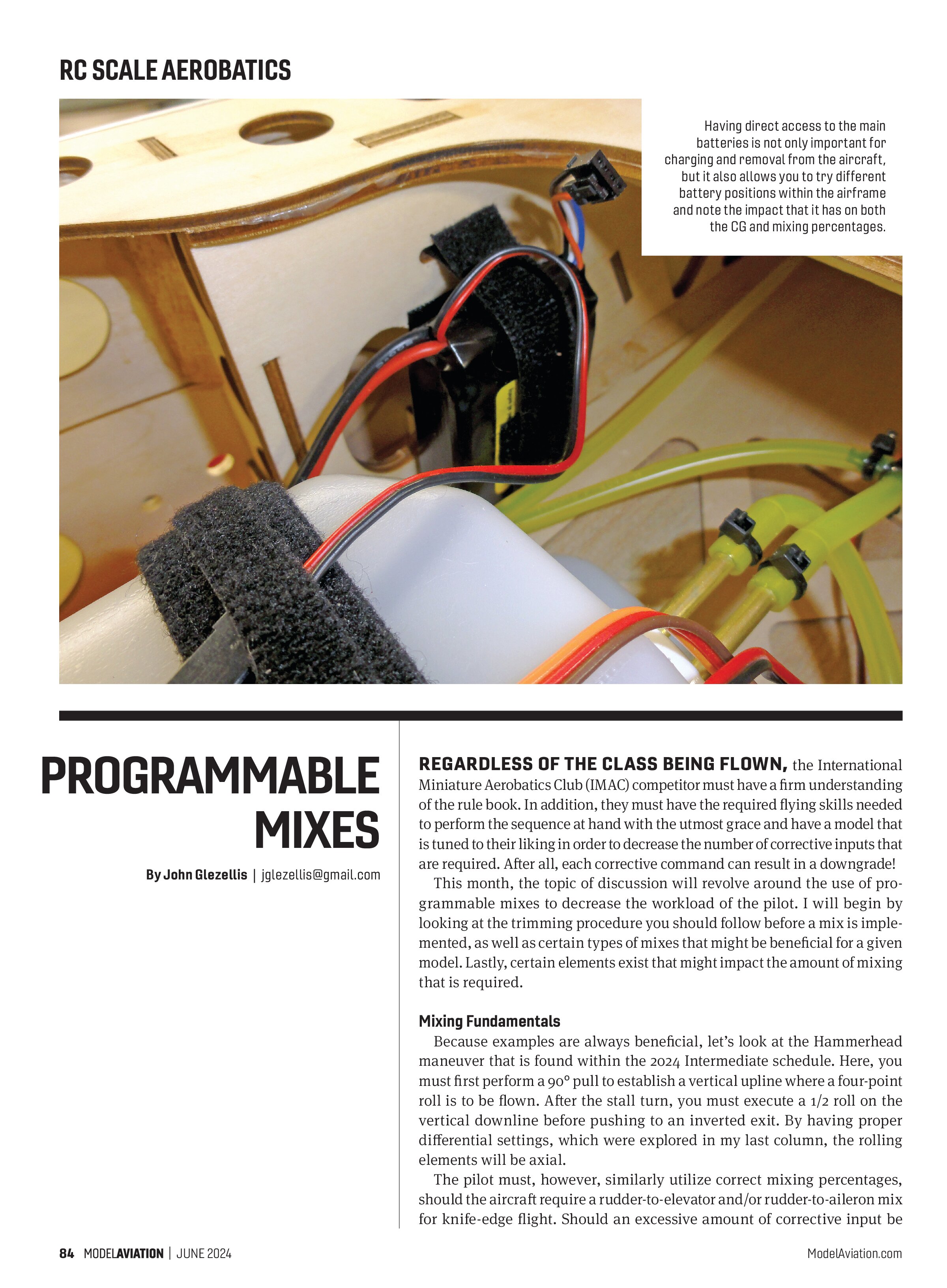
Having direct access to the main batteries is not only important for charging and removal from the aircraft, but it also allows you to try different battery positions within the airframe and note the impact that it has on both the CG and mixing percentages.
REGARDLESS OF THE CLASS BEING FLOWN, the International Miniature Aerobatics Club (IMAC) competitor must have a firm understanding of the rule book. In addition, they must have the required flying skills needed to perform the sequence at hand with the utmost grace and have a model that is tuned to their liking in order to decrease the number of corrective inputs that are required. After all, each corrective command can result in a downgrade!
This month, the topic of discussion will revolve around the use of programmable mixes to decrease the workload of the pilot. I will begin by looking at the trimming procedure you should follow before a mix is implemented, as well as certain types of mixes that might be beneficial for a given model. Lastly, certain elements exist that might impact the amount of mixing that is required.
Mixing Fundamentals
Because examples are always beneficial, let’s look at the Hammerhead maneuver that is found within the 2024 Intermediate schedule. Here, you must first perform a 90° pull to establish a vertical upline where a four-point roll is to be flown. After the stall turn, you must execute a 1/2 roll on the vertical downline before pushing to an inverted exit. By having proper differential settings, which were explored in my last column, the rolling elements will be axial.
The pilot must, however, similarly utilize correct mixing percentages, should the aircraft require a rudder-to-elevator and/or rudder-to-aileron mix for knife-edge flight. Should an excessive amount of corrective input be present when full rudder deflection is given for the stall turn, or even while rudder commands are given to keep the heading during the vertical segment, the aircraft might exhibit an undesired pitching and/or rolling tendency. As we saw earlier, visible corrective commands will result in points lost.
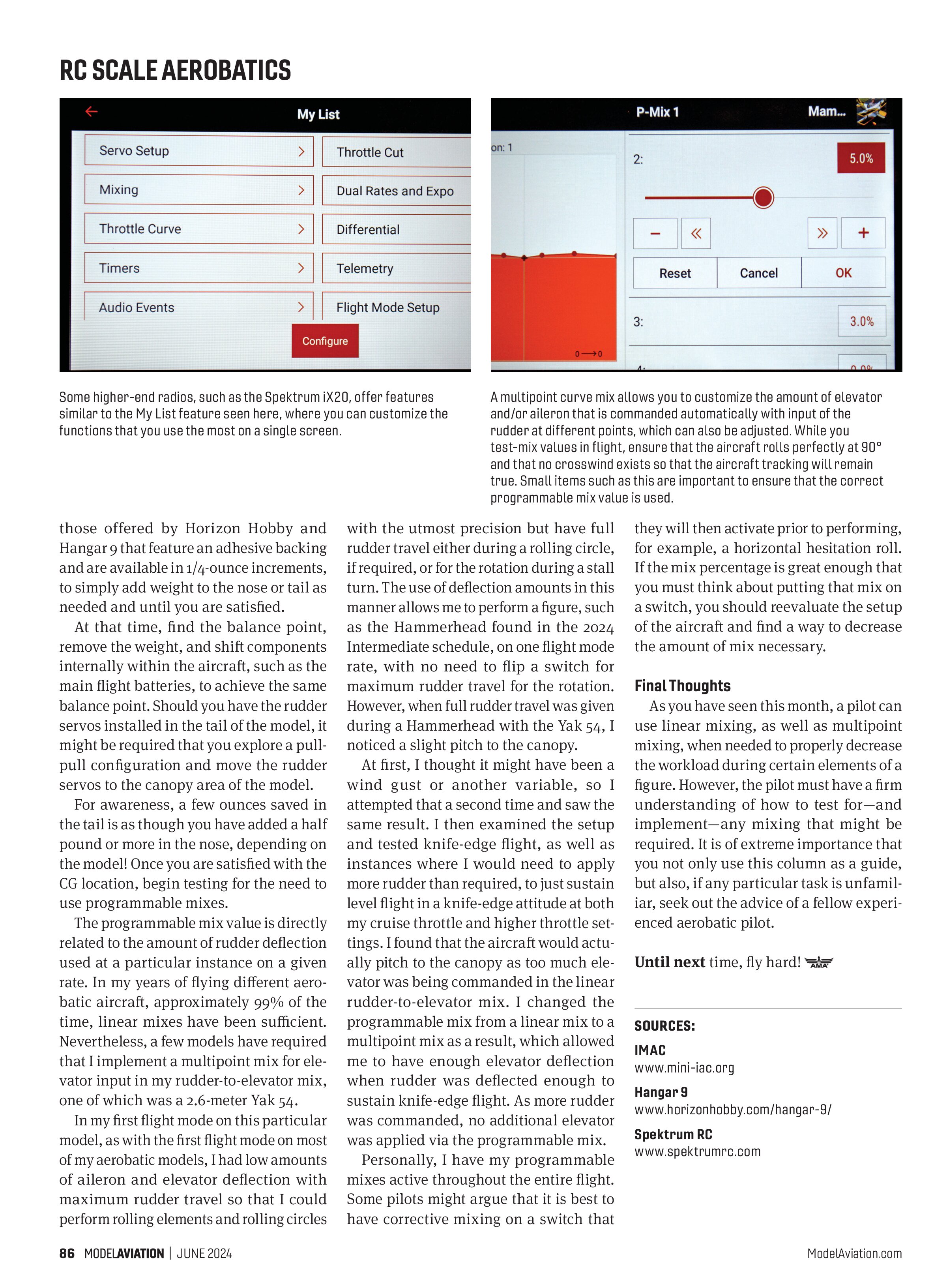
Most aerobatic airplanes require some form of mixing to correct unwanted tendencies from the aircraft. Typical mixes include rudder-to-elevator and rudder-to-aileron, so corrective elevator and aileron input is applied automatically by the radio when the pilot commands only rudder input. Common mix types are a linear mix or a multipoint curve mix. A linear mix will allow for a fixed maximum amount, but a curve mix will allow you to adjust the amount of mix from point to point over the full range of movement for a given control surface.
Numerous variables contribute to whether or not a particular model will require programmable mixing to reduce any pitching or rolling tendencies shown. In the design of the model, the rudder and overall fuselage shape can cause it to roll when rudder input is given, as will the presence of wing dihedral. Some similar design elements contribute to natural pitching tendencies while in knife-edge flight, as does the center of gravity (CG) location. A tail-heavy model will require a higher rudder-to-elevator mix value versus one that is nose heavy.
To illustrate this, if the aircraft is nose heavy, up-elevator trim will be present to sustain upright, level flight. This results in elevator trim being present in knife-edge flight, thus reducing the amount of mixing that is required compared to a tail-heavy version of the same model. Again, this is only one factor.
During the first few flights on an aircraft, you should work to obtain the correct CG, change the engine-thrust angle, if needed, and adjust the wing and/or stabilizer incidence, if required. Only after these items are addressed should you finetune the aileron differential amount, rates, exponential settings, and programmable mixing values that are required. Initially, I recommend the use of weights, such as


those offered by Horizon Hobby and Hangar 9 that feature an adhesive backing and are available in 1/4-ounce increments, to simply add weight to the nose or tail as needed and until you are satisfied.
At that time, find the balance point, remove the weight, and shift components internally within the aircraft, such as the main flight batteries, to achieve the same balance point. Should you have the rudder servos installed in the tail of the model, it might be required that you explore a pull-pull configuration and move the rudder servos to the canopy area of the model.
For awareness, a few ounces saved in the tail is as though you have added a half pound or more in the nose, depending on the model! Once you are satisfied with the CG location, begin testing for the need to use programmable mixes.
The programmable mix value is directly related to the amount of rudder deflection used at a particular instance on a given rate. In my years of flying different aerobatic aircraft, approximately 99% of the time, linear mixes have been sufficient. Nevertheless, a few models have required that I implement a multipoint mix for elevator input in my rudder-to-elevator mix, one of which was a 2.6-meter Yak 54.
In my first flight mode on this particular model, as with the first flight mode on most of my aerobatic models, I had low amounts of aileron and elevator deflection with maximum rudder travel so that I could perform rolling elements and rolling circles with the utmost precision but have full rudder travel either during a rolling circle, if required, or for the rotation during a stall turn. The use of deflection amounts in this manner allows me to perform a figure, such as the Hammerhead found in the 2024 Intermediate schedule, on one flight mode rate, with no need to flip a switch for maximum rudder travel for the rotation.
However, when full rudder travel was given during a Hammerhead with the Yak 54, I noticed a slight pitch to the canopy.
At first, I thought it might have been a wind gust or another variable, so I attempted that a second time and saw the same result. I then examined the setup and tested knife-edge flight, as well as instances where I would need to apply more rudder than required, to just sustain level flight in a knife-edge attitude at both my cruise throttle and higher throttle settings. I found that the aircraft would actually pitch to the canopy as too much elevator was being commanded in the linear rudder-to-elevator mix. I changed the programmable mix from a linear mix to a multipoint mix as a result, which allowed me to have enough elevator deflection when rudder was deflected enough to sustain knife-edge flight. As more rudder was commanded, no additional elevator was applied via the programmable mix.
Personally, I have my programmable mixes active throughout the entire flight. Some pilots might argue that it is best to have corrective mixing on a switch that they will then activate prior to performing, for example, a horizontal hesitation roll. If the mix percentage is great enough that you must think about putting that mix on a switch, you should reevaluate the setup of the aircraft and find a way to decrease the amount of mix necessary.
Final Thoughts
As you have seen this month, a pilot can use linear mixing, as well as multipoint mixing, when needed to properly decrease the workload during certain elements of a figure. However, the pilot must have a firm understanding of how to test for—and implement—any mixing that might be required. It is of extreme importance that you not only use this column as a guide, but also, if any particular task is unfamiliar, seek out the advice of a fellow experienced aerobatic pilot.
Until next time, fly hard!
SOURCES:
IMAC
www.mini-iac.org
Hangar 9
www.horizonhobby.com/hangar-9/
Spektrum RC
www.spektrumrc.com