RC HELICOPTERS
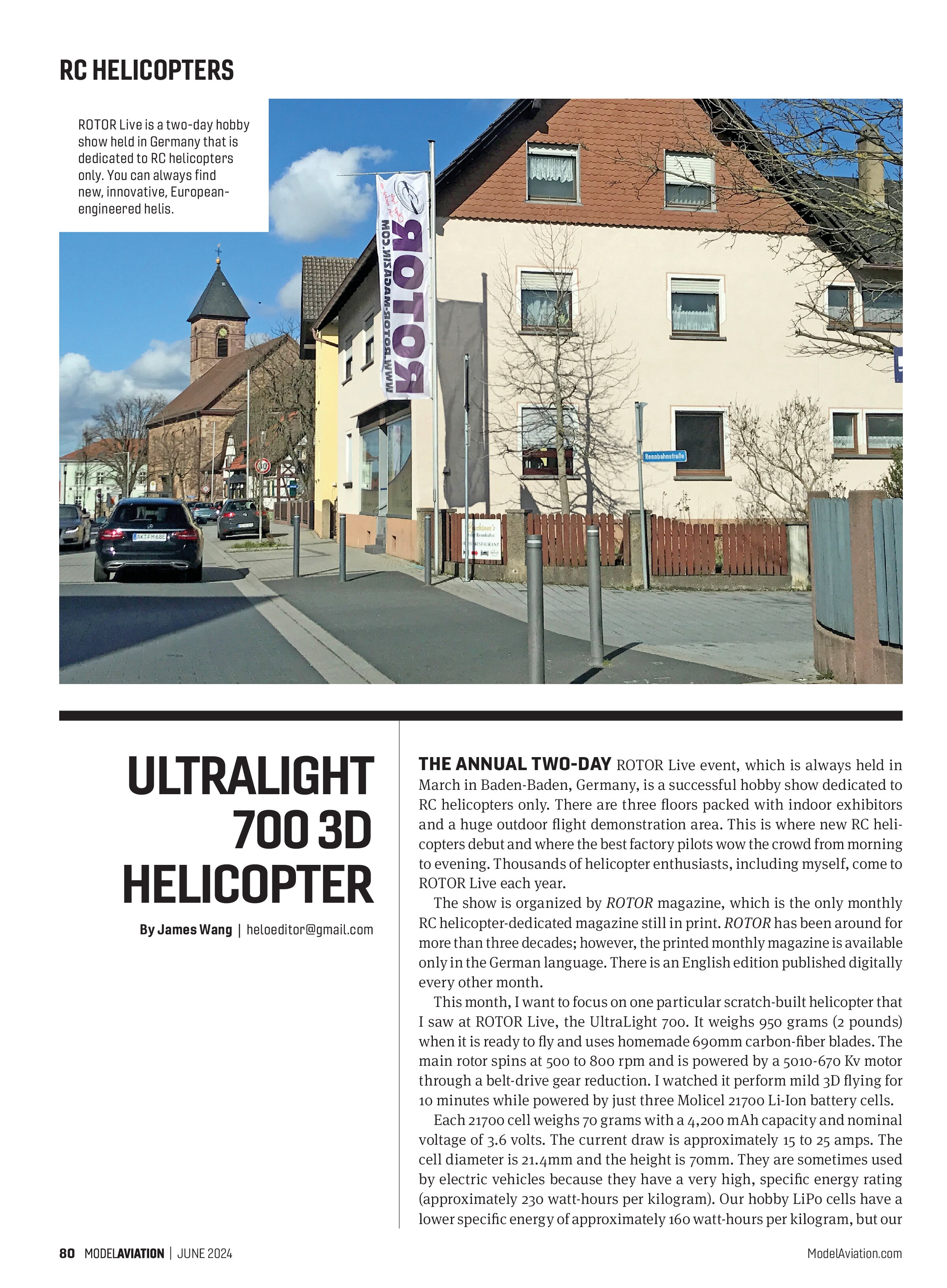
ROTOR Live is a two-day hobby show held in Germany that is dedicated to RC helicopters only. You can always find new, innovative, European-engineered helis.
ULTRALIGHT 700 3D HELICOPTER
By James Wang | heloedItor@gmail.com

THE ANNUAL TWO-DAY ROTOR Live event, which is always held in March in Baden-Baden, Germany, is a successful hobby show dedicated to RC helicopters only. There are three floors packed with indoor exhibitors and a huge outdoor flight demonstration area. This is where new RC helicopters debut and where the best factory pilots wow the crowd from morning to evening. Thousands of helicopter enthusiasts, including myself, come to ROTOR Live each year.
The show is organized by ROTOR magazine, which is the only monthly RC helicopter-dedicated magazine still in print. ROTOR has been around for more than three decades; however, the printed monthly magazine is available only in the German language. There is an English edition published digitally every other month.
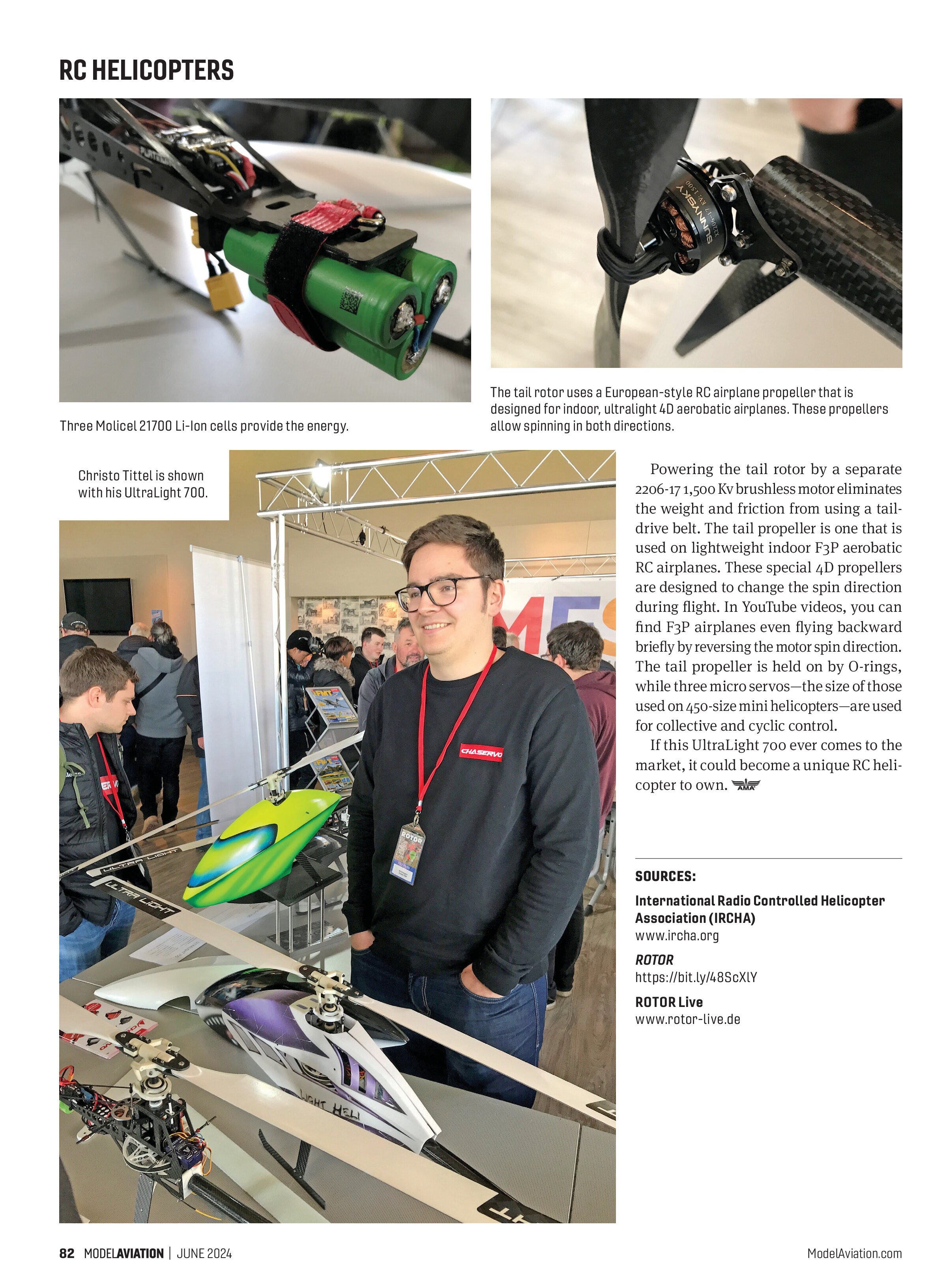
This month, I want to focus on one particular scratch-built helicopter that I saw at ROTOR Live, the UltraLight 700. It weighs 950 grams (2 pounds) when it is ready to fly and uses homemade 690mm carbon-fiber blades. The main rotor spins at 500 to 800 rpm and is powered by a 5010-670 Kv motor through a belt-drive gear reduction. I watched it perform mild 3D flying for 10 minutes while powered by just three Molicel 21700 Li-Ion battery cells.
Each 21700 cell weighs 70 grams with a 4,200 mAh capacity and nominal voltage of 3.6 volts. The current draw is approximately 15 to 25 amps. The cell diameter is 21.4mm and the height is 70mm. They are sometimes used by electric vehicles because they have a very high, specific energy rating (approximately 230 watt-hours per kilogram). Our hobby LiPo cells have a lower specific energy of approximately 160 watt-hours per kilogram, but our pouch hobby cells can handle a higher C-current draw.
The UltraLight 700 can fly for a long time because it spins at a low rotor speed to reduce drag and friction. It also has an exceptionally light disk loading. Disk loading is defined as the total helicopter weight divided by the main rotor disk area. This model has a disk loading of 0.1 pounds per sq. ft., while most 700-size helicopters have a disk loading of more than 0.5 pounds per sq. ft. As a comparison, a full-scale Sikorsky Blackhawk has a disk loading of 9 pounds per sq. ft. With a very light disk loading, the UltraLight 700 performs 3D aerobatics in a graceful manner. Despite the light disk loading, it handled the wind quite well during the flight demonstration.

The side frames are made from carbon-fiber graphite with a minimal amount of materials used. The carbon-fiber frame pieces are fitted together like a jigsaw, and they’re held together using CA glue instead of bolts. Even the main rotor shaft is made from carbon-fiber graphite. Metal components are limited to bolts and bearings. The swashplate, main gear, and main rotor hub are 3D-printed.


Powering the tail rotor by a separate 2206-17 1,500 Kv brushless motor eliminates the weight and friction from using a tail-drive belt. The tail propeller is one that is used on lightweight indoor F3P aerobatic RC airplanes. These special 4D propellers are designed to change the spin direction during flight. In YouTube videos, you can find F3P airplanes even flying backward briefly by reversing the motor spin direction. The tail propeller is held on by O-rings, while three micro servos—the size of those used on 450-size mini helicopters—are used for collective and cyclic control.
If this UltraLight 700 ever comes to the market, it could become a unique RC helicopter to own.
SOURCES:
International Radio Controlled Helicopter Association (IRCHA)
www.ircha.org
ROTOR Live
www.rotor-live.de