
MORE NOSTALGIC FUN
By Tim Bailiff | casurfisch@aol.com
AS I GROW OLDER, I appreciate more and more the amazing family that I was born into. Not only were they kind, loving people, but they were also pilots. For as long as I can remember, there was an airplane in our family. As a child, model airplanes were a large part of my life, and they remain so to this day.
That being said, you can imagine my delight when my wife gifted me 10 Revell Super Stratopheres. Those simple, balsa models allowed me to revisit the fun that I had flying them as a little boy. This time, however, there was one big difference. Using modern micro RC equipment, I could be in complete control and keep my airplanes off of the darn roof!
2-Fan Toucan
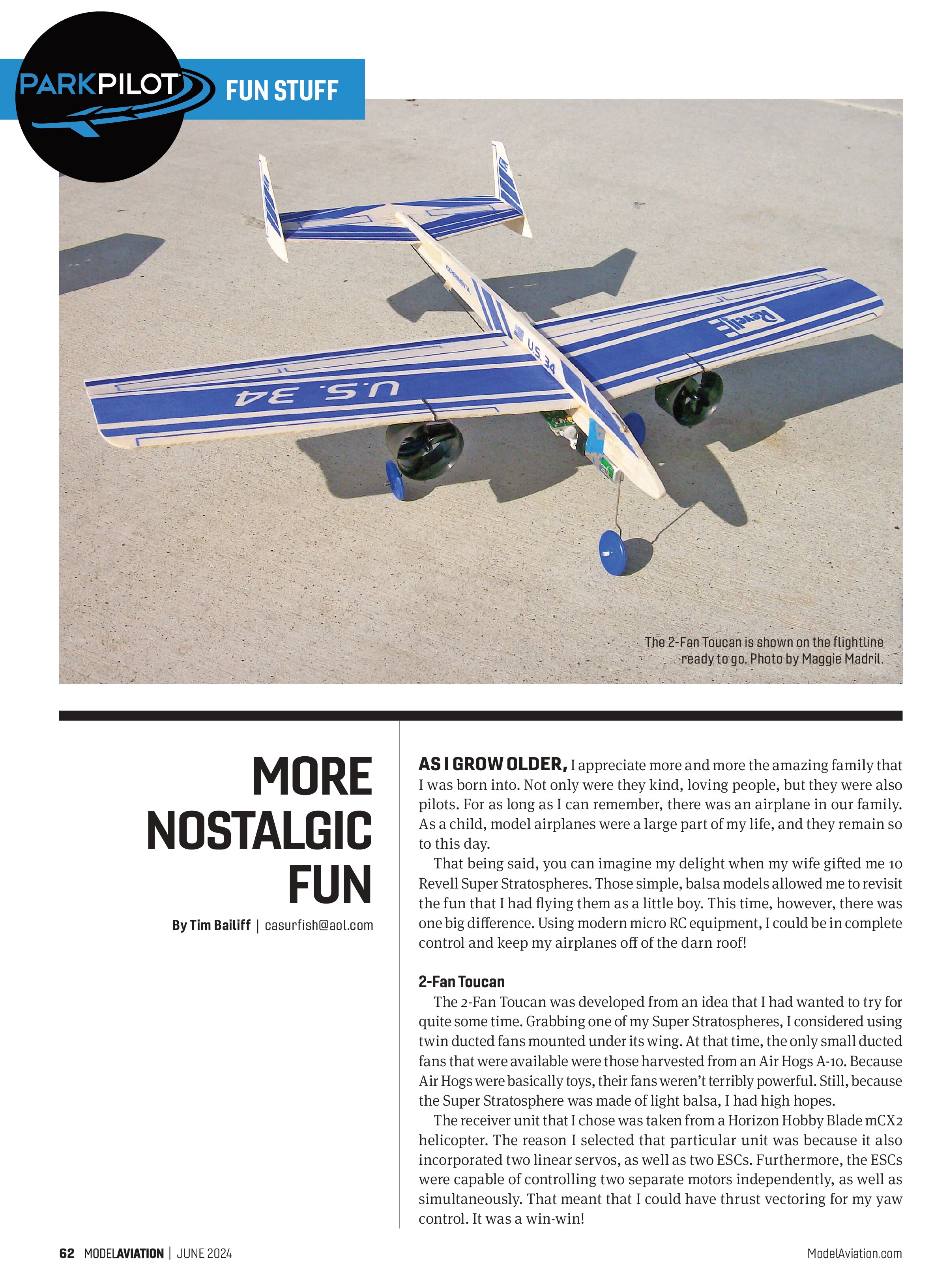
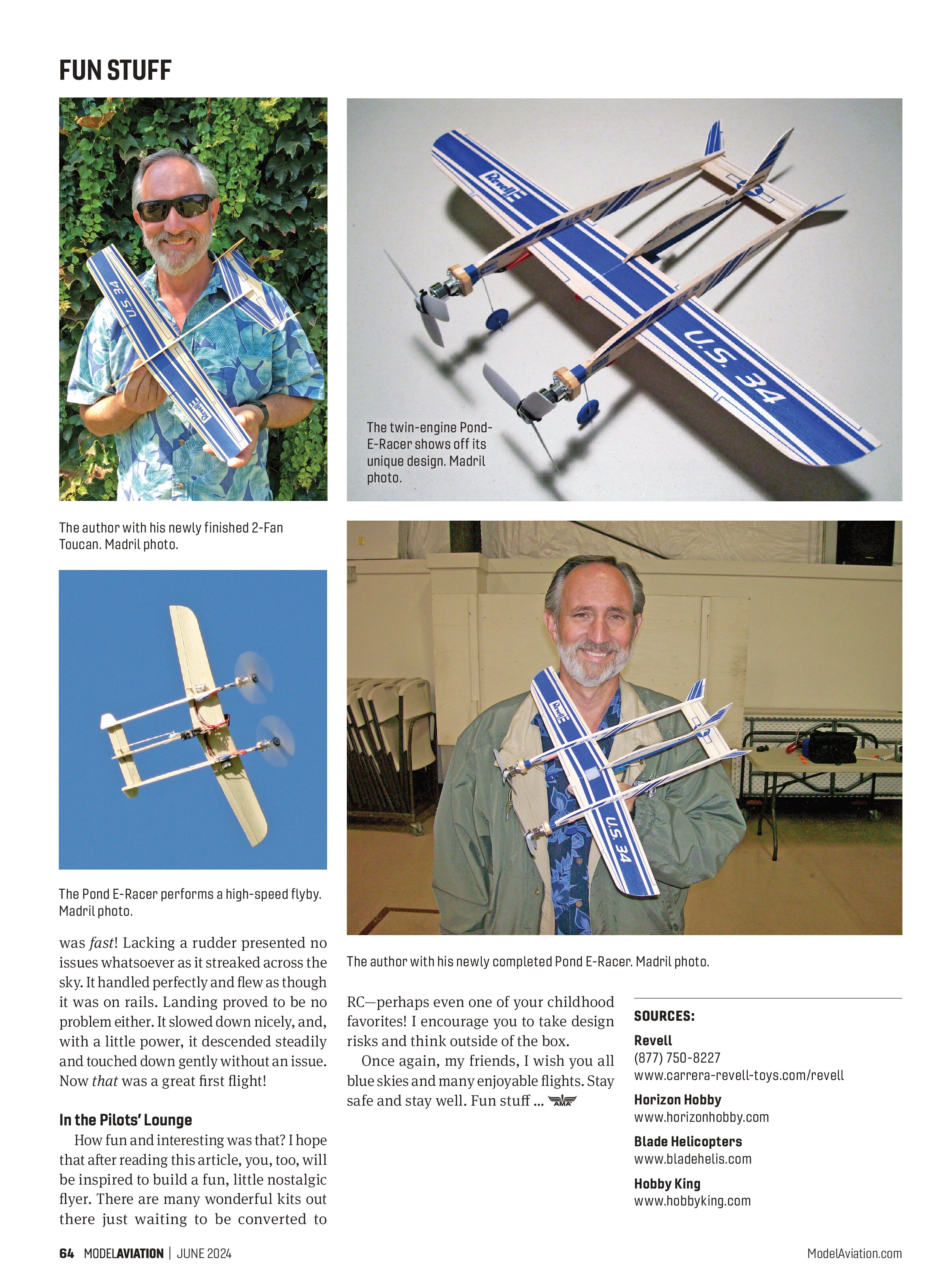
The 2-Fan Toucan was developed from an idea that I had wanted to try for quite some time. Grabbing one of my Super Stratopheres, I considered using twin ducted fans mounted under its wing. At that time, the only small ducted fans that were available were those harvested from an Air Hogs A-10. Because Air Hogs were basically toys, their fans weren’t terribly powerful. Still, because the Super Stratosphere was made of light balsa, I had high hopes.
The receiver unit that I chose was taken from a Horizon Hobby Blade mCX2 helicopter. The reason I selected that particular unit was because it also incorporated two linear servos, as well as two ESCs. Furthermore, the ESCs were capable of controlling two separate motors independently, as well as simultaneously. That meant that I could have thrust vectoring for my yaw control. It was a win-win!


was fast! Lacking a rudder presented no issues whatsoever as it streaked across the sky. It handled perfectly and flew as though it was on rails. Landing proved to be no problem either. It slowed down nicely, and, with a little power, it descended steadily and touched down gently without an issue. Now that was a great first flight!
In the Pilots’ Lounge
How fun and interesting was that? I hope that after reading this article, you, too, will be inspired to build a fun, little nostalgic flyer. There are many wonderful kits out there just waiting to be converted to


RC—perhaps even one of your childhood favorites! I encourage you to take design risks and think outside of the box.
Once again, my friends, I wish you all blue skies and many enjoyable flights. Stay safe and stay well. Fun stuff ...
SOURCES:
Revell
(877) 750-8227
www.carrera-revell-toys.com/revell
Horizon Hobby
www.horizonhobby.com
Blade Helicopters
www.bladehelis.com
Hobby King
www.hobbyking.com