OLD-TIMERS

COMPETITION EVENTS COME AND GO
By Bob Angel | samrcftler@verizon.net
THIS MONTH, I’ll review a few of the many competition subclasses that have faded away—some quickly and some more slowly. I’ve arbitrarily picked five basic categories of model events that have dominated and endured, under which we can pretty much classify the rest. Most of the dozens of different events can fit under one of these categories.
Flight Duration
Flight Duration pretty much started it with gliders and rubber-powered Free Flight (FF) models. It continues today, encompassing most of the FF, Old-Timer, and RC sailplane events. Some lesser-flown Duration events (usually for Control Line [CL] and RC) are for record establishment, such as the longest powered flight, longest distance flown, or, by stretching things a bit, the maximum altitude achieved. Distance flown was even an early rubber-powered FF event.
Aerobatics
Aerobatics has been one of the most popular and durable events throughout the years, with its beginnings in CL, where it still dominates, along with RC. By stretching things a little further, we could place both CL and RC Combat under this category.
Speed
Speed events were practiced early with rubber power and later in CL, which hosts most of the serious Speed events today. There are also Speed record categories for powered RC aircraft and RC gliders, of which specialties are less practiced but are in no danger of disappearing.
Racing
Racing involves speed, of course, but it adds to the excitement of direct competition between the pilots and sometimes the pit crews. Racing is popular in CL and RC events, including sailplanes.
Scale
Scale is its own specialty. It can be anything from static display models to FF, CL, or RC. There are six AMA subcategories of CL Scale alone. Some require the builder and the flier to be the same person. Others allow someone other than the builder to do the flying because some Scale builders spend countless hours building but are not necessarily skilled pilots, while many true Scale models are quite sensitive to control.
About Competition
Most modelers fly for their own enjoyment rather than competition, but competition is the main driver of development and improvement for both full-scale and model aircraft. Competition also attracts interest from modelers and non-modelers alike, sometimes steering non-modelers to become modelers.
Many competition events begin as club fun-fly events and often have short lifespans. The following are a few, in no particular order.
RC Limbo
RC Limbo was popular but didn’t endure for long, mostly because the high casualty rate often disabled the average person’s stock of older, disposable models rather quickly. The flight regime required flying the aircraft between the ground and a strip of crepe paper strung between two poles.
After each round of contestants completed (or failed to complete) a pass, the paper strip was progressively lowered for the next round. Models that cut the paper, flew above it, or crashed were eliminated. Establishing a winner obviously required all of the competitors but one to be eliminated one way or the other! Sometimes a coin toss was required because even the final two or more contestants didn’t successfully complete that final, low pass.
CL Scale Racing
CL Scale Racing cropped up in the late 1940s. The club that I belonged to ran it with few rules, which were mostly just “fly what you brung.” We flew recognizable Scale airplanes in full fuselage form because no one had yet considered building a profile Scale aircraft. The objective was to complete a certain number of laps, with two required pit stops for refueling and the engine restart.


Few CL modelers built Scale airplanes, so we often had no more than a half-dozen competitors for club-level competitions. Scale aircraft are often harder to fly than other models, and because we were mostly teenagers with varied flying skills, we usually preserved airplanes by just racing one at a time against the stopwatch, rather than two or more competing head-to-head in the circle.
I selected a Navion, which I’d always admired for its sleek appearance. I just scaled up a set of rubber plans and beefed the airplane up for my only engine at the time, an Ohlsson 23. There were no engine size limitations, so it would be competing against airplanes using mostly .35 to .60 cu. in. engines, all of which flew faster. Despite the size difference, I believe we all flew with the same length of lines. This was in pre-glow plug days, so the airplanes still carried the weight and complexity of spark-ignition systems.
As it turned out, my little airplane was about as competitive as most because, often as not, the races were won during the pit stops rather than by pure speed. We hadn’t developed fast-fill refueling techniques, and hardly anyone in those days could restart a hot engine in fewer than a dozen or more propeller flips. Starters were not readily available, but had anyone shown up with one, they would have simply been asked to put it away. Rulemaking was simpler then.
Our club, like many, was a low-budget operation, so one modest trophy was passed to the winner as a sort of perpetual trophy, to be turned over to the winner of the next event.
Honker Racing
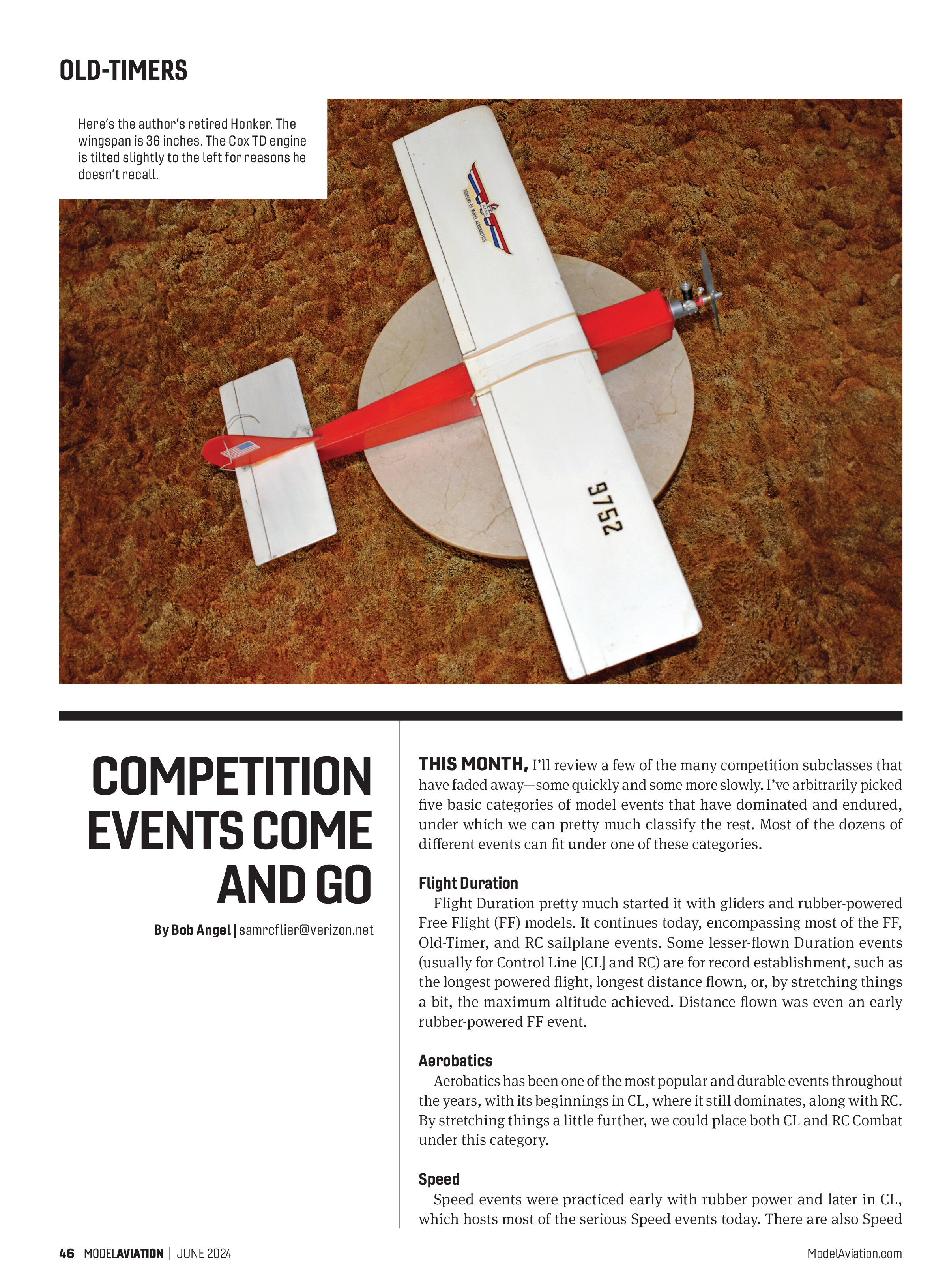
Honker Racing came on quickly and lasted for at least a couple of years as a popular, little, fun version of RC Pylon Racing. The Honker was a simple 1/2A-powered airplane that was easily constructed from plans and a few sheets of balsa. Even the wings were sheet balsa, shaped to a slight airfoil section, so not even wing ribs were required. Having no landing gear, they were simply hand-launched at a start flag and flew fairly fast.
Cox TD engines were used with no throttle or shutoff, so they carried just enough fuel to finish a race and soon make a dead-stick landing. Just two radio channels and servos were required because only aileron and elevators were used. The racecourse consisted of two rather than three pylons, as used in Formula 1 racing.
Balloon Bust
Balloon Bust was one of the more popular and lasting CL fun-fly events. I also mentioned it and the Limbo event in the February 2022 and April 2022 editions of this column, where I described the events more thoroughly. I still believe it could become popular once more if the now-complex rules were changed back to the simpler, original version, eliminating that hazardous (to nice models) barrier pole and dropping the unrelated beauty contest. In fact, the only time lately that I’ve come across a Balloon Bust event, it was being flown in an internet video and was pretty much the original version, as opposed to using the more-complex rules that are now described as Event 333, Dive Bombing and Strafing, in the CL Special Events Competition Rules and Regulations.
In summary, most of us have some degree of competitive impulse; however, most don’t have the resources (mostly time) to devote to extreme levels of competition. The last two events mentioned above seemed to attract a higher percentage of club members than did most other fun-type flying events. The airplanes that were used did not require hours of fine finishing techniques, specialized equipment, or exceptional flying skills.
I think both RC Honker Racing and the CL Balloon Bust could easily make comebacks for club fun-fly competition using the original, simple rules, aircraft, and support equipment.
SOURCES:
AMA Competition Rules and Regulations
www.modelaircraft.org/events/competition-resources/competition-regulations