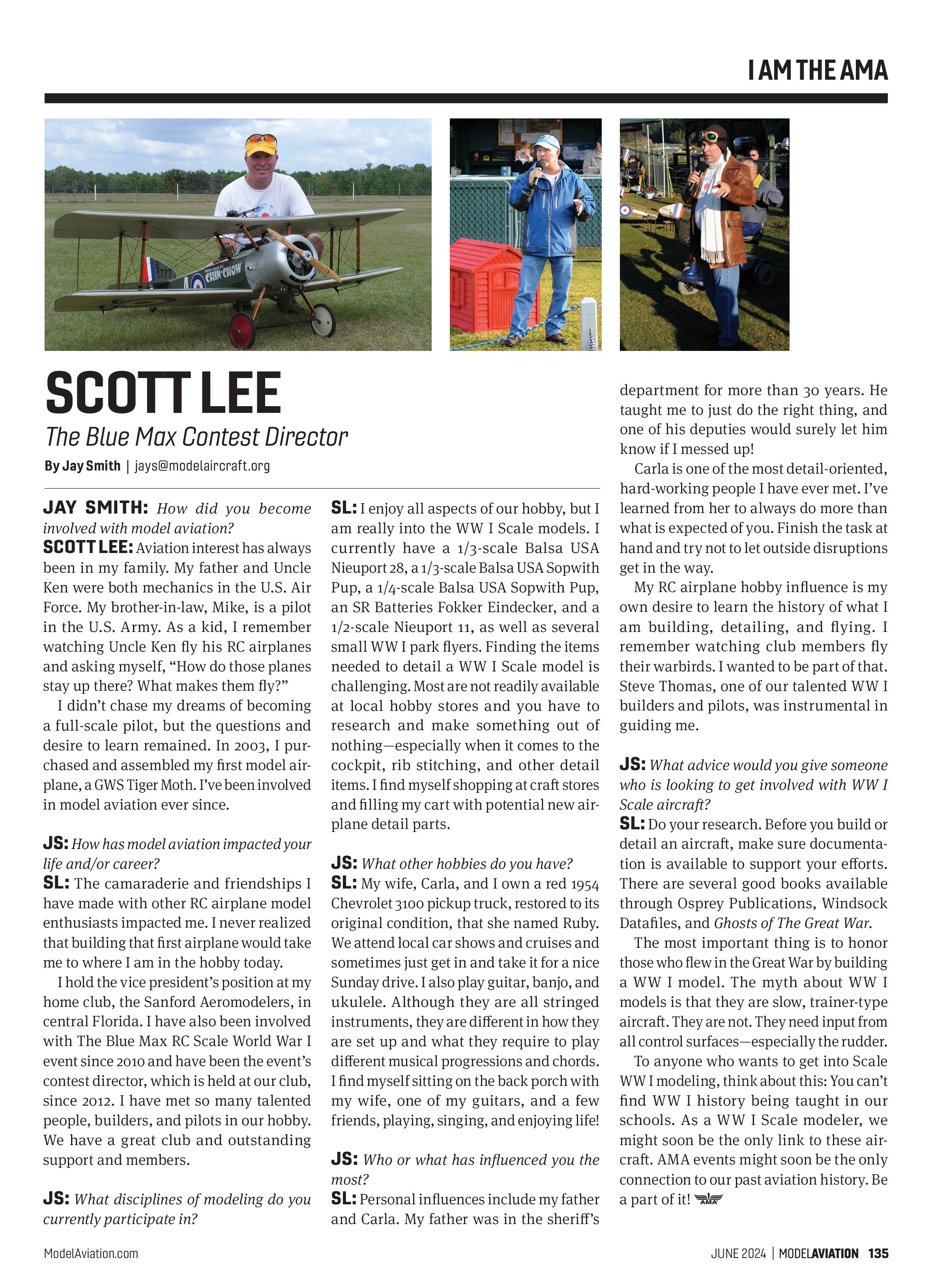
SCOTT LEE
The Blue Max Contest Director
By Jay Smith | jays@modelaircraft.org


JAY SMITH: How did you become involved with model aviation?
SCOTT LEE: Aviation interest has always been in my family. My father and Uncle Ken were both mechanics in the U.S. Air Force. My brother-in-law, Mike, is a pilot in the U.S. Army. As a kid, I remember watching Uncle Ken fly his RC airplanes and asking myself, “How do those planes stay up there? What makes them fly?”
I didn’t chase my dreams of becoming a full-scale pilot, but the questions and desire to learn remained. In 2003, I purchased and assembled my first model airplane, a GWS Tiger Moth. I’ve been involved in model aviation ever since.
JS: How has model aviation impacted your life and/or career?
SL: The camaraderie and friendships I have made with other RC airplane model enthusiasts impacted me. I never realized that building that first airplane would take me to where I am in the hobby today.
I hold the vice president’s position at my home club, the Sanford Aeromodelers, in central Florida. I have also been involved with The Blue Max RC Scale World War I event since 2010 and have been the event’s contest director, which is held at our club, since 2012. I have met so many talented people, builders, and pilots in our hobby. We have a great club and outstanding support and members.
JS: What disciplines of modeling do you currently participate in?
SL: I enjoy all aspects of our hobby, but I am really into the WW I Scale models. I currently have a 1/3-scale Balsa USA Nieuport 28, a 1/3-scale Balsa USA Sopwith Pup, a 1/4-scale Balsa USA Sopwith Pup, an SR Batteries Fokker Eindecker, and a 1/2-scale Nieuport 11, as well as several small WW I park flyers. Finding the items needed to detail a WW I Scale model is challenging. Most are not readily available at local hobby stores and you have to research and make something out of nothing—especially when it comes to the cockpit, rib stitching, and other detail items. I find myself shopping at craft stores and filling my cart with potential new airplane detail parts.
JS: What other hobbies do you have?
SL: My wife, Carla, and I own a red 1954 Chevrolet 3100 pickup truck, restored to its original condition, that she named Ruby. We attend local car shows and cruises and sometimes just get in and take it for a nice Sunday drive. I also play guitar, banjo, and ukulele. Although they are all stringed instruments, they are different in how they are set up and what they require to play different musical progressions and chords. I find myself sitting on the back porch with my wife, one of my guitars, and a few friends, playing, singing, and enjoying life!
JS: Who or what has influenced you the most?
SL: Personal influences include my father and Carla. My father was in the sheriff’s department for more than 30 years. He taught me to just do the right thing, and one of his deputies would surely let him know if I messed up!
Carla is one of the most detail-oriented, hard-working people I have ever met. I’ve learned from her to always do more than what is expected of you. Finish the task at hand and try not to let outside disruptions get in the way.
My RC airplane hobby influence is my own desire to learn the history of what I am building, detailing, and flying. I remember watching club members fly their warbirds. I wanted to be part of that. Steve Thomas, one of our talented WW I builders and pilots, was instrumental in guiding me.
JS: What advice would you give someone who is looking to get involved with WW I Scale aircraft?
SL: Do your research. Before you build or detail an aircraft, make sure documentation is available to support your efforts. There are several good books available through Osprey Publications, Windsock Datafiles, and Ghosts of The Great War.
The most important thing is to honor those who flew in the Great War by building a WW I model. The myth about WW I models is that they are slow, trainer-type aircraft. They are not. They need input from all control surfaces—especially the rudder.
To anyone who wants to get into Scale WW I modeling, think about this: You can’t find WW I history being taught in our schools. As a WW I Scale modeler, we might soon be the only link to these aircraft. AMA events might soon be the only connection to our past aviation history. Be a part of it!