FOCAL POINT
Interested in sharing your handiwork? Visit www.ModelAviation.com for submission guidelines.

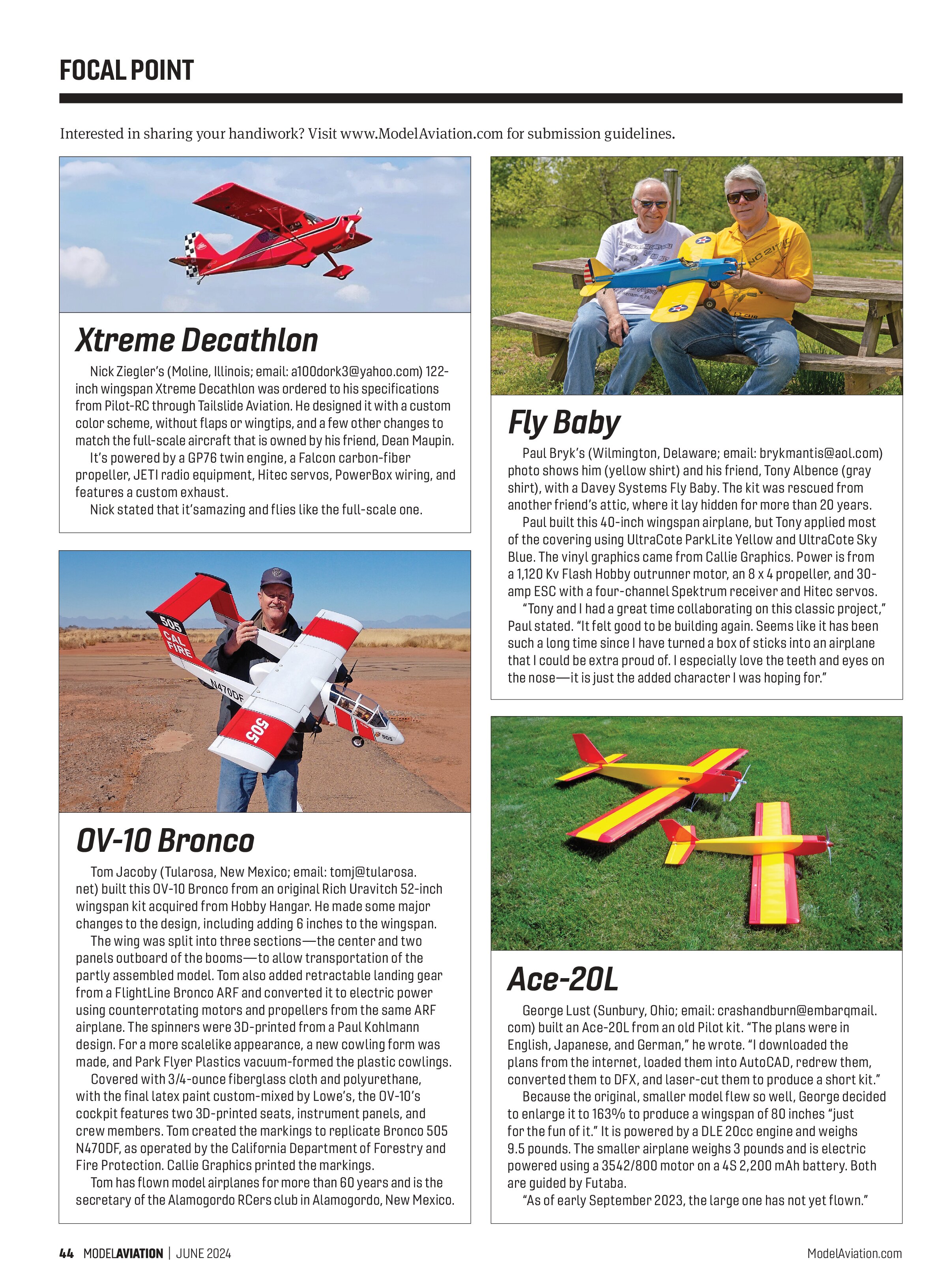
Xtreme Decathlon
Nick Ziegler’s (Moline, Illinois; email: a100dork3@yahoo.com) 122-inch wingspan Xtreme Decathlon was ordered to his specifications from Pilot-RC through Tailslide Aviation. He designed it with a custom color scheme, without flaps or wingtips, and a few other changes to match the full-scale aircraft that is owned by his friend, Dean Maupin.
It’s powered by a GP76 twin engine, a Falcon carbon-fiber propeller, JETI radio equipment, Hitec servos, PowerBox wiring, and features a custom exhaust.
Nick stated that it’s amazing and flies like the full-scale one.

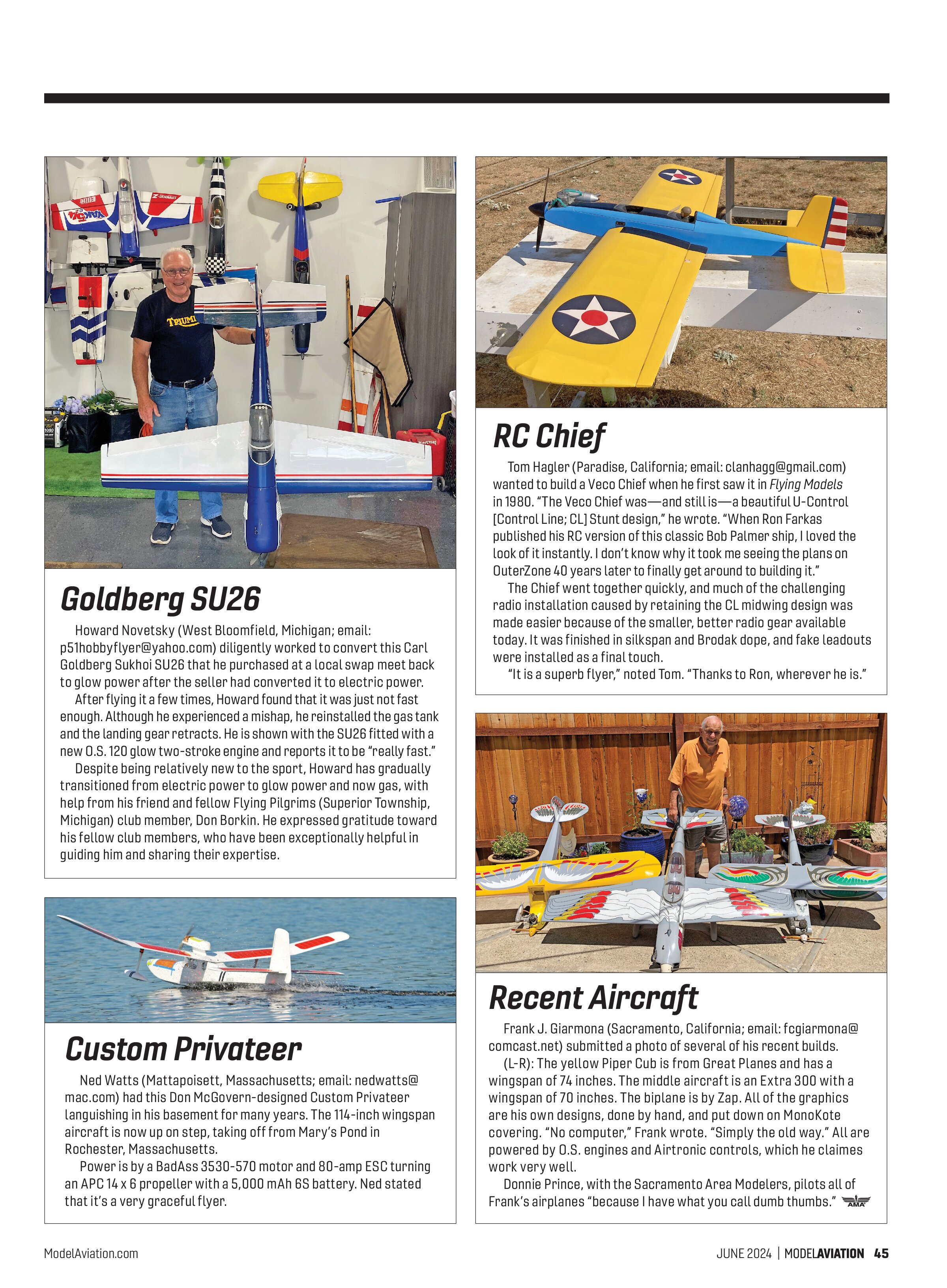
OV-10 Bronco
Tom Jacoby (Tularosa, New Mexico; email: tomj@tularosa.net) built this OV-10 Bronco from an original Rich Uravitch 52-inch wingspan kit acquired from Hobby Hangar. He made some major changes to the design, including adding 6 inches to the wingspan.
The wing was split into three sections—the center and two panels outboard of the booms—to allow transportation of the partly assembled model. Tom also added retractable landing gear from a FlightLine Bronco ARF and converted it to electric power using counterrotating motors and propellers from the same ARF airplane. The spinners were 3D-printed from a Paul Kohlmann design. For a more scalelike appearance, a new cowling form was made, and Park Flyer Plastics vacuum-formed the plastic cowlings.
Covered with 3/4-ounce fiberglass cloth and polyurethane, with the final latex paint custom-mixed by Lowe’s, the OV-10’s cockpit features two 3D-printed seats, instrument panels, and crew members. Tom created the markings to replicate Bronco 505 N470DF, as operated by the California Department of Forestry and Fire Protection. Callie Graphics printed the markings.
Tom has flown model airplanes for more than 60 years and is the secretary of the Alamogordo RCers club in Alamogordo, New Mexico.

Fly Baby
Paul Bryk’s (Wilmington, Delaware; email: brykmantis@aol.com) photo shows him (yellow shirt) and his friend, Tony Albence (gray shirt), with a Davey Systems Fly Baby. The kit was rescued from another friend’s attic, where it lay hidden for more than 20 years.
Paul built this 40-inch wingspan airplane, but Tony applied most of the covering using UltraCote ParkLite Yellow and UltraCote Sky Blue. The vinyl graphics came from Callie Graphics. Power is from a 1,120 Kv Flash Hobby outrunner motor, an 8 x 4 propeller, and 30-amp ESC with a four-channel Spektrum receiver and Hitec servos.
“Tony and I had a great time collaborating on this classic project,” Paul stated. “It felt good to be building again. Seems like it has been such a long time since I have turned a box of sticks into an airplane that I could be extra proud of. I especially love the teeth and eyes on the nose—it is just the added character I was hoping for.”

Ace-20L
George Lust (Sunbury, Ohio; email: crashandburn@embarqmail.com) built an Ace-20L from an old Pilot kit. “The plans were in English, Japanese, and German,” he wrote. “I downloaded the plans from the internet, loaded them into AutoCAD, redrew them, converted them to DFX, and laser-cut them to produce a short kit.”
Because the original, smaller model flew so well, George decided to enlarge it to 163% to produce a wingspan of 80 inches “just for the fun of it.” It is powered by a DLE 20cc engine and weighs 9.5 pounds. The smaller airplane weighs 3 pounds and is electric powered using a 3542/800 motor on a 4S 2,200 mAh battery. Both are guided by Futaba.
“As of early September 2023, the large one has not yet flown.”

Goldberg SU26
Howard Novetsky (West Bloomfield, Michigan; email: p51hobbyflyer@yahoo.com) diligently worked to convert this Carl Goldberg Sukhoi SU26 that he purchased at a local swap meet back to glow power after the seller had converted it to electric power.
After flying it a few times, Howard found that it was just not fast enough. Although he experienced a mishap, he reinstalled the gas tank and the landing gear retracts. He is shown with the SU26 fitted with a new O.S. 120 glow two-stroke engine and reports it to be “really fast.”
Despite being relatively new to the sport, Howard has gradually transitioned from electric power to glow power and now gas, with help from his friend and fellow Flying Pilgrims (Superior Township, Michigan) club member, Don Borkin. He expressed gratitude toward his fellow club members, who have been exceptionally helpful in guiding him and sharing their expertise.

Custom Privateer
Ned Watts (Mattapoisett, Massachusetts; email: nedwatts@mac.com) had this Don McGovern-designed Custom Privateer languishing in his basement for many years. The 114-inch wingspan aircraft is now up on step, taking off from Mary’s Pond in Rochester, Massachusetts.
Power is by a BadAss 3530-570 motor and 80-amp ESC turning an APC 14 x 6 propeller with a 5,000 mAh 6S battery. Ned stated that it’s a very graceful flyer.

RC Chief
Tom Hagler (Paradise, California; email: clanhagg@gmail.com) wanted to build a Veco Chief when he first saw it in Flying Models in 1980. “The Veco Chief was—and still is—a beautiful U-Control [Control Line; CL] stunt design,” he wrote. “When Ron Farkas published his RC version of this classic Bob Palmer ship, I loved the look of it instantly. I don’t know why it took me seeing the plans on OuterZone 40 years later to finally get around to building it.”
The Chief went together quickly, and much of the challenging radio installation caused by retaining the CL midwing design was made easier because of the smaller, better radio gear available today. It was finished in silksnap and Brodak dope, and fake leadouts were installed as a final touch.
“It is a superb flyer,” noted Tom. “Thanks to Ron, wherever he is.”

Recent Aircraft
Frank J. Giarmona (Sacramento, California; email: fcgiarmona@comcast.net) submitted a photo of several of his recent builds. (L-R): The yellow Piper Cub from Great Planes and has a wingspan of 74 inches. The middle aircraft is an Extra 300 with a wingspan of 70 inches. The biplane is by Zap. All of the graphics are his own designs, done by hand, and put down on MonoKote covering. “No computer,” Frank wrote. “Simply the old way.” All are powered by O.S. engines and Airtronic controls, which he claims work very well.
Donnie Prince, with the Sacramento Area Modelers, pilots all of Frank’s airplanes “because I have what you call dumb thumbs.”