
RETRO ELECTRO: COMPLETING THE V-STREAK
By Terry Dunn | terrydunn74@gmail.com
I AM VERY HAPPY to report that I have finally completed and flown my Electrostreak project! My aircraft is nicknamed V-Streak to reflect its V-tail modification. My buddy, Keith Sparks, thinks Laverne is a better name because of the leopard-print accents in the trim scheme. Hmmm. I’ll think about it, Keith ... I’ll think about it.
My motivation for building this model was the group build hosted by RC Plane Lab. With a legacy electric design, such as the E-Streak, there is guaranteed to be a lot of variety in the completed models. Even if everyone built the airframe exactly per the plans, there are bound to be unique selections when choosing a modern power system and radio gear.
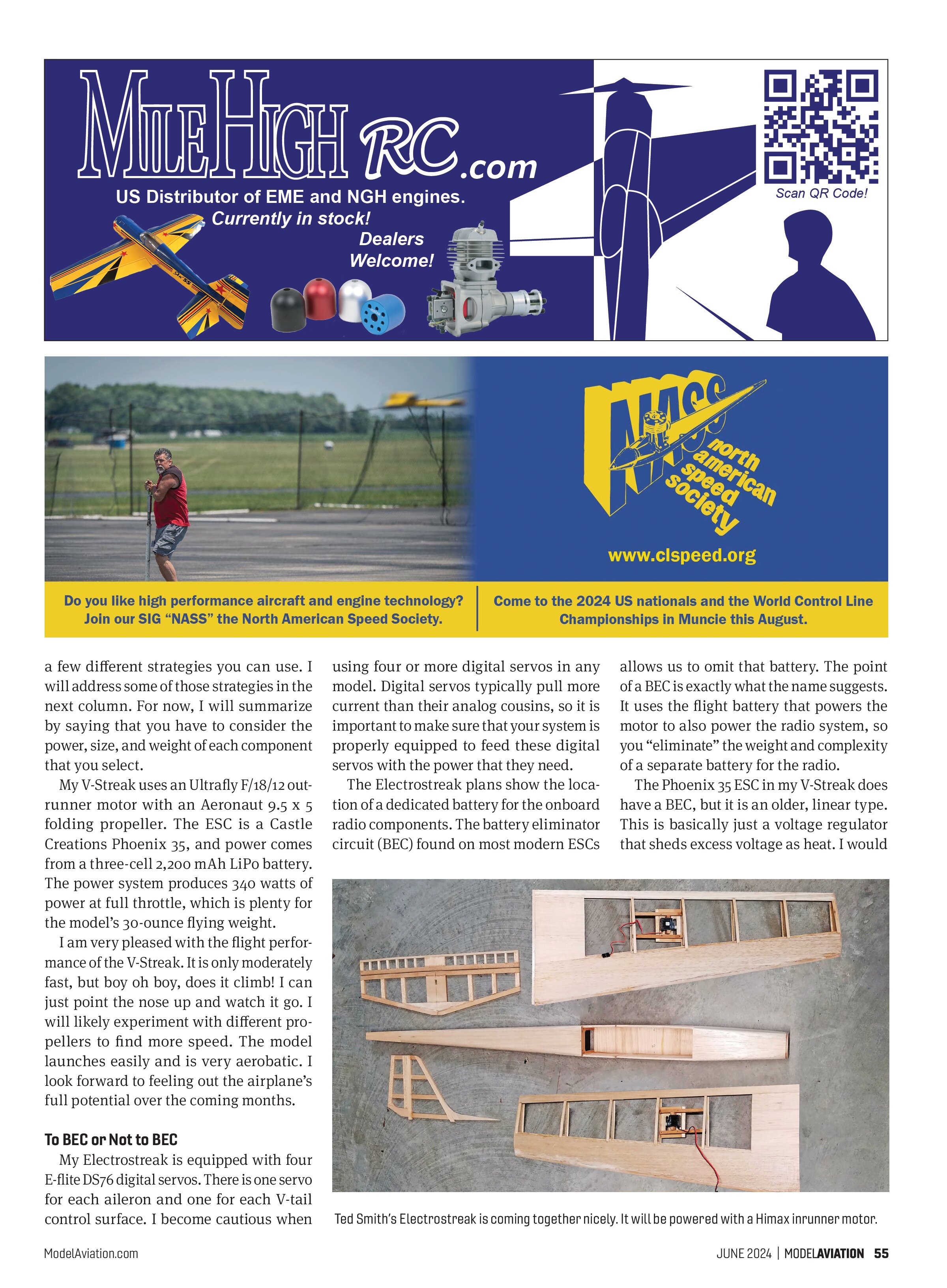
Speaking of variety, let’s look at two examples of Electrostreak projects sent in by readers. First is Ted Smith’s model. It still needs covering, but the airframe sure looks good! Ted plans to fly it with a Himax HB3615-1600 Kv inrunner motor and a three-cell 1,300 mAh LiPo battery. Four 9-gram servos drive the control surfaces.
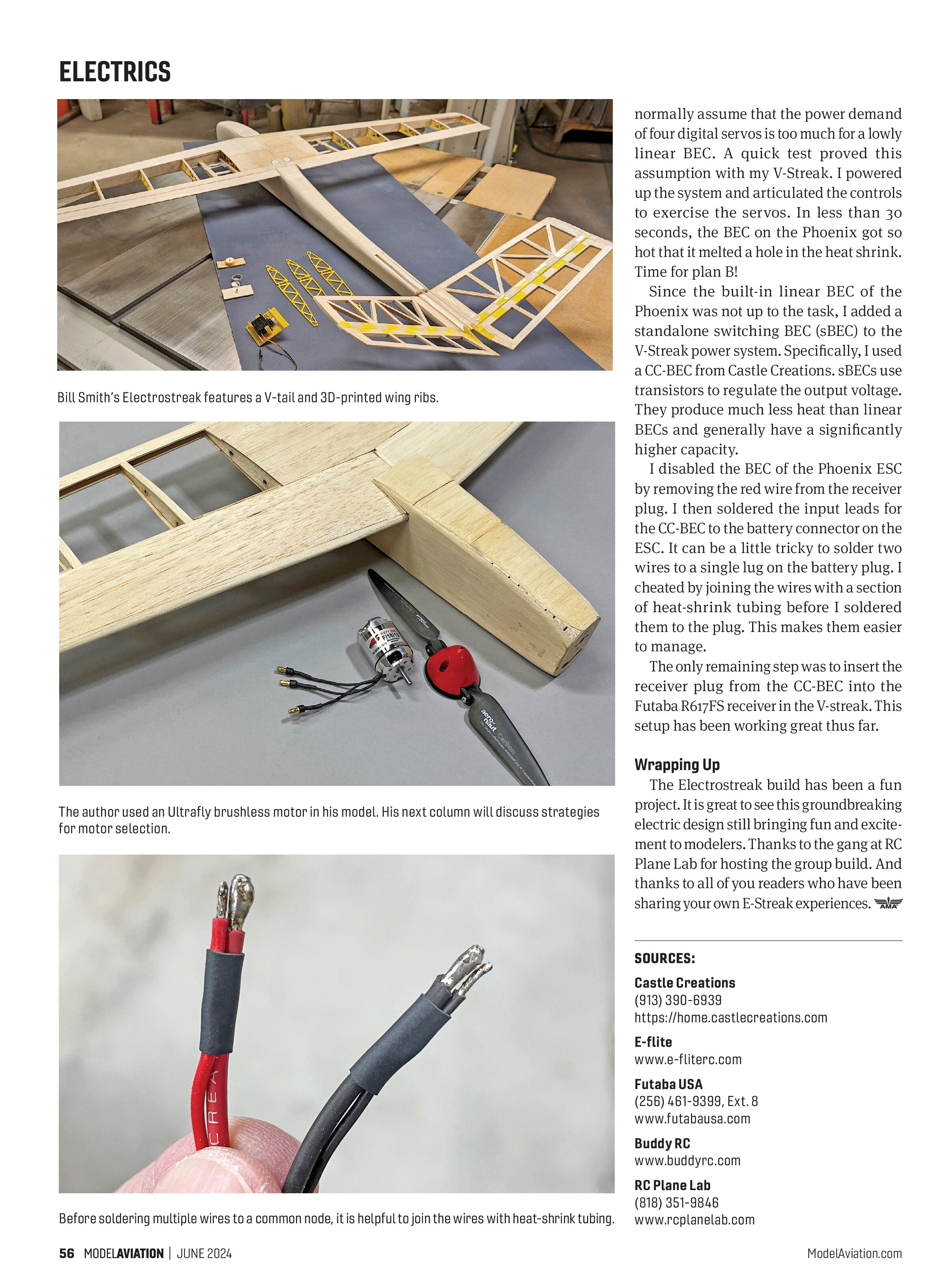
Next up is Bill Smith’s E-Streak, which also has a V-tail modification. Rather than cutting the wing ribs from balsa, Bill 3D-printed them! How clever. You can see a few other 3D-printed parts on his model as well. Bill is planning to use a Hacker motor with a 10 x 6 folding propeller, Castle Creations Talon 35 ESC, and a three-cell 1,300 mAh LiPo battery.
V-Streak Details
A few people have asked me how to choose a power system for a model such as the Electrostreak. That is actually a complex topic because there are a few different strategies you can use. I will address some of those strategies in the next column. For now, I will summarize by saying that you have to consider the power, size, and weight of each component that you select.
My V-Streak uses an Ultrafly F/18/12 outrunner motor with an Aeronaut 9.5 x 5 folding propeller. The ESC is a Castle Creations Phoenix 35, and power comes from a three-cell 2,200 mAh LiPo battery. The power system produces 340 watts of power at full throttle, which is plenty for the model’s 30-ounce flying weight.
I am very pleased with the flight performance of the V-Streak. It is only moderately fast, but boy oh boy, does it climb! I can just point the nose up and watch it go. I will likely experiment with different propellers to find more speed. The model launches easily and is very aerobatic. I look forward to feeling out the airplane’s full potential over the coming months.
To BEC or Not to BEC
My Electrostreak is equipped with four E-flite DS76 digital servos. There is one servo for each aileron and one for each V-tail control surface. I become cautious when using four or more digital servos in any model. Digital servos typically pull more current than their analog cousins, so it is important to make sure that your system is properly equipped to feed these digital servos with the power that they need.
The Electrostreak plans show the location of a dedicated battery for the onboard radio components. The battery eliminator circuit (BEC) found on most modern ESCs allows us to omit that battery. The point of a BEC is exactly what the name suggests. It uses the flight battery that powers the motor to also power the radio system, so you “eliminate” the weight and complexity of a separate battery for the radio.
The Phoenix 35 ESC in my V-Streak does have a BEC, but it is an older, linear type. This is basically just a voltage regulator that sheds excess voltage as heat. I would


normally assume that the power demand of four digital servos is too much for a lowly linear BEC. A quick test proved this assumption with my V-Streak. I powered up the system and articulated the controls to exercise the servos. In less than 30 seconds, the BEC on the Phoenix got so hot that it melted a hole in the heat shrink. Time for plan B!
Since the built-in linear BEC of the Phoenix was not up to the task, I added a standalone switching BEC (sBEC) to the V-Streak power system. Specifically, I used a CC-BEC from Castle Creations. sBECs use transistors to regulate the output voltage. They produce much less heat than linear BECs and generally have a significantly higher capacity.
I disabled the BEC of the Phoenix ESC by removing the red wire from the receiver plug. I then soldered the input leads for the CC-BEC to the battery connector on the ESC. It can be a little tricky to solder two wires to a single lug on the battery plug. I cheated by joining the wires with a section of heat-shrink tubing before I soldered them to the plug. This makes them easier to manage.
The only remaining step was to insert the receiver plug from the CC-BEC into the Futaba R617FS receiver in the V-Streak. This setup has been working great thus far.
Wrapping Up
The Electrostreak build has been a fun project. It is great to see this groundbreaking electric design still bringing fun and excitement to modelers. Thanks to the gang at RC Plane Lab for hosting the group build. And thanks to all of you readers who have been sharing your own E-Streak experiences.
SOURCES:
Castle Creations
(913) 390-6939
https://home.castlecreations.com
E-flite
www.e-fliterc.com
Futaba USA
(256) 461-9399, Ext. 8
www.futabausa.com
Buddy RC
www.buddyrc.com
RC Plane Lab
(818) 351-9846
www.rcplanelab.com