The Sato Red Dragons’ Journey
By David Roberts
david@dronesports.us
Photos courtesy of the author

In early 2020, leaders from the World Air Sports Federation, also known as the FAI, offered an invitation to introduce the new sport of drone soccer gameplay to the US. Matthias and Angelika Möbius of Germany, plus the president of the FAI Aeromodelling Commission (CIAM), Antonis Papadopoulos from Greece, and FAI CIAM Director of Sport Bruno Delor, from France, were most encouraging.
Together, much work had been done for several years in developing paths to the FAI F9U World Drone Racing Championship, which was attended by dozens of countries. The prior effort was through the AMA Special Interest Group (SIG) MultiGP, which represents FAI F9U drone racing with AMA.
Introducing the new sport of drone soccer across the US required multiple levels of collaboration, investment, and effort to form a team of leaders and develop resources. Think regulation-size competition arenas, drone soccer ball technologies, complimentary rules, educator professional development tools, interactive online league operations, and leadership programs to attract and engage educators across the US, all to focus on student career path development at an early age.
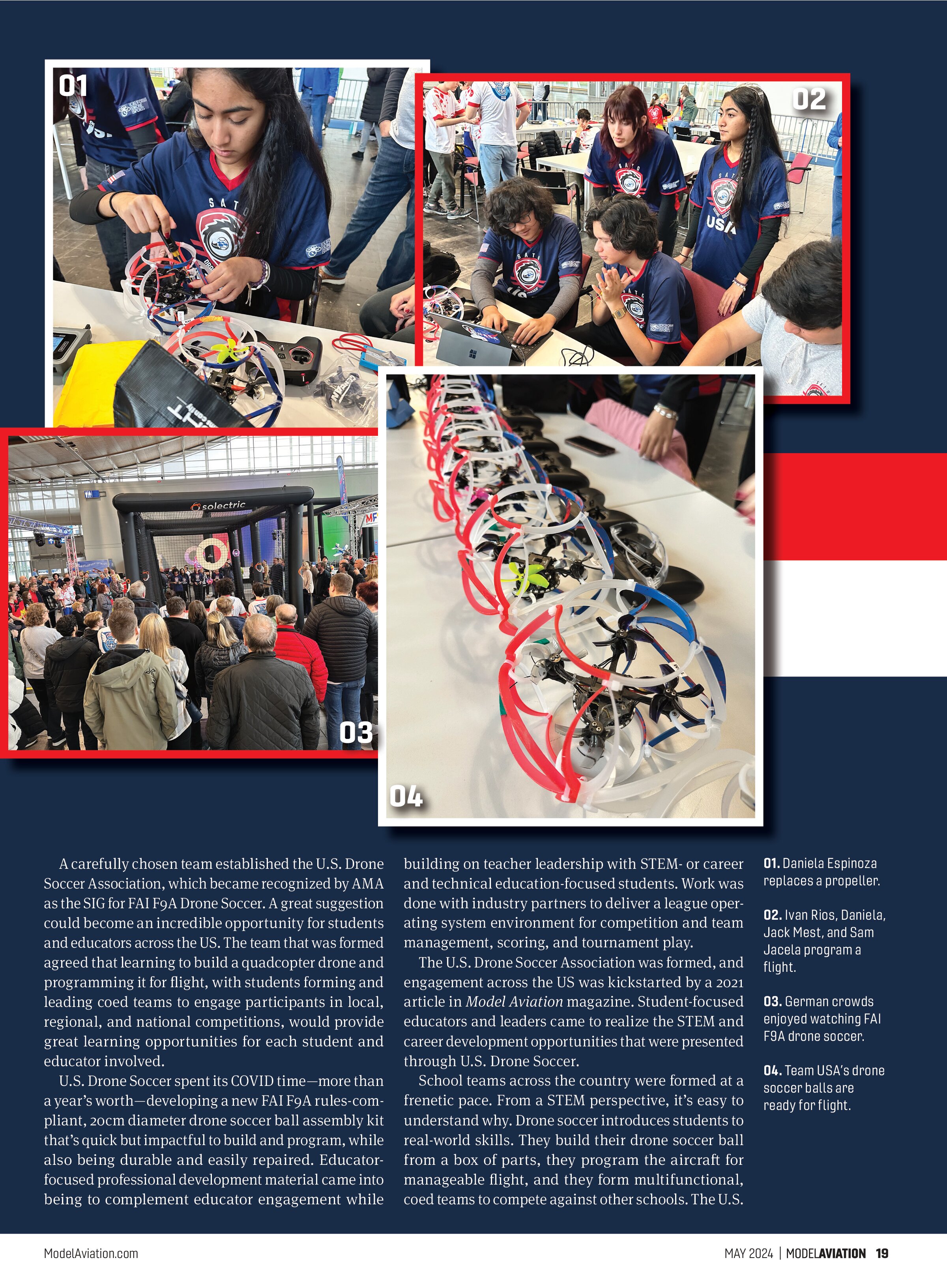
A carefully chosen team established the U.S. Drone Soccer Association, which became recognized by AMA as the SIG for FAI F9A Drone Soccer. A great suggestion could become an incredible opportunity for students and educators across the US. The team that was formed agreed that learning to build a quadcopter drone and programming it for flight, with students forming and leading coed teams to engage participants in local, regional, and national competitions, would provide great learning opportunities for each student and educator involved.
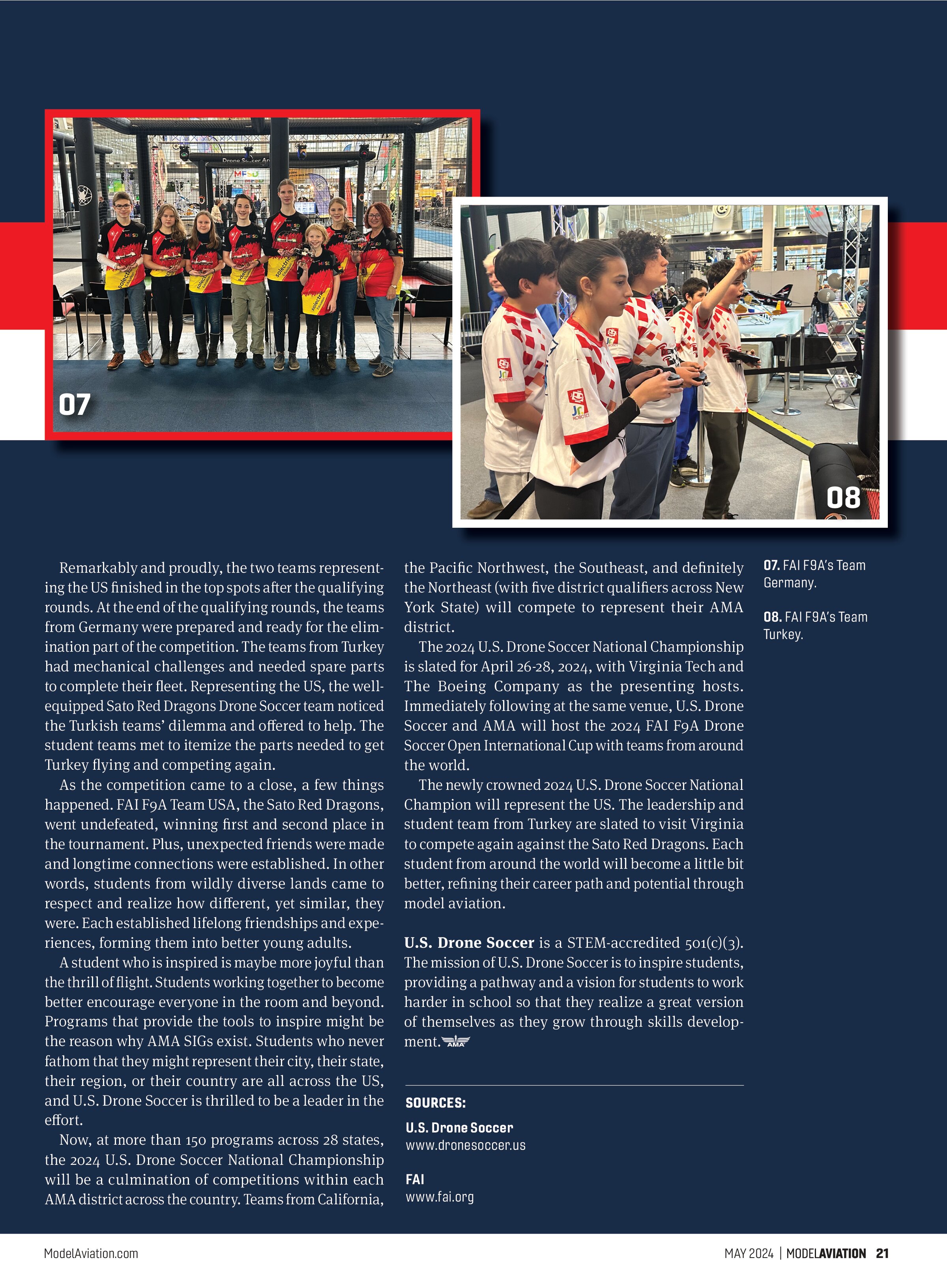
U.S. Drone Soccer spent its COVID time—more than a year’s worth—developing a new FAI F9A rules-compliant, 20cm diameter drone soccer ball assembly kit that’s quick but impactful to build and program, while also being durable and easily repaired. Educator-focused professional development material came into being to complement educator engagement while building on teacher leadership with STEM- or career and technical education-focused students. Work was done with industry partners to deliver a league operating system environment for competition and team management, scoring, and tournament play.
The U.S. Drone Soccer Association was formed, and engagement across the US was kickstarted by a 2021 article in Model Aviation magazine. Student-focused educators and leaders came to realize the STEM and career development opportunities that were presented through U.S. Drone Soccer.
School teams across the country were formed at a frenetic pace. From a STEM perspective, it’s easy to understand why. Drone soccer introduces students to real-world skills. They build their drone soccer ball from a box of parts, they program the aircraft for manageable flight, and they form multifunctional, coed teams to compete against other schools. The U.S.


Drone Soccer Association grew to more than 100 programs across the US.
Student teams began building, flying, repairing, and competing between teams in organized play in almost every AMA district across the country. Student teams started finessing the tune of their aircraft while also refining their tactics and strategies to win. Local and regional competition expanded, all leading to the inaugural U.S. Drone Soccer National Championship.
In 2023, 16 teams from California, Alabama, New York, and more earned their way to compete at the U.S. Drone Soccer National Championship, hosted by the State University of New York Polytechnic Institute, in Utica, New York. The diversity of student teams was remarkable, plus the skills and composure displayed were encouraging to everyone engaged. At the end of the competition, the Sato Academy Red Dragons, from Long Beach, California, won, earning bragging rights as the first U.S. Drone Soccer National Championship team.
The Sato Red Dragons team captain, Alana Arroyo, led her team to victory through careful cooperation between team members, each revealing their specialties that were superior to other competing teams, from programming and mechanical engineering to flight readiness and flight skills.
With their win, the Sato Red Dragons team earned the right to represent the US in the FAI F9A international competition. They received the invitation to compete in the FAI F9A Drone Soccer Open International Cup, held in Hanover, Germany, in early February 2024. The remarkable team, with their leaders and parents, raised funds to fly to Germany to compete on the world stage.


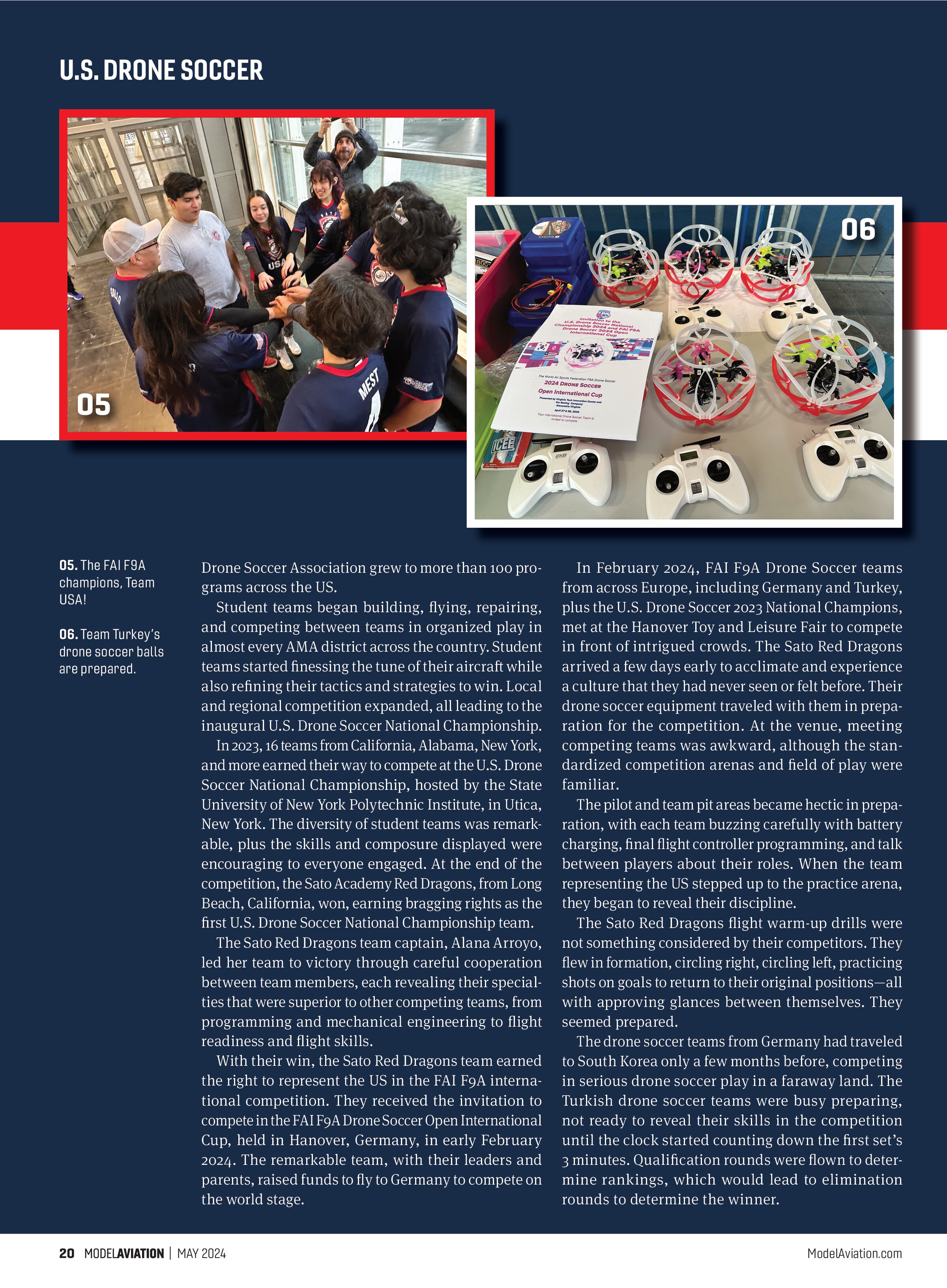
In February 2024, FAI F9A Drone Soccer teams from across Europe, including Germany and Turkey, plus the U.S. Drone Soccer 2023 National Champions, met at the Hanover Toy and Leisure Fair to compete in front of intrigued crowds. The Sato Red Dragons arrived a few days early to acclimate and experience a culture that they had never seen or felt before. Their drone soccer equipment traveled with them in preparation for the competition. At the venue, meeting competing teams was awkward, although the standardized competition arenas and field of play were familiar.
The pilot and team pit areas became hectic in preparation, with each team buzzing carefully with battery charging, final flight controller programming, and talk between players about their roles. When the team representing the US stepped up to the practice arena, they began to reveal their discipline.
The Sato Red Dragons flight warm-up drills were not something considered by their competitors. They flew in formation, circling right, circling left, practicing shots on goals to return to their original positions—all with approving glances between themselves. They seemed prepared.
The drone soccer teams from Germany had traveled to South Korea only a few months before, competing in serious drone soccer play in a faraway land. The Turkish drone soccer teams were busy preparing, not ready to reveal their skills in the competition until the clock started counting down the first set’s 3 minutes. Qualification rounds were flown to determine rankings, which would lead to elimination rounds to determine the winner.
Remarkably and proudly, the two teams representing the US finished in the top spots after the qualifying rounds. At the end of the qualifying rounds, the teams from Germany were prepared and ready for the elimination part of the competition. The teams from Turkey had mechanical challenges and needed spare parts to complete their fleet. Representing the US, the well-equipped Sato Red Dragons Drone Soccer team noticed the Turkish teams’ dilemma and offered to help. The student teams met to itemize the parts needed to get Turkey flying and competing again.
As the competition came to a close, a few things happened. FAI F9A Team USA, the Sato Red Dragons, went undefeated, winning first and second place in the tournament. Plus, unexpected friends were made and longtime connections were established. In other words, students from wildly diverse lands came to respect and realize how different, yet similar, they were. Each established lifelong friendships and experiences, forming them into better young adults.
A student who is inspired is maybe more joyful than the thrill of flight. Students working together to become better encourage everyone in the room and beyond. Programs that provide the tools to inspire might be the reason why AMA SIGs exist. Students who never fathom that they might represent their city, their state, their region, or their country are all across the US, and U.S. Drone Soccer is thrilled to be a leader in the effort.
Now, at more than 150 programs across 28 states, the 2024 U.S. Drone Soccer National Championship will be a culmination of competitions within each AMA district across the country. Teams from California, the Pacific Northwest, the Southeast, and definitely the Northeast (with five district qualifiers across New York State) will compete to represent their AMA district.
The 2024 U.S. Drone Soccer National Championship is slated for April 26-28, 2024, with Virginia Tech and The Boeing Company as the presenting hosts. Immediately following at the same venue, U.S. Drone Soccer and AMA will host the 2024 FAI F9A Drone Soccer Open International Cup with teams from around the world.
The newly crowned 2024 U.S. Drone Soccer National Champion will represent the US. The leadership and student team from Turkey are slated to visit Virginia to compete again against the Sato Red Dragons. Each student from around the world will become a little bit better, refining their career path and potential through model aviation.


U.S. Drone Soccer is a STEM-accredited 501(c)(3). The mission of U.S. Drone Soccer is to inspire students, providing a pathway and a vision for students to work harder in school so that they realize a great version of themselves as they grow through skills development.
SOURCES:
U.S. Drone Soccer
www.dronesoccer.us
FAI
www.fai.org