SAFETY COMES FIRST

A PYRAMID
SCHEME
FOR LIPO
CHARGING?
By Dave Gee | safetycolumn@cs.com
ED CROTTY made me laugh out loud. He shared his solution to a common issue, which involves masonry in a hobby that usually sticks to balsa and foam.
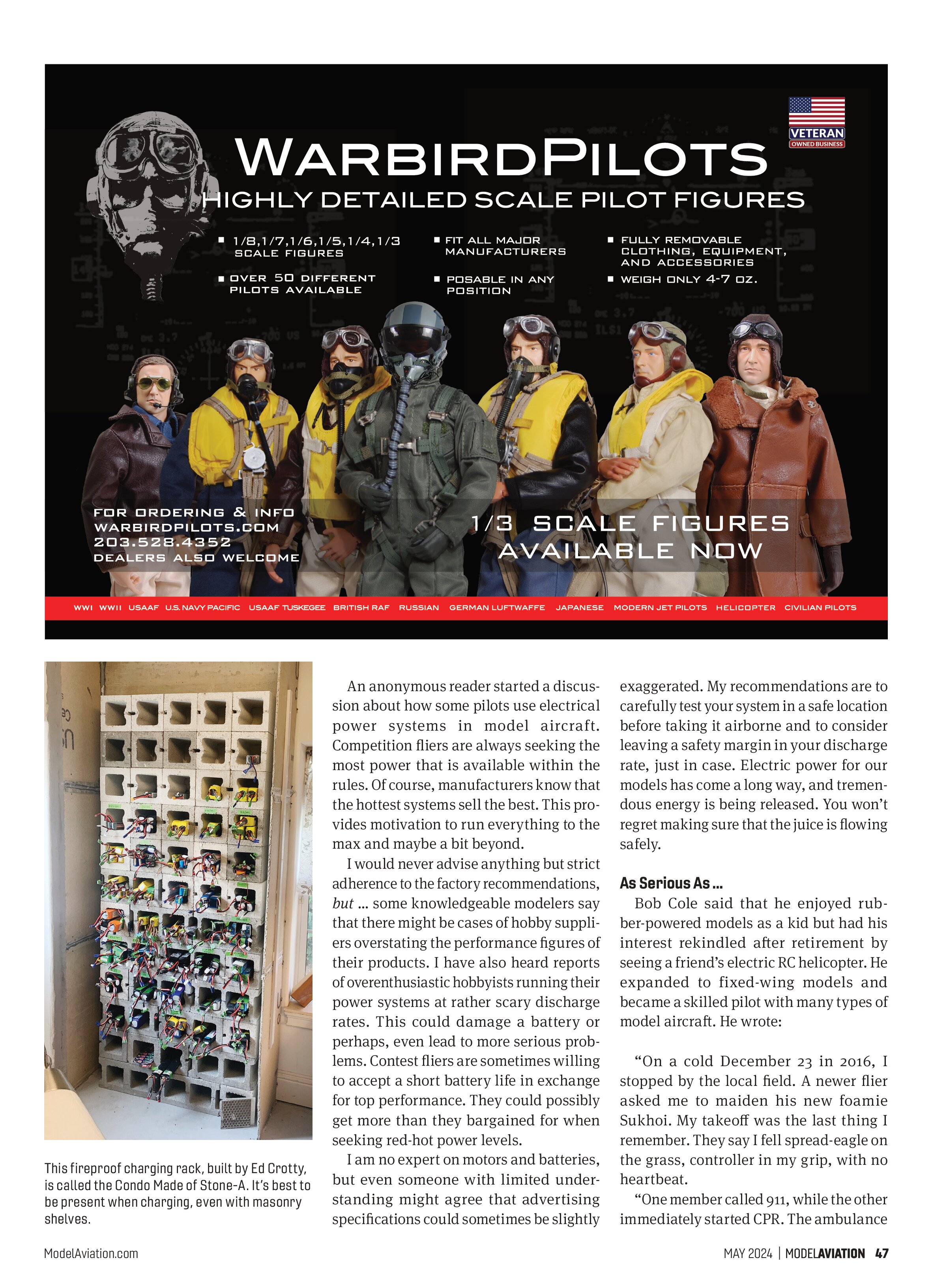
We all know that there have been incidents where battery charging operations led to fires at the homes of modelers. Ed wanted to reduce the risk, so he constructed a place for the batteries to safely sit as they got juiced up. He wrote:
“I call this my Condo Made of Stone-A. Easy to build from cinderblocks and fireproof cement and caulk. No masonry skill required, as I have none. The entire thing is surrounded (sides, top, and back) with cement board.”
Readers of a certain age might remember Steve Martin’s song about King Tut. If not, I recommend looking it up and having a listen. You’ll get an extra laugh now after seeing Ed’s project.
Please remember that the “best practices” standard is to be present at all times when your charger is operating. Fireproof locations are important, but there is no substitute for being right there in person when something goes wrong.
Advertising vs. Reality
Electric power systems can be a touchy subject. Watch now as I tiptoe through a minefield of legal liability, technological opinions, and anecdotal data.

An anonymous reader started a discussion about how some pilots use electrical power systems in model aircraft. Competition fliers are always seeking the most power that is available within the rules. Of course, manufacturers know that the hottest systems sell the best. This provides motivation to run everything to the max and maybe a bit beyond.
I would never advise anything but strict adherence to the factory recommendations, but ... some knowledgeable modelers say that there might be cases of hobby suppliers overstating the performance figures of their products. I have also heard reports of overenthusiastic hobbyists running their power systems at rather scary discharge rates. This could damage a battery or perhaps, even lead to more serious problems. Contest fliers are sometimes willing to accept a short battery life in exchange for top performance. They could possibly get more than they bargained for when seeking red-hot power levels.
I am no expert on motors and batteries, but even someone with limited understanding might agree that advertising specifications could sometimes be slightly exaggerated. My recommendations are to carefully test your system in a safe location before taking it airborne and to consider leaving a safety margin in your discharge rate, just in case. Electric power for our models has come a long way, and tremendous energy is being released. You won’t regret making sure that the juice is flowing safely.
As Serious As ...
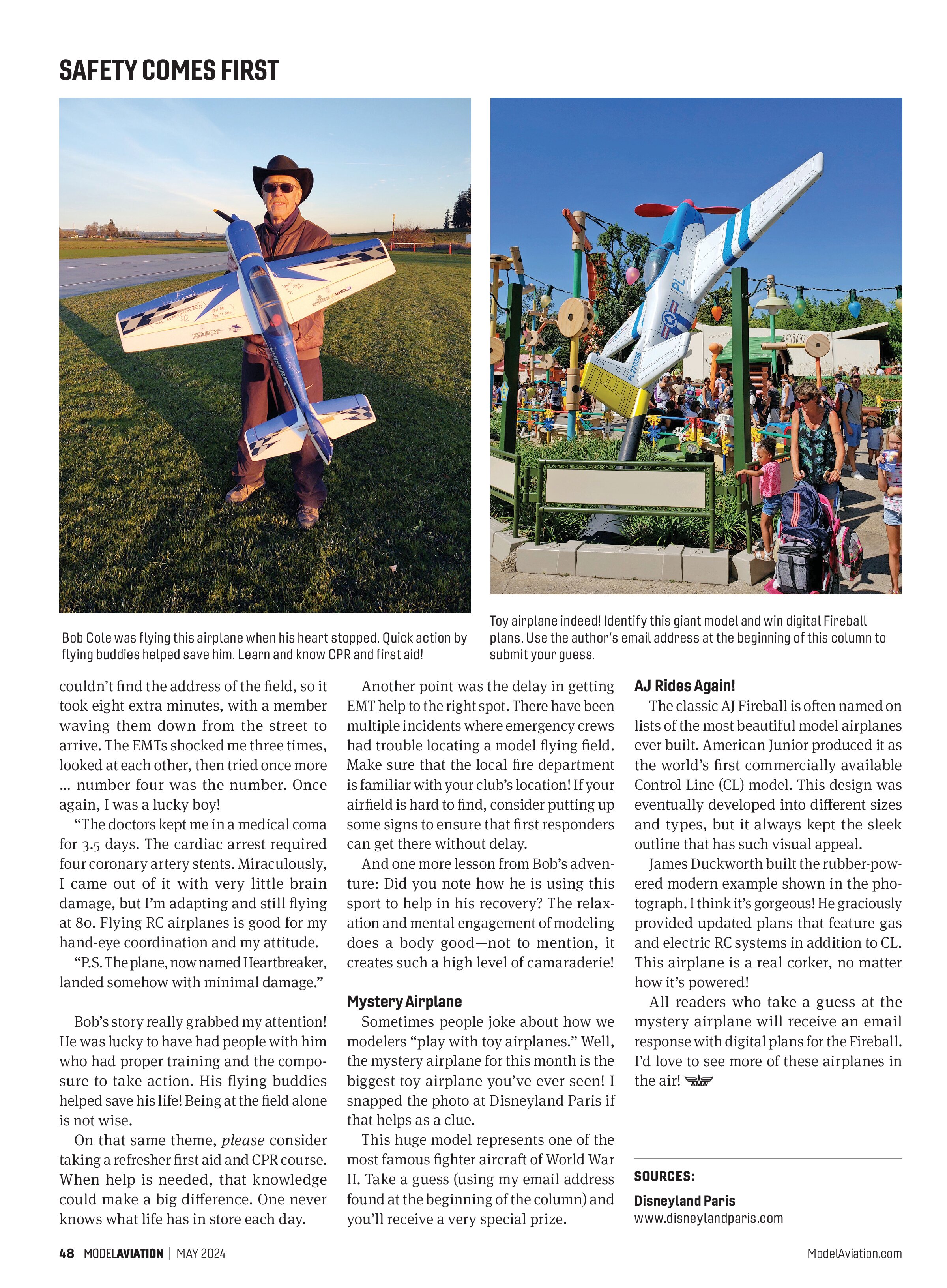
Bob Cole said that he enjoyed rubber-powered models as a kid but had his interest rekindled after seeing a friend’s electric RC helicopter. He expanded to fixed-wing models and became a skilled pilot with many types of model aircraft. He wrote:
“On a cold December 23 in 2016, I stopped by the local field. A newer flier asked me to maiden his new foamie Sukhoi. My takeoff was the last thing I remember. They say I fell spread-eagle on the grass, controller in my grip, with no heartbeat.
“One member called 911, while the other immediately started CPR. The ambulance
couldn’t find the address of the field, so it took eight extra minutes, with a member waving them down from the street to arrive. The EMTs shocked me three times, looked at each other, then tried once more ... number four was the number. Once again, I was a lucky boy!
“The doctors kept me in a medical coma for 3.5 days. The cardiac arrest required four coronary artery stents. Miraculously, I came out of it with very little brain damage, but I’m adapting and still flying at 80. Flying RC airplanes is good for my hand-eye coordination and my attitude.
“P.S. The plane, now named Heartbreaker, landed somehow with minimal damage.”
Bob’s story really grabbed my attention! He was lucky to have had people with him who had proper training and the composure to take action. His flying buddies helped save his life! Being at the field alone is not wise.
On that same theme, please consider taking a refresher first aid and CPR course. When help is needed, that knowledge could make a big difference. One never knows what life has in store each day.
Another point was the delay in getting EMT help to the right spot. There have been multiple incidents where emergency crews had trouble locating a model flying field. Make sure that the local fire department is familiar with your club’s location! If your airfield is hard to find, consider putting up some signs to ensure that first responders can get there without delay.
And one more lesson from Bob’s adventure: Did you note how he is using this sport to help in his recovery? The relaxation and mental engagement of modeling does a body good—not to mention, it creates such a high level of camaraderie!
Mystery Airplane
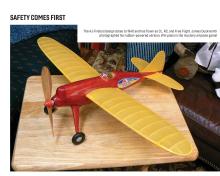
Sometimes people joke about how we modelers “play with toy airplanes.” Well, the mystery airplane for this month is the biggest toy airplane you’ve ever seen! I snapped the photo at Disneyland Paris if that helps as a clue.
This huge model represents one of the most famous fighter aircraft of World War II. Take a guess (using my email address found at the beginning of the column) and you’ll receive a very special prize.
AJ Rides Again!
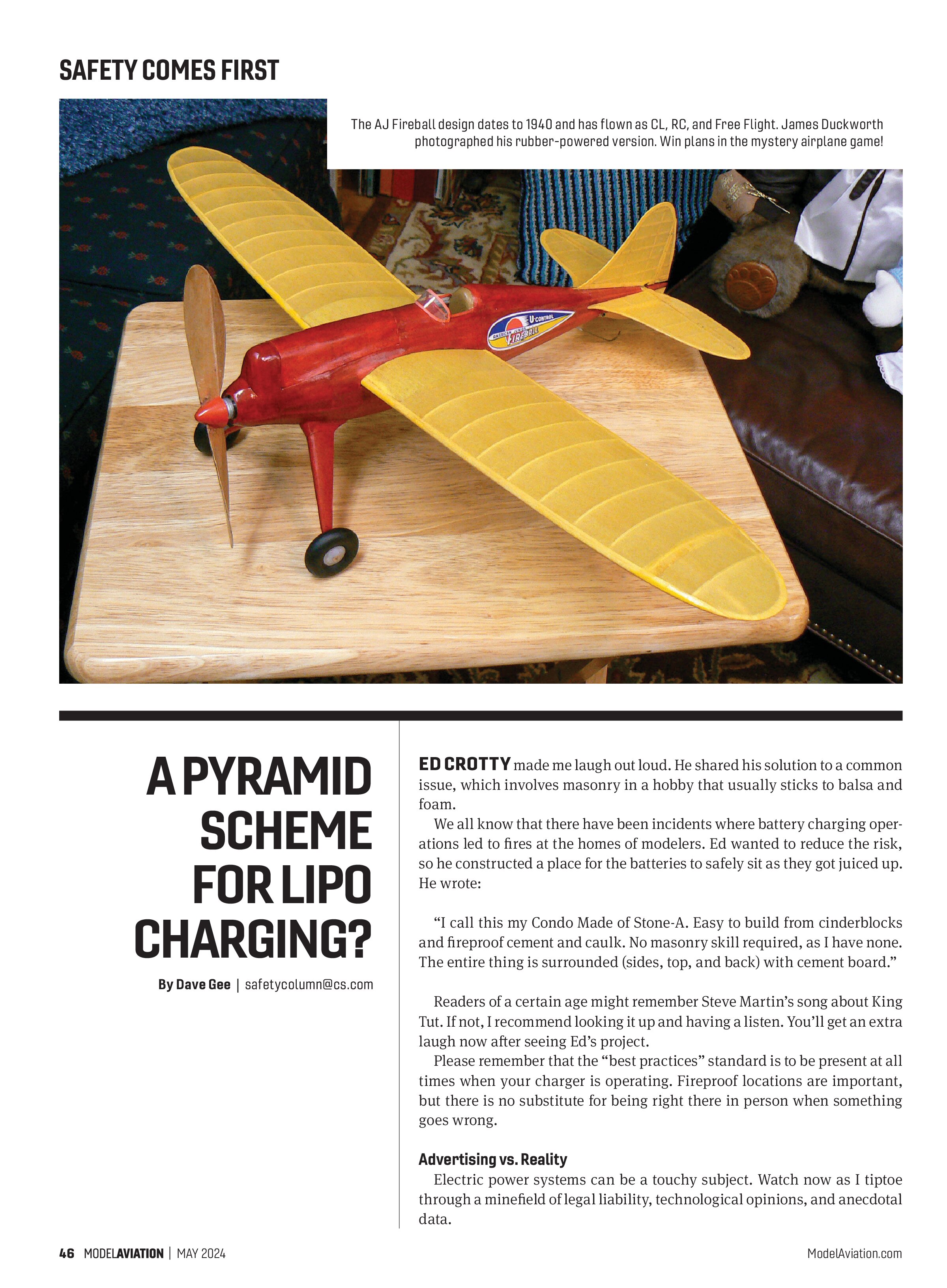
The classic AJ Fireball is often named on lists of the most beautiful model airplanes ever built. American Junior produced it as the world’s first commercially available Control Line (CL) model. This design was eventually developed into different sizes and types, but it always kept the sleek outline that has such visual appeal.
James Duckworth built the rubber-powered modern example shown in the photograph. I think it’s gorgeous! He graciously provided updated plans that feature gas and electric RC systems in addition to CL. This airplane is a real corker, no matter how it’s powered!
All readers who take a guess at the mystery airplane will receive an email response with digital plans for the Fireball. I’d love to see more of these airplanes in the air!
SOURCES:
Disneyland Paris
www.disneylandparis.com