RC PYLON RACING

2024 PYLON RACING EVENTS
By Tim Lampe | tim.lampe@hotmail.com
I’VE OCCASIONALLY WRITTEN about getting into three-pole RC Pylon Racing, what happens at a race, and what it’s like to experience success, exhilaration, and disappointment. By the time this column is published, the Pylon Racing season has begun. If Pylon Racing interests you and you would like to look into it further or actually experience it yourself, below is a list of the remaining 2024 races and their host clubs compiled from various sources:
- April 28: Arizona Electric Formula 1 (EF1) Racing Series; Mesa, Arizona—Arizona Model Aviators
- May 10-12: Heartland Speed Freakz (HSF) Spring Pylon Race; Lake Afton Park, Goddard, Kansas—HSF
- May 18-19: Fred Bungdorf Memorial Pylon Race; Woodland, California—Woodland/Davis Aeromodelers
- May 18-19: Indy Shootout; Muncie, Indiana—Can-Am Pylon Society (CAPS)
- May 19: Arizona EF1 Racing Series; Mesa, Arizona—Arizona Model Aviators
- June 1-2: Moonshot Pylon Race; Cincinnati, Ohio—Greater Cincinnati Radio Control Club/CAPS
- July 6-12: AMA RC Pylon Racing Nats; Muncie, Indiana
- July 27-28*: Lake County Modelers and Flying Association (LCMFA) Michigan Pylon Race; Baldwin, Michigan—LCMFA/CAPS
- August 24-25: National Miniature Pylon Racing Association (NMPRA)/CAPS Quarter 40 (Q-40) Championship Race; Muncie, Indiana
- September 7: Midwest Sundowners/CAPS Pylon Race; Hobart, Indiana
- September 14-15: Ben and Carolyn Martin Fall Classic; Muncie, Indiana—CAPS
- September 22: Arizona EF1 Racing Series; Mesa, Arizona—Arizona Model Aviators
- September 20-22: Annual Mike Tallman Memorial Q-40 Race; Lake Afton Park, Goddard, Kansas—HSF
- October 5-6*: Quickie 500 Championship; Scobee Field, Houston, Texas
- October 19-20: Dave Gavin Memorial Champ Race; Whittier, California—San Gabriel Valley Radio Control League
- October 20: Arizona EF1 Racing Series; Mesa, Arizona—Arizona Model Aviators
- October 26-27: Pylon Over The Glades; Delray Beach, Florida—Palm Beach Radio Control Association
- December 15: Arizona EF1 Racing Series; Mesa, Arizona—Arizona Model Aviators
*The format and dates of these races are tentative and still in discussion.
Note that each event might differ from others in the format, schedule, and classes that are held. Some events are only one class, while others might hold all four classes (EF1, 424, 426, and Q-40).
Be certain to consult the Upcoming Races schedule and the General Discussions Q500 & Q40 forum on the NMPRA website, the host club, the “Sanctioned Event Calendar” in Model Aviation, and/or the AMA Event Finder on the AMA website for the latest updates, format changes, classes being run, and possible date changes.
Also note that on April 26-28, there will be a Pylon Racing school at the AMA


International Aeromodeling Center in Muncie, Indiana. This is a preseason warmup/test and introduction to three-pole Pylon Racing that is open to veteran pilots and anyone who has an interest in participating in or observing Pylon Racing.
A New Q-40 on the Circuit
While the composite Pylon Racing aircraft that are available today are sequentially produced in boutique shops by meticulous craftsman, each design started out as a pilot’s dream or quest, beginning with an idea then some sketches and/or CAD drawings that proceeded to molds and, finally, evolved into a flyable prototype.
RC Pylon Racing is dotted with ingenious, technically minded craftsmen who design and custom-build their own models. One such craftsman is Jacob Raquet from Texas. After a several-year hiatus from Pylon Racing, Jacob returned to the circuit

a few years ago. He must have already been fast then because he’s one of the fastest pilots today.
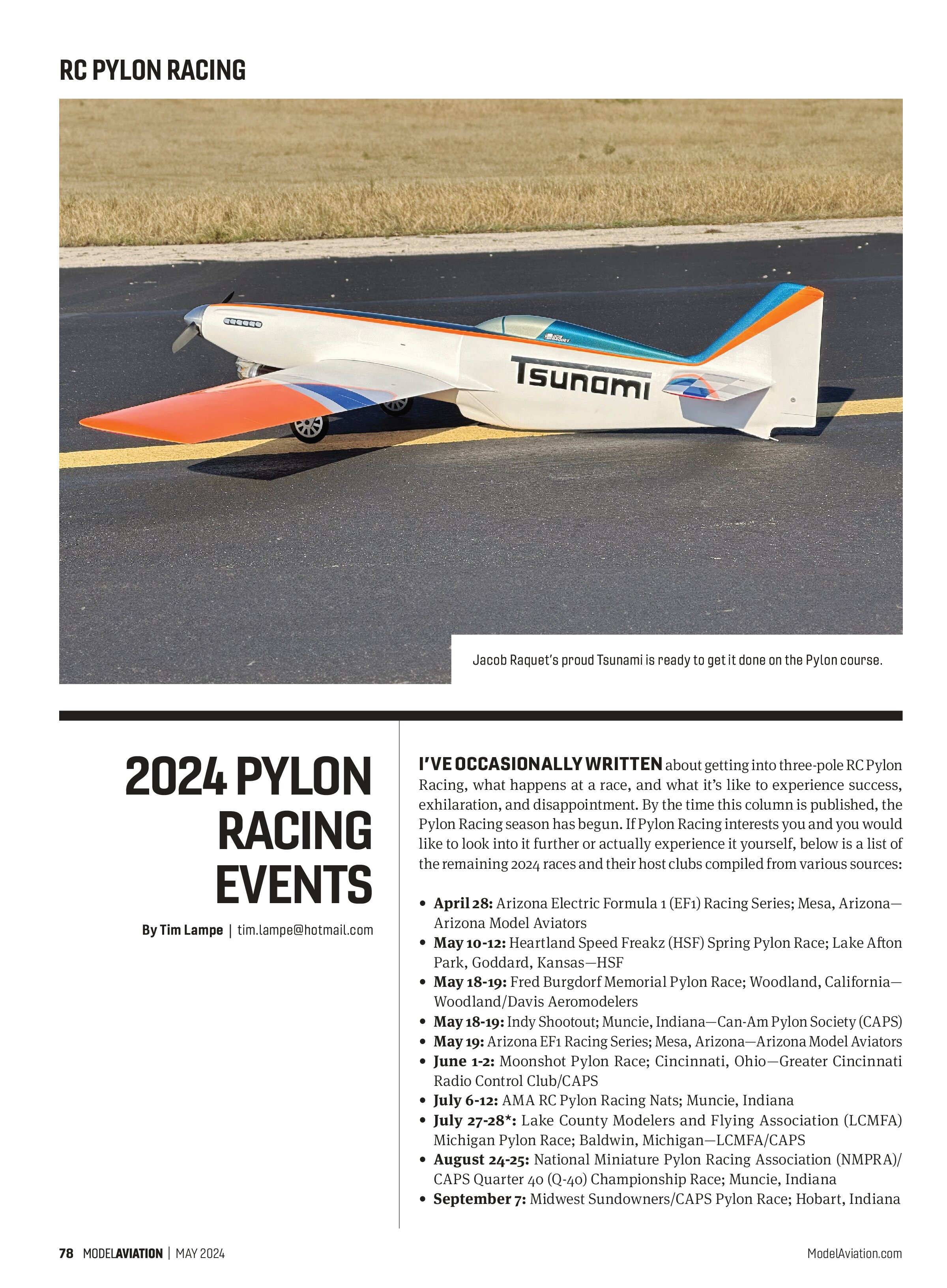
At some point, Jacob got the itch to make his own airplane for the premier class of Q-40 (AMA 422). The airplane he chose was the Tsunami. Although success was fleeting, the full-scale Tsunami was an iconic racing aircraft in the Unlimited class of Reno air racers. Jacob chose the Tsunami not only for its appearance but also to pay homage to the founders of the AMA 422 class and the very first Q-40 ever, a Tsunami by Jim Gager.
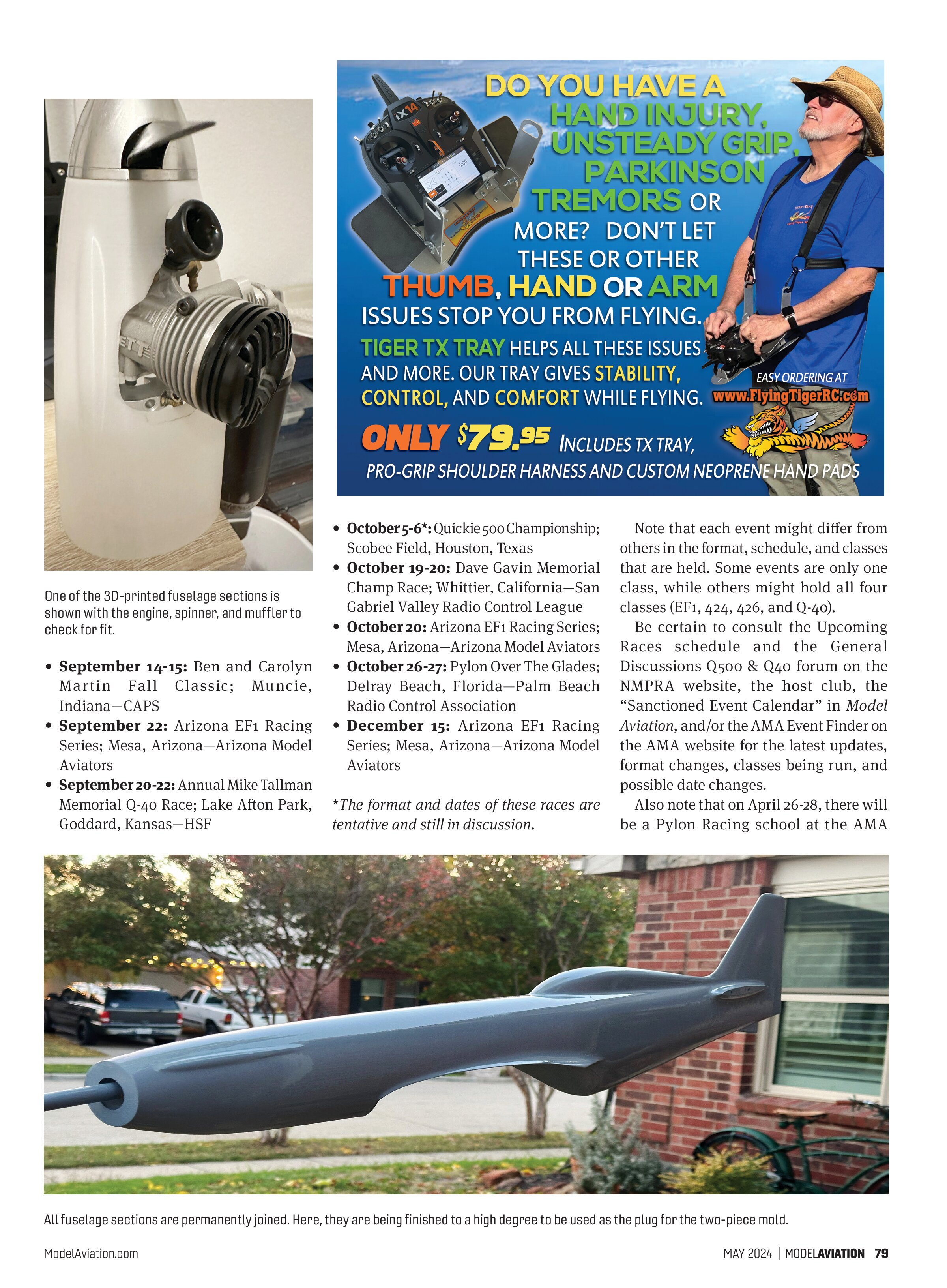
Pictures of Jacob’s design started to surface on Facebook, keeping enthusiasts riveted until the finished model was revealed. He told me that the project commenced by identifying a wing and tail already in existence from the Midget Mustang that was manufactured by Steve and Jo Taylor of A1 Composites in Australia. He then began designing the fuselage in SolidWorks, generating 3D models and, eventually, printing sections on a Formlabs SLA 3D printer.
Each section incorporated dowel pins to align with each other. Once joined, the assembly was finished with automotive primers and paint to produce a high-quality plug from which to make a traditional mold using a splitter plate sealed around the perimeter. The entire assembly was waxed and polished to provide a clean release from the mold components.
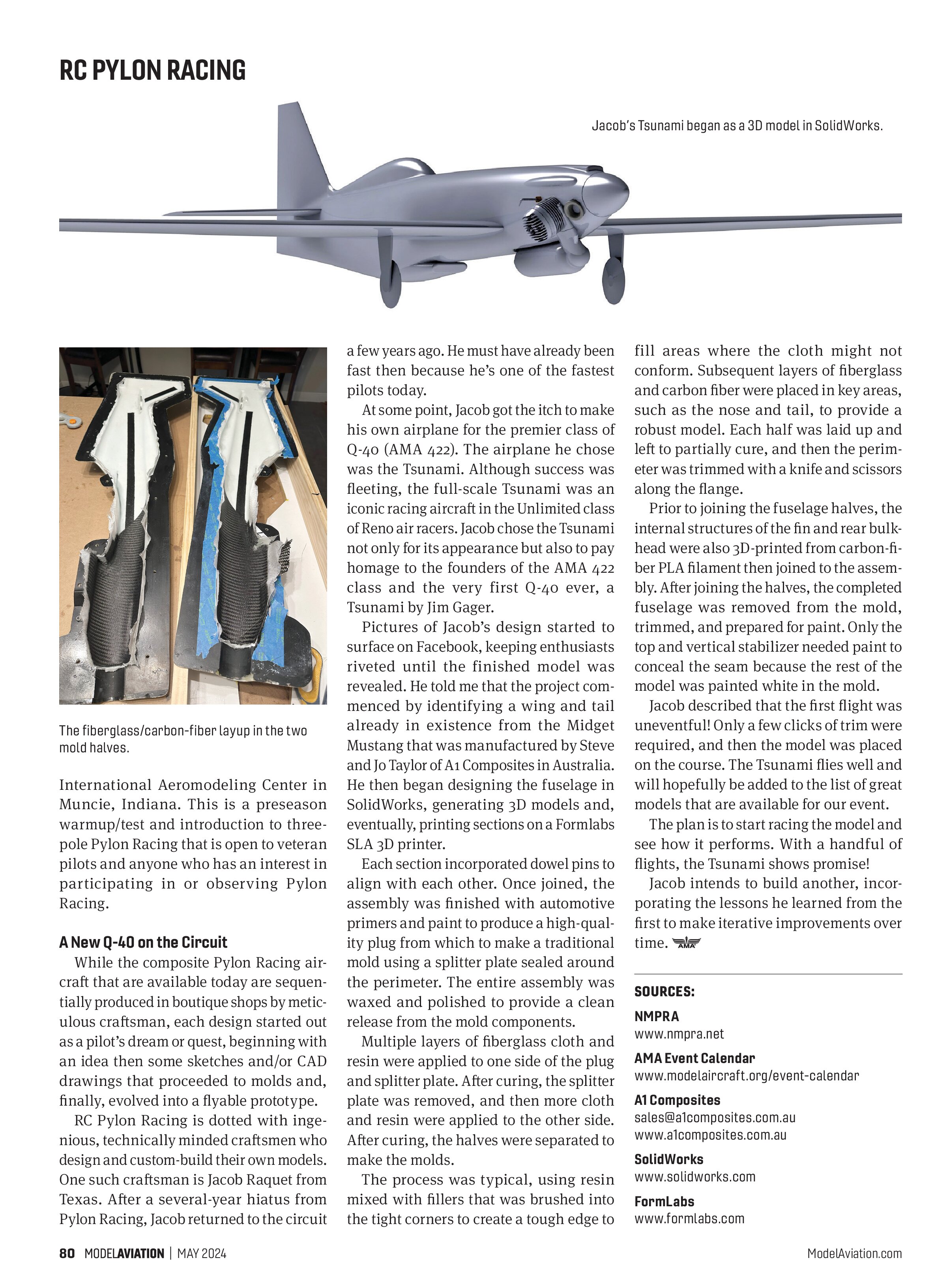
Multiple layers of fiberglass cloth and resin were applied to one side of the plug and splitter plate. After curing, the splitter plate was removed, and then more cloth and resin were applied to the other side. After curing, the halves were separated to make the molds.
The process was typical, using resin mixed with fillers that was brushed into the tight corners to create a tough edge to
fill areas where the cloth might not conform. Subsequent layers of fiberglass and carbon fiber were placed in key areas, such as the nose and tail, to provide a robust model. Each half was laid up and left to partially cure, and then the perimeter was trimmed with a knife and scissors along the flange.
Prior to joining the fuselage halves, the internal structures of the fin and rear bulkhead were also 3D-printed from carbon-fiber PLA filament then joined to the assembly. After joining the halves, the completed fuselage was removed from the mold, trimmed, and prepared for paint. Only the top and vertical stabilizer needed paint to conceal the seam because the rest of the model was painted white in the mold.
Jacob described that the first flight was uneventful! Only a few clicks of trim were required, and then the model was placed on the course. The Tsunami flies well and will hopefully be added to the list of great models that are available for our event.
The plan is to start racing the model and see how it performs. With a handful of flights, the Tsunami shows promise!
Jacob intends to build another, incorporating the lessons he learned from the first to make iterative improvements over time.
SOURCES:
NMPRA
www.nmpra.net
AMA Event Calendar
www.modelaircraft.org/event-calendar
A1 Composites
sales@a1composites.com.au
www.a1composites.com.au
SolidWorks
www.solidworks.com
FormLabs
www.formlabs.com