RC JETS

LARGE MODEL
AIRPLANE
PROGRAM
By Jim Hiller | jetmodeler@earthlink.net
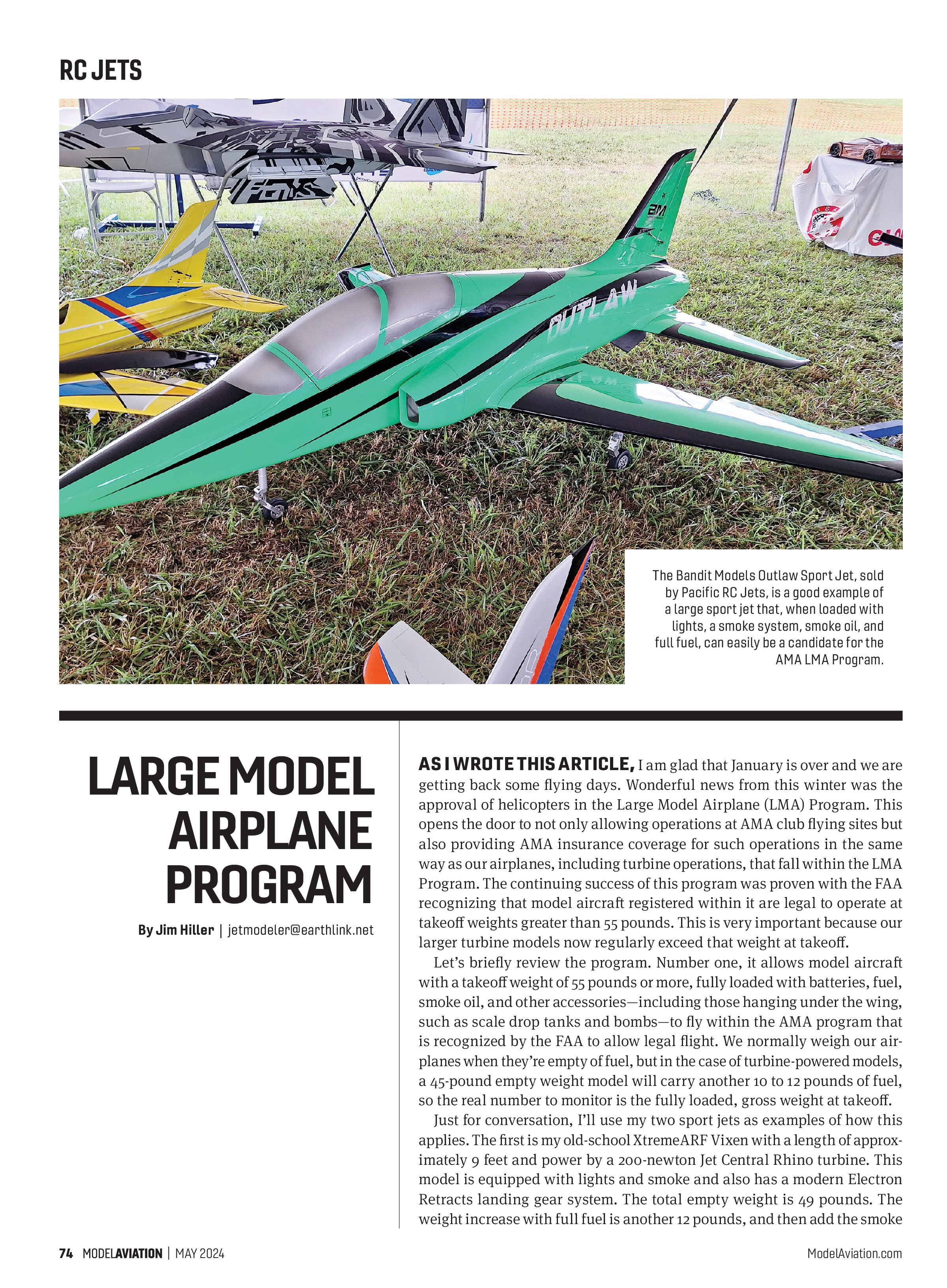
AS I WROTE THIS ARTICLE, I am glad that January is over and we are getting back some flying days. Wonderful news from this winter was the approval of helicopters in the Large Model Airplane (LMA) Program. This opens the door to not only allowing operations at AMA club flying sites but also providing AMA insurance coverage for such operations in the same way as our airplanes, including turbine operations, that fall within the LMA Program. The continuing success of this program was proven with the FAA recognizing that model aircraft registered within it are legal to operate at takeoff weights greater than 55 pounds. This is very important because our larger turbine models now regularly exceed that weight at takeoff.
Let’s briefly review the program. Number one, it allows model aircraft with a takeoff weight of 55 pounds or more, fully loaded with batteries, fuel, smoke oil, and other accessories—including those hanging under the wing, such as scale drop tanks and bombs—to fly within the AMA program that is recognized by the FAA to allow legal flight. We normally weigh our airplanes when they’re empty of fuel, but in the case of turbine-powered models, a 45-pound empty weight model will carry another 10 to 12 pounds of fuel, so the real number to monitor is the fully loaded, gross weight at takeoff.
Just for conversation, I’ll use my two sport jets as examples of how this applies. The first is my old-school XtremeARF Vixen with a length of approximately 9 feet and power by a 200-newton Jet Central Rhino turbine. This model is equipped with lights and smoke and also has a modern Electron Retracts landing gear system. The total empty weight is 49 pounds. The weight increase with full fuel is another 12 pounds, and then add the smoke oil for up to another 3 pounds. I only have close to 2.5 minutes of smoke. The takeoff weight totals 64 pounds, so it is a registered Large Turbine Model Airplane 1 (LTMA-1) model aircraft.
My latest build is an Elite Aerosports Picaro, which is about the same size at approximately 9 feet in length. It is again powered by a 200-newton Jet Central Rhino turbine. The empty weight is only 42 pounds. This airplane is also equipped with the heavier Electron Retracts landing gear system. Yes, pneumatic gear and brakes can save some weight, but the Picaro does not have lights or a smoke system. This airplane carries slightly less fuel, so fully fueled, it only adds 10 pounds for a takeoff weight of 52 pounds. This is easily within the non-LTMA weight limits.
I cite these two examples to show how close we are to our larger models needing to be registered in the LMA Program. The process for turbine models of less than 77 pounds, 2 ounces is simple; it only involves filling out a few forms.
Form 1 is filled out and signed by the owner as a verification of the preflight inspection. Form 2 is the flight itself, which is witnessed by the owner and an observer who is either a contest director, Leader Member, or an LMA Inspector. Finding someone to witness the flight has never proven difficult for me. Most clubs have at least one member who meets the criteria.
Forms 3 and 4 are owner/builder declaration forms, with Form 5 establishing the standard preflight checklist for the model’s operator.
I have easily accomplished these tasks for LTMA-1. It takes roughly an hour, including the flight with observers at the field, even when walking first-timers through the process.
For LTMA-2 turbine aircraft that are 77 pounds, 2 ounces up to 100 pounds fully fueled, an LMA Inspector is required to sign off on Form 1, the preflight inspection. Arranging time with a volunteer LMA Inspector tends to be more involved, but many of them have proven quite helpful in arranging a time and place to witness the flight and assist in the paperwork. Most tend to be avid modelers themselves.
The LTMA Program works well because we use it—let that thought help decide your choice. Large turbine models are quite popular and, with the advent of the increasing number of ARFs and kits for large models, this program allows us to participate in AMA sanctioned flying events.
Maintaining an LTMA-1 registration is not that difficult. The three-year renewal


of paperwork is straightforward. Keep a copy of your original records and obtain updated signatures, which assures AMA leaders that the airplane is still active.
For more information, visit the AMA website and go to the Programs menu. In the lower right column, you will find the AMA LMA Program section, which has all of the information that you need to know about whether you should register your model aircraft, what is required, and how to register. The list of models that have been registered under this program is 22 pages, or approximately 400 models, and with the direction that our hobby is moving, there will be many more to come.
AMA Hall of Fame Induction
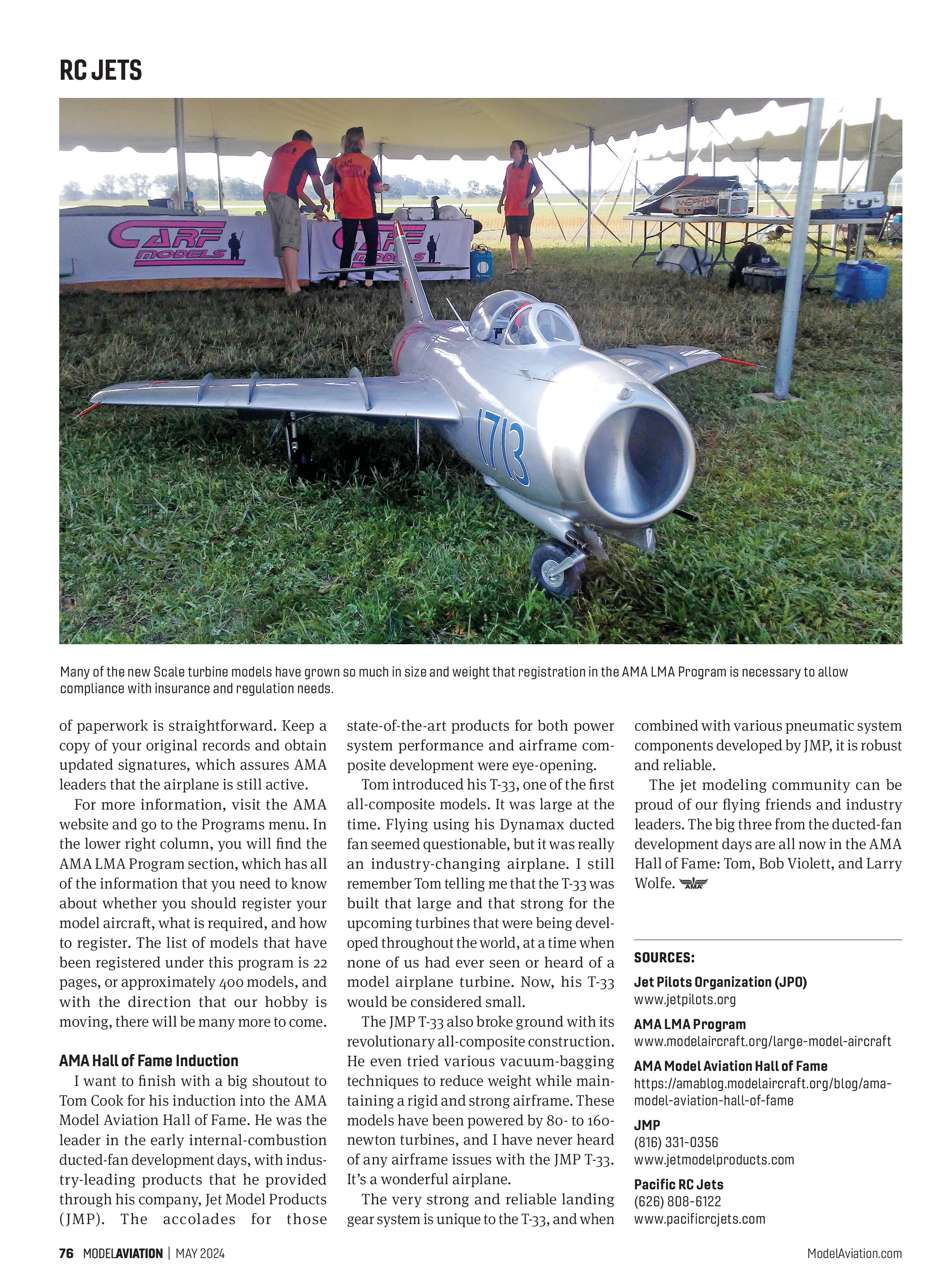
I want to finish with a big shoutout to Tom Cook for his induction into the AMA Model Aviation Hall of Fame. He was the leader in the early internal-combustion ducted-fan development days, with industry-leading products that he provided through his company, Jet Model Products (JMP). The accolades for those state-of-the-art products for both power system performance and airframe composite development were eye-opening.
Tom introduced his T-33, one of the first all-composite models. It was large at the time. Flying using his Dynamax ducted fan seemed questionable, but it was really an industry-changing airplane. I still remember Tom telling me that the T-33 was built that large and that strong for the upcoming turbines that were being developed throughout the world, at a time when none of us had ever seen or heard of a model airplane turbine. Now, his T-33 would be considered small.
The JMP T-33 also broke ground with its revolutionary all-composite construction. He even tried various vacuum-bagging techniques to reduce weight while maintaining a rigid and strong airframe. These models have been powered by 80- to 160-newton turbines, and I have never heard of any airframe issues with the JMP T-33. It’s a wonderful airplane.
The very strong and reliable landing gear system is unique to the T-33, and when combined with various pneumatic system components developed by JMP, it is robust and reliable.
The jet modeling community can be proud of our flying friends and industry leaders. The big three from the ducted-fan development days are all now in the AMA Hall of Fame: Tom, Bob Violett, and Larry Wolfe.
SOURCES:
Jet Pilots Organization (JPO)
www.jetpilots.org
AMA LMA Program
www.modelaircraft.org/large-model-aircraft
AMA Model Aviation Hall of Fame
https://amablog.modelaircraft.org/blog/ama-model-aviation-hall-of-fame
JMP
(816) 331-0356
www.jetmodelproducts.com
Pacific RC Jets
(626) 808-6122
www.pacificrcjets.com