RC Aerobatics
THE STALL
TURN
By Justin Wells | justinwells@mac.com

WE’VE SPENT THE LAST TWO SEASONS working on our rolling and looping maneuvers. I’ll dive into something a little different and mix it up a bit. Let’s try the stall turn, also known as the Hammerhead.
I would consider this maneuver easy, but if it’s not correctly executed, it can be a “flop.” Like many things in RC Aerobatics (Pattern), this one is about timing and consistency. In its simplest form, the stall turn can be described as full throttle, pull to a vertical upline, throttle back, full rudder, and done! If you have been following my columns for some time, you know that there is much more to it than that, so let’s dive in deeper.
The single stall turn is commonly a turnaround maneuver that is executed at each end of the aerobatic box. For example, you might find a double stall turn used as a center maneuver. The figure “M” or double stall turn would be used like this.
Executing the Stall Turn
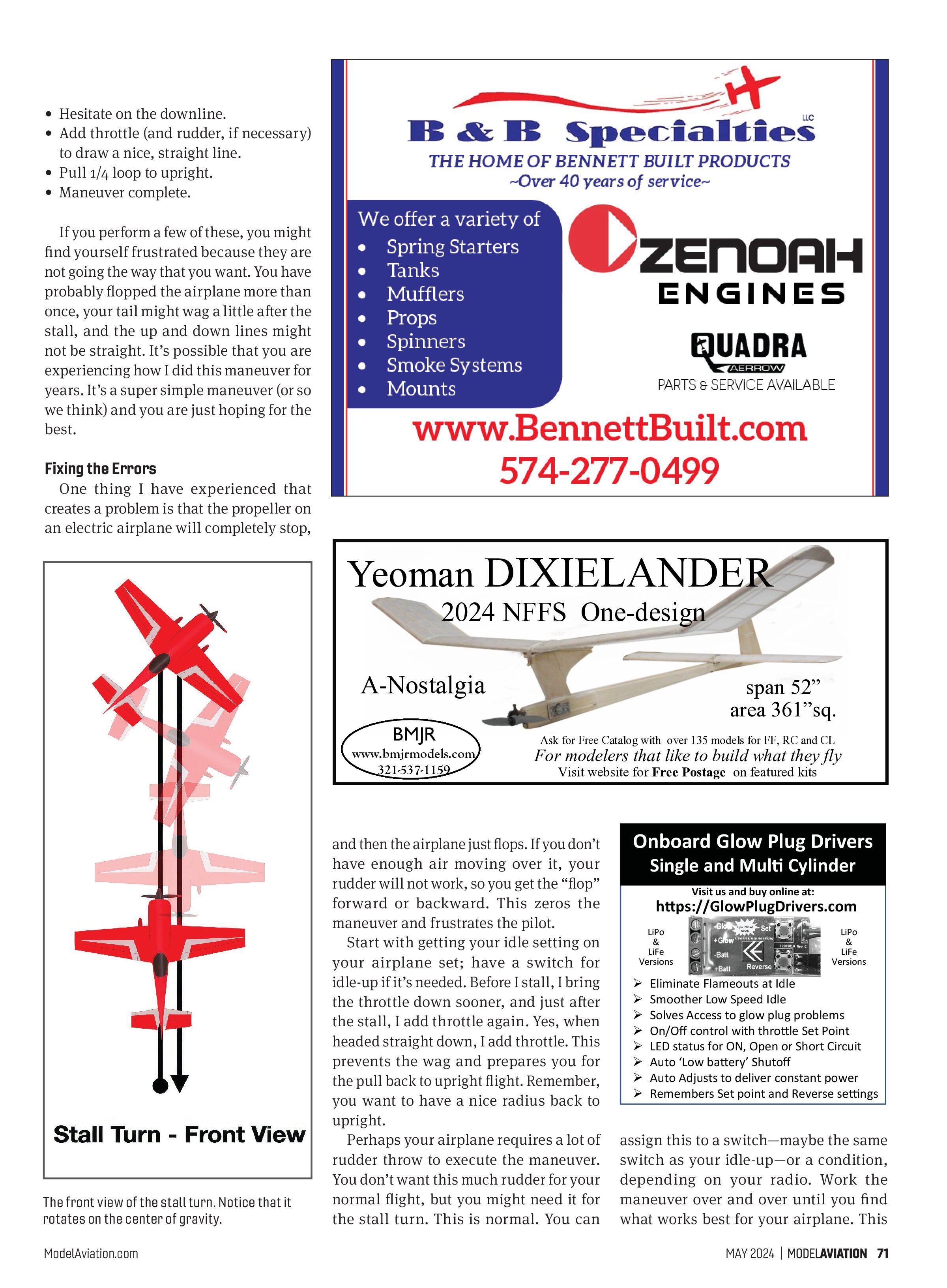
For ease of understanding, let’s execute the single stall turn to the right (past center) so that you can get the feel of how it should look.
- Fly past center and throttle up.
- Wings level.
- Pull 1/4 loop to a vertical upline.
- Hesitate. Use some rudder if needed to keep the airplane going straight up.
- Slowly reduce your throttle; don’t slam it closed.
- As the airplane starts to stall, give it right (or left) rudder.
- Hesitate on the downline.
- Add throttle (and rudder, if necessary) to draw a nice, straight line.
- Pull 1/4 loop to upright.
- Maneuver complete.
If you perform a few of these, you might find yourself frustrated because they are not going the way that you want. You have probably flopped the airplane more than once, your tail might wag a little after the stall, and the up and down lines might not be straight. It’s possible that you are experiencing how I did this maneuver for years. It’s a super simple maneuver (or so we think) and you are just hoping for the best.
Fixing the Errors
One thing I have experienced that creates a problem is that the propeller on an electric airplane will completely stop,

and then the airplane just flops. If you don’t have enough air moving over it, your rudder will not work, so you get the “flop” forward or backward. This zeros the maneuver and frustrates the pilot.
Start with getting your idle setting on your airplane set; have a switch for idle-up if it’s needed. Before I stall, I bring the throttle down sooner, and just after the stall, I add throttle again. Yes, when headed straight down, I add throttle. This prevents the wag and prepares you for the pull back to upright flight. Remember, you want to have a nice radius back to upright.
Perhaps your airplane requires a lot of rudder throw to execute the maneuver. You don’t want this much rudder for your normal flight, but you might need it for the stall turn. This is normal. You can assign this to a switch—maybe the same switch as your idle-up—or a condition, depending on your radio. Work the maneuver over and over until you find what works best for your airplane. This
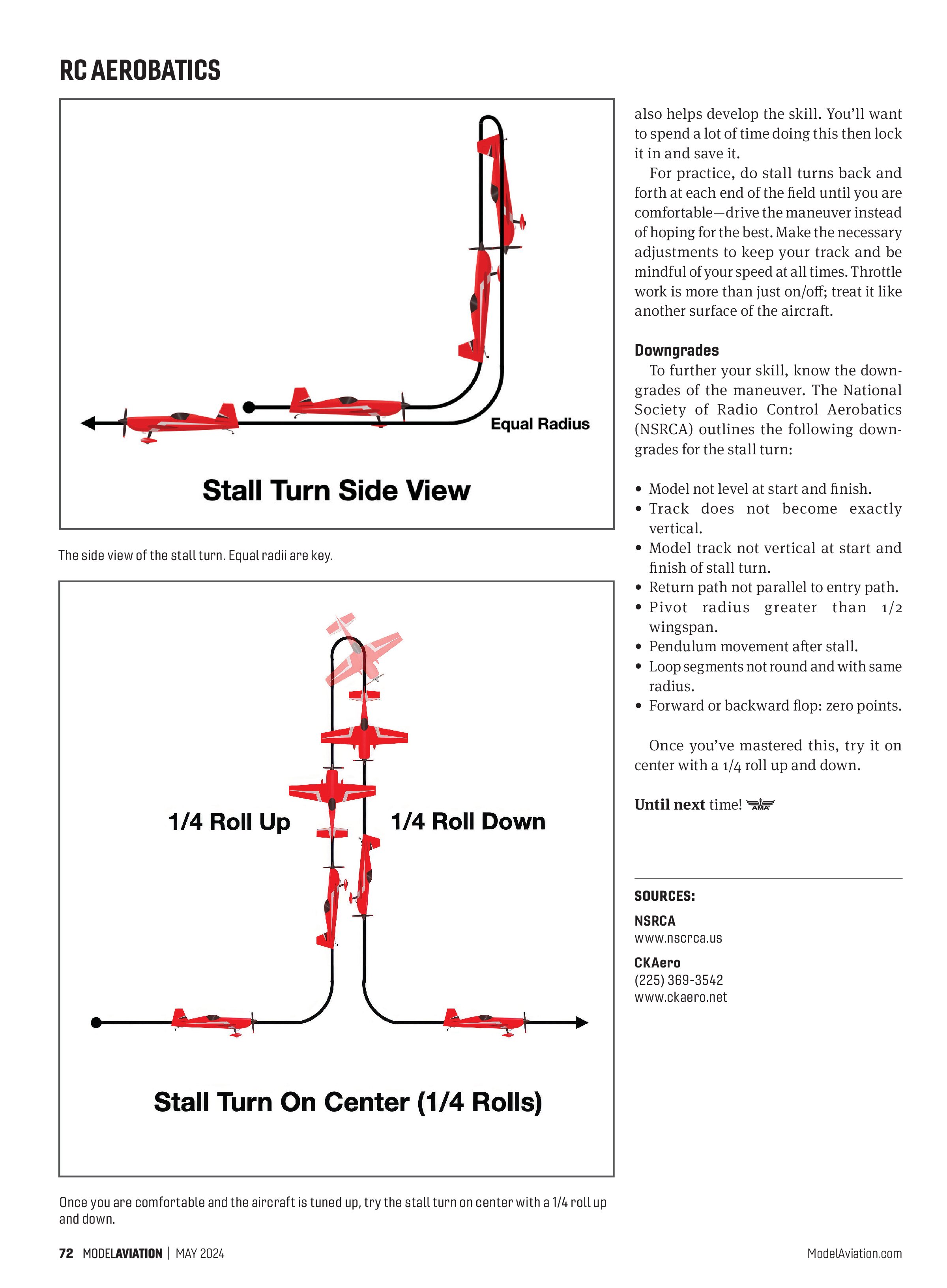
Stall Turn Side View

Once you are comfortable and the aircraft is tuned up, try the stall turn on center with a 1/4 roll up and down.
also helps develop the skill. You’ll want to spend a lot of time doing this then lock it in and save it.
For practice, do stall turns back and forth at each end of the field until you are comfortable—drive the maneuver instead of hoping for the best. Make the necessary adjustments to keep your track and be mindful of your speed at all times. Throttle work is more than just on/off; treat it like another surface of the aircraft.
Downgrades
To further your skill, know the downgrades of the maneuver. The National Society of Radio Control Aerobatics (NSRCA) outlines the following downgrades for the stall turn:
- Model not level at start and finish.
- Track does not become exactly vertical.
- Model track not vertical at start and finish of stall turn.
- Return path not parallel to entry path.
- Pivot radius greater than 1/2 wingspan.
- Pendulum movement after stall.
- Loop segments not round and with same radius.
- Forward or backward flop: zero points.
Once you’ve mastered this, try it on center with a 1/4 roll up and down.
Until next time!
Sources:
NSRCA
www.nsrca.us
CKAero
(225) 369-3542
www.ckaero.net