JOINING
CARBON-FIBER
TUBES
By Rob Caso | quack916@aol.com
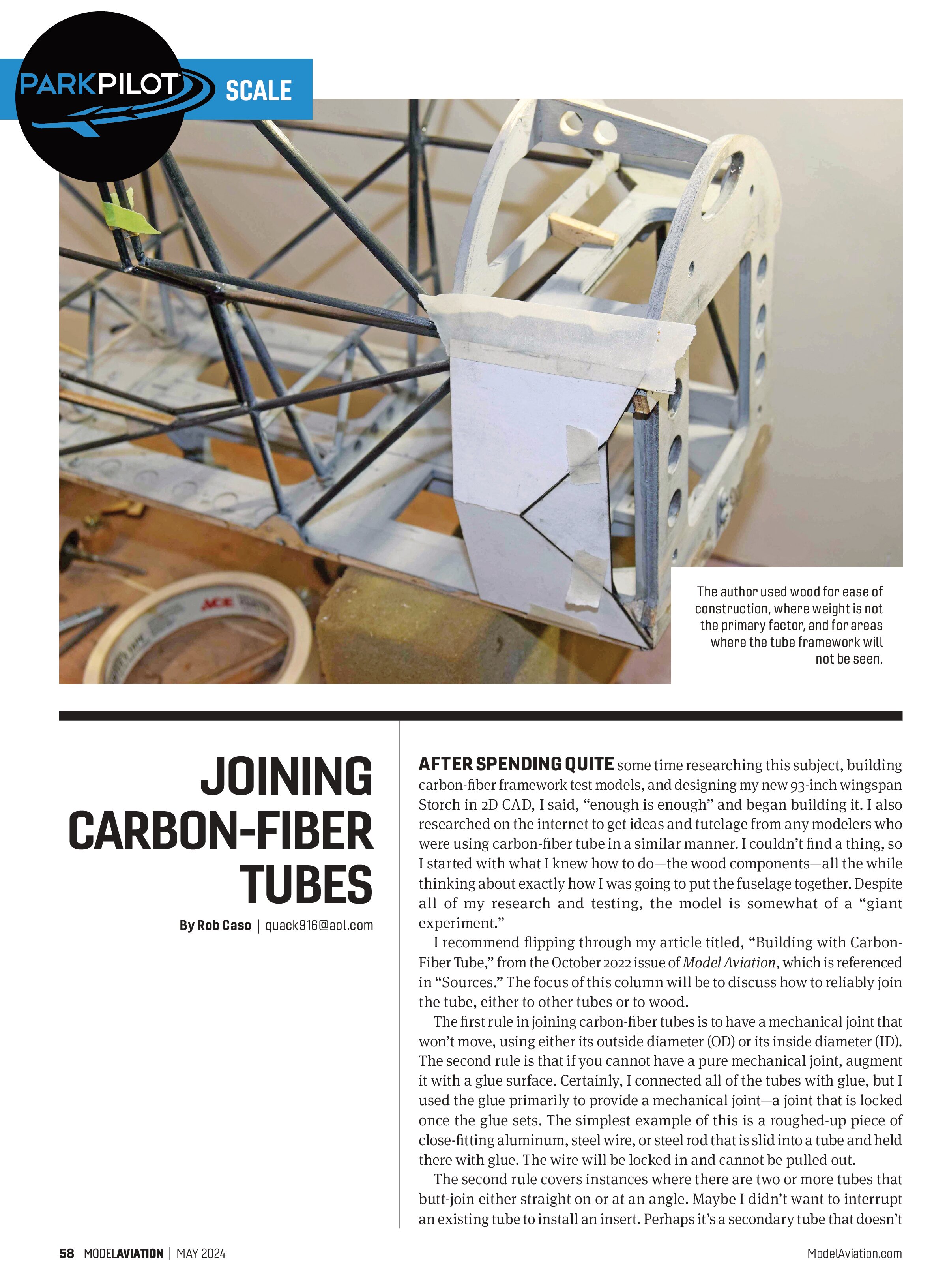
AFTER SPENDING QUITE some time researching this subject, building carbon-fiber framework test models, and designing my new 93-inch wingspan Storch in 2D CAD, I said, “enough is enough” and began building it. I also researched on the internet to get ideas and tutelage from any modelers who were using carbon-fiber tube in a similar manner. I couldn’t find a thing, so I started with what I knew how to do—the wood components—all the while thinking about exactly how I was going to put the fuselage together. Despite all of my research and testing, the model is somewhat of a “giant experiment.”
I recommend flipping through my article titled, “Building with Carbon-Fiber Tube,” from the October 2022 issue of Model Aviation, which is referenced in “Sources.” The focus of this column will be to discuss how to reliably join the tube, either to other tubes or to wood.
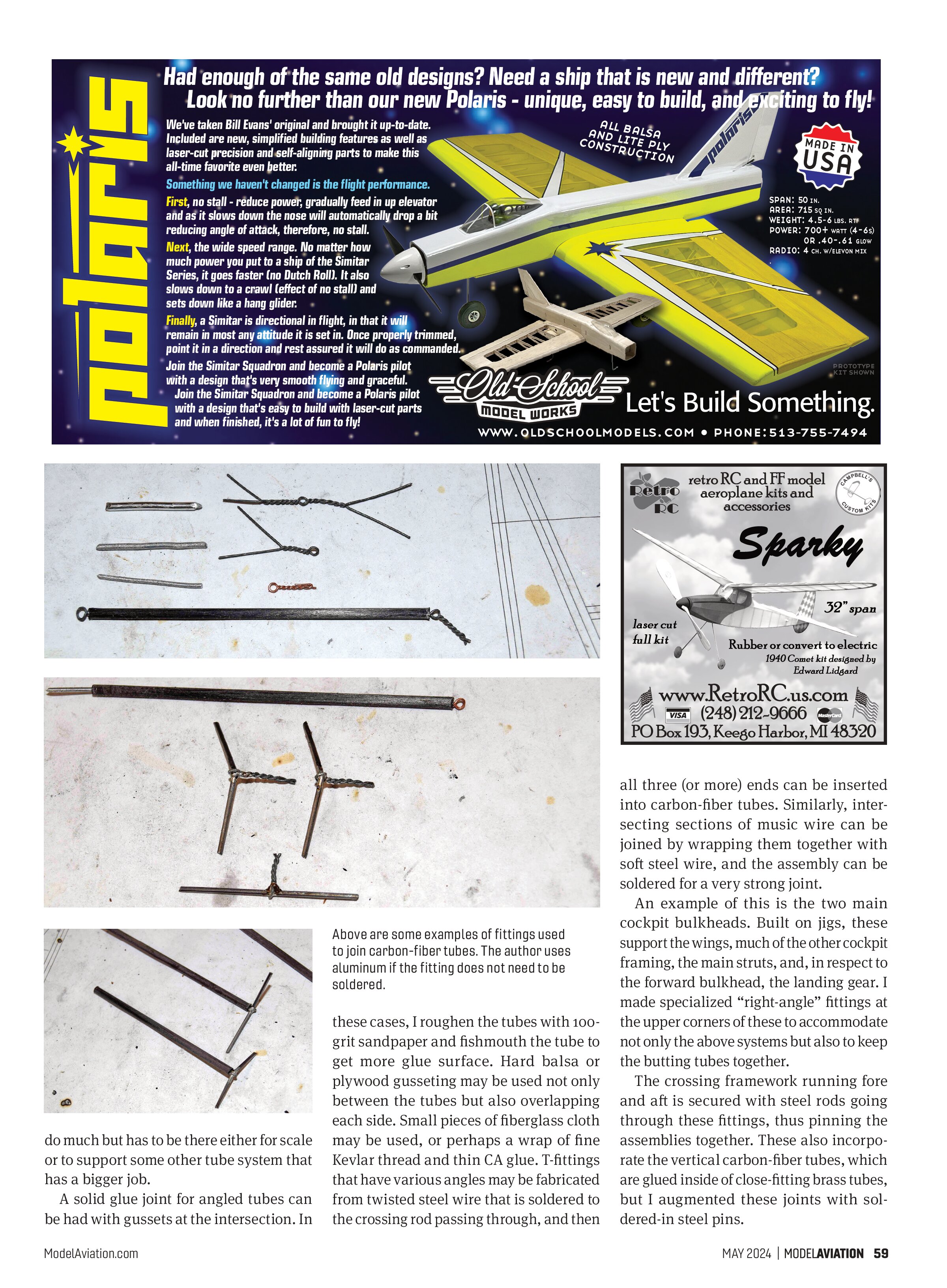
The first rule in joining carbon-fiber tubes is to have a mechanical joint that won’t move, using either its outside diameter (OD) or its inside diameter (ID). The second rule is that if you cannot have a pure mechanical joint, augment it with a glue surface. Certainly, I connected all of the tubes with glue, but I used the glue primarily to provide a mechanical joint—a joint that is locked once the glue sets. The simplest example of this is a roughed-up piece of close-fitting aluminum, steel wire, or steel rod that is slid into a tube and held there with glue. The wire will be locked in and cannot be pulled out.
The second rule covers instances where there are two or more tubes that butt-join either straight on or at an angle. Maybe I didn’t want to interrupt an existing tube to install an insert. Perhaps it’s a secondary tube that doesn’t
all three (or more) ends can be inserted into carbon-fiber tubes. Similarly, intersecting sections of music wire can be joined by wrapping them together with soft steel wire, and the assembly can be soldered for a very strong joint.
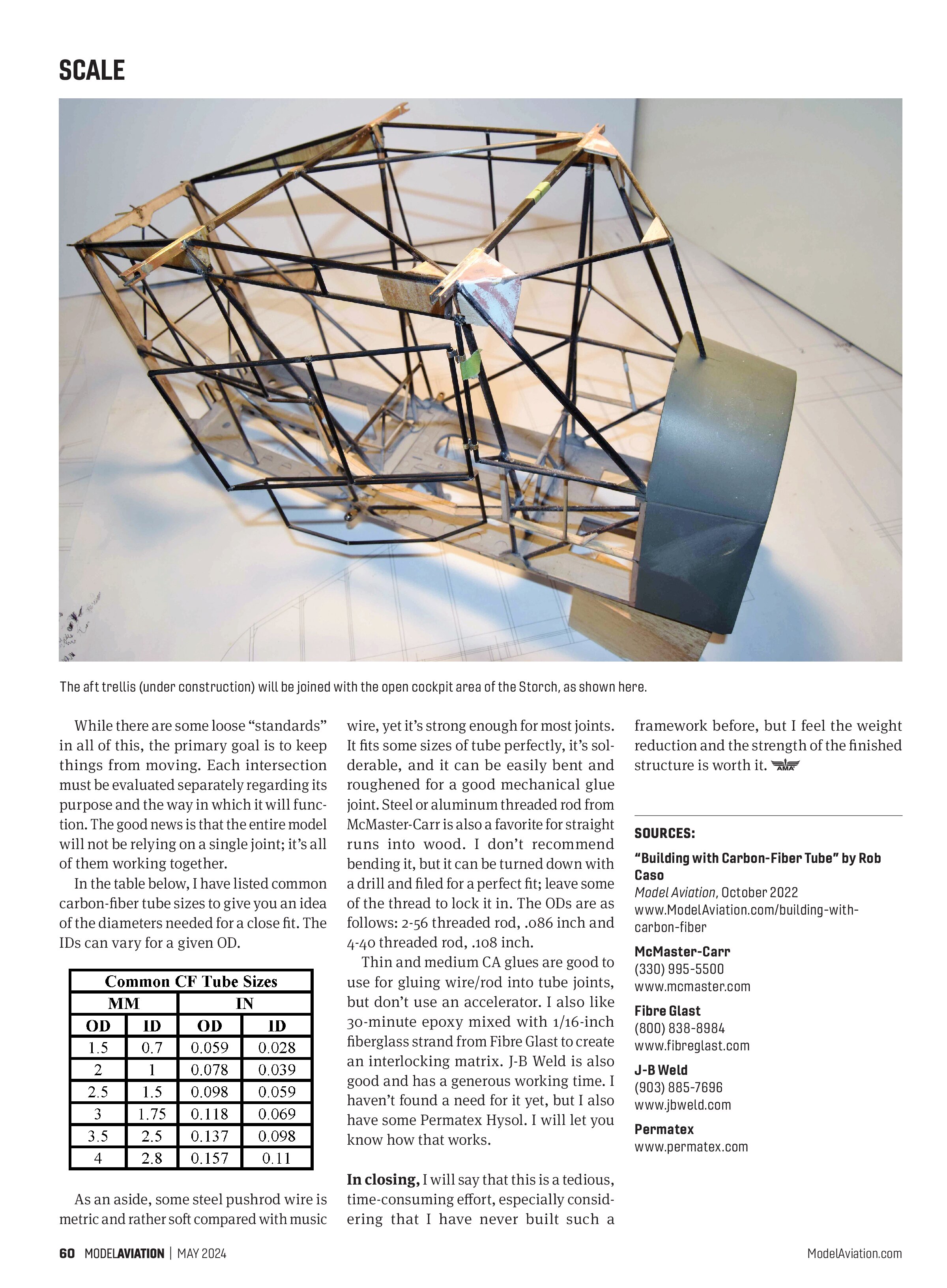
An example of this is the two main cockpit bulkheads. Built on jigs, these support the wings, much of the other cockpit framing, the main struts, and, in respect to the forward bulkhead, the landing gear. I made specialized “right-angle” fittings at the upper corners of these to accommodate not only the above systems but also to keep the butting tubes together.
The crossing framework running fore and aft is secured with steel rods going through these fittings, thus pinning the assemblies together. These also incorporate the vertical carbon-fiber tubes, which are glued inside of close-fitting brass tubes, but I augmented these joints with soldered-in steel pins.


While there are some loose “standards” in all of this, the primary goal is to keep things from moving. Each intersection must be evaluated separately regarding its purpose and the way in which it will function. The good news is that the entire model will not be relying on a single joint; it’s all of them working together.
In the table below, I have listed common carbon-fiber tube sizes to give you an idea of the diameters needed for a close fit. The IDs can vary for a given OD.
Common CF Tube Sizes
MM: OD, ID
1.5, 0.7
2, 1
2.5, 1.5
3, 1.75
3.5, 2.5
4, 2.8
IN: OD, ID
0.059, 0.028
0.078, 0.039
0.098, 0.059
0.118, 0.069
0.137, 0.098
0.157, 0.11
As an aside, some steel pushrod wire is metric and rather soft compared with music wire, yet it’s strong enough for most joints. It fits some sizes of tube perfectly, it’s solderable, and it can be easily bent and roughened for a good mechanical glue joint. Steel or aluminum threaded rod from McMaster-Carr is also a favorite for straight runs into wood. I don’t recommend bending it, but it can be turned down with a drill and filed for a perfect fit; leave some of the thread to lock it in. The ODs are as follows: 2-56 threaded rod, .086 inch and 4-40 threaded rod, .108 inch.
Thin and medium CA glues are good to use for gluing wire/rod into tube joints, but don’t use an accelerator. I also like 30-minute epoxy mixed with 1/16-inch fiberglass strand from Fibre Glast to create an interlocking matrix. J-B Weld is also good and has a generous working time. I haven’t found a need for it yet, but I also have some Permatex Hysol. I will let you know how that works.
In closing, I will say that this is a tedious, time-consuming effort, especially considering that I have never built such a framework before, but I feel the weight reduction and the strength of the finished structure is worth it.