MICRO-FLYING
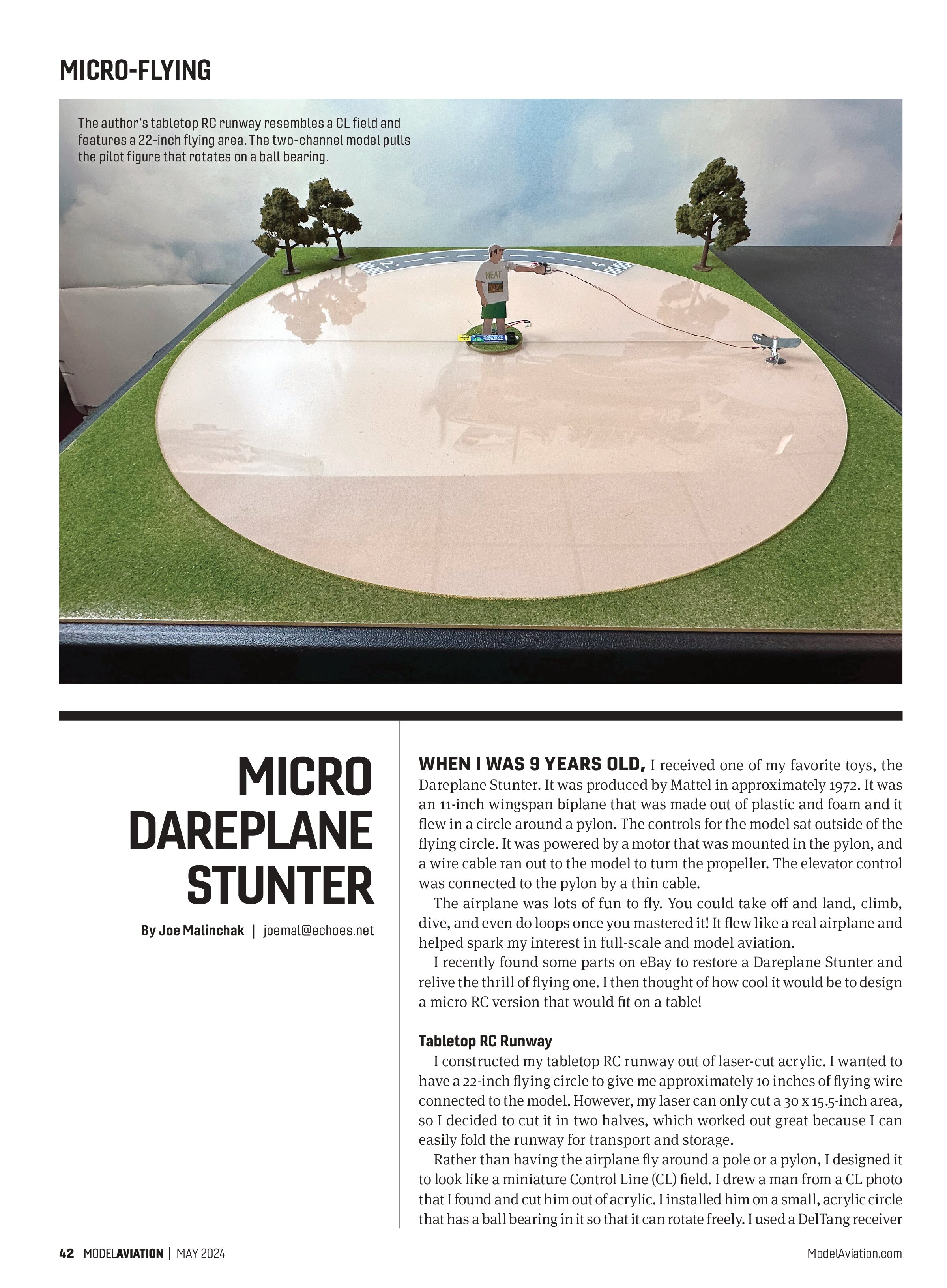
The author’s tabletop RC runway resembles a CL field and features a 22-inch flying area. The two-channel model pulls the pilot figure that rotates on a ball bearing.

MICRO
DAREPLANE
STUNTER
By Joe Malinchak | joemal@echoes.net
WHEN I WAS 9 YEARS OLD, I received one of my favorite toys, the Dareplane Stunter. It was produced by Mattel in approximately 1972. It was an 11-inch wingspan biplane that was made out of plastic and foam and it flew in a circle around a pylon. The controls for the model sat outside of the flying circle. It was powered by a motor that was mounted in the pylon, and a wire cable ran out to the model to turn the propeller. The elevator control was connected to the pylon by a thin cable.
The airplane was lots of fun to fly. You could take off and land, climb, dive, and even do loops once you mastered it! It flew like a real airplane and helped spark my interest in full-scale and model aviation.
I recently found some parts on eBay to restore a Dareplane Stunter and relive the thrill of flying one. I then thought of how cool it would be to design a micro RC version that would fit on a table!
Tabletop RC Runway
I constructed my tabletop RC runway out of laser-cut acrylic. I wanted to have a 22-inch flying circle to give me approximately 10 inches of flying wire connected to the model. However, my laser can only cut a 30 x 15.5-inch area, so I decided to cut it in two halves, which worked out great because I can easily fold the runway for transport and storage.
Rather than having the airplane fly around a pole or a pylon, I designed it to look like a miniature Control Line (CL) field. I drew a man from a CL photo that I found and cut him out of acrylic. I installed him on a small, acrylic circle that has a ball bearing in it so that it can rotate freely. I used a DelTang receiver and a 150 mAh battery cell that was mounted on the base of the circle, and then I installed a four-pin connector in the man’s hand so that I can easily swap out airplanes. The arm of the man can tilt up and down as the model is flying.
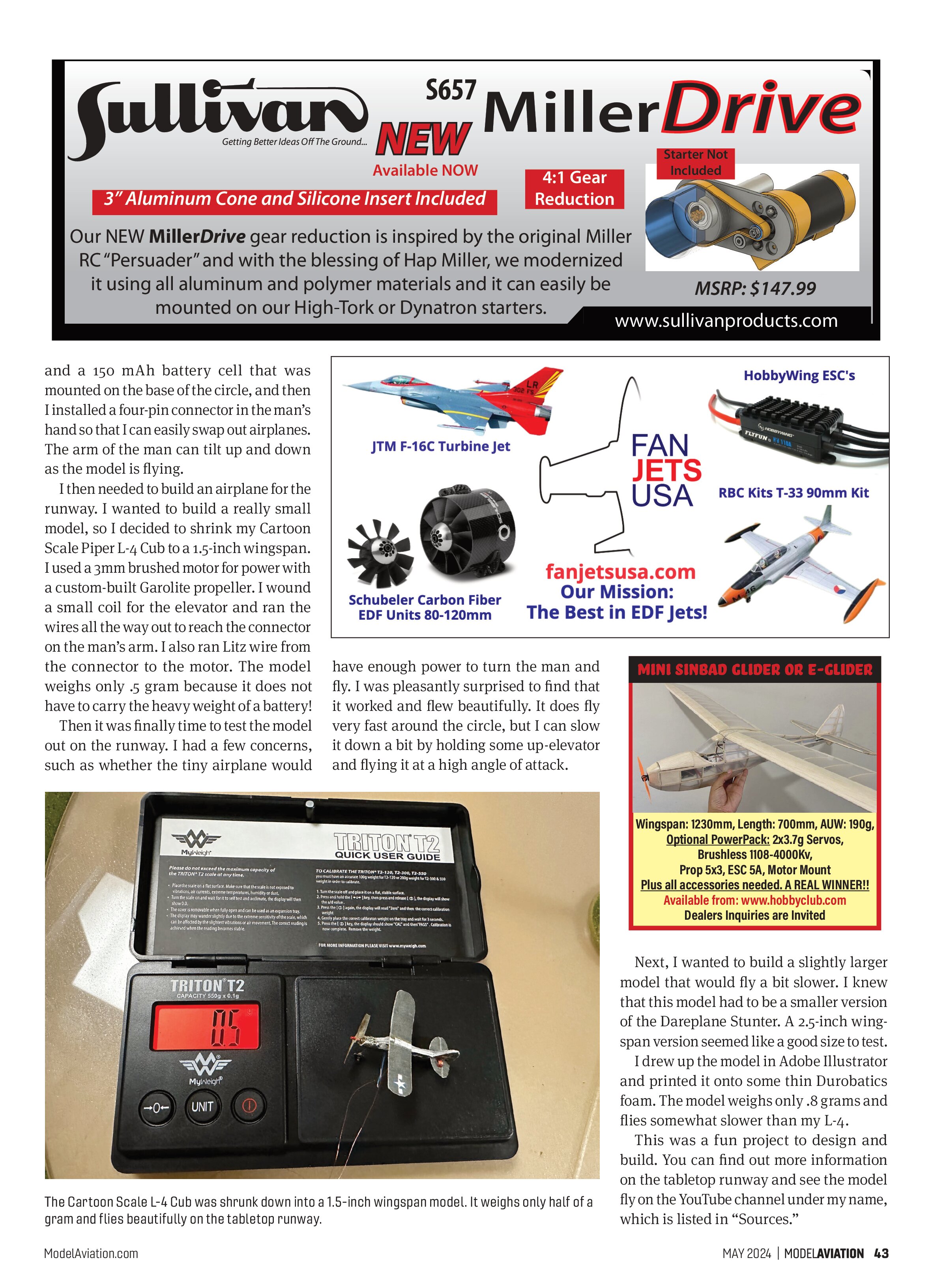
I then needed to build an airplane for the runway. I wanted to build a really small model, so I decided to shrink my Cartoon Scale Piper L-4 Cub to a 1.5-inch wingspan. I used a 3mm brushed motor for power with a custom-built Garolite propeller. I wound a small coil for the elevator and ran the wires all the way out to reach the connector on the man’s arm. I also ran Litz wire from the connector to the motor. The model weighs only .5 gram because it does not have to carry the heavy weight of a battery!
Then it was finally time to test the model out on the runway. I had a few concerns, such as whether the tiny airplane would have enough power to turn the man and fly. I was pleasantly surprised to find that it worked and flew beautifully. It does fly very fast around the circle, but I can slow it down a bit by holding some up-elevator and flying it at a high angle of attack.
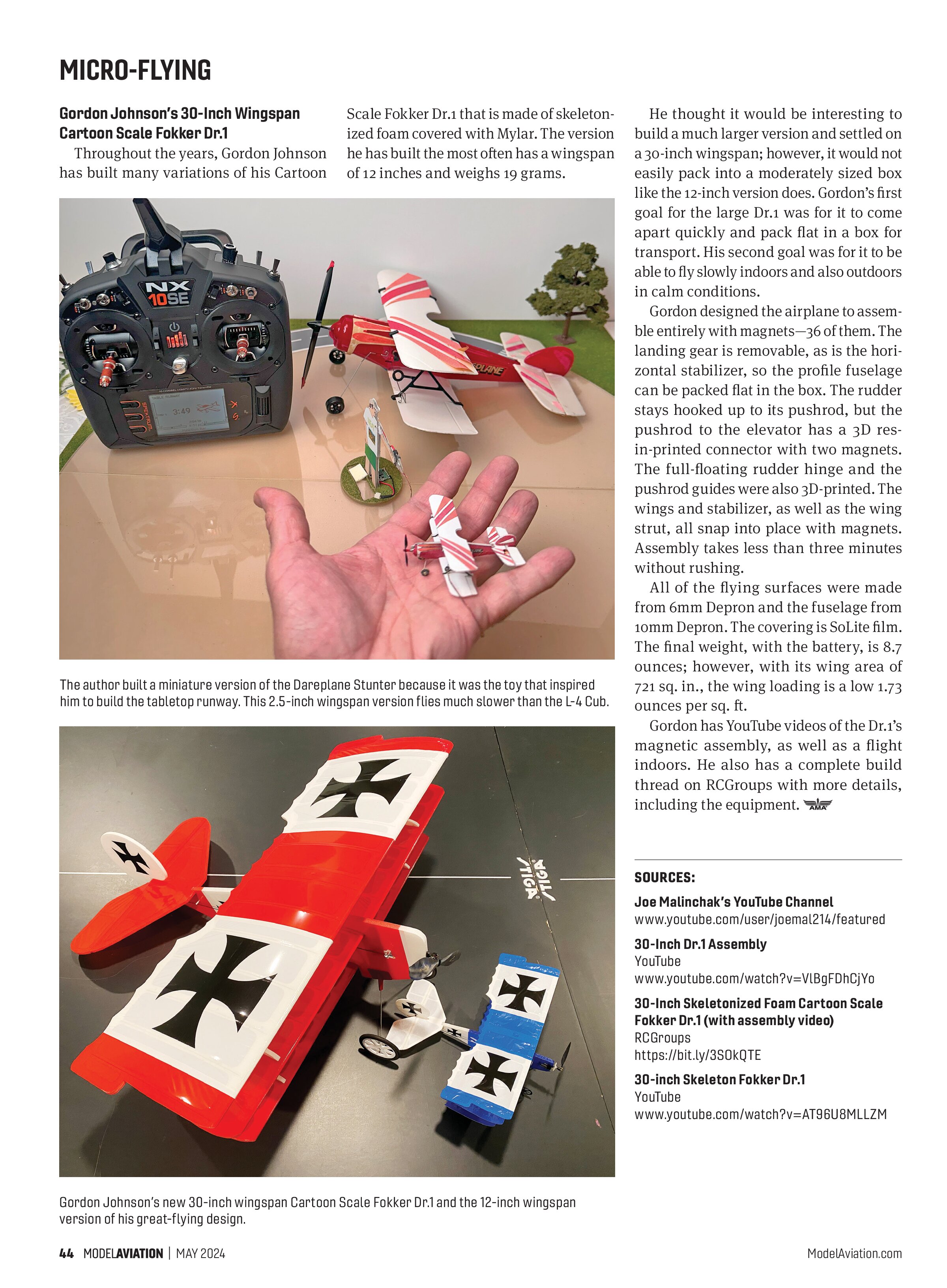
Next, I wanted to build a slightly larger model that would fly a bit slower. I knew that this model had to be a smaller version of the Dareplane Stunter. A 2.5-inch wingspan version seemed like a good size to test.
I drew up the model in Adobe Illustrator and printed it onto some thin Durobatics foam. The model weighs only .8 grams and flies somewhat slower than my L-4.
This was a fun project to design and build. You can find out more information on the tabletop runway and see the model fly on the YouTube channel under my name, which is listed in “Sources.”

Gordon Johnson's 30-Inch Wingspan Cartoon Scale Fokker Dr.1
Throughout the years, Gordon Johnson has built many variations of his Cartoon Scale Fokker Dr.1 that is made of skeletonized foam covered with Mylar. The version he has built the most often has a wingspan of 12 inches and weighs 19 grams.
He thought it would be interesting to build a much larger version and settled on a 30-inch wingspan; however, it would not easily pack into a moderately sized box like the 12-inch version does. Gordon’s first goal for the large Dr.1 was for it to come apart quickly and pack flat in a box for transport. His second goal was for it to be able to fly slowly indoors and also outdoors in calm conditions.
Gordon designed the airplane to assemble entirely with magnets—36 of them. The landing gear is removable, as is the horizontal stabilizer, so the profile fuselage can be packed flat in the box. The rudder stays hooked up to its pushrod, but the pushrod to the elevator has a 3D re-printed connector with two magnets. The full-floating rudder hinge and the pushrod guides were also 3D-printed. The wings and stabilizer, as well as the wing strut, all snap into place with magnets. Assembly takes less than three minutes without rushing.
All of the flying surfaces were made from 6mm Depron and the fuselage from 10mm Depron. The covering is SoLite film. The final weight, with the battery, is 8.7 ounces; however, with its wing area of 721 sq. in., the wing loading is a low 1.73 ounces per sq. ft.
Gordon has YouTube videos of the Dr.1’s magnetic assembly, as well as a flight indoors. He also has a complete build thread on RCGroups with more details, including the equipment.

The author built a miniature version of the Dareplane Stunter because it was the toy that inspired him to build the tabletop runway. This 2.5-inch wingspan version flies much slower than the L-4 Cub.

Gordon Johnson’s new 30-inch wingspan Cartoon Scale Fokker Dr.1 and the 12-inch wingspan version of his great-flying design.
SOURCES:
Joe Malinchak’s YouTube Channel
www.youtube.com/user/joemal214/featured
30-Inch Dr.1 Assembly
YouTube
www.youtube.com/watch?v=VlBgFDhCjYo
30-Inch Skeletonized Foam Cartoon Scale Fokker Dr.1 (with assembly video)
RCGroups
https://bit.ly/3S0kQTE
30-inch Skeleton Fokker Dr.1
YouTube
www.youtube.com/watch?v=AT96U8MLLZM