FOCAL POINT
Interested in sharing your handiwork? Visit www.ModelAviation.com for submission guidelines.

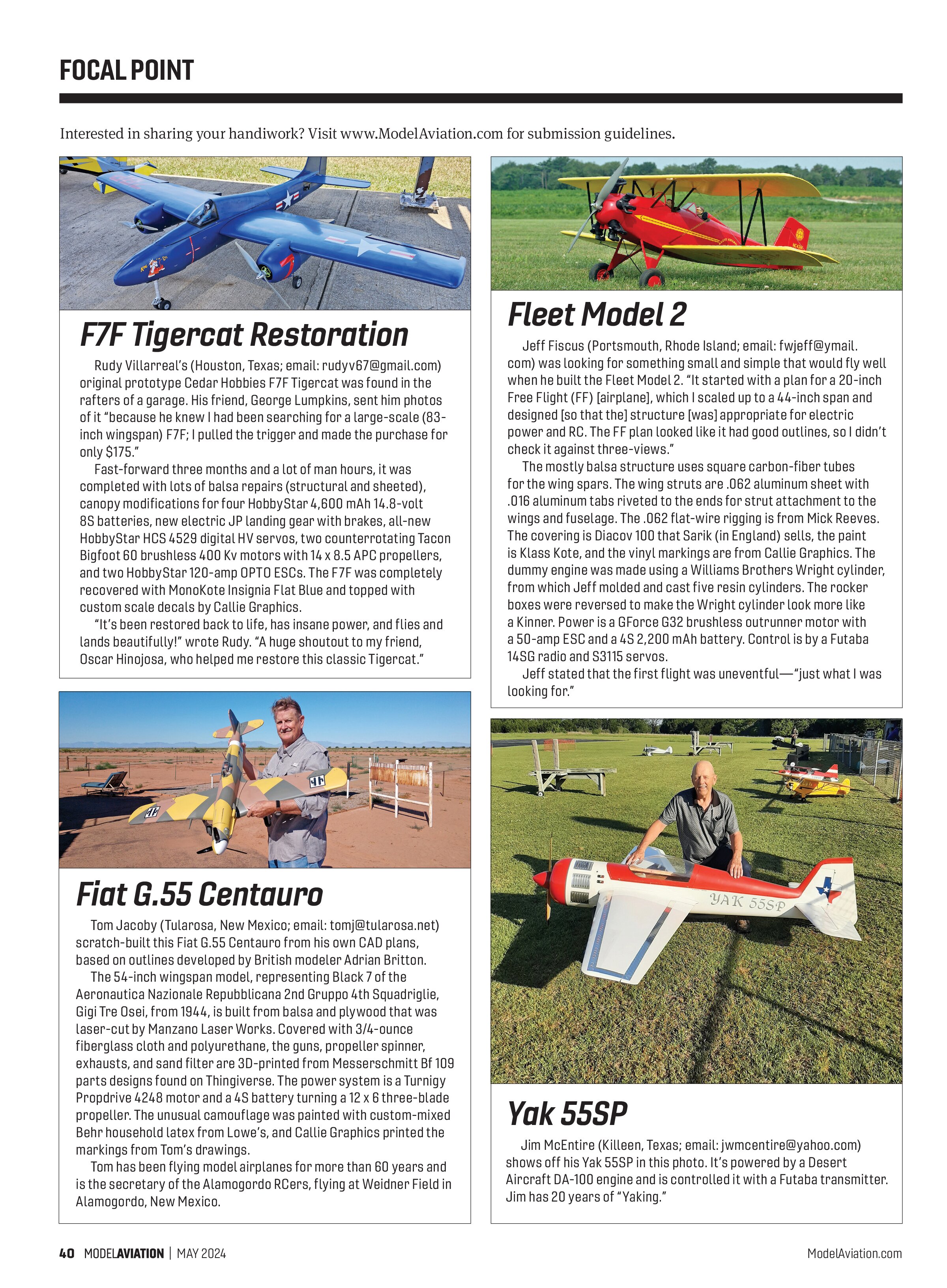
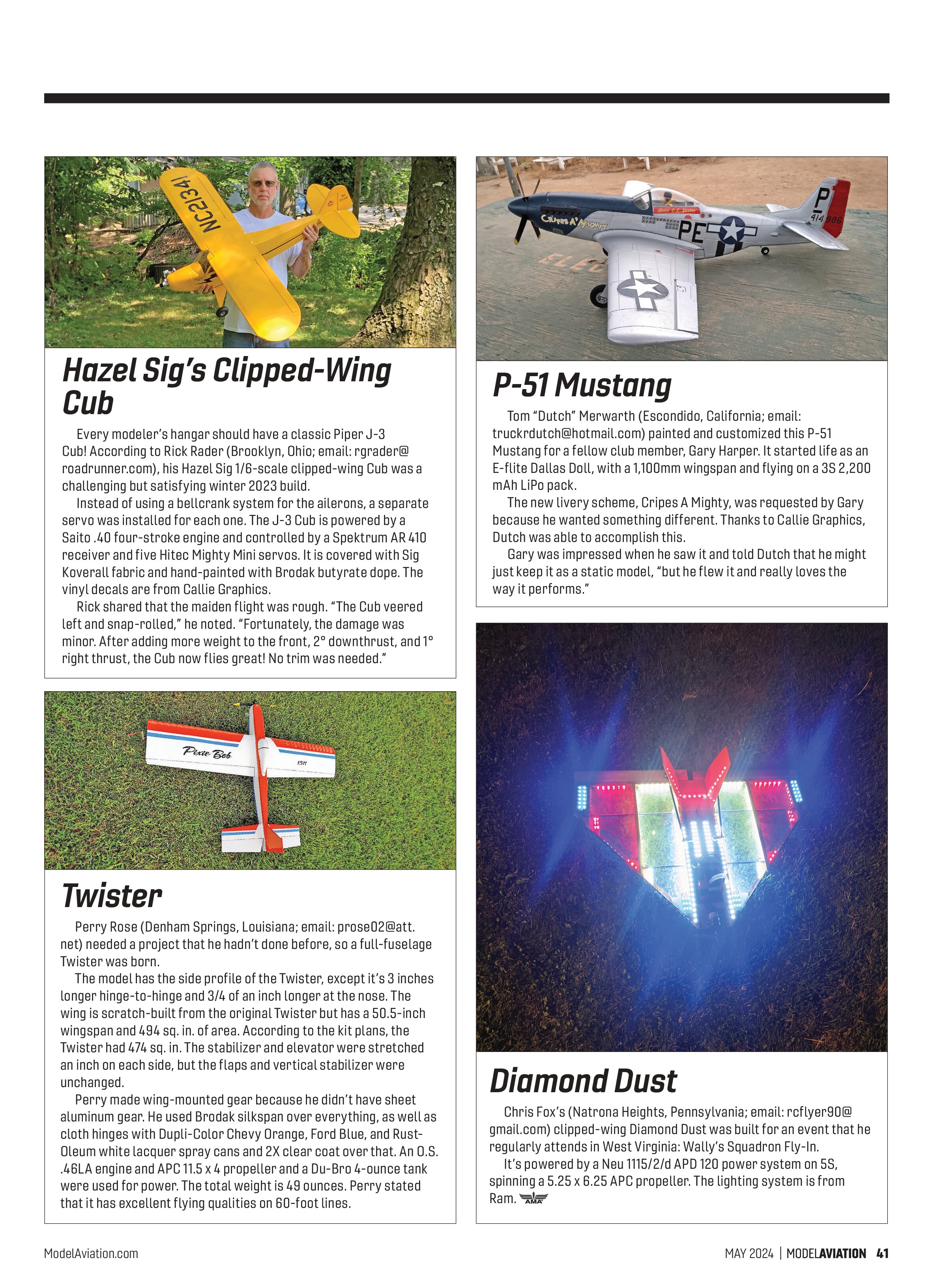
F7F Tigercat Restoration
Rudy Villarreal's (Houston, Texas; email: rud yv67@gmail.com) original prototype Cedar Hobbies F7F Tigercat was found in the rafters of a garage. His friend, George Lumpkins, sent him photos of it “because he knew I had been searching for a large-scale (83-inch wingspan) F7F; I pulled the trigger and made the purchase for only $175.”
Fast-forward three months and a lot of man hours, it was completed with lots of balsa repairs (structural and sheeted), canopy modifications for four HobbyStar 4,600 mAh 14.8-volt 8S batteries, new electric JP landing gear with brakes, all-new HobbyStar HCS 4529 digital HV servos, two counterrotating Tacon Bigfoot 60 brushless 400 Kv motors with 14 x 8.5 APC propellers, and two HobbyStar 120-amp OPTO ESCs. The F7F was completely recovered with MonoKote Insignia Flat Blue and topped with custom scale decals by Callie Graphics.
“It’s been restored back to life, has insane power, and flies and lands beautifully!” wrote Rudy. “A huge shoutout to my friend, Oscar Hinojosa, who helped me restore this classic Tigercat.”

Fiat G.55 Centauro
Tom Jacoby (Tularosa, New Mexico; email: tomj@tularosa.net) scratch-built this Fiat G.55 Centauro from his own CAD plans, based on outlines developed by British modeler Adrian Britton.
The 54-inch wingspan model, representing Black 7 of the Aeronautica Nazionale Repubblicana 2nd Gruppo 4th Squadriglie, Gigi Tre Osei, from 1944, is built from balsa and plywood that was laser-cut by Manzano Laser Works. Covered with 3/4-ounce fiberglass cloth and polyurethane, the guns, propeller spinner, exhausts, and sand filter are 3D-printed from Messerschmitt Bf 109 parts designs found on Thingiverse. The power system is a Turnigy Prodrive 4248 motor and a 4S battery turning a 12 x 6 three-blade propeller. The unusual camouflage was painted with custom-mixed Behr household latex from Lowe’s, and Callie Graphics printed the markings from Tom’s drawings.
Tom has been flying model airplanes for more than 60 years and is the secretary of the Alamogordo RCers, flying at Weidner Field in Alamogordo, New Mexico.

Fleet Model 2
Jeff Fiscus (Portsmouth, Rhode Island; email: fwjeff@ymail.com) was looking for something small and simple that would fly well when he built the Fleet Model 2. “It started with a plan for a 20-inch Free Flight (FF) [airplane], which I scaled up to a 44-inch span and designed [so that the] structure [was] appropriate for electric power and RC. The FF plan looked like it had good outlines, so I didn’t check it against three-views.”
The mostly balsa structure uses square carbon-fiber tubes for the wing spars. The wing struts are .062 aluminum sheet with .016 aluminum tabs riveted to the ends for strut attachment to the wings and fuselage. The .062 flat-wire rigging is from Mick Reeves. The covering is Diacov 100 that Sarik (in England) sells, the paint is Klass Kote, and the vinyl markings are from Callie Graphics. The dummy engine was made using a Williams Brothers Wright cylinder, from which Jeff molded and cast five resin cylinders. The rocker boxes were reversed to make the Wright cylinder look more like a Kinner. Power is a GForce G32 brushless outrunner motor with a 50-amp ESC and a 4S 2,200 mAh battery. Control is by a Futaba 14SG radio and S3115 servos.
Jeff stated that the first flight was uneventful—“just what I was looking for.”

Yak 55SP
Jim McEntire (Killeen, Texas; email: jwmcentire@yahoo.com) shows off his Yak 55SP in this photo. It’s powered by a Desert Aircraft DA-100 engine and is controlled with a Futaba transmitter. Jim has 20 years of “Yaking.”

Hazel Sig’s Clipped-Wing Cub
Every modeler’s hangar should have a classic Piper J-3 Cub! According to Rick Rader (Brooklyn, Ohio; email: grader@roadrunner.com), his Hazel Sig 1/6-scale clipped-wing Cub was a challenging but satisfying winter 2023 build.
Instead of using a bellcrank system for the ailerons, a separate servo was installed for each one. The J-3 Cub is powered by a Saito .40 four-stroke engine controlled by a Spektrum AR 410 receiver and five Hitec Mighty Mini servos. It is covered with Sig Koverall fabric and hand-painted with Brodak butyrate dope. The vinyl decals are from Callie Graphics.
Rick shared that the maiden flight was rough. “The Cub veered left and snap-rolled,” he noted. “Fortunately, the damage was minor. After adding more weight to the front, 2° downthrust, and 1° right thrust, the Cub now flies great! No trim was needed.”

P-51 Mustang
Tom “Dutch” Merwarth (Escondido, California; email: truckrdutch@hotmail.com) painted and customized this P-51 Mustang for a fellow club member, Gary Harper. It started life as an E-flite Dallas Doll, with a 1,100mm wingspan and flying on a 3S 2,200 mAh LiPo pack.
The new livery scheme, Gripes A Mighty, was requested by Gary because he wanted something different. Thanks to Callie Graphics, Dutch was able to accomplish this.
Gary was impressed when he saw it and told Dutch that he might just keep it as a static model, “but he flew it and really loves the way it performs.”

Twister
Perry Rose (Denham Springs, Louisiana; email: prose02@att.net) needed a project that he hadn’t done before, so a full-fuselage Twister was born.
The model has the side profile of the Twister, except it’s 3 inches longer hinge-to-hinge and 3/4 of an inch longer at the nose. The wing is scratch-built from the original Twister but has a 50.5-inch wingspan and 494 sq. in. of area. According to the kit plans, the Twister had 474 sq. in. The stabilizer and elevator were stretched an inch on each side, but the flaps and vertical stabilizer were unchanged.
Perry made wing-mounted gear because he didn’t have sheet aluminum gear. He used Brodak silks pan over everything, as well as cloth hinges with Dupli-Color Chevy Orange, Ford Blue, and Rust-Oleum white lacquer spray cans and 2X clear coat over that. An O.S. .46LA engine and APC 11.5 x 4 propeller and a Du-Bro 4-ounce tank were used for power. The total weight is 49 ounces. Perry stated that it has excellent flying qualities on 60-foot lines.

Diamond Dust
Chris Fox’s (Natrona Heights, Pennsylvania; email: rcflyer90@gmail.com) clipped-wing Diamond Dust was built for an event that he regularly attends in West Virginia: Wally’s Squadron on Fly-In.
It’s powered by a Neu 1115/2d/APD 120 power system on 5S, spinning a 5.25 x 6.25 APC propeller. The lighting system is from Ram.