SMALL-FIELD FLYING

TAKE A BREAK
FROM THE BIG
PROJECTS
By Pat Tritle | patscustommodels@gmail.com
COMING OUT of the winter building season, this is the time of year when thoughts of getting back to flying are at the top of the list. Along with our old favorites, there will undoubtedly be a couple of new models ready to be test-flown as well.
Before you fly your latest masterpiece, take a few minutes to look it over to make sure that the airframe is free from warps, is balanced properly, and that the controls are working smoothly, centering properly, and, above all, moving in the right direction. When that’s done, a successful maiden flight is more than likely a sure thing; after all, a crooked, tail-heavy model with twice as much control throw as what is needed is not an ideal setup for a successful maiden flight.
During the building season, you sometimes just need to take a break from a big project. When that happens to me, I like to break open an old, simple kit and at least frame it up before jumping back into the larger projects. The next time you need a bit of down time for further head scratching, it’ll be there to cover. I’ve always found that when you hit a rough spot on a project, nothing works better than walking away for a while to let your thoughts gel. Working on something completely unrelated is a great way to clear the confusion and get that done.
Surprise, Surprise
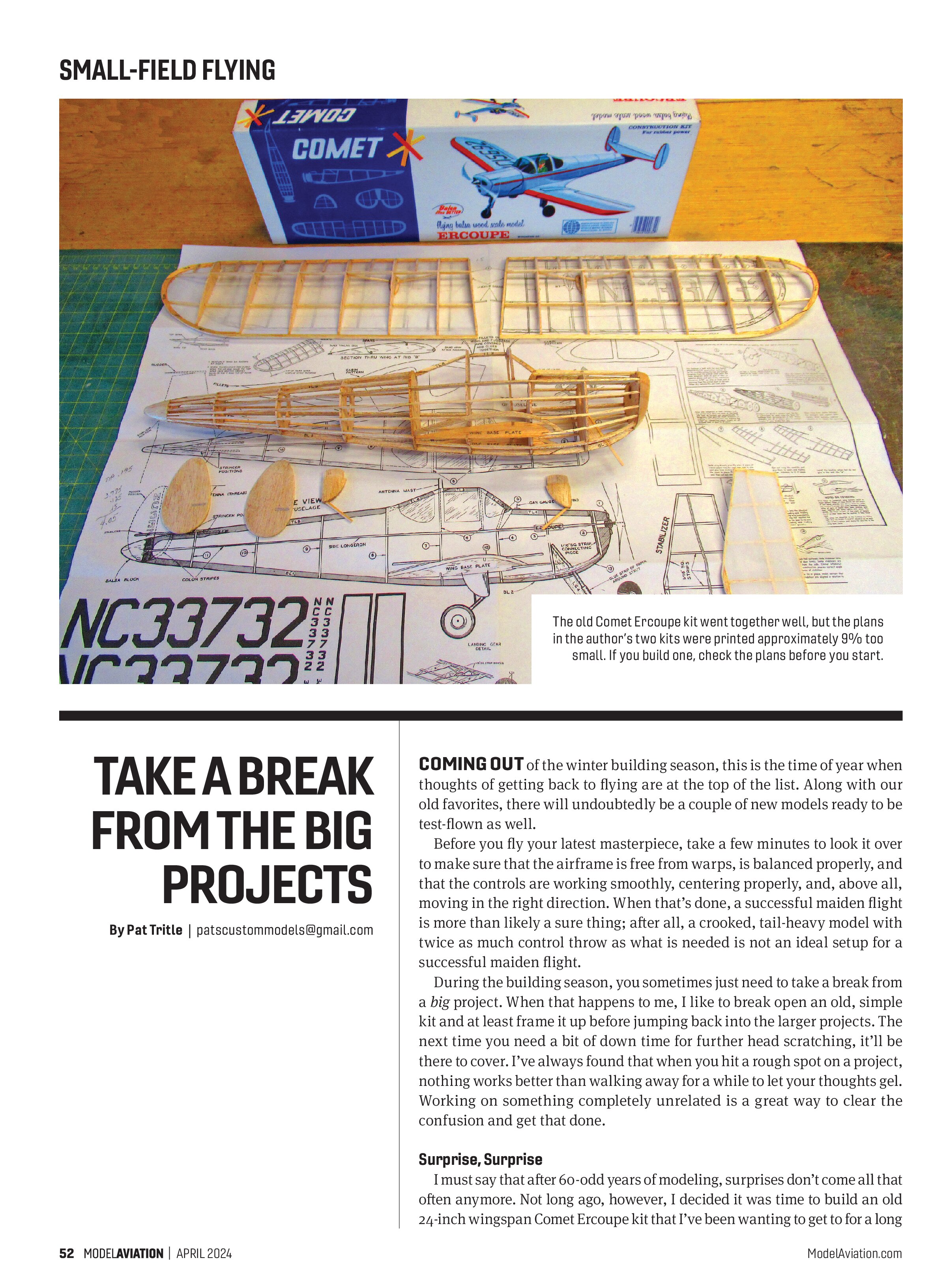
I must say that after 60-odd years of modeling, surprises don’t come all that often anymore. Not long ago, however, I decided it was time to build an old 24-inch wingspan Comet Ercoupe kit that I’ve been wanting to get to for a long time. The kit was typical of the era. The balsa wasn’t great (actually, it was somewhere between oak and maple), so cutting the printwood was a bit of a challenge, but it did bring back some fond memories of the old double-edge razor blade days.
The fuselage, which was undersized on the plans, was built first. This wasn’t a big deal because it’s built basically in midair anyway. The horizontal stabilizer was completed next, directly over the plans. Then came the wing, and it was undersized too. As it turned out, the plans were printed at approximately 9½%–9% too small! Hey, no big deal; I had two kits, so I pulled the other one down, but I found that those plans were undersized too.
I talked with a couple of guys who I knew had built these kits and both of theirs were okay. It was just my luck to get two kits, years apart, in different parts of the country, and they were both wrong. Not to worry! The wing and stabilizer plans were redrawn at 1:1 and the frame-up was completed using the kit parts.
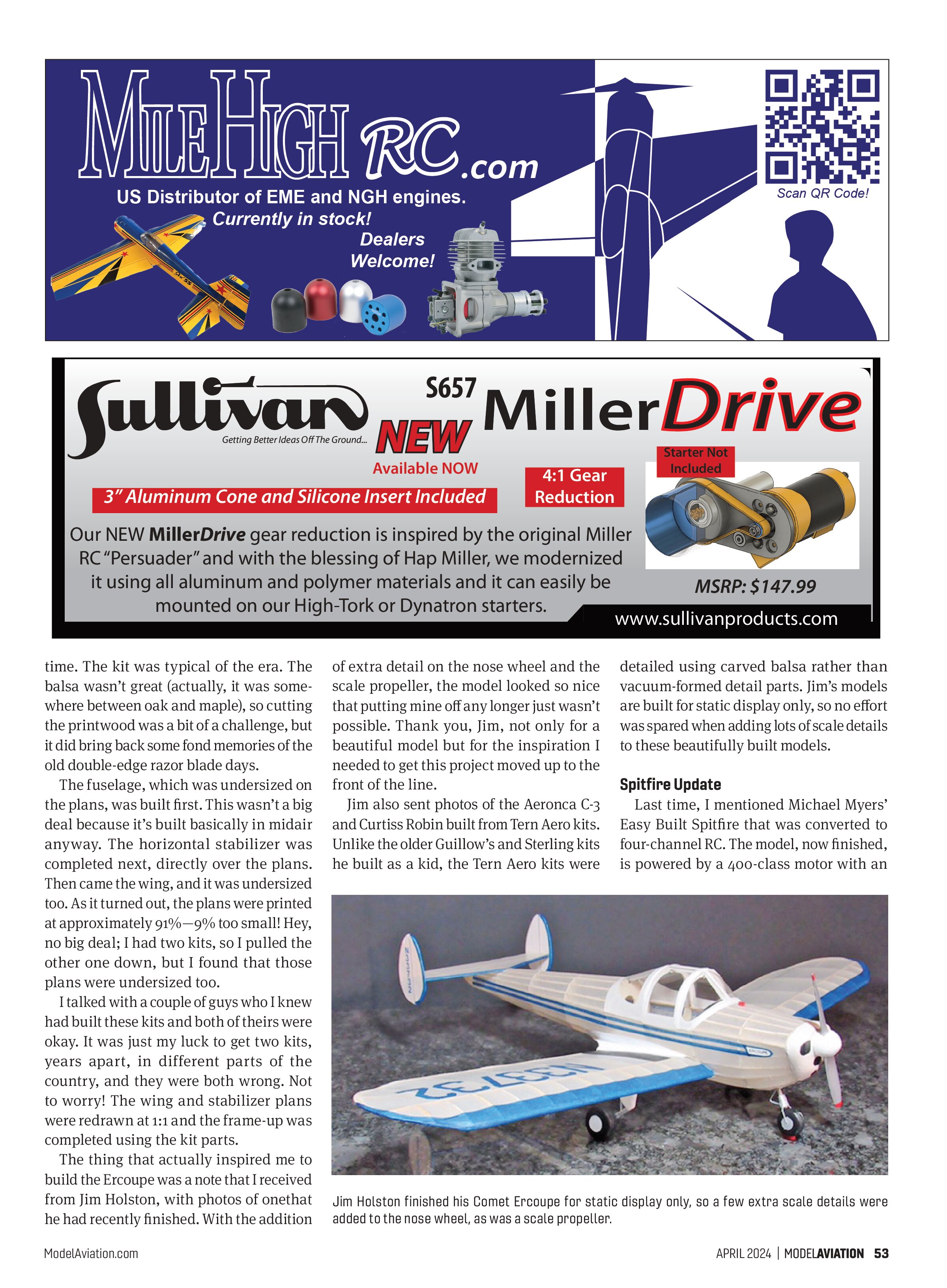
The thing that actually inspired me to build the Ercoupe was a note that I received from Jim Holston, with photos of one that he had recently finished. With the addition of extra detail on the nose wheel and the scale propeller, the model looked so nice that putting mine off any longer just wasn’t possible. Thank you, Jim, not only for a beautiful model but for the inspiration I needed to get this project moved up to the front of the line.
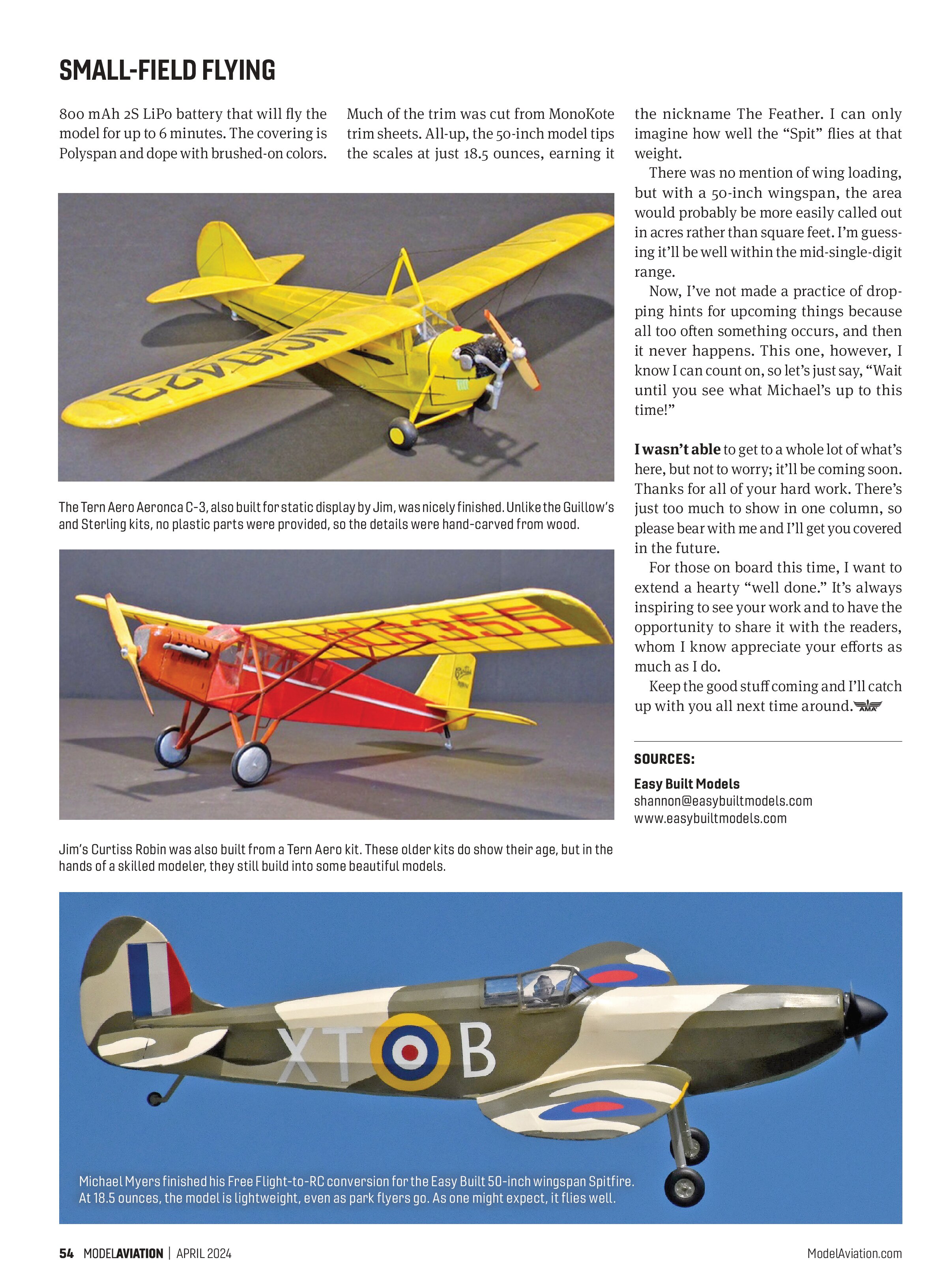
Jim also sent photos of the Aeronca C-3 and Curtiss Robin built from Tern Aero kits. Unlike the older Guillow’s and Sterling kits he built as a kid, the Tern Aero kits were detailed using carved balsa rather than vacuum-formed detail parts. Jim’s models are built for static display only, so no effort was spared when adding lots of scale details to these beautifully built models.
Spitfire Update
Last time, I mentioned Michael Myers’ Easy Built Spitfire that was converted to four-channel RC. The model, now finished, is powered by a 400-class motor with an

800 mAh 2S LiPo battery that will fly the model for up to 6 minutes. The covering is Polyspan and dope with brushed-on colors.
Much of the trim was cut from MonoKote trim sheets. All-up, the 50-inch model tips the scales at just 18.5 ounces, earning it the nickname The Feather. I can only imagine how well the “Spit” flies at that weight.
There was no mention of wing loading, but with a 50-inch wingspan, the area would probably be more easily called out in acres rather than square feet. I’m guessing it’ll be well within the mid-single-digit range.
Now, I’ve not made a practice of dropping hints for upcoming things because all too often something occurs, and then it never happens. This one, however, I know I can count on, so let’s just say, “Wait until you see what Michael’s up to this time!”


I wasn’t able to get to a whole lot of what’s here, but not to worry; it’ll be coming soon. Thanks for all of your hard work. There’s just too much to show in one column, so please bear with me and I’ll get you covered in the future.
For those on board this time, I want to extend a hearty “well done.” It’s always inspiring to see your work and to have the opportunity to share it with the readers, whom I know appreciate your efforts as much as I do.
Keep the good stuff coming and I’ll catch up with you all next time around.
SOURCES:
Easy Built Models
shannon@easybuiltmodels.com
www.easybuiltmodels.com