RC SLOPE SOARING

SLOPE STARTER
By Greg Schutte | gshooty@yahoo.com
LATELY, I HAVE BEEN asked the question about how to get into Slope Soaring. Although I have written about this subject before, I still need to cover the topic at least once every couple of years to help new pilots.
Slope Soaring is the art of flying an RC glider in a band of rising air in front of a slope or hill. The slope can be anything that rises off the ground. Mountains, steep hills, or cliffs are the most common. These places can be natural or manufactured.
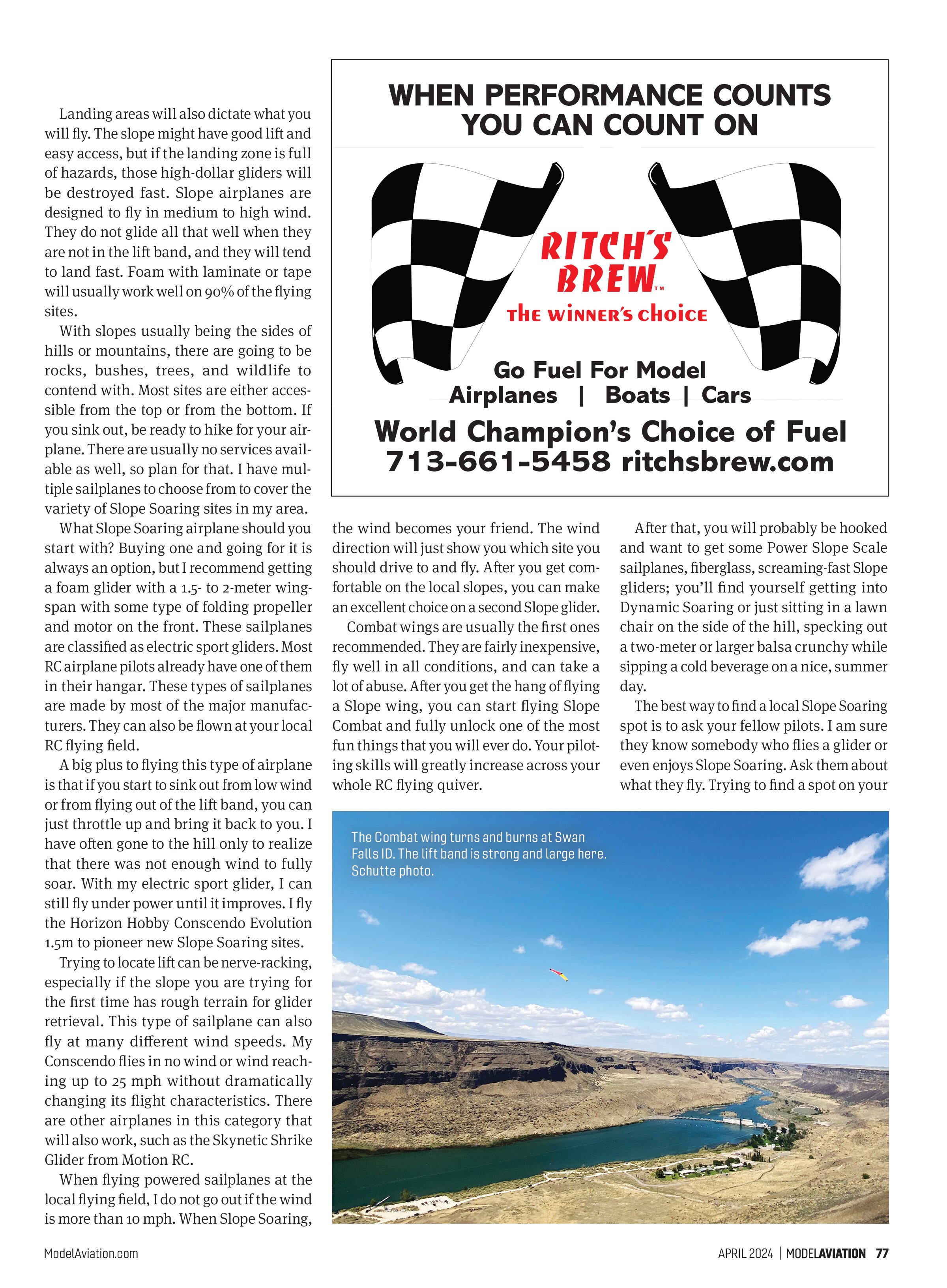
The wind blows into objects and is diverted up and over. This creates an area in front that makes a “lift band.” The band size depends on how large the slope is and how strong the wind is blowing. Those are pretty much the mechanics of a Slope Soaring site.
One of the cool things about Slope Soaring is being able to fly for a long time. You only need to worry about your transmitter/receiver batteries and the wind strength. I have flown some Slope gliders for multiple hours endlessly.
The standard Slope glider usually has no motor and is made from foam, balsa wood, and fiberglass. Like your standard RC airplanes, they are usually two channels and are easy to fly. This is just a general rule, but you can get crazy with them just like any other RC discipline!
The slope that you have available will generally dictate the type of Slope sailplane. The standard-size Slope model has a 48-inch wingspan range and is made from some type of foam with a protective covering, such as packing tape, laminate, or shrink covering. There are smaller and larger sailplanes as well, but just getting into the sport is where you want to start. They are easy to make, transport, fly, and see.
Landing areas will also dictate what you will fly. The slope might have good lift and easy access, but if the landing zone is full of hazards, those high-dollar gliders will be destroyed fast. Slope airplanes are designed to fly in medium to high wind. They do not glide all that well when they are not in the lift band, and they will tend to land fast. Foam with laminate or tape will usually work well on 90% of the flying sites.
With slopes usually being the sides of hills or mountains, there are going to be rocks, bushes, trees, and wildlife to contend with. Most sites are either accessible from the top or from the bottom. If you sink out, be ready to hike for your airplane. There are usually no services available as well, so plan for that. I have multiple sailplanes to choose from to cover the variety of Slope Soaring sites in my area.
What Slope Soaring airplane should you start with? Buying one and going for it is always an option, but I recommend getting a foam glider with a 1.5- to 2-meter wingspan with some type of folding propeller and motor on the front. These sailplanes are classified as electric sport gliders. Most RC airplane pilots already have one of them in their hangar. These types of sailplanes are made by most of the major manufacturers. They can also be flown at your local RC flying field.
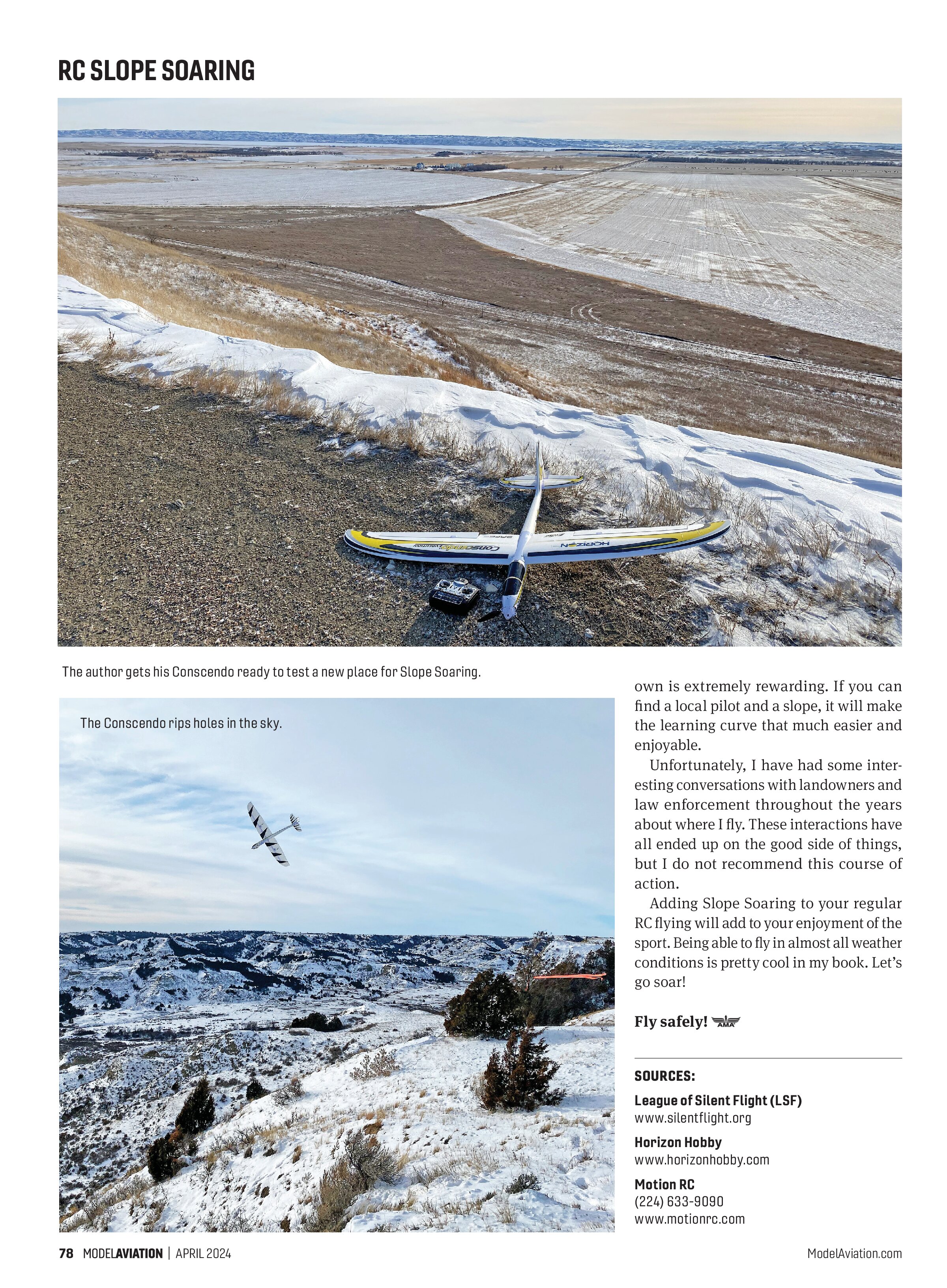
A big plus to flying this type of airplane is that if you start to sink out from low wind or from flying out of the lift band, you can just throttle up and bring it back to you. I have often gone to the hill only to realize that there was not enough wind to fully soar. With my electric sport glider, I can still fly under power until it improves. I fly the Horizon Hobby Consendo Evolution 1.5m to pioneer new Slope Soaring sites.
Trying to locate lift can be nerve-racking, especially if the slope you are trying for the first time has rough terrain for glider retrieval. This type of sailplane can also fly at many different wind speeds. My Consendo flies in no wind or wind reaching up to 25 mph without dramatically changing its flight characteristics. There are other airplanes in this category that will also work, such as the Skynetic Shrike Glider from Motion RC.
When flying powered sailplanes at the local flying field, I do not go out if the wind is more than 10 mph. When Slope Soaring, the wind becomes your friend. The wind direction will just show you which site you should drive to and fly. After you get comfortable on the local slopes, you can make an excellent choice on a second Slope glider.
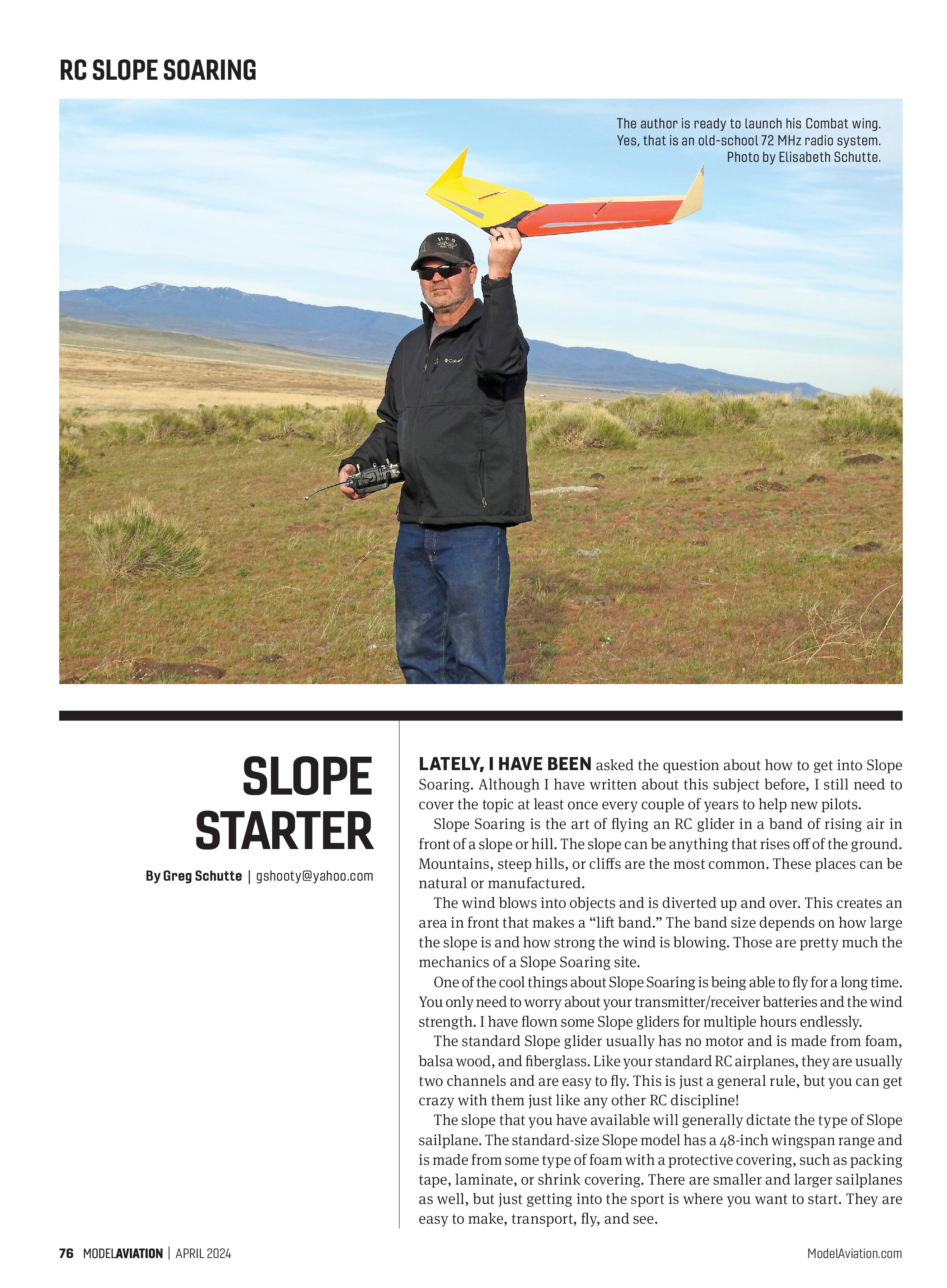
Combat wings are usually the first ones recommended. They are fairly inexpensive, fly well in all conditions, and can take a lot of abuse. After you get the hang of flying a Slope wing, you can start flying Slope Combat and fully unlock one of the most fun things that you will ever do. Your piloting skills will greatly increase across your whole RC flying quiver.
After that, you will probably be hooked and want to get some Power Slope Scale sailplanes, fiberglass, screaming-fast Slope gliders; you’ll find yourself getting into Dynamic Soaring or just sitting in a lawn chair on the side of the hill, specking out a two-meter or larger balsa crunchy while sipping a cold beverage on a nice, summer day.
The best way to find a local Slope Soaring spot is to ask your fellow pilots. I am sure they know somebody who flies a glider or even enjoys Slope Soaring. Ask them about what they fly. Trying to find a spot on your


own is extremely rewarding. If you can find a local pilot and a slope, it will make the learning curve that much easier and enjoyable.
Unfortunately, I have had some interesting conversations with landowners and law enforcement throughout the years about where I fly. These interactions have all ended up on the good side of things, but I do not recommend this course of action.
Adding Slope Soaring to your regular RC flying will add to your enjoyment of the sport. Being able to fly in almost all weather conditions is pretty cool in my book. Let’s go soar!
Fly safely!
SOURCES:
League of Silent Flight (LSF)
www.silentflight.org
Horizon Hobby
www.horizonhobby.com
Motion RC
(224) 633-9090
www.motionrc.com