RC SCALE AEROBATICS

ROLLING IN
AN AXIAL
MANNER
By John Glezellis | jglezellis@gmail.com
BECOMING THE BEST RC Scale Aerobatics pilot is knowing not only how to perform given aerobatic maneuvers according to the criteria outlined within the International Miniature Aerobatic Club (IMAC) rule book, but also having the ability to program, set up, and trim a model to allow for the best presentation of each figure.
In my last discussion, I examined a Double Humpty Bump that contained many different elements, one being two different roll variations. I will now go one step further and look at a few core fundamentals of the aircraft setup process to ensure that your model can roll in an axial manner. Should a model not roll in an axial fashion, not only will the pilot’s workload increase with necessary corrective inputs, but downgrades will also occur that will be impossible to overcome.
Without further delay, let’s get down to business!
Aileron Differential Defined!
Most, but not all, aerobatic airplanes require differential. Aileron differential is required when the drag of one aileron direction does not match the other and results in a roll that appears to wander and not be perfectly axial. A center-hinged model might need differential, where the upward-traveling aileron has more deflection than the downward-moving aileron. Some composite models have hinges located on the top of the surface and will demand the use of differential, where the aileron moving up has less deflection than the one traveling down.
The trimming and setup process must be performed in a specific sequence to be successful. You must start with equal travel on all control surfaces and understand how to test for and adjust the aircraft’s center of gravity, as well as the engine thrust angles, before proceeding to test for aileron differential. Should this sequence not be followed, a change in one item will impact another. This might result in a pilot being in a constant chase for the perfect setup.
Connection and Programming Basics
As you start the programming process on a new model, you must first select the proper wing configuration that will allow the differential function to work as required. For example, some pilots use a Y-harness on smaller models that feature one servo per aileron, to allow both ailerons to be connected to a single receiver port. This won’t allow the pilot to fine-tune each servo; rather, each servo should be connected to a separate port found on the receiver. Some aircraft feature multiple servos, where two or more servos connect to a surface. It is important to note which servo is connected to which port on the receiver.
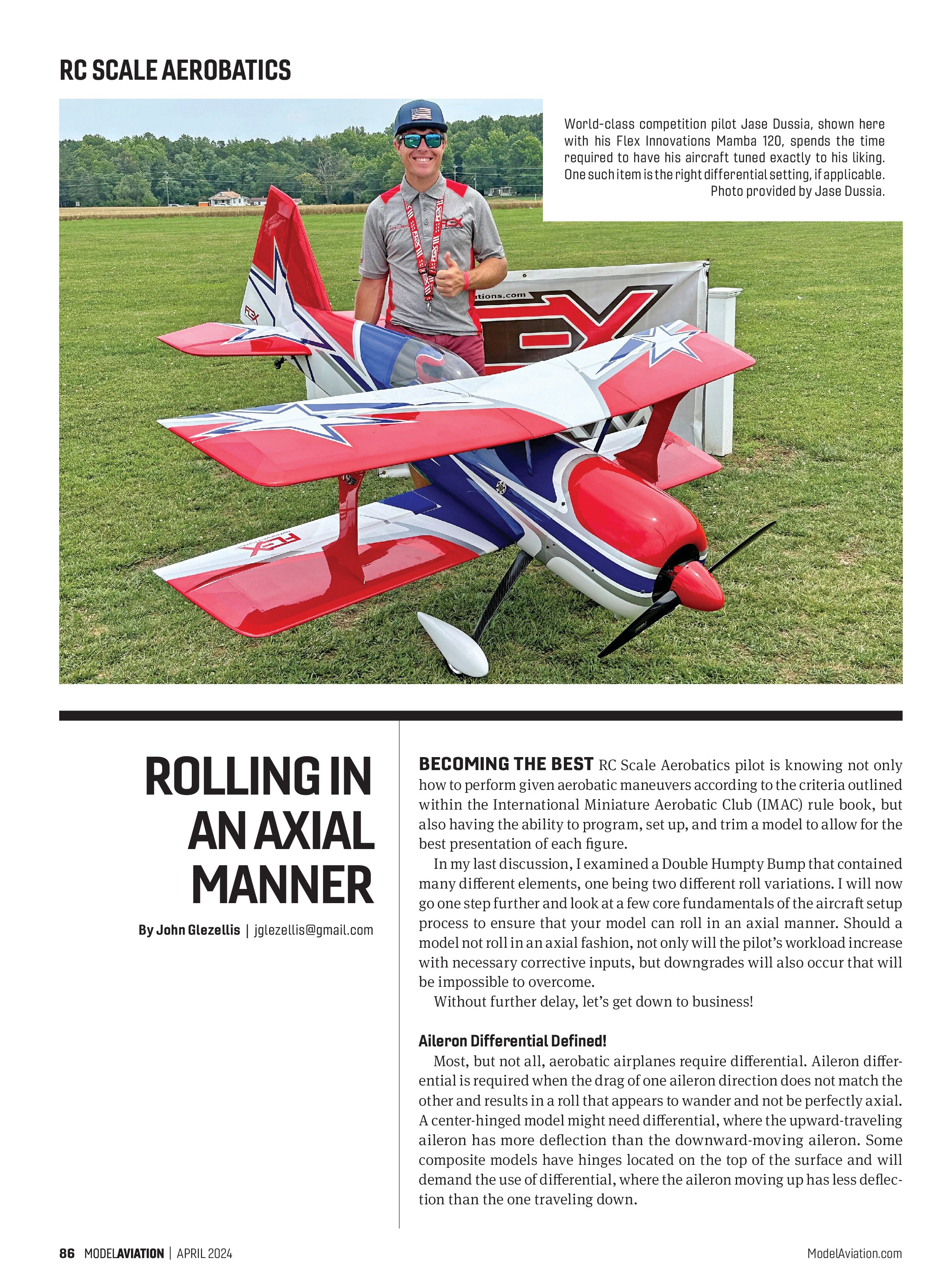
A neat feature on radio offerings, such as the Spektrum iX20, is being able to name specific receiver ports on the transmitter. In the case of my Flex Innovations Mamba 120 airplane, which contains four aileron servos, the naming structure is right upper aileron (RUAL), right lower aileron (RLAL), left upper aileron (LUAL), and left lower aileron (LLAL). This is done by accessing the Names feature through the Model Adjust function.
The pilot should then examine the mechanical setup of their model starting with the servo linkage installation and adjustable travel volume (ATV) settings, which other manufacturers sometimes refer to as the end-point adjustment (EPA). Geometry-wise, the distance from the center of the hinge line to the pivot point on the control horn must be the same as the center of the servo arm output gear to the pivot point on the servo arm.
You should also ensure that each control horn pivot point is directly over the hinge line. Regarding the servo and ATV/EPA settings, you should always try to maximize these values for the best resolution and torque obtained per servo. You must then mechanically adjust the linkage as required to result in stick travel that corresponds to the proper amount of deflection that is desired.
Before I move on to flight tests, some radios feature a balance function that allows you to adjust servo travel as the control surface is moved. This feature is an adjustable curve to allow you to fine-tune the servo position at up to seven points along the curve. Although commonly used to prevent binding when multiple servos are used on a single control surface, it can also be used to match servo travel on different servos.
In the case of the Mamba, you can use this feature to ensure that all four separate aileron servos have the same deflection amounts at different deflection points. Similarly, you can use programmable mixes to accomplish a similar task, should this feature not be available. With equal travel throughout, you are ready to test your model at the flying field!
I had a recent conversation with Jase Dussia, a world-renowned 3D Aerobatics pilot and Freestyle champion. We discussed testing for differential and he mentioned the

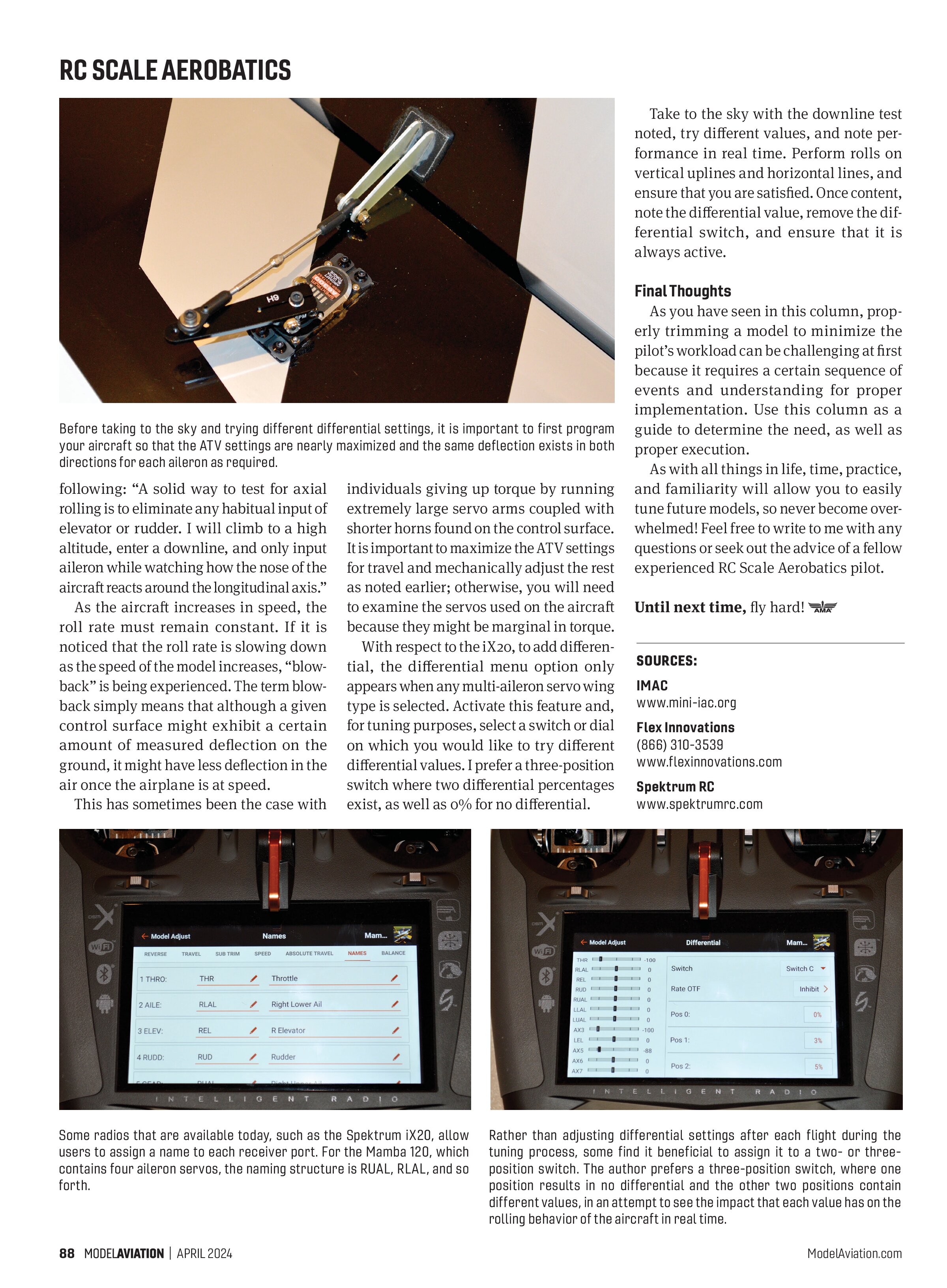
Before taking to the sky and trying different differential settings, it is important to first program your aircraft so that the ATV settings are nearly maximized and the same deflection exists in both directions for each aileron as required.
following: “A solid way to test for axial rolling is to eliminate any habitual input of elevator or rudder. I will climb to a high altitude, enter a downline, and only input aileron while watching how the nose of the aircraft reacts around the longitudinal axis.”
As the aircraft increases in speed, the roll rate must remain constant. If it is noticed that the roll rate is slowing down as the speed of the model increases, “blow-back” is being experienced. The term blow-back simply means that although a given control surface might exhibit a certain amount of measured deflection on the ground, it might have less deflection in the air once the airplane is at speed.
This has sometimes been the case with
individuals giving up torque by running extremely large servo arms coupled with shorter horns found on the control surface. It is important to maximize the ATV settings for travel and mechanically adjust the rest as noted earlier; otherwise, you will need to examine the servos used on the aircraft because they might be marginal in torque.
With respect to the iX20, to add differential, the differential menu option only appears when any multi-aileron servo wing type is selected. Activate this feature and, for tuning purposes, select a switch or dial on which you would like to try different differential values. I prefer a three-position switch where two differential percentages exist, as well as 0% for no differential.
Take to the sky with the downline test noted, try different values, and note performance in real time. Perform rolls on vertical uplines and horizontal lines, and ensure that you are satisfied. Once content, note the differential value, remove the differential switch, and ensure that it is always active.
Final Thoughts
As you have seen in this column, properly trimming a model to minimize the pilot’s workload can be challenging at first because it requires a certain sequence of events and understanding for proper implementation. Use this column as a guide to determine the need, as well as proper execution.
As with all things in life, time, practice, and familiarity will allow you to easily tune future models, so never become overwhelmed! Feel free to write to me with any questions or seek out the advice of a fellow experienced RC Scale Aerobatics pilot.
Until next time, fly hard!
SOURCES:
IMAC
www.mini-iac.org
Flex Innovations
(866) 310-3539
www.flexinnovations.com
Spektrum RC
www.spektrumrc.com

Some radios that are available today, such as the Spektrum iX20, allow users to assign a name to each receiver port. For the Mamba 120, which contains four aileron servos, the naming structure is RUAL, RLAL, and so forth.

Rather than adjusting differential settings after each flight during the tuning process, some find it beneficial to assign it to a two- or three-position switch. The author prefers a three-position switch, where one position results in no differential and the other two positions contain different values, in an attempt to see the impact that each value has on the rolling behavior of the aircraft in real time.