FOCAL POINT
Interested in sharing your handiwork? Visit www.ModelAviation.com for submission guidelines.
E-flite P-47 Razorback

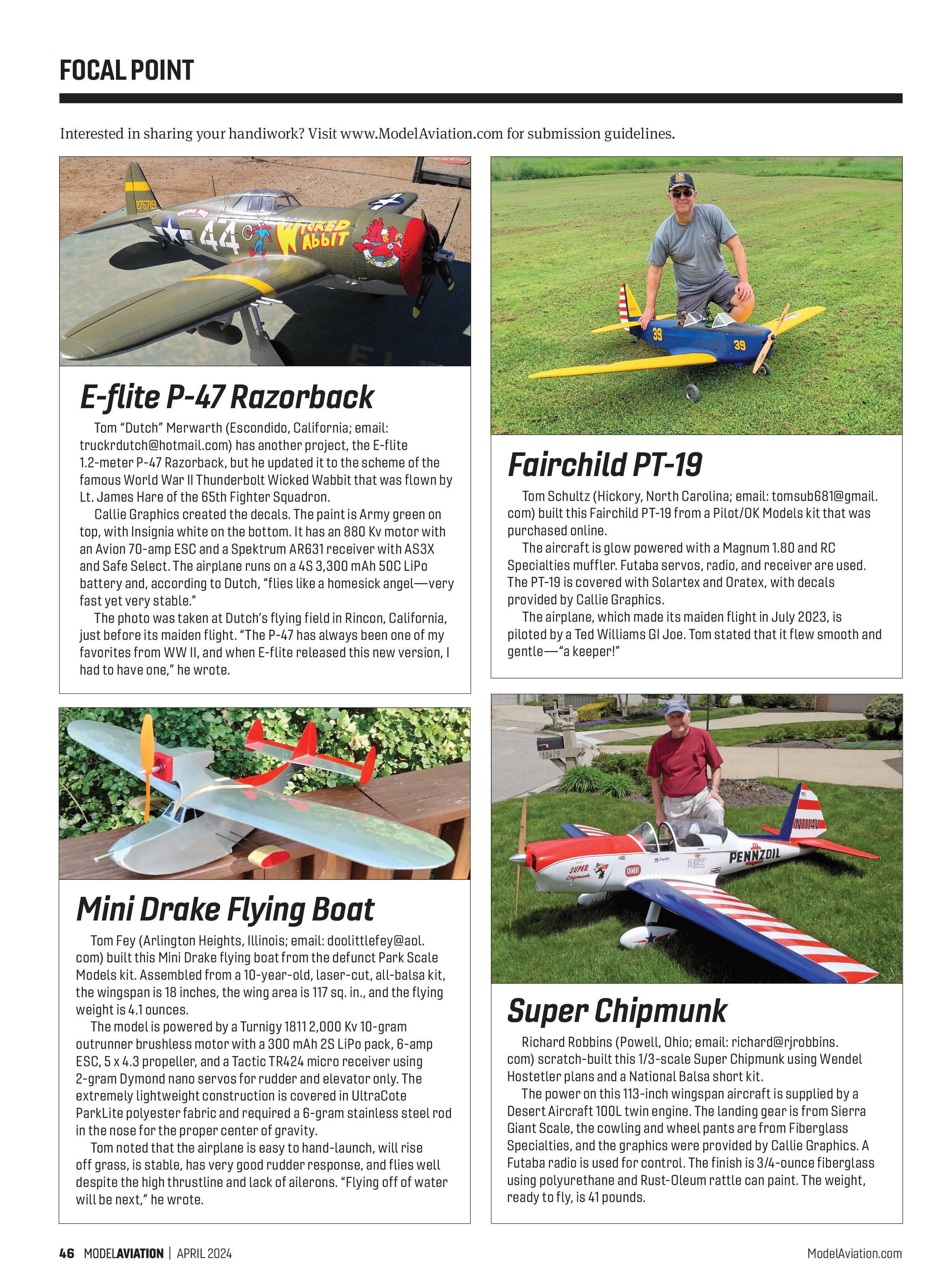
Tom “Dutch” Merwarth (Escondido, California; email: truckcrutch@hotmail.com) has another project, the E-flite 1.2-meter P-47 Razorback, but he updated it to the scheme of the famous World War II Thunderbolt Wicked Wabbit that was flown by Lt. James Hare of the 65th Fighter Squadron.
Callie Graphics created the decals. The paint is Army green on top, with Insignia white on the bottom. It has an 880 Kv motor with an Avion 70-amp ESC and a Spektrum AR631 receiver with AS3X and Safe Select. The airplane runs on a 4S 3,300 mAh 50C LiPo battery and, according to Dutch, “flies like a homesick angel—very fast yet very stable.”
The photo was taken at Dutch’s flying field in Rincon, California, just before its maiden flight. “The P-47 has always been one of my favorites from WW II, and when E-flite released this new version, I had to have one,” he wrote.
Mini Drake Flying Boat

Tom Fey (Arlington Heights, Illinois; email: doolittlefey@aol.com) built this Mini Drake flying boat from the defunct Park Scale Models kit. Assembled from a 10-year-old, laser-cut, all-balsa kit, the wingspan is 18 inches, the wing area is 117 sq. in., and the flying weight is 4.1 ounces.
The model is powered by a Turnigy 1811 2,000 Kv 10-gram outrunner brushless motor with a 300 mAh 2S LiPo pack, 6-amp ESC, 5 x 4.3 propeller, and a Tactic TR24 mar receiver using 2-gram Dymond nano servos for rudder and elevator only. The extremely lightweight construction is covered in UltraCote ParkLite polyester fabric and required a 6-gram stainless steel rod in the nose for the proper center of gravity.
Tom noted that the airplane is easy to hand-launch, will rise off grass, is stable, has very good rudder response, and flies well despite the high thrustline and lack of ailerons. “Flying off of water will be next,” he wrote.
Fairchild PT-19

Tom Schultz (Hickory, North Carolina; email: tomsub681@gmail.com) built this Fairchild PT-19 from a Pilot/OK Models kit that was purchased online.
The aircraft is glow powered with a Magnum 1.80 and RC Specialties muffler. Futaba servos, radio, and receiver are used. The PT-19 is covered with Solartex and Oratex, with decals provided by Callie Graphics.
The airplane, which made its maiden flight in July 2023, is piloted by a Ted Williams GI Joe. Tom stated that it flew smooth and gentle—“a keeper!”
Super Chipmunk

Richard Robbins (Powell, Ohio; email: richard@rirobbins.com) scratch-built this 1/3-scale Super Chipmunk using Wendel Hostetler plans and a National Balsa short kit.
The power on this 113-inch wingspan aircraft is supplied by a Desert Aircraft 100L twin engine. The landing gear is from Sierra Giant Scale, the cowling and wheel pants are from Fiberglass Specialties, and the graphics were provided by Callie Graphics. A Futaba radio is used for control. The finish is 3/4-ounce fiberglass using polyurethane and Rust-Oleum rattle can paint. The weight, ready to fly, is 41 pounds.
Bicentennial T-28

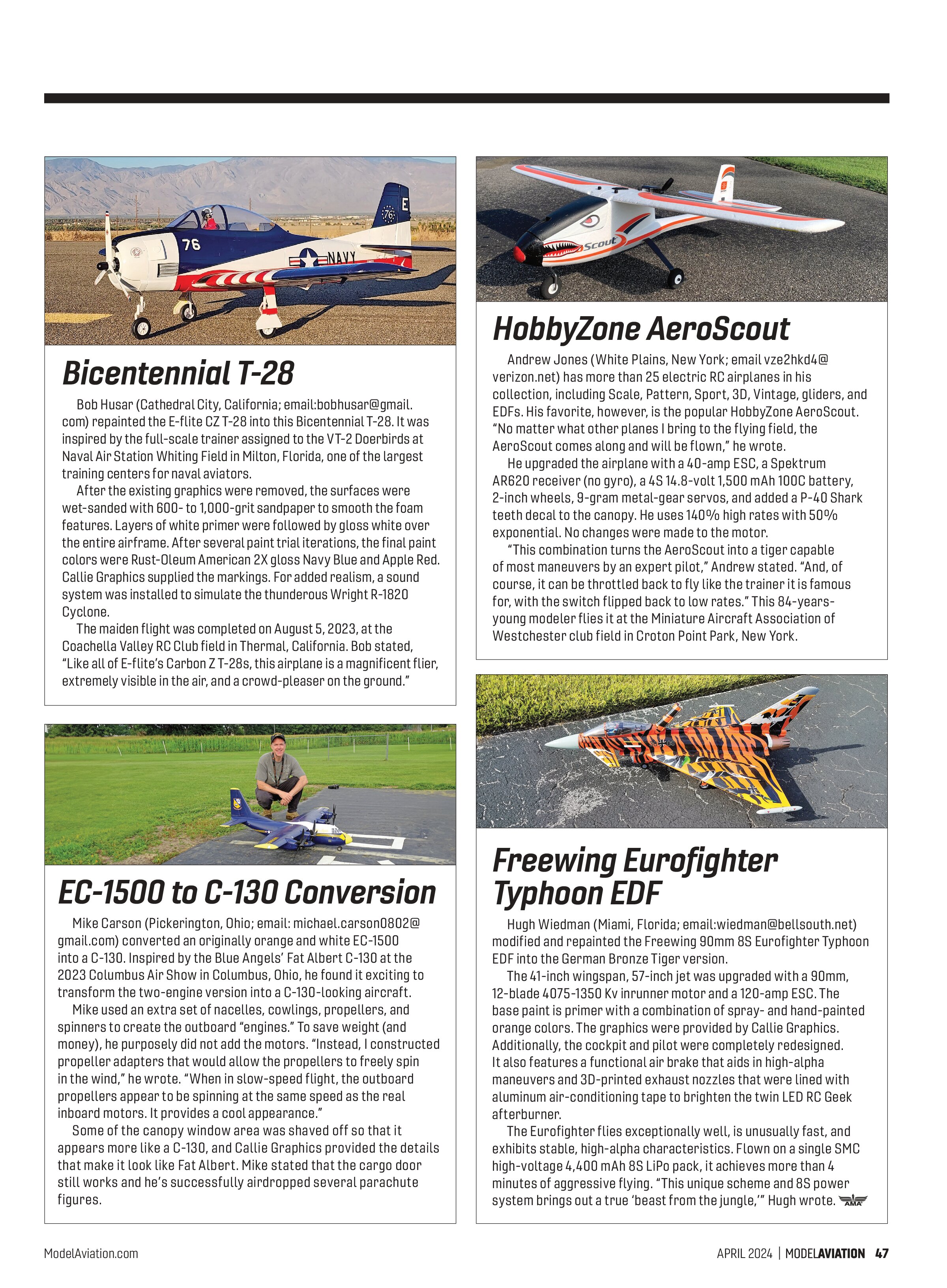
Bob Husar (Cathedral City, California; email:bobhusar@gmail.com) repainted the E-flite C7 T-28 into this Bicentennial T-28. It was inspired by the full-scale trainer assigned to the VT-2 Doerbirds at Naval Air Station Whiting Field in Milton, Florida, one of the largest training centers for naval aviators.
After the existing graphics were removed, the surfaces were wet-sanded with 600-to 1,000-grit sandpaper to smooth the foam features. Layers of white primer were followed by gloss white over the entire airframe. After several paint trial iterations, the final paint colors were Rust-Oleum American 2X gloss Navy Blue and Apple Red. Callie Graphics supplied the markings. For added realism, a sound system was installed to simulate the thunderous Wright R-1820 Cyclone.
The maiden flight was completed on August 5, 2023, at the Coachella Valley RC Club field in Thermal, California. Bob stated, “Like all of E-flite’s Carbon Z T-28s, this airplane is a magnificent flier, extremely visible in the air, and a crowd-pleaser on the ground.”
EC-1500 to C-130 Conversion

Mike Carson (Pickerington, Ohio; email: michael.carson0802@gmail.com) converted an originally orange and white EC-1500 into a C-130. Inspired by the Blue Angels’ Fat Albert C-130 at the 2023 Columbus Air Show in Columbus, Ohio, he found it exciting to transform the two-engine version into a C-130-looking aircraft.
Mike used an extra set of nacelles, cowlings, propellers, and spinners to create the outboard “engines.” To save weight (and money), he purposely did not add the motors. “Instead, I constructed propeller adapters that would allow the propellers to freely spin in the wind,” he wrote. “When in slow-speed flight, the outboard propellers appear to be spinning at the same speed as the real inboard motors. It provides a cool appearance.”
Some of the canopy window area was shaved off so that it appears more like a C-130, and Callie Graphics provided the details that make it look like Fat Albert. Mike stated that the cargo door still works and he’s successfully airdropped several parachute figures.
HobbyZone AeroScout

Andrew Jones (White Plains, New York; email: vze2hkd4@verizon.net) has more than 25 electric RC airplanes in his collection, including Scale, Pattern, Sport, 3D, Vintage, gliders, and EDFs. His favorite, however, is the popular HobbyZone AeroScout. “No matter what other planes I bring to the flying field, the AeroScout comes along and will be flown,” he wrote.
He upgraded the airplane with a 40-amp ESC, a Spektrum AR620 receiver (no gyro), a 4S 14.8-volt 1,500 mAh 100C battery, 2-inch wheels, 9-gram metal-gear servos, and added a P-40 Shark teeth decal to the canopy. He uses 140% high rates with 50% exponential. No changes were made to the motor.
“This combination turns the AeroScout into a tiger capable of most maneuvers by an expert pilot,” Andrew stated. “And, of course, it can be throttled back to fly like the trainer it is famous for, with the switch flipped back to low rates.” This 84-years-young modeler flies it at the Miniature Aircraft Association of Westchester club field in Croton Point Park, New York.
Freewing Eurofighter Typhoon EDF

Hugh Wiedman (Miami, Florida; email: wiedman@bellsouth.net) modified and repainted the Freewing 90mm 8S Eurofighter Typhoon EDF into the German Bronze Tiger version.
The 41-inch wingspan, 57-inch jet was upgraded with a 90mm, 12-blade 4075-1350 Kv inrunner motor and a 120-amp ESC. The base paint is primer with a combination of spray- and hand-painted orange colors. The graphics were provided by Callie Graphics. Additionally, the cockpit and pilot were completely redesigned. It also features a functional air brake that aids in high-alpha maneuvers and 3D-printed exhaust nozzles that were lined with aluminum air-conditioning tape to brighten the twin LED RC Geek afterburner.
The Eurofighter flies exceptionally well, is unusually fast, and exhibits stable, high-alpha characteristics. Flown on a single SMC high-voltage 4,400 mAh 8S LiPo pack, it achieves more than 4 minutes of aggressive flying. “This unique scheme and 8S power system brings out a true ‘beast from the jungle,’” Hugh wrote.