THE ELECTRIC REVOLUTION
By Don DeLoach | ddeloach@comcast.net

IN THE GOLDEN YEARS of engine-powered Free Flight (FF)—the 1950s through 1970s—fast-climbing, glow-engine models were among the most popular in our sport. Screaming racing engines powered these vertical drag racers to thrilling heights. Every hobby shop carried the latest engines and fuels, and hot, new engines came out every year to push the performance envelope. As late as 1972, the Nats 1/2A FF Gas event had 200-plus contestants.
In time, the FF hobby evolved from fast, large, and loud. Engine manufacturing waned, and with it, the popularity of wet-fueled aircraft. Smaller and quieter aircraft have steadily become the norm in FF. Gliders and rubber power have seen a resurgence, and as glow engine popularity has dwindled, hot electric setups have taken their place.
The first brushless electric motors and LiPo batteries came out in the early 2000s. FFers soon realized their potential for fast climbs with relatively light weight. By 2010, the National Free Flight Society (NFFS) had come up with a simple, inexpensive competition event for brushless motors and LiPo batteries called E-36.
A couple of years later, as E-36 became an AMA then FAI (F1S) event, modelers in the Pacific Northwest worked up an even smaller, simpler, electric-powered event called E-20. The idea was simple: a 20-inch wingspan model that weighed 1 ounce and was powered by a standard propeller, motor, and battery for moderate performance. A couple of rules changes followed, but the popularity of the E-20 class remains high.
in Japanese tissue with two light coats of nitrate dope, is 27 grams.
The Sky Demon is truly a stick-and-tissue modeler’s airplane. The original Sky Demon that was designed by Tim Bucher was published in the Stick and Tissue Modelers Album as a micro-electric FF model. The BMJR Sky Demon deviates only slightly from the original to accommodate E-20 components and to comply with the E-20 rules. The wing area is 69 sq. in. and the flying weight is 29 grams.
Build an E-20
Today, E-20 rivals E-36 as the simplest and most popular Electric competition event. The simplest kit can be bought for $50, including all of the electronics. A number of suppliers are producing kits now, and I haven’t seen any that don’t fly nicely.
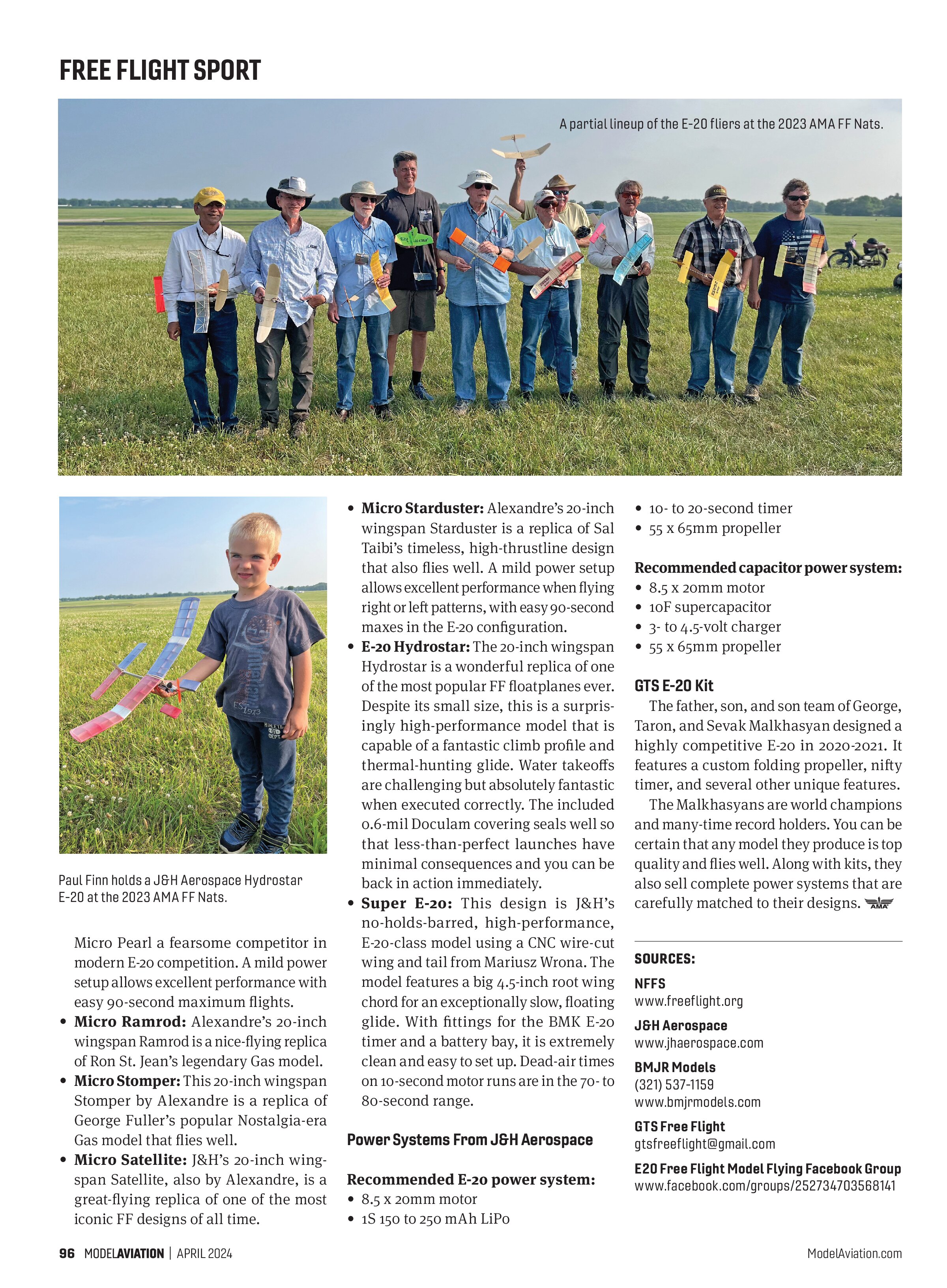
Scratch-building is common too, with mostly wood structures and simple iron-on coverings. Some designers are even using solid balsa and foam wings, à la FF Hand-Launched Gliders. Last year at the Nats, 20 fliers flew in the unofficial E-20 event, which was a better turnout than most of the official Nats events. E-20 is now an official NFFS event.
BMJR E-20 Kits
Lew Mahieu designed the Kiwi in 1954. It was originally thought to be a Zeek with straight wingtips, a tail, and rudder, but it’s a model with the flight characteristics of the Zeek without the complex construction. The E-20 version has a 20-inch wingspan with an area of 54 sq. in. It is powered by a PKZ 3616 motor using a 150 mAh 1S battery and an E-20 timer. The all-up, ready-to-fly weight of the model, covered
J&H Aerospace E-20 Kits
The husband-and-wife team of Josh and Hope Finn runs J&H Aerospace out of their home in rural Georgia. They have been at the forefront of promoting E-20 from shortly after the beginning. They currently have seven excellent kit choices: the Micro Pearl, Micro Ramrod, Micro Satellite, Micro Starduster, Micro Stomper, Hydrost ar, and Super E-20.
The power system is not included in any of their kits. You will need to select either a capacitor unit or an E-20 power system, both of which are available from J&H.

- Micro Pearl: The 20-inch wingspan Pearl, by Alexandre Cruz, is a great-flying replica of America’s dominant Gas model. Its thoroughbred lineage is on full display, with a fantastic climb profile and thermal-hunting glide, making

Micro Pearl, a fearsome competitor in modern E-20 competition. A mild power setup allows excellent performance with easy 90-second maximum flights.
- Micro Ramrod: Alexandre’s 20-inch wingspan Ramrod is a nice-flying replica of Ron St. Jean’s legendary Gas model.
- Micro Stomper: This 20-inch wingspan Stomper by Alexandre is a replica of George Fuller’s popular Nostalgia-era Gas model that flies well.
- Micro Satellite: J&H’s 20-inch wingspan Satellite, also by Alexandre, is a great-flying replica of one of the most iconic FF designs of all time.

- Micro Starduster: Alexandre’s 20-inch wingspan Starduster is a replica of Sal Taibi’s timeless, high-thrustline design that also flies well. A mild power setup allows excellent performance when flying right or left patterns, with easy 90-second maxes in the E-20 configuration.
- E-20 Hydrostar: The 20-inch wingspan Hydrostar is a wonderful replica of one of the most popular FF floatplanes ever. Despite its small size, this is a surprisingly high-performance model that is capable of a fantastic climb profile and thermal-hunting glide. Water takeoffs are challenging but absolutely fantastic when executed correctly. The included 0.6-mil Doculam covering seals well so that less-than-perfect launches have minimal consequences and you can be back in action immediately.
- Super E-20: This design is J&H’s no-holds-barred, high-performance, E-20-class model using a CNC wire-cut wing and tail from Mariusz Wrona. The model features a big 4.5-inch root wing chord for an exceptionally slow, floating glide. With fittings for the BMK E-20 timer and a battery bay, it is extremely clean and easy to set up. Dead-air times on 10-second motor runs are in the 70- to 80-second range.
Power Systems From J&H Aerospace
Recommended E-20 power system:
- 8.5 x 20mm motor
- 1S 150 to 250 mAh LiPo
- 10- to 20-second timer
- 55 x 65mm propeller
Recommended capacitor power system:
- 8.5 x 20mm motor
- 10F supercapacitor
- 3- to 4.5-volt charger
- 55 x 65mm propeller
GTS E-20 Kit
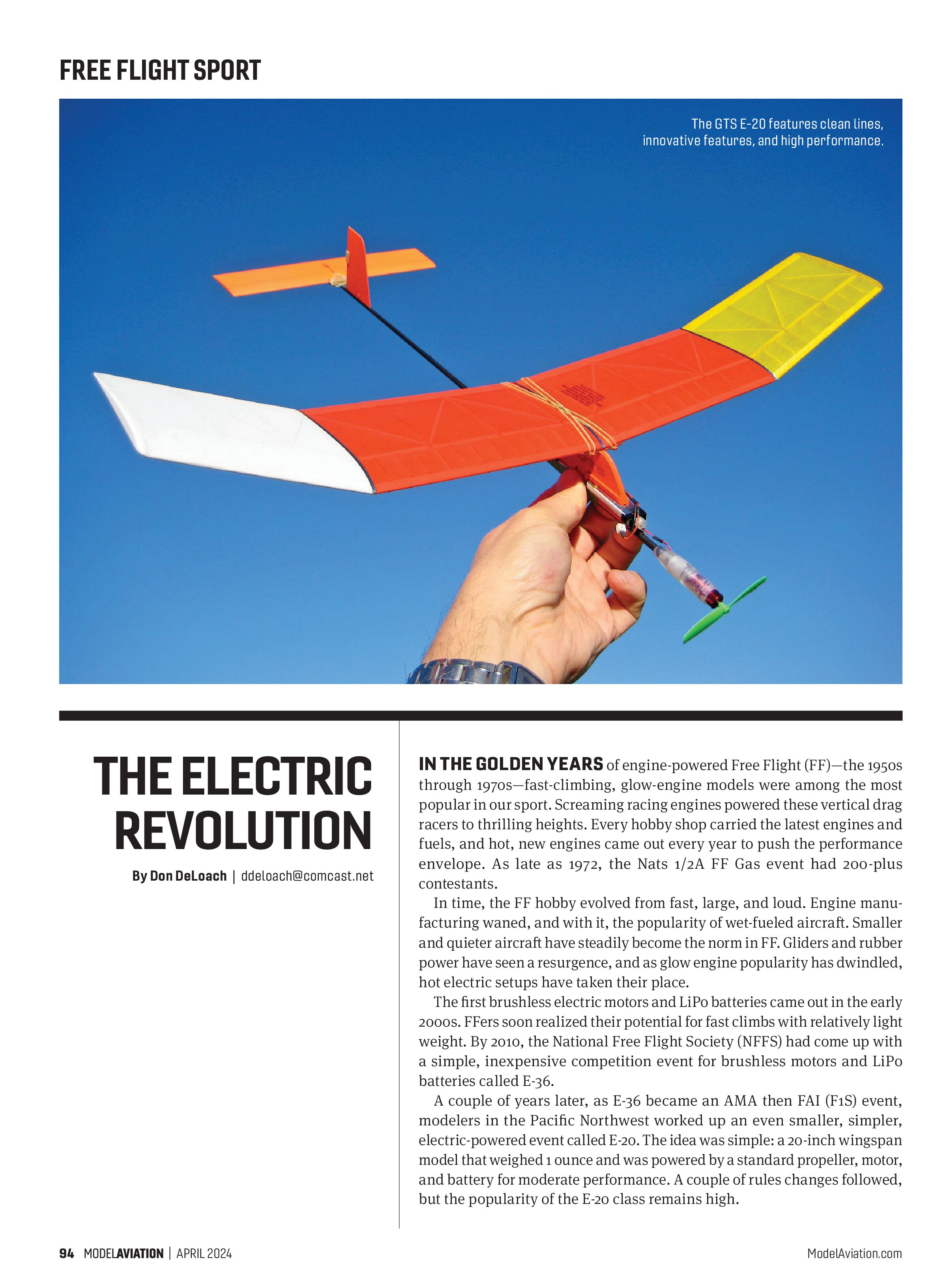
The father, son, and son team of George, Taron, and Sevak Malkhasyan designed a highly competitive E-20 in 2020-2021. It features a custom folding propeller, nifty timer, and several other unique features.
The Malkhasyans are world champions and many-time record holders. You can be certain that any model they produce is top quality and flies well. Along with kits, they also sell complete power systems that are carefully matched to their designs.
SOURCES:
J&H Aerospace
www.jhaerospace.com
BMJR Models
(321) 537-1159
www.bmj rmodels.com
GTS Free Flight
gtsfreeflight@gmail.com
E20 Free Flight Model Flying Facebook Group
www.facebook.com/groups/252734703568141