DECLUTTER
YOUR POWER
SYSTEM
By Terry Dunn | terrydunn74@gmail.com

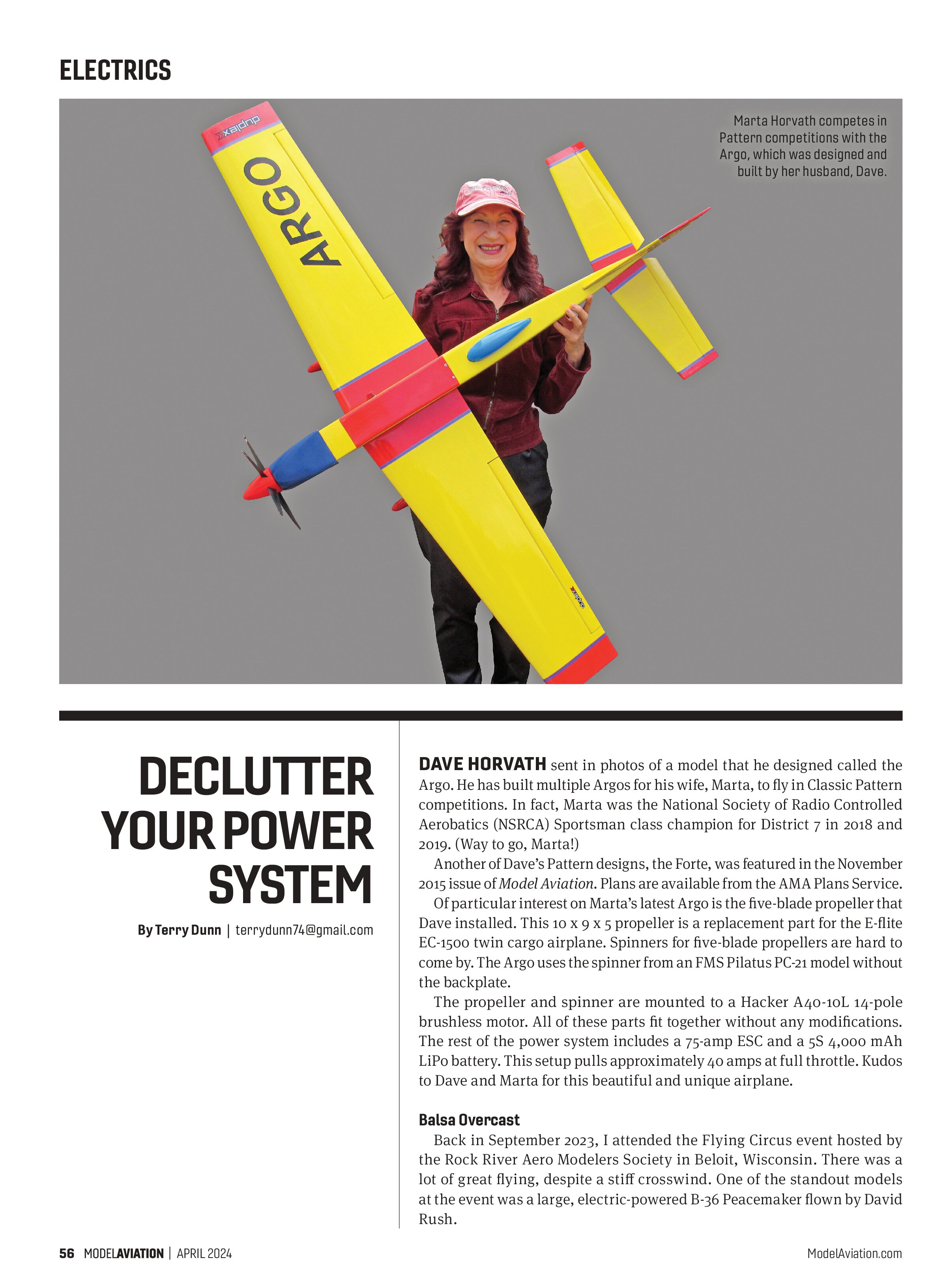
DAVE HORVATH sent in photos of a model that he designed called the Argo. He has built multiple Argos for his wife, Marta, to fly in Classic Pattern competitions. In fact, Marta was the National Society of Radio Controlled Aerobatics (NSRCA) Sportsman class champion for District 7 in 2018 and 2019. (Way to go, Marta!)
Another of Dave’s Pattern designs, the Forte, was featured in the November 2015 issue of Model Aviation. Plans are available from the AMA Plans Service.
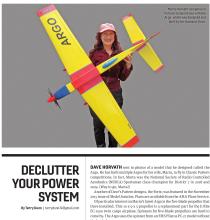
Of particular interest on Marta’s latest Argo is the five-blade propeller that Dave installed. This 10 x 9 x 5 propeller is a replacement part for the E-flite EC-1500 twin cargo airplane. Spinners for five-blade propellers are hard to come by. The Argo uses the spinner from an FMS Pilatus PC-21 model without the backplate.
The propeller and spinner are mounted to a Hacker A40-10L 14-pole brushless motor. All of these parts fit together without any modifications. The rest of the power system includes a 75-amp ESC and a 5S 4,000 mAh LiPo battery. This setup pulls approximately 40 amps at full throttle. Kudos to Dave and Marta for this beautiful and unique airplane.
Balsa Overcast
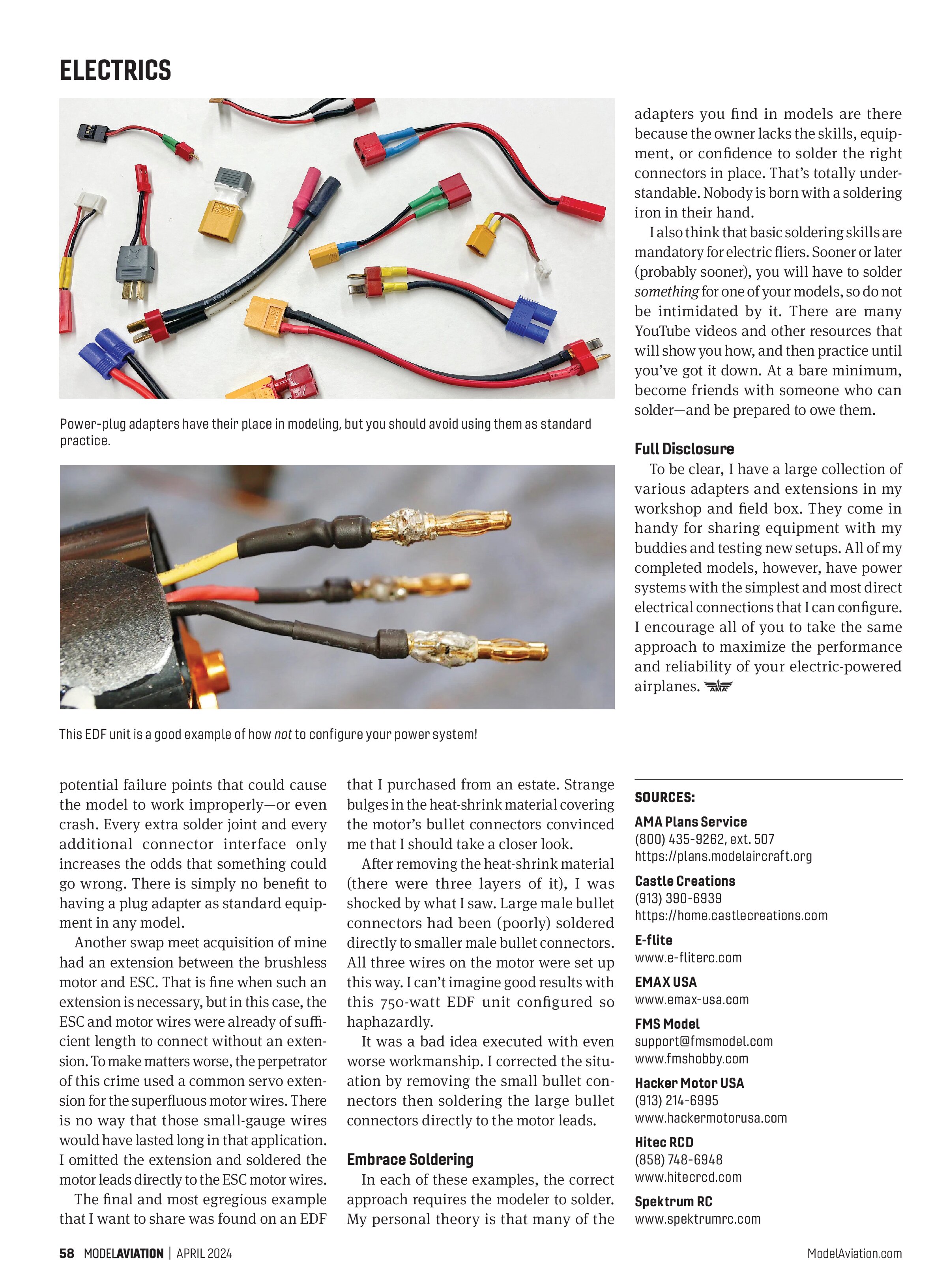
Back in September 2023, I attended the Flying Circus event hosted by the Rock River Aero Modelers Society in Beloit, Wisconsin. There was a lot of great flying, despite a stiff crosswind. One of the standout models at the event was a large, electric-powered B-36 Peacemaker flown by David Rush.
The balsa bomber was originally built by Howard Von Ruden. It has a wingspan of 115 inches and weighs 12 pounds ready to fly. Six EMAX 2212 1,400 Kv motors spin 8 x 4 propellers to drive the B-36. Each motor is connected to a discrete 30-amp ESC. Two 3S 3,200 mAh LiPo batteries are wired in parallel to create a single power source for all six motors. The total power output is 1,176 watts. A separate 3S 1,300 mAh LiPo is connected to a Castle Creations BEC Pro to power the Spektrum AR610 receiver and Hitec servos.
Dave’s B-36 performed well and looked great in the air. Others must have agreed because Dave and the B-36 earned the Best Military Aircraft award for the event.
Thou Shalt Not Adapt
One of the primary benefits of electric-powered models is their reliability. Most of the time, you simply connect the battery and everything will work exactly as it did for the previous flight. That’s how it should be. I have, however, seen many examples of modelers who compromise this reliability by overcomplicating the power system. The most common sin I have noticed is the use of unnecessary adapters and extensions.
A recent swap meet purchase included an adapter that converted the factory-installed power plug on the ESC to the type of plug used by the previous owner. They used this adapter on every flight, rather than just installing the correct plug on the ESC. The adapter adds electrical resistance, wasting power that would otherwise go to the motor. More importantly, the adapter introduces


adapters you find in models are there because the owner lacks the skills, equipment, or confidence to solder the right connectors in place. That’s totally understandable. Nobody is born with a soldering iron in their hand.
I also think that basic soldering skills are mandatory for electric fliers. Sooner or later (probably sooner), you will have to solder something for one of your models, so do not be intimidated by it. There are many YouTube videos and other resources that will show you how, and then practice until you’ve got it down. At a bare minimum, become friends with someone who can solder—and be prepared to owe them.
Full Disclosure
To be clear, I have a large collection of various adapters and extensions in my workshop and field box. They come in handy for sharing equipment with my buddies and testing new setups. All of my completed models, however, have power systems with the simplest and most direct electrical connections that I can configure. I encourage all of you to take the same approach to maximize the performance and reliability of your electric-powered airplanes.
potential failure points that could cause the model to work improperly—or even crash. Every extra solder joint and every additional connector interface only increases the odds that something could go wrong. There is simply no benefit to having a plug adapter as standard equipment in any model.
Another swap meet acquisition of mine had an extension between the brushless motor and ESC. That is fine when such an extension is necessary, but in this case, the ESC and motor wires were already of sufficient length to connect without an extension. To make matters worse, the perpetrator of this crime used a common servo extension for the superfluous motor wires. There is no way that those small-gauge wires would have lasted long in that application. I omitted the extension and soldered the motor leads directly to the ESC motor wires.
The final and most egregious example that I want to share was found on an EDF that I purchased from an estate. Strange bulges in the heat-shrink material covering the motor’s bullet connectors convinced me that I should take a closer look.
After removing the heat-shrink material (there were three layers of it), I was shocked by what I saw. Large male bullet connectors had been (poorly) soldered directly to smaller male bullet connectors. All three wires on the motor were set up this way. I can’t imagine good results with this 750-watt EDF unit configured so haphazardly.
It was a bad idea executed with even worse workmanship. I corrected the situation by removing the small bullet connectors then soldering the large bullet connectors directly to the motor leads.
Embrace Soldering
In each of these examples, the correct approach requires the modeler to solder. My personal theory is that many of the adapters you find in models are there because the owner lacks the skills, equipment, or confidence to solder the right connectors in place.
SOURCES:
AMA Plans Service
(800) 435-9262, ext. 507
https://plans.modelaircraft.org
Castle Creations
(913) 390-6939
https://home.castlecreations.com
E-flite
www.e-fliterc.com
EMAX USA
www.emax-usa.com
FMS Model
support@fmsmodel.com
www.fmshobby.com
Hacker Motor USA
(913) 214-6995
www.hackermotorusa.com
Hitec RCD
(858) 748-6948
www.hitecrcd.com
Spektrum RC
www.spektrumrc.com