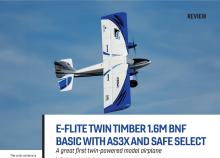
E-FLITE TWIN TIMBER 1.6M BNF BASIC WITH AS3X AND SAFE SELECT
A great first twin-powered model airplane
By Fitz Walker | flying_fitz@yahoo.com

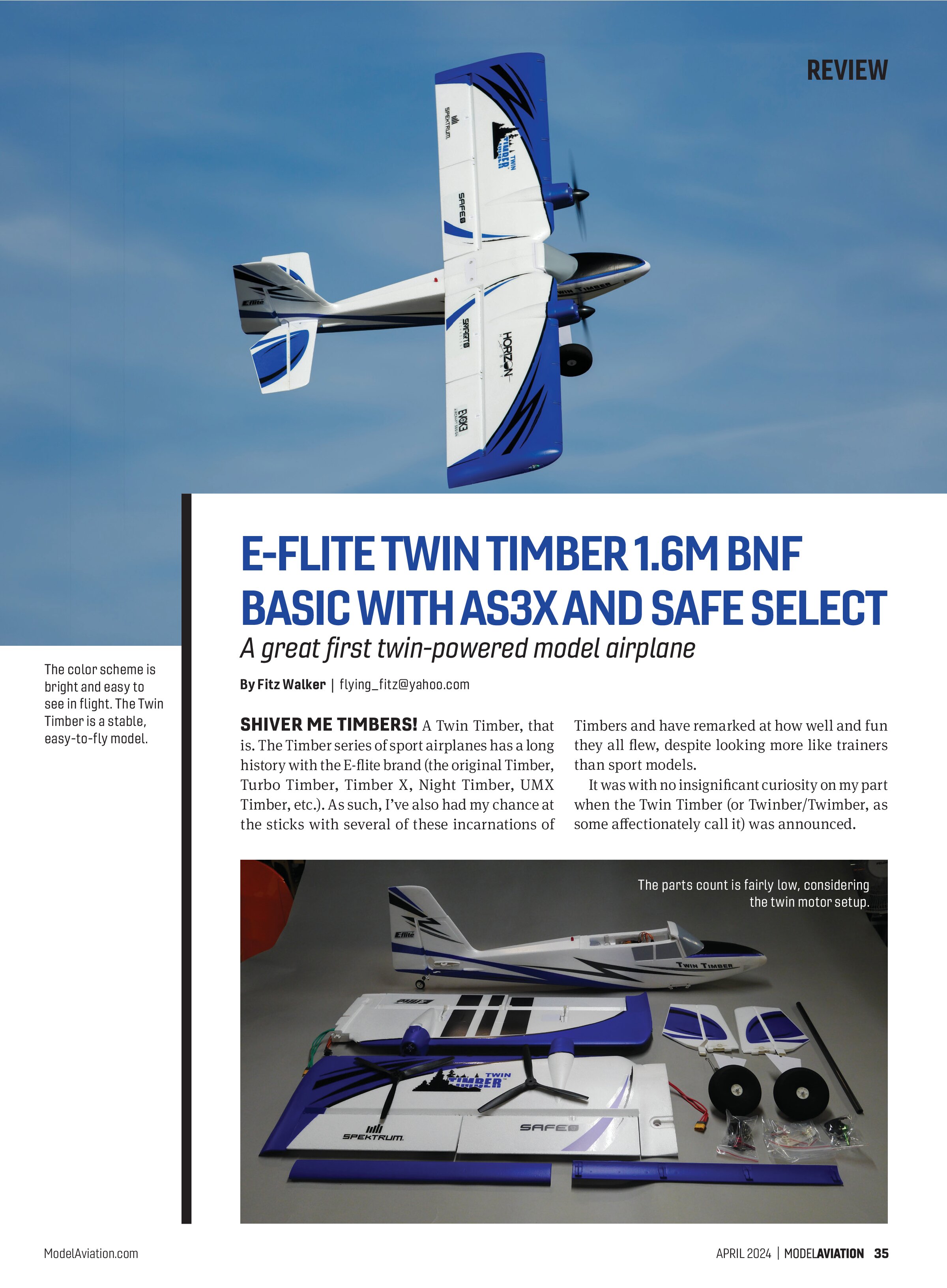
SHIVER ME TIMBERS! A Twin Timber, that is. The Timber series of sport airplanes has a long history with the E-flite brand (the original Timber, Turbo Timber, Timber X, Night Timber, UMX Timber, etc.). As such, I’ve also had my chance at the sticks with several of these incarnations of Timbers and have remarked at how well and fun they all flew, despite looking more like trainers than sport models.
It was with no insignificant curiosity on my part when the Twin Timber (or Twinber/Twimber, as some affectionately call it) was announced.

At a Glance
Specifications
Wingspan: 63.58 inches
Length: 42.99 inches
Weight (as flown): 5 pounds, 10 ounces
Channels: Six to eight channels
Motors: Avian 3521-750 Kv outrunner brushless
Battery: Spektrum 3S 2,200 mAh and 4S 3,200 mAh Smart
Receiver: Spektrum AR637T six-channel
Transmitter: Spektrum NX10SE
Pluses
- Wide range of battery options.
- Easy-flying qualities.
- Quick assembly.
Minuses
- Bouncy wheels.
Manufacturer/Distributor
E-flite/Horizon Hobby
www.horizonhobby.com/e-flite-1

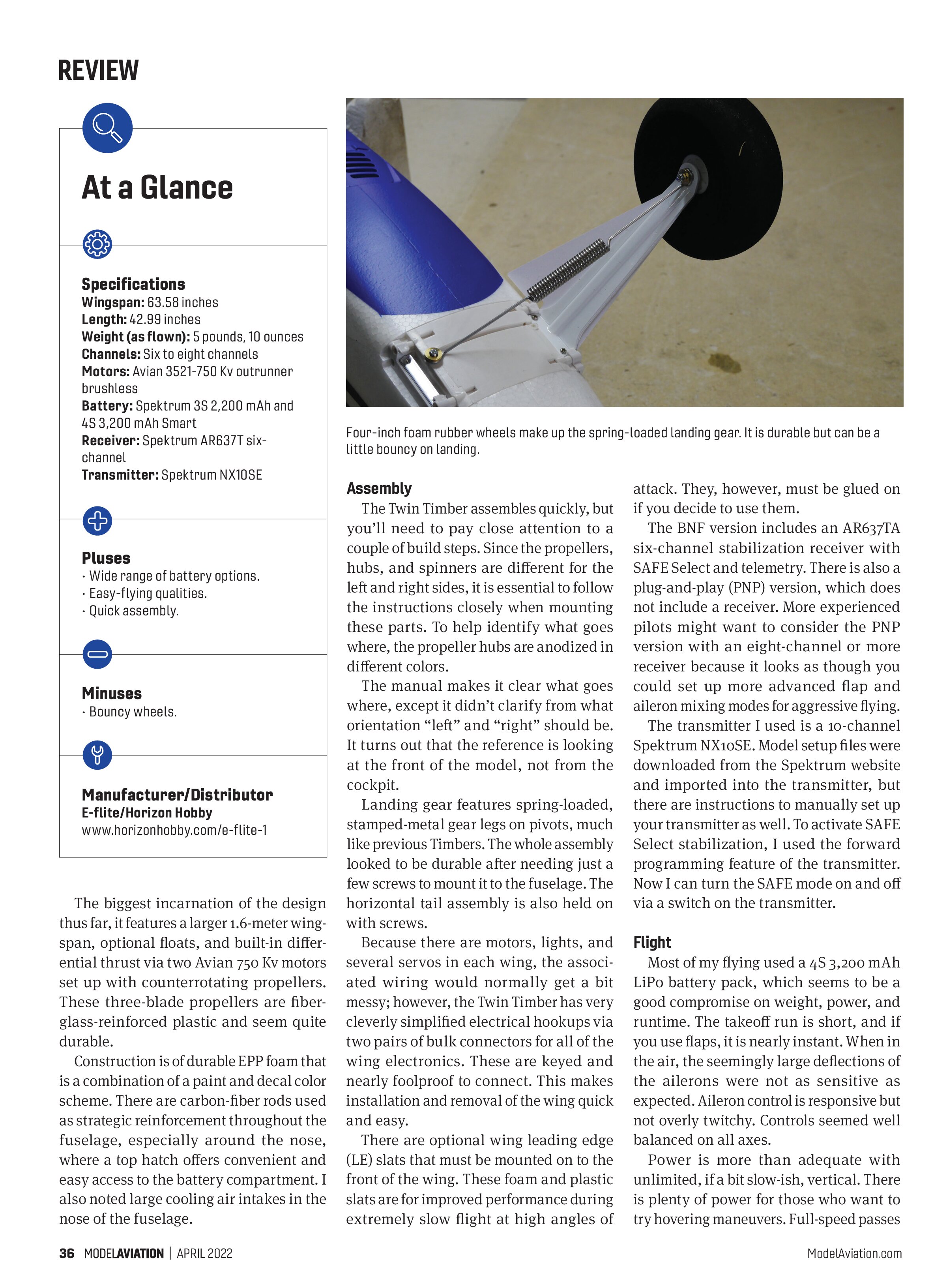
The biggest incarnation of the design thus far, it features a larger 1.6-meter wingspan, optional floats, and built-in differential thrust via two Avian 750 Kv motors set up with counterrotating propellers. These three-blade propellers are fiberglass-reinforced plastic and seem quite durable.
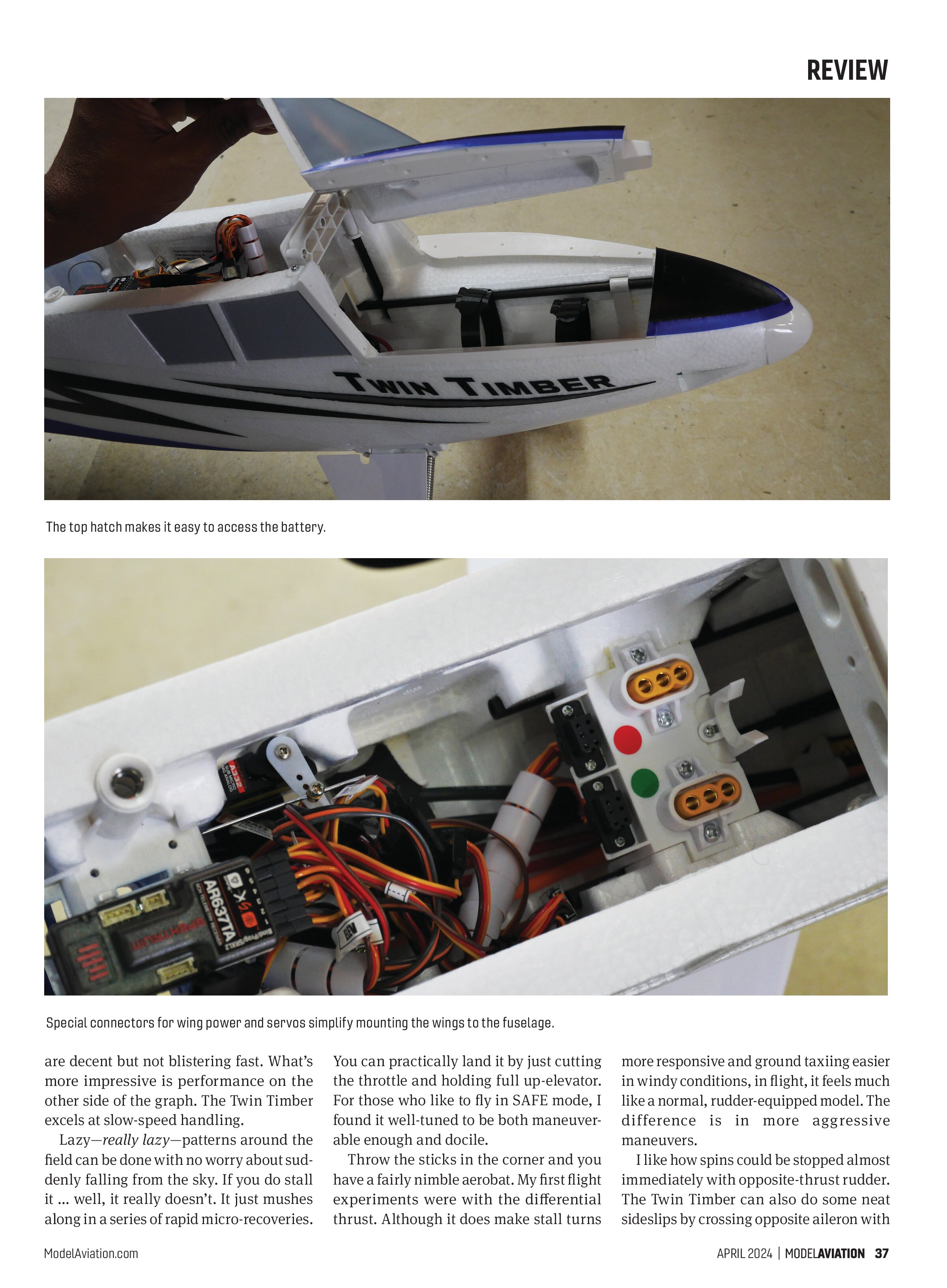
Construction is of durable EPP foam that is a combination of a paint and decal color scheme. There are carbon-fiber rods used as strategic reinforcement throughout the fuselage, especially around the nose, where a top hatch offers convenient and easy access to the battery compartment. I also noted large cooling air intakes in the nose of the fuselage.
Assembly
The Twin Timber assembles quickly, but you’ll need to pay close attention to a couple of build steps. Since the propellers, hubs, and spinners are different for the left and right sides, it is essential to follow the instructions closely when mounting these parts. To help identify what goes where, the propeller hubs are anodized in different colors.
The manual makes it clear what goes where, except it didn’t clarify from what orientation “left” and “right” should be. It turns out that the reference is looking at the front of the model, not from the cockpit.
Landing gear features spring-loaded, stamped-metal gear legs on pivots, much like previous Timbers. The whole assembly looked to be durable after needing just a few screws to mount it to the fuselage. The horizontal tail assembly is also held on with screws.
Because there are motors, lights, and several servos in each wing, the associated wiring would normally get a bit messy; however, the Twin Timber has very cleverly simplified electrical hookups via two pairs of bulk connectors for all of the wing electronics. These are keyed and nearly foolproof to connect. This makes installation and removal of the wing quick and easy.
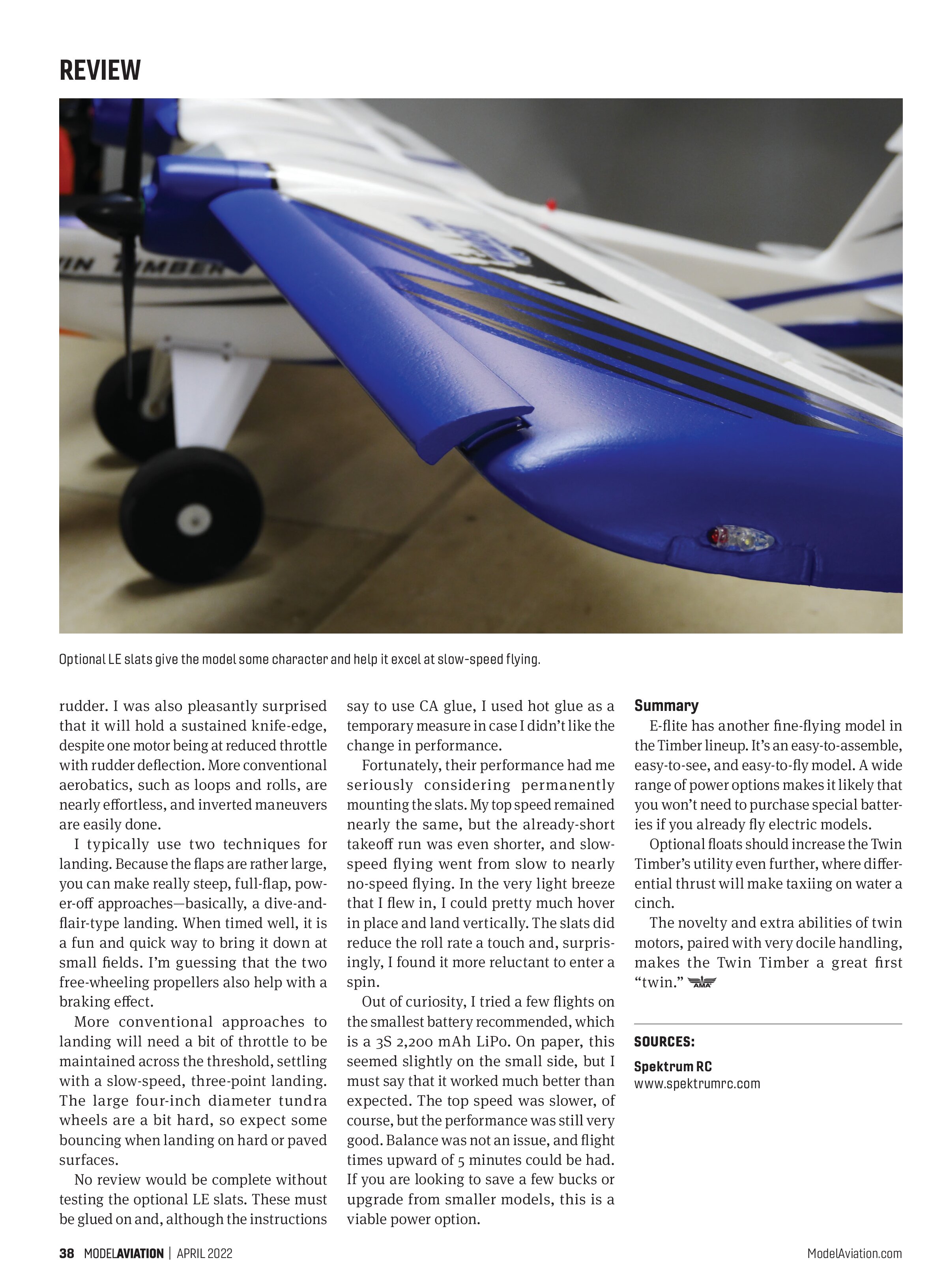
There are optional wing leading edge (LE) slats that must be mounted on to the front of the wing. These foam and plastic slats are for improved performance during extremely slow flight at high angles of attack. They, however, must be glued on if you decide to use them.
The BNF version includes an AR637TA six-channel stabilization receiver with SAFE Select and telemetry. There is also a plug-and-play (PNP) version, which does not include a receiver. More experienced pilots might want to consider the PNP version with an eight-channel or more receiver because it looks as though you could set up more advanced flap and aileron mixing modes for aggressive flying.
The transmitter I used is a 10-channel Spektrum NX10SE. Model setup files were downloaded from the Spektrum website and imported into the transmitter, but there are instructions to manually set up your transmitter as well. To activate SAFE Select stabilization, I used the forward programming feature of the transmitter. Now I can turn the SAFE mode on and off via a switch on the transmitter.
Flight
Most of my flying used a 4S 3,200 mAh LiPo battery pack, which seems to be a good compromise on weight, power, and runtime. The takeoff run is short, and if you use flaps, it is nearly instant. When in the air, the seemingly large deflections of the ailerons were not as sensitive as expected. Aileron control is responsive but not overly twitchy. Controls seemed well balanced on all axes.
Power is more than adequate with unlimited, if a bit slow-ish, vertical. There is plenty of power for those who want to try hovering maneuvers. Full-speed passes are decent but not blistering fast. What’s more impressive is performance on the other side of the graph. The Twin Timber excels at slow-speed handling.

You can practically land it by just cutting the throttle and holding full up-elevator. For those who like to fly in SAFE mode, I found it well-tuned to be both maneuverable enough and docile.
Throw the sticks in the corner and you have a fairly nimble aerobat. My first flight experiments were with the differential thrust. Although it does make stall turns more responsive and ground taxiing easier in windy conditions, in flight, it feels much like a normal, rudder-equipped model. The difference is in more aggressive maneuvers.
I like how spins could be stopped almost immediately with opposite-thrust rudder. The Twin Timber can also do some neat sideslips by crossing opposite aileron with


rudder. I was also pleasantly surprised that it will hold a sustained knife-edge, despite one motor being at reduced throttle with rudder deflection. More conventional aerobatics, such as loops and rolls, are nearly effortless, and inverted maneuvers are easily done.
I typically use two techniques for landing. Because the flaps are rather large, you can make really steep, full-flap, power-off approaches—basically, a dive-and-flair-type landing. When timed well, it is a fun and quick way to bring it down at small fields. I’m guessing that the two free-wheeling propellers also help with a braking effect.
More conventional approaches to landing will need a bit of throttle to be maintained across the threshold, settling with a slow-speed, three-point landing. The large four-inch diameter tundra wheels are a bit hard, so expect some bouncing when landing on hard or paved surfaces.
No review would be complete without testing the optional LE slats. These must be glued on and, although the instructions say to use CA glue, I used hot glue as a temporary measure in case I didn’t like the change in performance.
Fortunately, their performance had me seriously considering permanently mounting the slats. My top speed remained nearly the same, but the already-short takeoff run was even shorter, and slow-speed flying went from slow to nearly no-speed flying. In the very light breeze that I flew in, I could pretty much hover in place and land vertically. The slats did reduce the roll rate a touch and, surprisingly, I found it more reluctant to enter a spin.
Out of curiosity, I tried a few flights on the smallest battery recommended, which is a 3S 2,200 mAh LiPo. On paper, this seemed slightly on the small side, but I must say that it worked much better than expected. The top speed was slower, of course, but the performance was still very good. Balance was not an issue, and flight times upward of 5 minutes could be had. If you are looking to save a few bucks or upgrade from smaller models, this is a viable power option.
Summary
E-flite has another fine-flying model in the Timber lineup. It’s an easy-to-assemble, easy-to-see, and easy-to-fly model. A wide range of power options makes it likely that you won’t need to purchase special batteries if you already fly electric models.
Optional floats should increase the Twin Timber’s utility even further, where differential thrust will make taxiing on water a cinch.
The novelty and extra abilities of twin motors, paired with very docile handling, makes the Twin Timber a great first “twin.”
SOURCES:
Spektrum RC
www.spektrumrc.com