THE DEAL WITH DRONES

MATH, ENGINEERING, computer programming, and piloting—drones teach children many science, technology, engineering and math (STEM) skills that can lead to future career paths.
“I’ve seen my teenager go from a complete beginner to a pro-level pilot,” said Clare Cannizzaro, who works closely with the MultiGP STEM Alliance. “He can pick up a professional drone and fly it without any problem. If children start at 6, 8, or 10 years old with FPV training and skills, they can move into any career they want in the USA field.”
Clare, the director of sales with MultiGP, should know. Her son, Spencer, is one of the fastest drone racers in the country. She jumped at the opportunity to become involved with the STEM Alliance to help students learn more about drones.
“Educationally, MultiGP feels this is very important,” she said. “The STEM Alliance is here to support students and teachers at every level, whether they are just starting out or are working to become professional drone pilots.
“Even if the pilots don’t go into this as a career, they nurture their passion for aviation because there is something after middle school, high school, and college. They find a MultiGP chapter and fly on the weekends. That is our goal: to grow the sport of drone racing.”
Formed in 2020, the STEM Alliance features programs for middle school, through college-age students. Teachers can work with a complete curriculum to offer drones as a class course or as a club after school.
YDSC
Youth Drone Sports Championships (YDSC) help middle and high school students learn to fly a drone, going from a simulator to championship races. Its aim is purely to teach students how to race drones. “If you think racing is where you want to improve your skills, then YDSC is a great program,” said YDSC’s Marty Wetherall.
“YDSC represents the skills of racing and engineering and the ‘MacGyvering’ you have to do to keep your drone in the air,” he said.
The organization began after Marty and his team noticed how captivated children were when watching drone races. They built computer software to run drone races and thought they could build a great youth program.
Some schools in Minnesota approved an FPV elective class, and the program began taking off. When the COVID-19 pandemic began, YDSC saw the opportunity to take the racing nationwide.
“We told the kids to bring their radio controllers home and we didn’t miss a beat,” Marty said. “We held a very successful state tournament online when no other school sports were happening. It even aired live on television. When we moved to the computer simulator, we had kids all over the world racing in blade-to-blade action.”
YDSC organizes weekly virtual races and helps students sharpen their piloting skills. The organization has had several successful graduates of its program go on to compete at the national level and even represent the US at the FAI World Drone Racing Championship.
Drones in School
Piloting a drone is an important skill, but there are other components to UAS. “We feel like for curriculum and educational use, you need to go a bit deeper,” said Tad Douce, who’s been an educator for nearly 30 years. “Piloting is one component, but it isn’t the whole program. We focus on engineering and layer in problem-solving, entrepreneurship, design, and even marketing.”
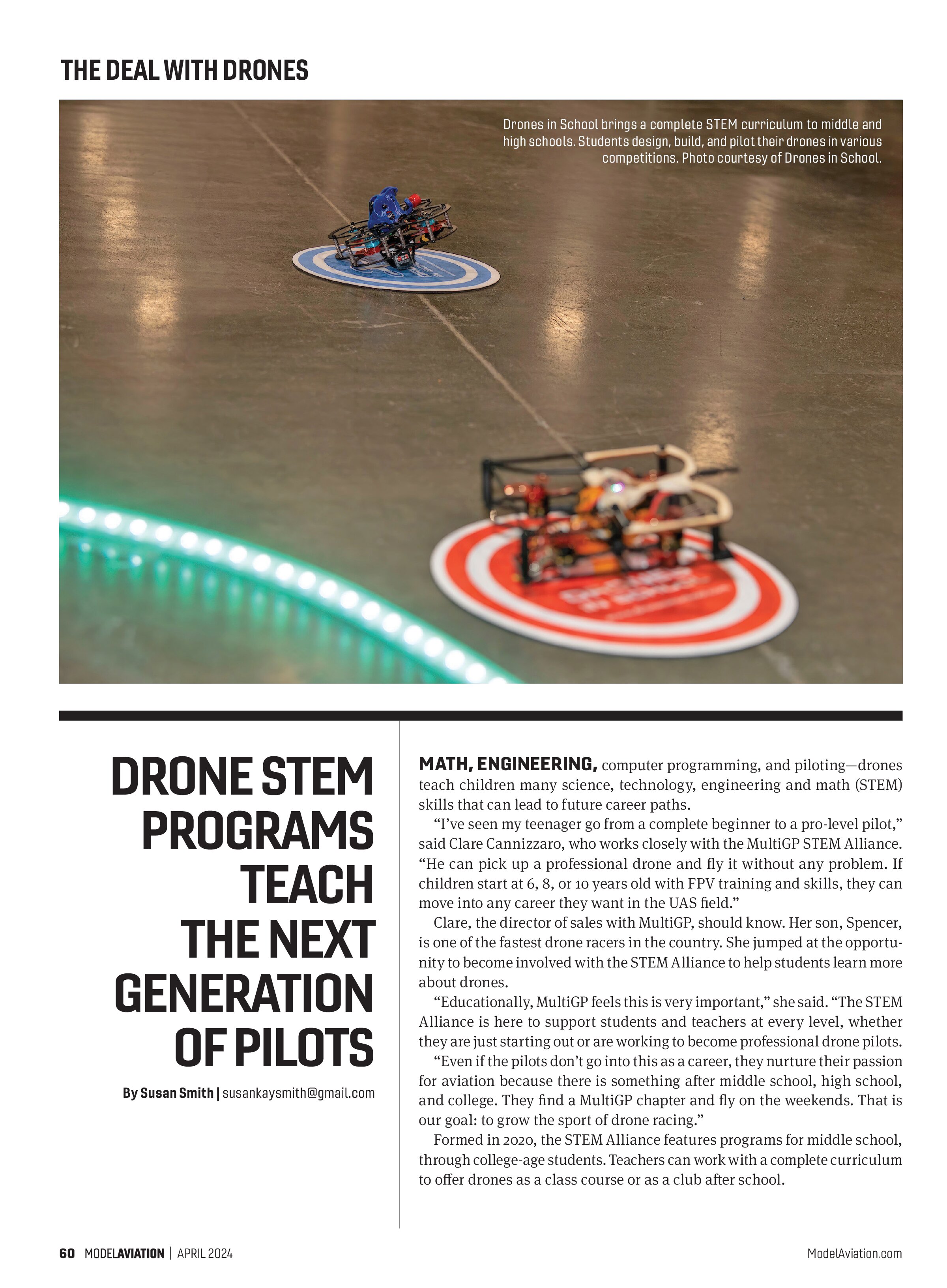
Drones in School gives teachers a complete curriculum, with support to help them be successful. The premise is that the students are starting a drone racing team. They need to create logos, websites, and marketing videos.
The students then build their drone. They must design a way to carry their drone’s mock payload—something such as a small memory card. “Each team goes through an iterative process of designing, prototyping, and redesigning,” said Tad. “Our goal is to give kids real-life experiences. You want people who can solve problems, be creative, and work on a team.”
The students also compete in races or capture-the-flag contests. Approximately 120 teams race either in real life or on a computer simulator. In the timed race, students fly through obstacles, land, and must give their payload to a judge within 30 seconds.
“MultiGP helps us run engaging and exciting events,” he said. “They want to grow the sport by engaging with the youth. I’m not a drone racer; I’m an educator. MultiGP helps us keep up to date with technology changes and ensuring that students will have a place to grow after their time in our program.”
AVR
Advanced Vertical Robotics (AVR) is a challenging high school capstone program where students create drones that can fly both automatically and via remote control. The program gives teams a new mission to solve each year. For example, the teams recently simulated putting out a fire and rescuing stranded people.

“Through the AVR program, students develop skills that can lead to a career pathway or college enrollment to set them on a course for a lifetime of success,” Tad said.


CDRA
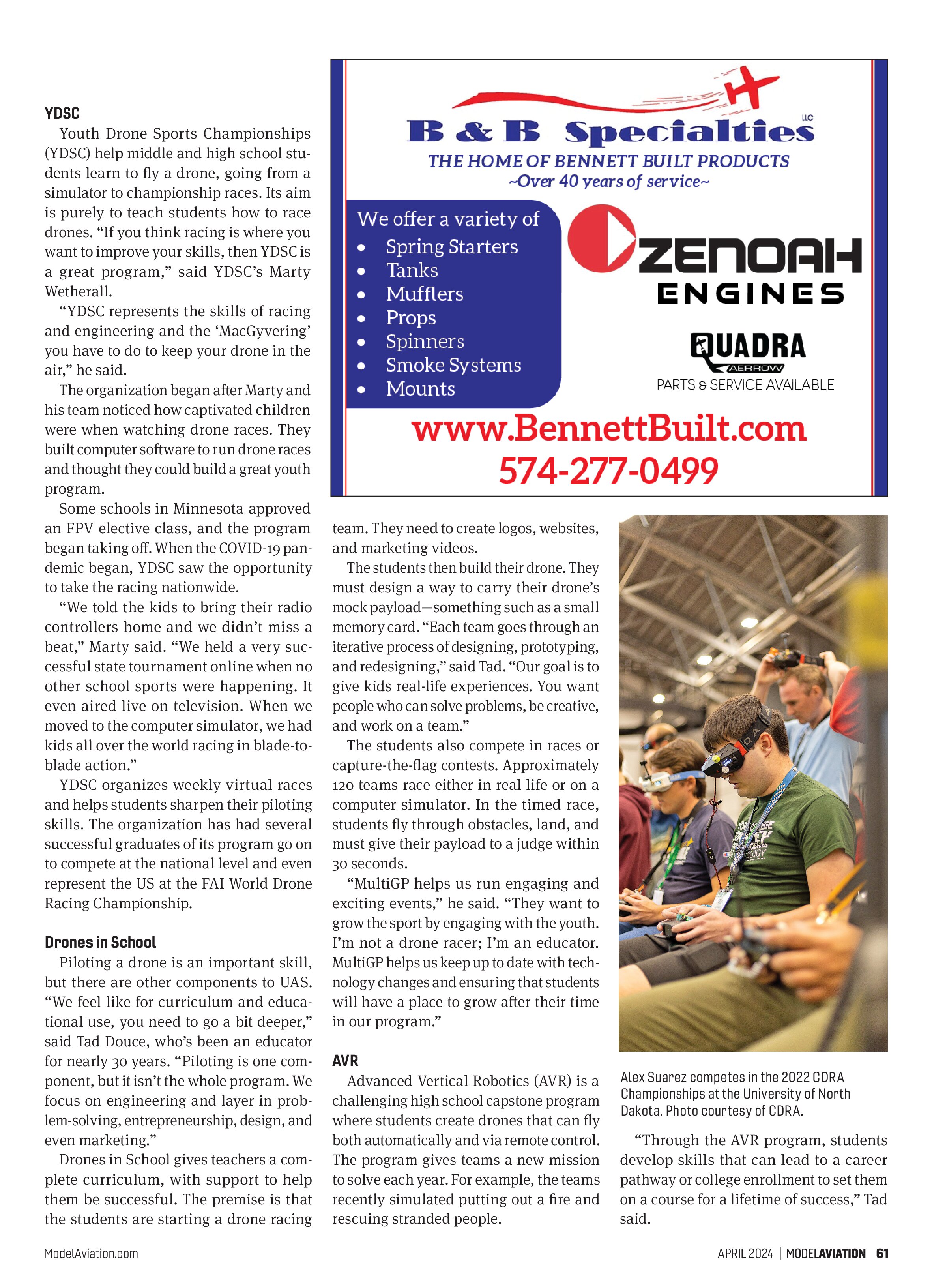
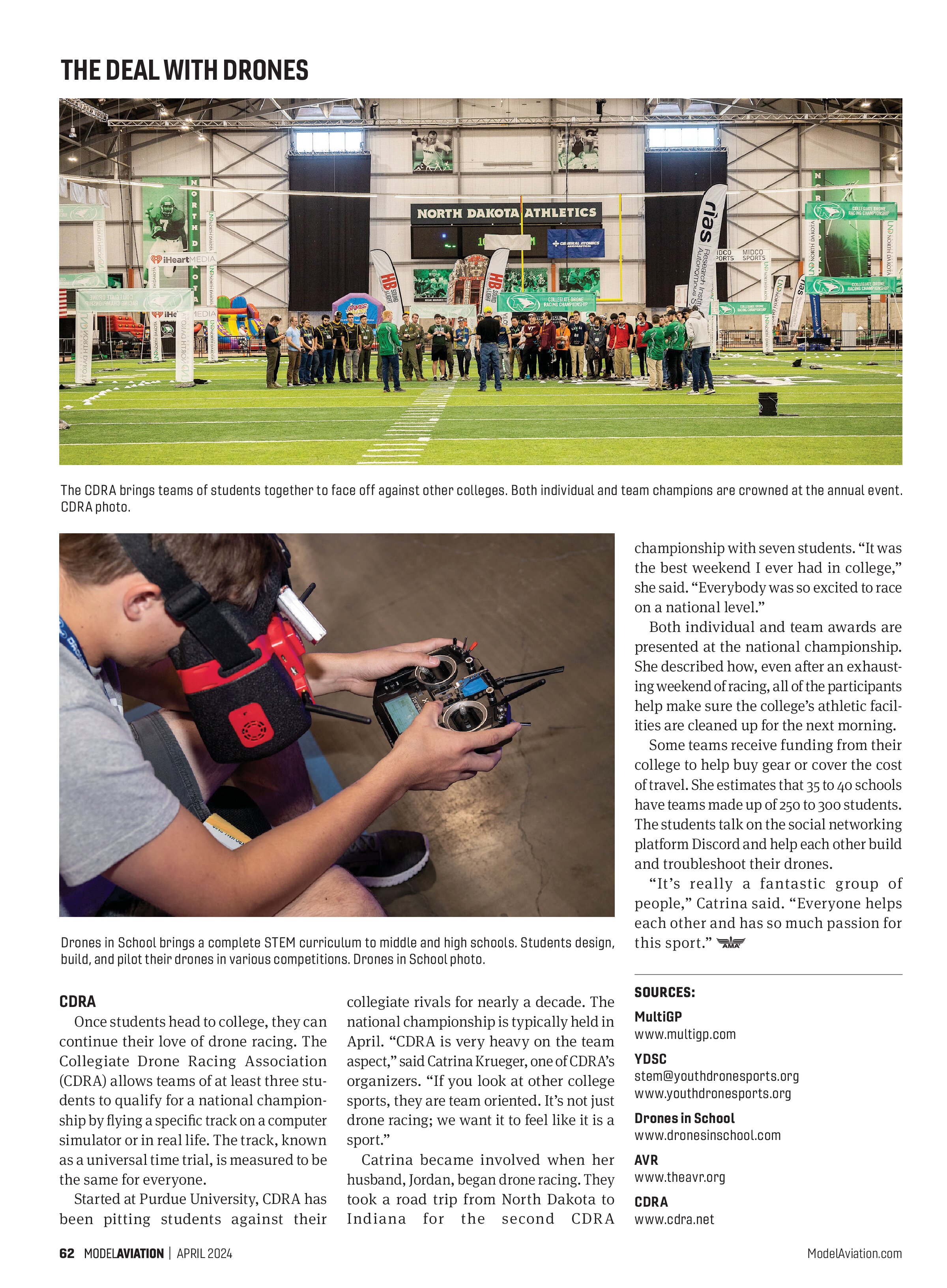
Once students head to college, they can continue their love of drone racing. The Collegiate Drone Racing Association (CDRA) allows teams of at least three students to qualify for a national championship by flying a specific track on a computer simulator or in real life. The track, known as a universal time trial, is measured to be the same for everyone.
Started at Purdue University, CDRA has been pitting students against their collegiate rivals for nearly a decade. The national championship is typically held in April. “CDRA is very heavy on the team aspect,” said Catrina Krueger, one of CDRA’s organizers. “If you look at other college sports, they are team oriented. It’s not just drone racing; we want it to feel like it is a sport.”
Catrina became involved when her husband, Jordan, began drone racing. They took a road trip from North Dakota to Indiana for the second CDRA championship with seven students. “It was the best weekend I ever had in college,” she said. “Everybody was so excited to race on a national level.”
Both individual and team awards are presented at the national championship. She described how, even after an exhausting weekend of racing, all of the participants help make sure the college’s athletic facilities are cleaned up for the next morning.
Some teams receive funding from their college to help buy gear or cover the cost of travel. She estimates that 35 to 40 schools have teams made up of 250 to 300 students. The students talk on the social networking platform Discord and help each other build and troubleshoot their drones.
“It’s really a fantastic group of people,” Catrina said. “Everyone helps each other and has so much passion for this sport.”
SOURCES:
MultiGP
www.multigp.com
YDSC
stem@youthdronesports.org
www.youthdronesports.org
Drones in School
www.dronesinschool.com
CDRA
www.cdra.net