SEL IN UAS4STEM
By Gwen Mathis, AMA Education Development Coordinator | gwenm@modelaircraft.org
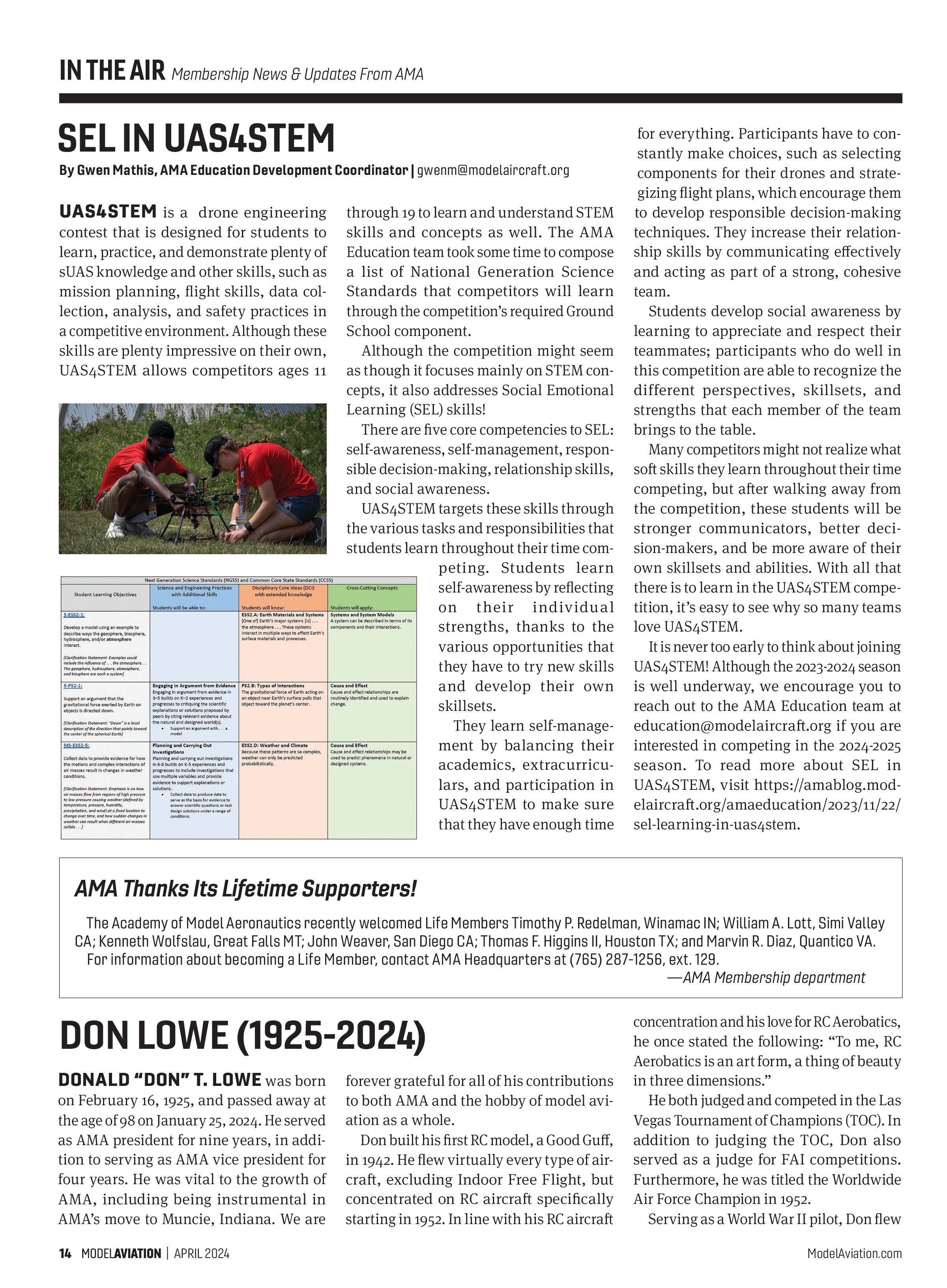
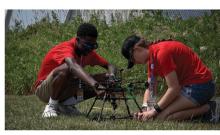
UAS4STEM is a drone engineering contest that is designed for students to learn, practice, and demonstrate plenty of sUAS knowledge and other skills, such as mission planning, flight skills, data collection, analysis, and safety practices in a competitive environment. Although these skills are plenty impressive on their own, UAS4STEM allows competitors ages 11

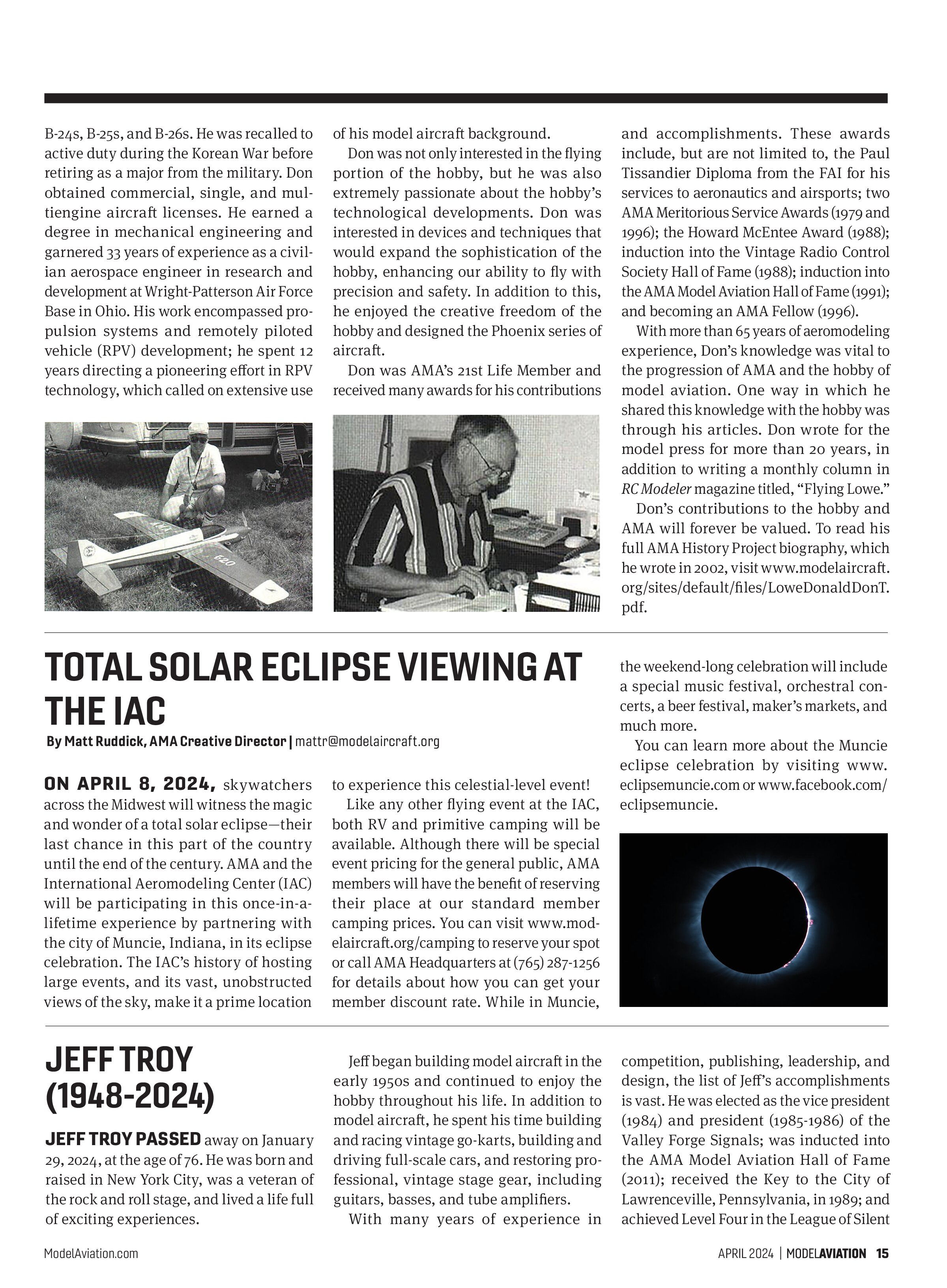
through 19 to learn and understand STEM skills and concepts as well. The AMA Education team took some time to compose a list of National Generation Science Standards that competitors will learn through the competition’s required Ground School component.
Although the competition might seem as though it focuses mainly on STEM concepts, it also addresses Social Emotional Learning (SEL) skills!
There are five core competencies to SEL: self-awareness, self-management, responsible decision-making, relationship skills, and social awareness.
UAS4STEM targets these skills through the various tasks and responsibilities that students learn throughout their time competing. Students learn self-awareness by reflecting on their individual strengths, thanks to the various opportunities that they have to try new skills and develop their own skillsets.
They learn self-management by balancing their academics, extracurriculars, and participation in UAS4STEM to make sure that they have enough time
for everything. Participants have to constantly make choices, such as selecting components for their drones and strategizing flight plans, which encourage them to develop responsible decision-making techniques. They increase their relationship skills by communicating effectively and acting as part of a strong, cohesive team.
Students develop social awareness by learning to appreciate and respect their teammates; participants who do well in this competition are able to recognize the different perspectives, skillsets, and strengths that each member of the team brings to the table.
Many competitors might not realize what soft skills they learn throughout their time competing, but after walking away from the competition, these students will be stronger communicators, better decision-makers, and be more aware of their own skillsets and abilities. With all that there is to learn in the UAS4STEM competition, it’s easy to see why so many teams love UAS4STEM.
It is never too early to think about joining UAS4STEM! Although the 2023-2024 season is well underway, we encourage you to reach out to the AMA Education team at education@modelaircraft.org if you are interested in competing in the 2024-2025 season. To read more about SEL in UAS4STEM, visit https://amablog.modelaircraft.org/amaeducation/2023/11/22/sel-learning-i....

AMA Thanks Its Lifetime Supporters!
The Academy of Model Aeronautics recently welcomed Life Members Timothy P. Redelman, Winamac IN; William A. Lott, Simi Valley CA; Kenneth Wolfs lau, Great Falls MT; John Weaver, San Diego CA; Thomas F. Higgin s II, Houston TX; and Marvin R. Diaz, Quantico VA. For information about becoming a Life Member, contact AMA Headquarters at (765) 287-1256, ext. 129.
—AMA Membership department
DON LOWE (1925-2024)
DONALD “DON” T. LOWE was born on February 16, 1925, and passed away at the age of 98 on January 25, 2024. He served as AMA president for nine years, in addition to serving as AMA vice president for four years. He was vital to the growth of AMA, including being instrumental in AMA’s move to Muncie, Indiana. We are forever grateful for all of his contributions to both AMA and the hobby of model aviation as a whole.
Don built his first RC model, a Good Guff, in 1942. He flew virtually every type of aircraft, excluding Indoor Free Flight, but concentrated on RC aircraft specifically starting in 1952. In line with his RC aircraft concentration and his love for RC Aerobatics, he once stated the following: “To me, RC Aerobatics is an art form, a thing of beauty in three dimensions.”
He both judged and competed in the Las Vegas Tournament of Champions (TOC). In addition to judging the TOC, Don also served as a judge for FAI competitions. Furthermore, he was titled the Worldwide Air Force Champion in 1952.
Serving as a World War II pilot, Don flew B-24s, B-25s, and B-26s. He was recalled to active duty during the Korean War before retiring as a major from the military. Don obtained commercial, single, and multiengine aircraft licenses. He earned a degree in mechanical engineering and garnered 33 years of experience as a civilian aerospace engineer in research and development at Wright-Patterson Air Force Base in Ohio. His work encompassed propulsion systems and remotely piloted vehicle (RPV) development; he spent 12 years directing a pioneering effort in RPV technology, which called on extensive use

of his model aircraft background.
Don was not only interested in the flying portion of the hobby, but he was also extremely passionate about the hobby’s technological developments. Don was interested in devices and techniques that would expand the sophistication of the hobby, enhancing our ability to fly with precision and safety. In addition to this, he enjoyed the creative freedom of the hobby and designed the Phoenix series of aircraft.
Don was AMA’s 21st Life Member and received many awards for his contributions

and accomplishments. These awards include, but are not limited to, the Paul Tissandier Diploma from the FAI for his services to aeronautics and airsports; two AMA Meritorious Service Awards (1979 and 1996); the Howard McEntee Award (1988); induction into the Vintage Radio Control Society Hall of Fame (1988); induction into the AMA Model Aviation Hall of Fame (1991); and becoming an AMA Fellow (1996).
With more than 65 years of aeromodeling experience, Don’s knowledge was vital to the progression of AMA and the hobby of model aviation. One way in which he shared this knowledge with the hobby was through his articles. Don wrote for the model press for more than 20 years, in addition to writing a monthly column in RC Modeler magazine titled, “Flying Lowe.”
Don’s contributions to the hobby and AMA will forever be valued. To read his full AMA History Project biography, which he wrote in 2002, visit www.modelaircraft.org/sites/default/files/LoweDonaldDonT.pdf.
TOTAL SOLAR ECLIPSE VIEWING AT THE IAC
By Matt Ruddick, AMA Creative Director | mattr@modelaircraft.org
ON APRIL 8, 2024, skywatchers across the Midwest will witness the magic and wonder of a total solar eclipse—their last chance in this part of the country until the end of the century. AMA and the International Aeromodeling Center (IAC) will be participating in this once-in-a-lifetime experience by partnering with the city of Muncie, Indiana, in its eclipse celebration. The IAC’s history of hosting large events, and its vast, unobstructed views of the sky, make it a prime location to experience this celestial-level event!
Like any other flying event at the IAC, both RV and primitive camping will be available. Although there will be special event pricing for the general public, AMA members will have the benefit of reserving their place at our standard member camping prices. You can visit www.modelaircraft.org/camping to reserve your spot or call AMA Headquarters at (765) 287-1256 for details about how you can get your member discount rate. While in Muncie, the weekend-long celebration will include a special music festival, orchestral concerts, a beer festival, maker’s markets, and much more.
You can learn more about the Muncie eclipse celebration by visiting www.eclipsemuncie.com or www.facebook.com/eclipsemuncie.

JEFF TROY (1948-2024)
JEFF TROY PASSED away on January 29, 2024, at the age of 76. He was born and raised in New York City, was a veteran of the rock and roll stage, and lived a life full of exciting experiences.
Jeff began building model aircraft in the early 1950s and continued to enjoy the hobby throughout his life. In addition to model aircraft, he spent his time building and racing vintage go-karts, building and driving full-scale cars, and restoring professional, vintage stage gear, including guitars, basses, and tube amplifiers.
With many years of experience in competition, publishing, leadership, and design, the list of Jeff’s accomplishments is vast. He was elected as the vice president (1984) and president (1985-1986) of the Valley Forge Signals; was inducted into the AMA Model Aviation Hall of Fame (2011); received the Key to the City of Lawrenceville, Pennsylvania, in 1989; and achieved Level Four in the League of Silent
Flight RC Soaring SIG, just to name a few! Jeff was also an AMA Leader Member, contest director, and Life Member.
One of the ways in which Jeff gave back to the hobby was through his work with hobby publications. He was editor-in-chief for Park Pilot and Hobby Merchandiser magazines, wrote the “Model Builder” column for Park Pilot, edited Model Rectifier Corporation’s (MRC) monthly publication The Altech Advantage, and wrote an instructional series titled “Build” for RC Sport Flyer magazine. Furthermore, Jeff wrote and published two books of his own: Sportflier’s Guide to Finishing and Detailing Flying Models (1989) and The Sportflier’s Guide to RC Soaring (1991).
In addition to writing for and about the hobby, Jeff appreciated designing aircraft. He designed and developed the F-14 TAMEcat Trainer, which debuted as a construction article in the June 1990 issue of Model Aviation. It was initially distributed as an almost-ready-to-cover kit for the Altech Marketing Division of MRC. The updated version of the model was eventually distributed worldwide by AirBorne Models in Livermore, California.
Jeff and his wife, Lisa, ran a hobby shop—Allied Hobbies—in King of Prussia, Pennsylvania, from 1981-1986. While running this shop, he assisted hobbyists both young and old with building and flying model aircraft. His contributions to the hobby community were invaluable and he positively impacted many in their aeromodeling journeys.
To read Jeff’s AMA History Project biography, visit www.modelaircraft.org/sites/default/files/TroyJeff.pdf. For additional insight into Jeff’s life and aeromodeling experience, read an interview from the Fall 2023 issue of Park Pilot magazine by visiting www.theparkpilot.org/content/clarissa-poston-interviews-jeff-troy.
Model Builder Plans
AMA PLANS SERVICE now houses all plans formerly sold through Model Builder, Bill Northrup’s Plan Service, and the Scratch Builder’s Almanac. There are more than 18,000 plans in the collection.
Good Times was designed and drawn by Bob Stalik before being traced by S.A. Patterson for inclusion in Model Builder in 1976. Good Times was initially powered by a Jetex 50 Hellcat, meant to be a competition model for Rocket Free Flight. The completed model weighed 13 to 15 grams. This model can be built with minimal effort and time; various building tips can be found in the initial Model Builder article, which can be accessed by visiting the AMA Plans Service website.
Plans for Good Times, plans number 12763, can be ordered for $4 by visiting https://plans.modelaircraft.org or calling AMA Plans Service at (800) 435-9296, ext. 507.
Robert C. Noll (1937-2024)
ROBERT “BOB” C. NOLL was born in Allentown, Pennsylvania, on March 27, 1937. He passed away at the age of 86 on January 17, 2024.
Bob became interested in RC aircraft in roughly 1953. His first airplane was a Royal Rudderbug from a Berkeley kit, and he first competed in RC Aerobatics in 1954 with a deBolt LiveWire Champion.
Competing in hundreds of contests and at least 20 AMA Nats, Bob garnered many trophies and awards. He was the National Miniature Pylon Racing Association (NMPRA) Season Champion in Formula II in 1968; the NMPRA Season second place winner in Formula II in 1969; fourth-place winner at the 1974 Nats in Designer Scale; and a member of the US Pylon Racing team in 1974, during which he flew a scratch-built Bobcat designed by Bob Violett.
Some of the awards that Bob received include the Spirit of Selinsgrove Award from the Vintage RC Society (VRCS), two VRCS Concours awards, and an Outstanding Service Award from the Aero Radio Club of Syracuse. He became an AMA Leader Member in 1980, and he was inducted into the AMA Model Aviation Hall of Fame in 2007.
Bob chose to give back to the hobby through his building articles. He had various articles published in Model Aviation, Flying Models, RC Modeler, and Model Airplane News. He was also a columnist for Model Aviation, writing the “Vintage Viewpoint” column since May 2016.
Bob was a member of the National Model Aviation Museum’s Acquisition Committee and he made a number of donations to the museum, including aircraft and memorabilia.
He was a contest director for more than 50 different events, judged various Tournament of Champions competitions, and was an event director for RC Aerobatics (Pattern) during the Nats in 1998, ’99, and 2000.
To read Bob’s full AMA History Project autobiography, which he wrote in 2005, visit www.modelaircraft.org/sites/default/files/NollRobertCBobNoll.pdf.


History Preserved
A Treasure Found
By Michael Smith, National Model Aviation Museum Director | michaels@modelaircraft.org
SWAP MEETS, CLUB SALES, antique malls ... you never know what you might find. I have a friend who will buy a whole box of stuff just because there’s one thing that he wants. He said, “You never know. There might be a treasure in the bottom.”
Along those lines was a purchase recently made by RC car enthusiast Pat Bellner. He happened across a box of modeling supplies at an antique mall. Originally marked at $50, it had been reduced to $25; however, as it appeared that the vendor was going out of business, Pat offered $5. “Sold,” was the answer.
The box contained wheels, propellers, transmitters, engines, and, in the bottom, a Ziploc bag with a flag marked “Betkey’s Flying Circus.”
Curious, Pat did some research and discovered some information on Col. Betkey’s Flying Circus. He then offered, and we accepted, the flag for the National Model Aviation Museum.
Albert “Al” Betkey formed his Flying Circus in 1973, with a vision that there was a need to introduce the public to aeromodeling. As a member of the Toledo Weak Signals RC Club’s Demonstration Team, he had seen the benefit but felt that there needed to be more than just airplane flying; he wanted something that would provide entertainment for the entire family.
Skilled pilots from the Weak Signals and the Flying Tigers aeromodeling clubs were recruited, and the first season included shows throughout northern Ohio, Michigan, and Canada.
In 1974, the club became an AMA chartered club and funded its own activities, including uniforms, equipment, and travel. During that time, the aeromodeling community became aware of the club’s activities.
Companies soon stepped forward, with Jack Yarger of Kraft Great Lakes providing radio frequency assistance, Frank Polowy of Nitrotane providing fuel, and Ed Manulkin of Sterling helping with kits for the Snoopy and Red Baron routine. One of the Circus’ key aircraft was its Top Flite Contender. Magazine ads for the airplane, as well as MonoKote covering, featured the team. With support from Sig Manufacturing, the team even worked on a P-51 Mustang formation flight.
Benefit shows were also an important part of the Circus, with members performing for groups such as the Northwest Ohio Lung Association, the City League of Mothers, St. Joseph’s School, and the Toledo Chamber of Commerce. As of 1975, they had raised more than $8,000.
At the 1975 Toledo Weak Signals Exposition, the Circus was presented with AMA’s Distinguished Service Award for outstanding publicity efforts on behalf of model aviation.
The last newspaper article that we have found about the Circus relates to its 1978 show in Edgerton, Ohio.
Sadly, we have no records of the operations, but given its dedicated members, we are sure that thousands of individuals were introduced to aeromodeling through the group’s efforts.
If you were a part of the Betkey Flying Circus or have memorabilia from the group, we would love to hear from you. Please contact us at museum@modelaircraft.org.