FINE-TUNING YOUR JET
By Jim Hiller | jetmodeler@earthlink.net

THE TOPIC in my January 2023 column was about preparing for test flights and some initial setup ideas. Now, let’s move on to the unusual detail of fine-tuning your model. This is the tale of the things that you can do to make your airplane match your flying style.
My style is that of a somewhat aggressive, old-school RC Aerobatics (Pattern) pilot, meaning that a precise-flying airframe with equal inside and outside looping capabilities is high on my list of requirements. This greatly narrows the field of available jet models on the market because most have semisymmetrical airfoils incorporated into their wing design.
Last year was the first with my Elite Aerosports Picaro, which is truly an incredible piece of machinery. It’s still open to some minor tweaking to suit my style of flying. This model is meant to supplement my older Extreme ARF Vixen, an excellent sport aerobatic jet that excels at precision flying. Both aircraft are 200-newton, 45-pound thrust models. The Picaro is slightly smaller in wing area but otherwise roughly the same size; however, with the development of lightweight composite construction, it’s approximately 5 pounds lighter.
The flight characteristics are strengths of both models and similar, although the lighter weight really helps with tighter loops, better acceleration, and improved vertical performance—light airplanes fly better. This should result in shorter takeoff distances, but with my Picaro’s setup, it actually has a longer takeoff run.
Elite Aerosports recommends a center of gravity (CG) that is a bit far aft, which is great for aggressive flying. I could not get comfortable with this CG, so I kept moving it forward until the Picaro felt comfortable for my style of favoring more precision in pitch when flying high-speed aerobatics. I am not particularly a high G-load, high roll-rate kind of pilot. I tend to favor smooth, old-school, Pattern-type flying, so my setups tend to not be too aggressive.
This created a new problem for me. I found that the extra weight on the nose gear made the rotation weak on takeoff. I had to adapt a takeoff style of letting the airplane gain an excessive amount of speed then gently applying some up-elevator to lift off the runway. This wasn’t to my liking.
I prefer a setup that allows me to plant the main gear with full up-elevator from the start of the takeoff roll until the nose gear lifts off of the ground prior to achieving flying speed. I then hold the nose wheel approximately 1 inch off of the ground until the remaining airspeed is achieved to fly slower. Think of the difference as driving the airplane down the runway versus flying the airplane down the runway. I couldn’t make that happen, so takeoffs required great ground speed until the Picaro could lift off. This was the tradeoff of not flying the factory’s recommended CG.
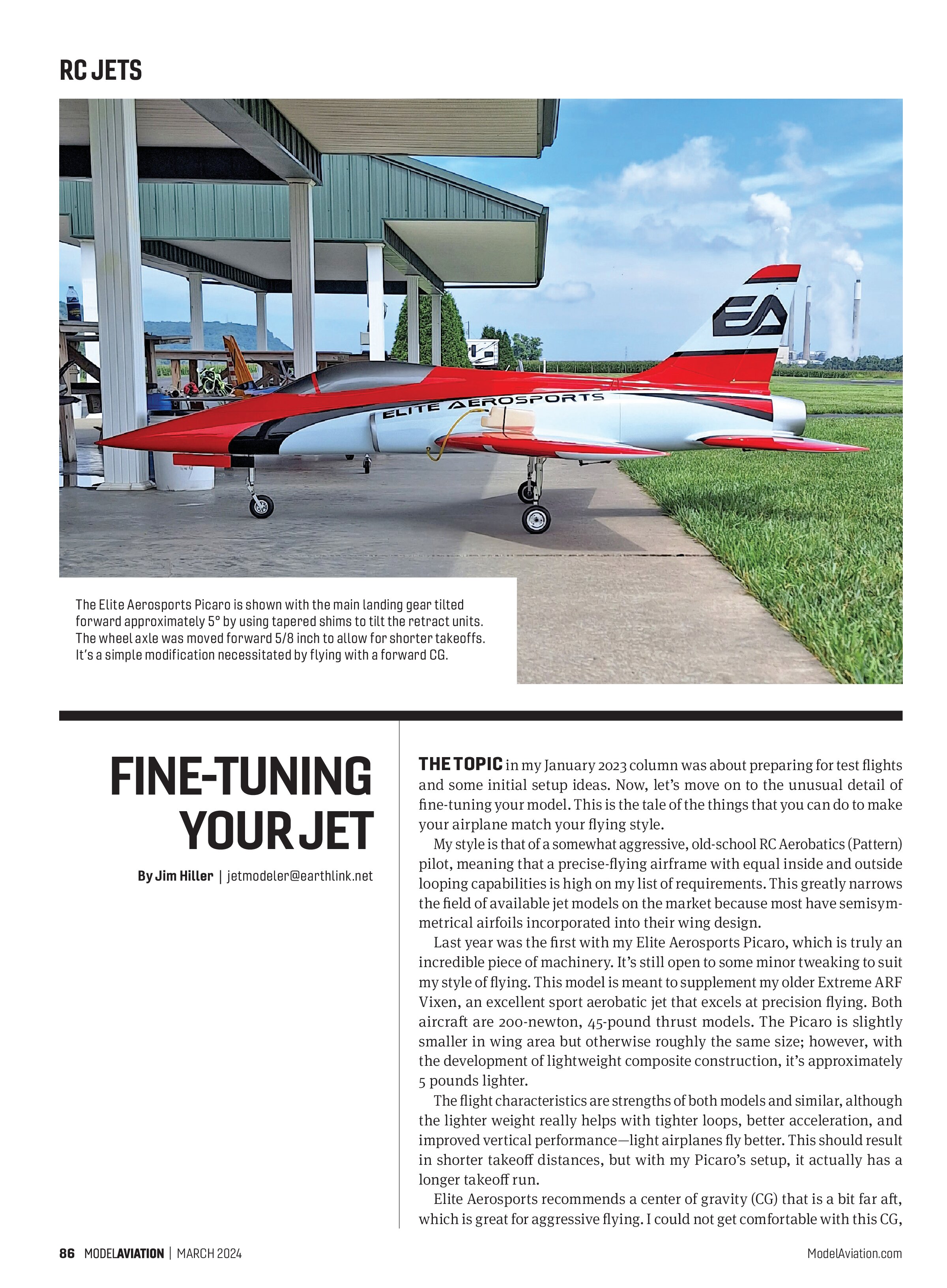
A solution was easily put in place. I could move the main-gear axle forward by relocating the main gear retract units forward 5/8 inch, but this was an impractical solution on a modern composite with a prepainted wing, so another solution had to be found. I opted to fabricate tapered shims to be placed on the backside of the retract unit mounts to lean the gear strut forward.
The nice part with this method is that, in the retracted position, the wheel still aligns in the wheel well, although it is tilted down in the front, so it is no longer parallel and flush with the bottom wing skin. The angle is so slight, however, that it is not noticeable in flight.
The final shims are made from 3/16-inch fiberglass material that I had left over from another project. I sanded on a taper to allow the retract unit to be fully supported without imposing a bending stress.
In aviation, all changes have consequences. In this case, a simple CG change affected the takeoff characteristics in a negative way, leading to a second change to correct the new problem. The extra effort has paid off well. My Picaro flies and performs aerobatics that match my style of flying. I can now rotate early for shorter takeoff distances, and holding the nose gear up following the touchdown on landing, as well as wheelie landings, is even easier than before.
Cold Weather Maintenance
This cold weather time is a good opportunity to do some annual maintenance on our models. A good example is my Vixen sport jet that is more than seven years old and has hundreds of flights. It’s time to replace the fuel lines again.
The fuel tank clunk plumbing was done with Viton tubing, which is wonderful stuff. It holds up well and, to this day, it has not needed replacement. The Tygon tubing outside of the tanks does age with exposure to kerosene, and some areas of it are getting rather stiff.
Another issue that has become quite concerning is the older wiring harness that appears to be made from silicone or vinyl-insulated servo wiring. Kerosene

fumes and fuel exposure have taken their toll, and areas of the wiring have become quite stiff as well.
This year’s assignment will be to replace the wiring harness with one made from PowerBox Systems premium servo-lead wire. The insulation is more appropriate for use with kerosene, and, as a side benefit, it is a lighter-weight wire for the same gauge because the insulation is thinner.
Approaches to Landing
Last summer, I coached some pilots who were having issues with achieving consistently good landings. Sometimes they had very good landings, while other times they were getting behind and fighting the airplane while trying to get it down on the runway. The common theme was that they suffered from a poor approach to the landing. By flying a consistent approach, you will be rewarded with more quality landings.
The goal of the landing approach is to present yourself with the airplane set up for landing at approximately 6 feet off of the ground, aligned with the runway centerline with any crosswind heading correction already in place, and at the same speed for a smooth transition to the landing phase. When this is accomplished, you can concentrate purely on the final landing flare without the complications of other corrections that come from a poor approach. Pilots can easily be overwhelmed if, during the landing flare, they are also forced to turn the airplane to get back over the runway or make a heading correction to align with the runway.
Hold yourself to a higher standard for the landing approach. If you get behind turning final and you have turned too early—or worse, too late—make the decision immediately to go around while you still have altitude and airspeed. Don’t force a bad situation. Turn this attempt into a practice approach and go around and make corrections on your next approach. Remember, you can always go around.
A note about airspeed control on the approach sequence. Airspeed is directly related to the angle of attack, and with a proper CG, it’s also related to the elevator position. The less elevator, the faster the airspeed, and with more up-elevator, the slower the approach speed. Too much and you stall and drop a wing. This leads to whether you are aware of how much elevator you are using during the landing approach. Think about it as how you control your airspeed and use throttle to control the rate of descent.
Many of us fall into the trap of trying to extend our landing approach to make it to the runway by using elevator. It then leads to you running out of airspeed for the flare for landing. Use the throttle to extend the landing approach when it’s short, and with a turbine-powered aircraft, use it early because the throttle response will take some time. Again, remember that you can always go around.
Consistent landings are the result of always presenting yourself with the goals of a good landing approach, proper airspeed, aligning with the runway centerline, a glide path parallel to the runway, and the proper height.
View the YouTube video listed in “Sources” to see what happens to full-scale pilots who fail to make the decision to go around. It looks like we modelers when we screw up our landings.
Sources:
Jet Pilots Organization (JPO)
www.jetpilots.org
You can always go around
YouTube
www.youtube.com/watch?v=lr5d3sGxSXQ
Elite Aerosports
(954) 444-8808
www.eliteaerosports.com
PowerBox Systems Americas
(904) 330-0145
www.powerbox-americas.com
AeroPanda
(321) 312-0723
www.aeropanda.com