IMPORTANT CHANGES: PUTTING YOU IN THE KNOW!
By Justin Wells | justinwells@mac.com

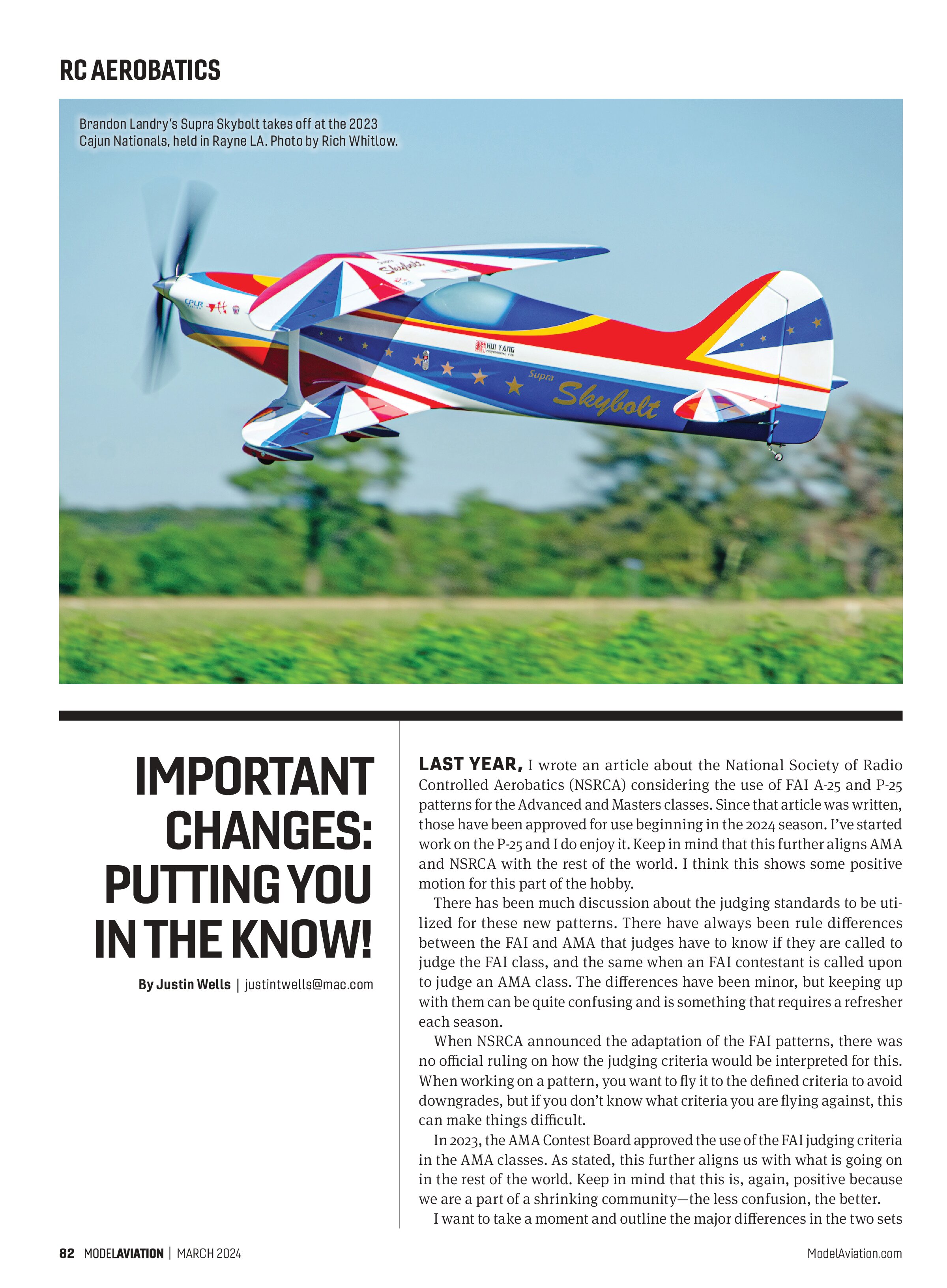
LAST YEAR, I wrote an article about the National Society of Radio Controlled Aerobatics (NSRCA) considering the use of FAI A-25 and P-25 patterns for the Advanced and Masters classes. Since that article was written, those have been approved for use beginning in the 2024 season. I’ve started work on the P-25 and I do enjoy it. Keep in mind that this further aligns AMA and NSRCA with the rest of the world. I think this shows some positive motion for this part of the hobby.
There has been much discussion about the judging standards to be utilized for these new patterns. There have always been rule differences between the FAI and AMA that judges have to know if they are called to judge the FAI class, and the same when an FAI contestant is called upon to judge an AMA class. The differences have been minor, but keeping up with them can be quite confusing and is something that requires a refresher each season.
When NSRCA announced the adaptation of the FAI patterns, there was no official ruling on how the judging criteria would be interpreted for this. When working on a pattern, you want to fly it to the defined criteria to avoid downgrades, but if you don’t know what criteria you are flying against, this can make things difficult.
In 2023, the AMA Contest Board approved the use of the FAI judging criteria in the AMA classes. As stated, this further aligns us with what is going on in the rest of the world. Keep in mind that this is, again, positive because we are a part of a shrinking community—the less confusion, the better.
I want to take a moment and outline the major differences in the two sets of criteria so that you know how to proceed this season. FAI offers plenty of documentation, but hopefully this will help get you started.
The Standard FAI Principals of Judging thay you should know
- Geometrical accuracy.
- Constant flying speed. Significant differences up to one point are subtracted.
- Correct positioning within the maneuvering zone. Centering is downgraded from 1/2 to four points. Distance out is downgraded by one point from 175 to 200 meters and two to three points if greater than 200 meters.
- Size matching to the size of the maneuvering zone and relative to the size of the other maneuvering performed throughout a schedule.
- Proportion of the maneuvering outside of the maneuvering zone.
The following is a list of the specific items that differ:
- Weight limit: The new weight limit is now 5,500 grams and electric-powered models with batteries and internal combustion have a full tank of fuel. (Previously, internal-combustion models were weighed without fuel.)
- Required calls: None. No takeoff, box, or landing is required.
- Maneuvering direction (the direction in which the first maneuver is done): Either direction. FAI may take off, make a turnaround, and enter the box for maneuvering or make a trim pass then enter the box. A box call is not required, so you, as a judge, have to be prepared for either direction.
4. Landing direction: You can land in any direction when complete, regardless of what direction you took off.
5. Lines between maneuvers: All maneuvers are entered and exited by a horizontal line of recognizable length.
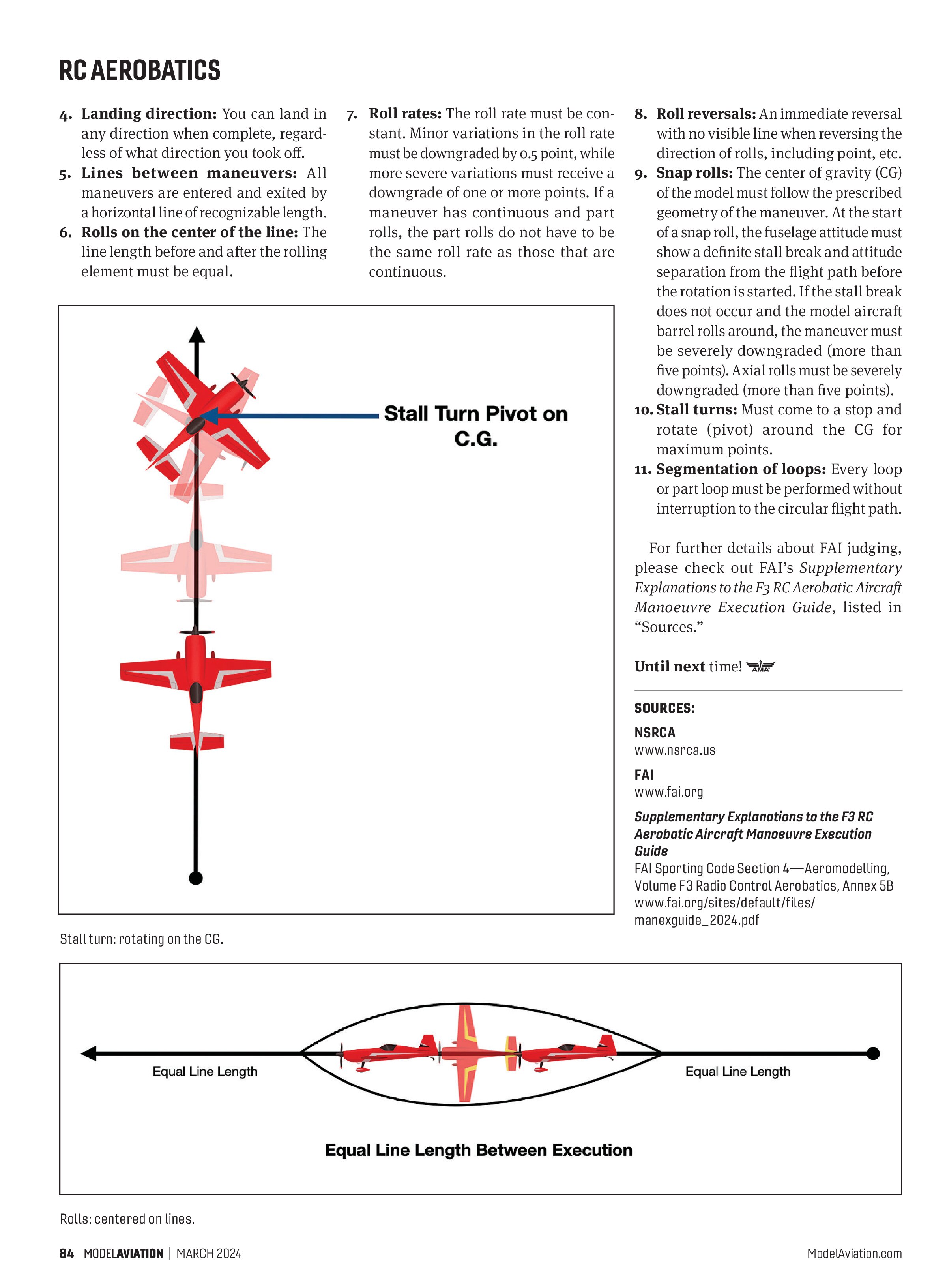
6. Rolls on the center of the line: The line length before and after the rolling element must be equal.

7. Roll rates: The roll rate must be constant. Minor variations in the roll rate must be downgraded by 0.5 point, while more severe variations must receive a downgrade of one or more points. If a maneuver has continuous and part rolls, the part rolls do not have to be the same roll rate as those that are continuous.
8. Roll reversals: An immediate reversal with no visible line when reversing the direction of rolls, including point, etc.
9. Snap rolls: The center of gravity (CG) of the model must follow the prescribed geometry of the maneuver. At the start of a snap roll, the fuselage attitude must show a definite stall break and attitude separation from the flight path before the rotation is started. If the stall break does not occur and the model aircraft barrel rolls around, the maneuver must be severely downgraded (more than five points). Axial rolls must be severely downgraded (more than five points).
10. Stall turns: Must come to a stop and rotate (pivot) around the CG for maximum points.
11. Segmentation of loops: Every loop or part loop must be performed without interruption to the circular flight path.
For further details about FAI judging, please check out FAI’s Supplementary Explanations to the F3 RC Aerobatic Aircraft Manoeuvre Execution Guide, listed in “Sources.”
Until next time!
SOURCES:
NSRCA
www.nsrca.us
FAI
www.fai.org
Supplementary Explanations to the F3 RC Aerobatic Aircraft Manoeuvre Execution Guide
FAI Sporting Code Section 4—Aeromodelling, Volume F3 Radio Control Aerobatics, Annex 5B
www.fai.org/sites/default/files/maneyguide_2024.pdf