Focal Point
Interested in sharing your handiwork? Visit www.ModelAviation.com for submission guidelines.
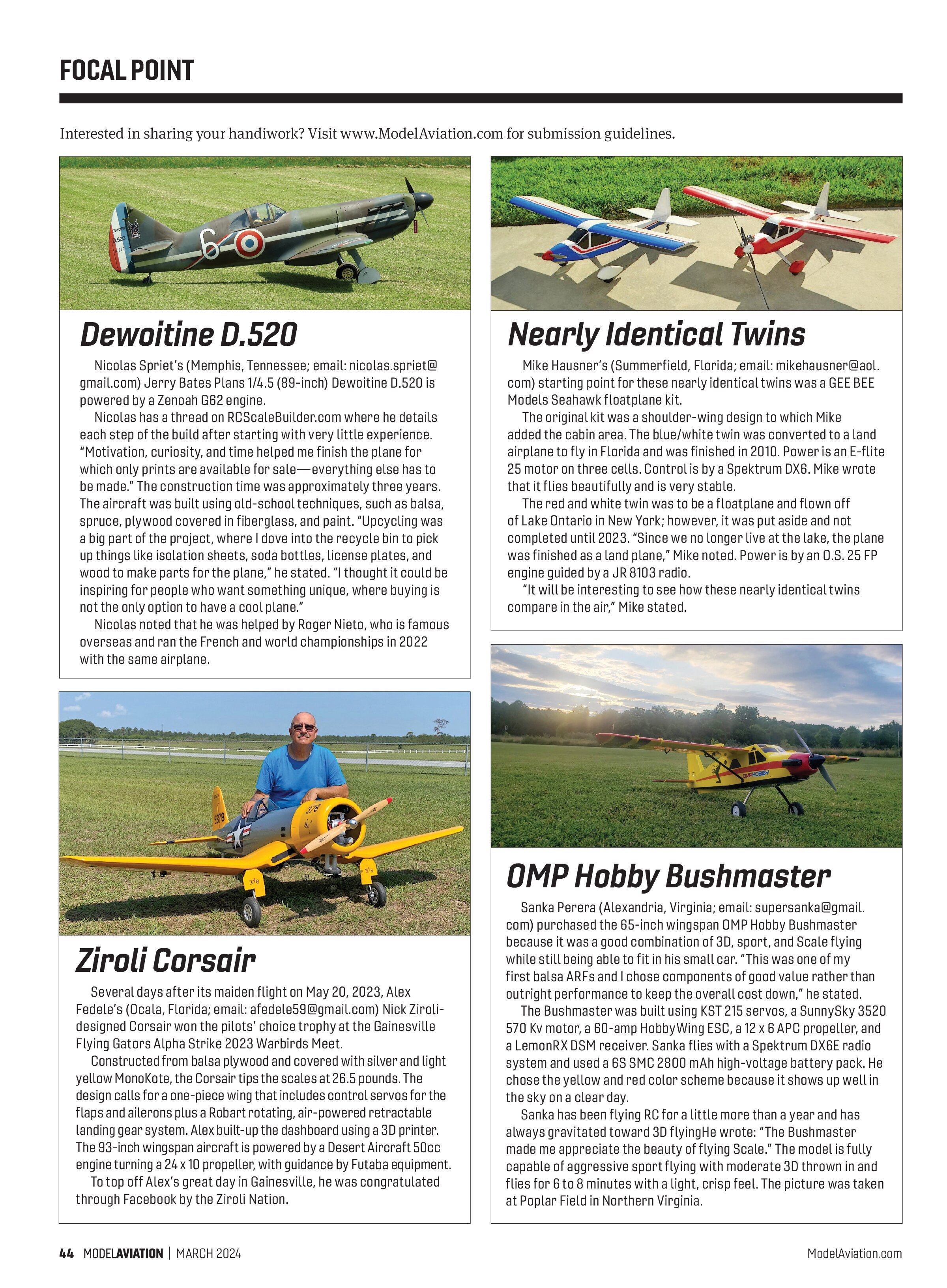
Dewoitine D.520
Nicolas Spriet’s (Memphis, Tennessee; email: nicolas.spriet@gmail.com) Jerry Bates Plans 1/4.5 (89-inch) Dewoitine D.520 is powered by a Zenoah G62 engine.
Nicolas has a thread on RCScaleBuilder.com where he details each step of the build after starting with very little experience. “Motivation, curiosity, and time helped me finish the plane for which only prints are available for sale—everything else has to be made.” The construction time was approximately three years. The aircraft was built using old-school techniques, such as balsa, spruce, plywood covered in fiberglass, and paint. “Upcycling was a big part of the project, where I dove into the recycle bin to pick up things like isolation sheets, soda bottles, license plates, and wood to make parts for the plane,” he stated. “I thought it could be inspiring for people who want something unique, where buying is not the only option to have a cool plane.”
Nicolas noted that he was helped by Roger Nieto, who is famous overseas and ran the French and world championships in 2022 with the same airplane.

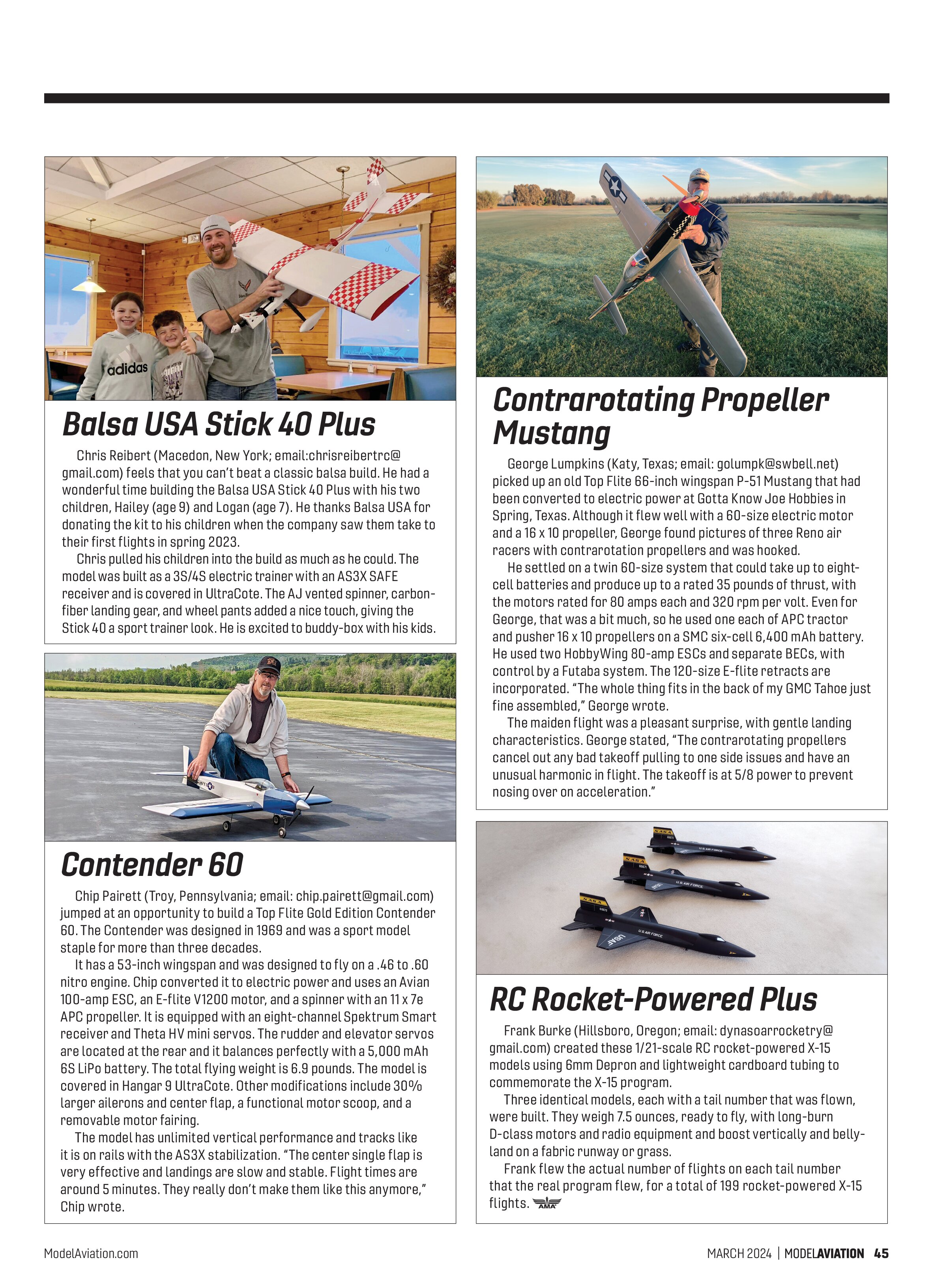
Nearly Identical Twins
Mike Hausner’s (Summerfield, Florida; email: mikehausner@aol.com) starting point for these nearly identical twins was a GEE BEE Models Seahawk floatplane kit.
The original kit was a shoulder-wing design to which Mike added the cabin area. The blue/white twin was converted to a land airplane to fly in Florida and was finished in 2010. Power is an E-flite 25 motor on three cells. Control is by a Spektrum DX6. Mike wrote that it flies beautifully and is very stable.
The red and white twin was to be a floatplane and flown off of Lake Ontario in New York; however, it was put aside and not completed until 2023. “Since we no longer live at the lake, the plane was finished as a land plane,” Mike noted. Power is by an O.S. 25 FP engine guided by a JR 8103 radio.
“It will be interesting to see how these nearly identical twins compare in the air,” Mike stated.

Zirolli Corsair
Several days after its maiden flight on May 20, 2023, Alex Fedele’s (Ocala, Florida; email: afedele59@gmail.com) Nick Ziroli-designed Corsair won the pilot’s choice trophy at the Gainesville Flying Gators Alpha Strike 2023 Warbirds Meet.
Constructed from balsa plywood and covered with silver and light yellow MonoKote, the Corsair tips the scales at 26.5 pounds. The design calls for a one-piece wing that includes control servos for the flaps and ailerons plus a Robart rotating, air-powered retractable landing gear system. Alex built-up the dashboard using a 3D printer. The 93-inch wingspan aircraft is powered by a Desert Aircraft 50cc engine turning a 24 x 10 propeller, with guidance by Futaba equipment.
To top off Alex’s great day in Gainesville, he was congratulated through Facebook by the Ziroli Nation.

OMP Hobby Bushmaster
Sanka Perera (Alexandria, Virginia; email: supersanka@gmail.com) purchased the 65-inch wingspan OMP Hobby Bushmaster because it was a good combination of 3D, sport, and Scale flying while still being able to fit in his small car. “This was one of my first balsa ARFs and I chose components of good value rather than outright performance to keep the overall cost down,” he stated.
The Bushmaster was built using KST 215 servos, a SunnySky 3520 570 Kv motor, a 60-amp HobbyWing ESC, a 12 x 6 APC propeller, and a LemonRX DSM receiver. Sanka flies with a Spektrum DX6E radio system and used a 6S SMC 2800 mAh high-voltage battery pack. He chose the yellow and red color scheme because it shows up well in the sky on a clear day.
Sanka has been flying RC for a little more than a year and has always gravitated toward 3D flying. He wrote: “The Bushmaster made me appreciate the beauty of flying Scale.” The model is fully capable of aggressive sport flying with moderate 3D thrown in and flies for 6 to 8 minutes with a light, crisp feel. The picture was taken at Poplar Field in Northern Virginia.

Balsa USA Stick 40 Plus
Chris Reibert (Macedon, New York; email:chrisreibert.rc@gmail.com) feels that you can’t beat a classic balsa build. He had a wonderful time building the Balsa USA Stick 40 Plus with his two children, Hailey (age 9) and Logan (age 7). He thanks Balsa USA for donating the kit to his children when the company saw them take to their first flights in spring 2023.
Chris pulled his children into the build as much as he could. The model was built as a 3S/4S electric trainer with an AS3X SAFE receiver and is covered in UltraCote. The AJ vented spinner, carbon-fiber landing gear, and wheel pants added a nice touch, giving the Stick 40 a sport trainer look. He is excited to buddy-box with his kids.

Contender 60
Chip Pairett (Troy, Pennsylvania; email: chip.pairett@gmail.com) jumped at an opportunity to build a Top Flite Gold Edition Contender 60. The Contender was designed in 1969 and was a sport model staple for more than three decades.
It has a 53-inch wingspan and was designed to fly on a .46 to .60 nitro engine. Chip converted it to electric power and uses an Avian 100-amp ESC, an E-flite V1200 motor, and a spinner with an 11 x 7e APC propeller. It is equipped with an eight-channel Spektrum Smart receiver and Theta HV mini servos. The rudder and elevator servos are located at the rear and it balances perfectly with a 5,000 mAh 6S LiPo battery. The total flying weight is 6.9 pounds. The model is covered in Hangar 9 UltraCote. Other modifications include 30% larger ailerons and a center flap, a functional motor scoop, and a removable motor fairing.
The model has unlimited vertical performance and tracks like it is on rails with the AS3X stabilization. “The center single flap is very effective and landings are slow and stable. Flight times are around 5 minutes. They really don’t make them like this anymore,” Chip wrote.

Contrarotating Propeller Mustang
George Lumpkins (Katy, Texas; email: golumpk@swbell.net) picked up an old Top Flite 66-inch wingspan P-51 Mustang that had been converted to electric power at Gotta Know Joe Hobbies in Spring, Texas. Although it flew well with a 60-size electric motor and a 16 x 10 propeller, George found pictures of three Reno air racers with contrarotation propellers and was hooked.
He settled on a twin 60-size system that could take up to eight-cell batteries and produce up to a rated 35 pounds of thrust, with the motors rated for 80 amps each and 320 rpm per volt. Even for George, that was a bit much, so he used one each of APC tractor and pusher 16 x 10 propellers on a SMC six-cell 6,400 mAh battery. He used two HobbyWing 80-amp ESCs and separate BECs, with control by a Futaba system. The 120-size E-flite retracts are incorporated. “The whole thing fits in the back of my GMC Tahoe just fine assembled,” George wrote.
The maiden flight was a pleasant sunrise, with gentle landing characteristics. George stated, “The contrarotating propellers cancel out any bad takeoff pulling to one side issues and have an unusual harmonic in flight. The takeoff is at 5/8 power to prevent nosing over on acceleration.”

RC Rocket-Powered Plus
Frank Burke (Hillsboro, Oregon; email: dynasaurrocketry@gmail.com) created these 1/21-scale RC rocket-powered X-15 models using 6mm Depron and lightweight cardboard tubing to commemorate the X-15 program.
Three identical models, each with a tail number that was flown, were built. They weigh 7.5 ounces, ready to fly, with long-burn D-class motors and radio equipment and boost vertically and belly-land on a fabric runway or grass.
Frank flew the actual number of flights on each tail number that the real program flew, for a total of 199 rocket-powered X-15 flights.