CORNFIELD RESCUE
You lost your model airplane
in the corn—now what?
By Tom Hallman
maxfliart@hallmanstudio.com
Photos by the author
You find yourself standing in the middle of a large field, watching your rubber-powered Free Flight (FF) model airplane drift deep into a bordering cornfield. What happens next?
This is a story of being the lone chaser of my 1941 Gollywock at the 2023 Flying Aces Club (FAC) Outdoor Championships in Muncie, Indiana, watching it float over a large field of 10-foot-high corn, and then dropping below my view of the horizon. I’ll detail the lessons learned, what to do and what not to do, and hopefully improve the chances of a quick and successful retrieval on future flights.
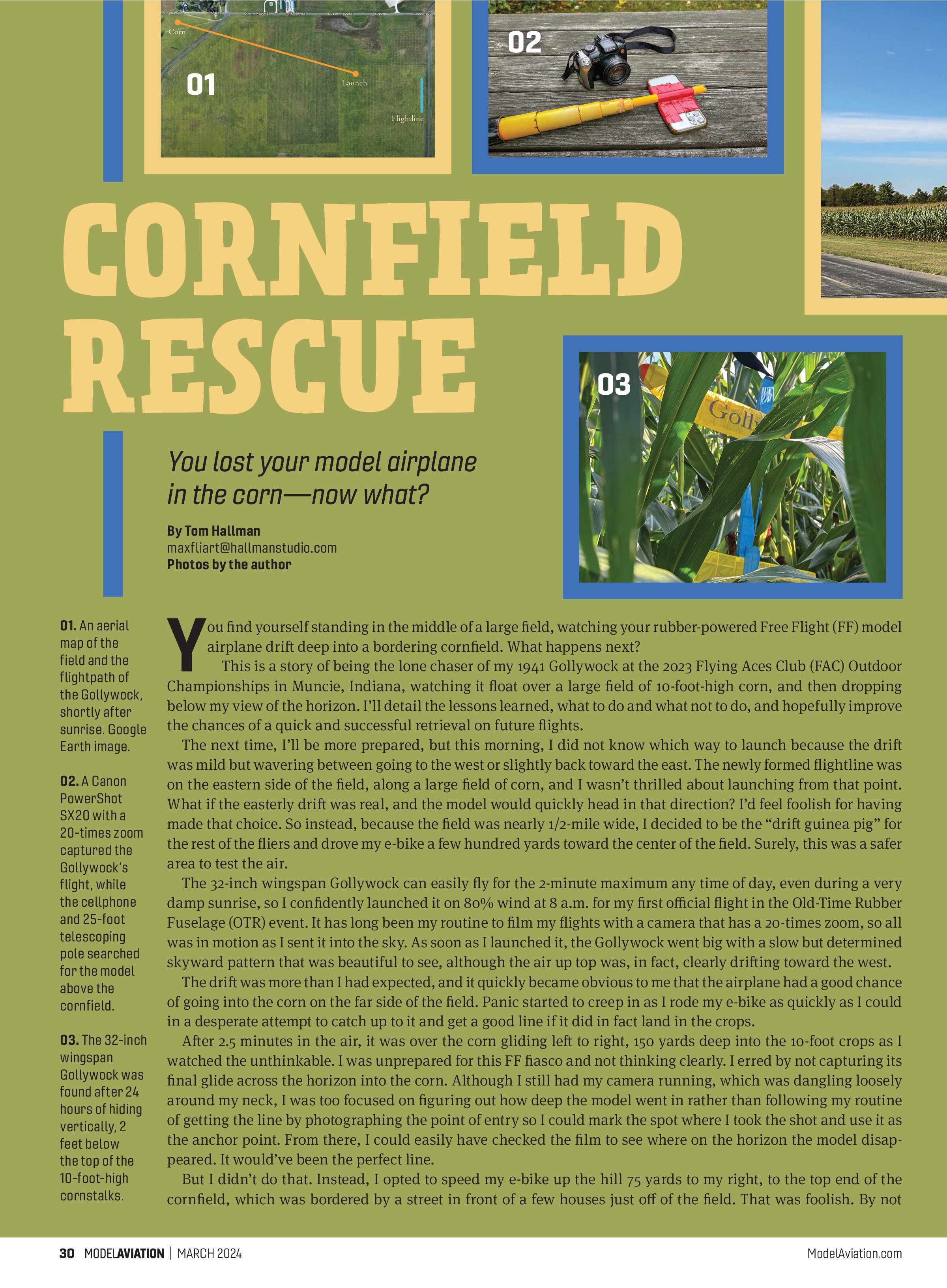
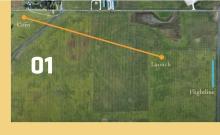
The next time, I’ll be more prepared, but this morning, I did not know which way to launch because the drift was mild but wavering between going to the west or slightly back toward the east. The newly formed flightline was on the eastern side of the field, along a large field of corn, and I wasn’t thrilled about launching from that point. What if the easterly drift was real, and the model would quickly head in that direction? I’d feel foolish for having made that choice. So instead, because the field was nearly 1/2-mile wide, I decided to be the “drift guinea pig” for the rest of the fliers and drove my e-bike a few hundred yards toward the center of the field. Surely, this was a safer area to test the air.
The 32-inch wingspan Gollywock can easily fly for the 2-minute maximum any time of day, even during a very damp sunrise, so I confidently launched it on 80% wind at 8 a.m. for my first official flight in the Old-Time Rubber Fuselage (OTR) event. It has long been my routine to film my flights with a camera that has a 20-times zoom, so all was in motion as I sent it into the sky. As soon as I launched it, the Gollywock went big with a slow but determined skyward pattern that was beautiful to see, although the air up top was, in fact, clearly drifting toward the west.
The drift was more than I had expected, and it quickly became obvious to me that the airplane had a good chance of going into the corn on the far side of the field. Panic started to creep in as I rode my e-bike as quickly as I could in a desperate attempt to catch up to it and get a good line if it did in fact land in the crops.
After 2.5 minutes in the air, it was over the corn gliding left to right, 150 yards deep into the 10-foot crops as I watched the unthinkable. I was unprepared for this FF fiasco and not thinking clearly. I erred by not capturing its final glide across the horizon into the corn. Although I still had my camera running, which was dangling loosely around my neck, I was too focused on figuring out how deep the model went in rather than following my routine of getting the line by photographing the point of entry so I could mark the spot where I took the shot and use it as the anchor point. From there, I could easily have checked the film to see where on the horizon the model disappeared. It would’ve been the perfect line.
But I didn’t do that. Instead, I opted to speed my e-bike up the hill 75 yards to my right, to the top end of the cornfield, which was bordered by a street in front of a few houses just off of the field. That was foolish. By not


The realization of this left me somewhat defeated, although I knew I had to scramble. I raced back to my van, nearly half of a mile away. The street above the corn was gated, so I had to go off of the AMA site and drive a few miles around to the back side of the field via local roads. I thought that if I could pull alongside of the corn on the raised street along the northern edge, I could then stand on top of the van and see it resting spread-eagle on top of the dense corn. I quickly realized that I wasn’t going to make that maneuver happen, seeing as my van-climbing skills aren’t what they once were.
Seeing a cornfield from a distance is quite different from being right alongside one. They’re dense, and in some cases massive, leaving you with the hopeless feeling of looking for a needle in a haystack. In this case, the corn was around 300 yards deep and much wider. Why didn’t I stop short and record the line as the Gollywock went in? I had found many of my friends’ models by doing exactly that. Clearly, today’s flight had not received my best effort.
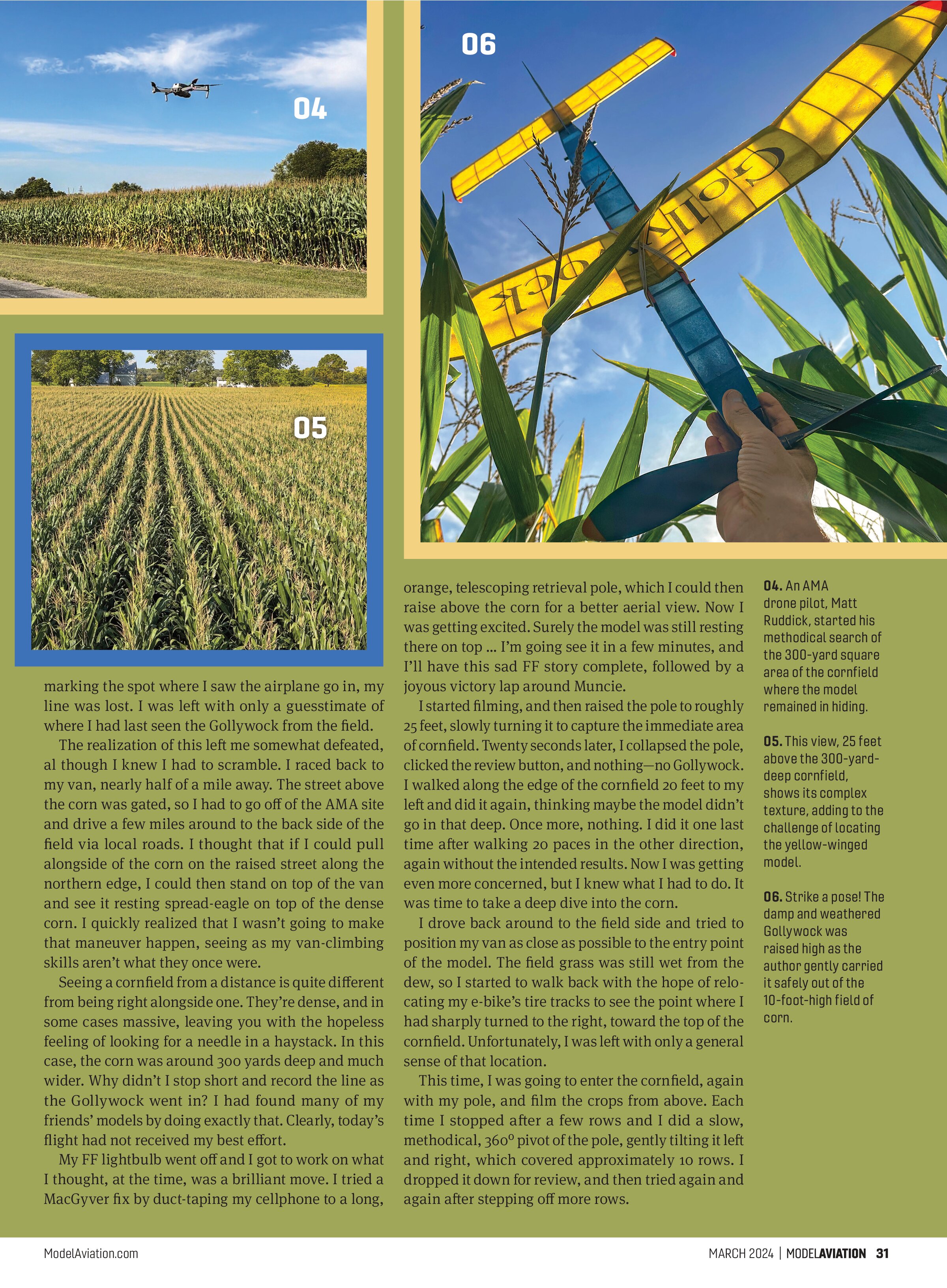
My FF lightbulb went off and I got to work on what I thought, at the time, was a brilliant move. I tried a MacGyver fix by duct-taping my cellphone to a long, orange, telescoping retrieval pole, which I could then raise above the corn for a better aerial view. Now I was getting excited. Surely the model was still resting there on top ... I’m going see it in a few minutes, and I’ll have this sad FF story complete, followed by a joyous victory lap around Muncie.
I started filming, and then raised the pole to roughly 25 feet, slowly turning it to capture the immediate area of cornfield. Twenty seconds later, I collapsed the pole, clicked the review button, and nothing—no Gollywock. I walked along the edge of the cornfield 20 feet to my left and did it again, thinking maybe the model didn’t go in that deep. Once more, nothing. I did it one last time after walking 20 paces in the other direction, again without the intended results. Now I was getting even more concerned, but I knew what I had to do. It was time to take a deep dive into the corn.
I drove back around to the field side and tried to position my van as close as possible to the entry point of the model. The field grass was still wet from the dew, so I started to walk back with the hope of relocating my e-bike’s tire tracks to see the point where I had sharply turned to the right, toward the top of the cornfield. Unfortunately, I was left with only a general sense of that location.
This time, I was going to enter the cornfield, again with my pole, and film the crops from above. Each time I stopped after a few rows and I did a slow, methodical, 360° pivot of the pole, gently tilting it left and right, which covered approximately 10 rows. I dropped it down for review, and then tried again and again after stepping off more rows.


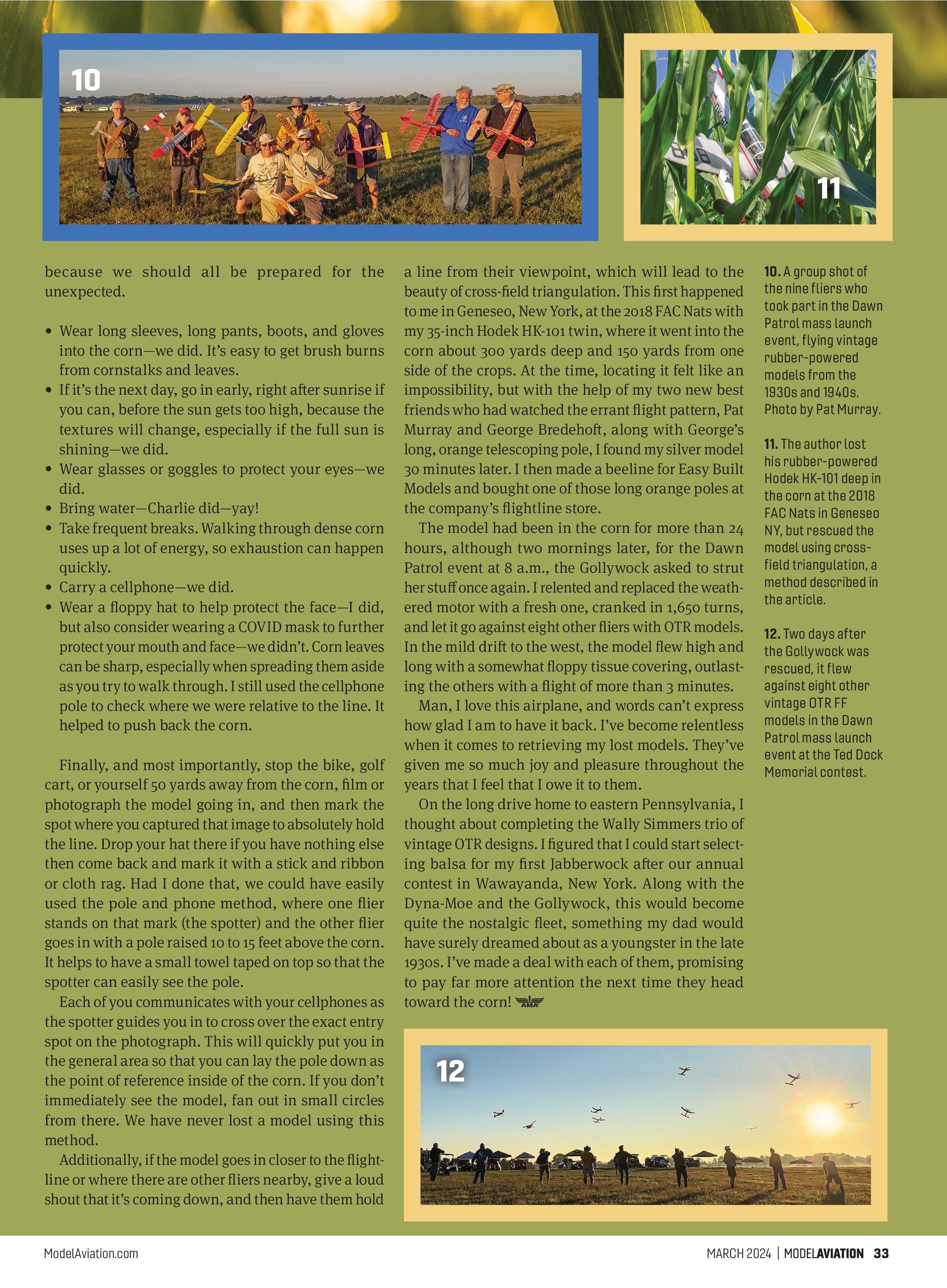
After 90 minutes, I got some calls and texts from a few concerned flying buddies. Note to self: Cellphone reception in a dense cornfield is spotty at best. I let them know that I was fine, went to the van for some water, and then went back into the corn for another half hour. While searching, I got a call from my flying pal, Ted Allebone, who had been talking with Jay Smith (Model Aviation’s executive editor) on the flight-line. Ted said that he wished he had a drone to search from above, to which Jay mentioned that there were two at AMA Headquarters! A call was placed and Matt Ruddick, one of AMA’s drone pilots, arrived 15 minutes later, ready to take care of business and initiate plan number two. Oh, happy day!
He used up two batteries (20 minutes each) while scanning the crop from above in a gridlike fashion, but we still couldn’t spot the model because the shadow and contrast of the corn with the higher sun created a difficult texture to see anything clearly—especially a model with a yellow wing, similar to the silvery corn leaves. I very much appreciated the time and effort by AMA and its crew to help with the search, but now we knew for sure that the model had fallen into the corn below the surface. A new plan would need to be initiated.
It had been 3.5 hours already, plus it was getting hotter, so rather than going back in, I opted to try again the next morning. I knew the model was still in there, so I wasn’t going to turn my back on it now. After looking over my pole films again back at the motel, I figured out the ideal search box within the corn to walk, row by row. Refreshed and armed with plan number three and wingman Charlie Sauter, we arrived at the site at 7:30 a.m. to renew the search. I was determined to pull that Gollywock out of the corn.
Forty-five minutes later, after we had gone back and forth four times, walking four rows apart from each other and covering a total of 30 rows, I went back out of the corn to check the footage from the original camera that I had used to film the flight. Fortunately, I had left the camera running as I quickly chased with the e-bike.
Because of the rough terrain and motion, the footage was blurry and scattered, bouncing all over the place from the strap around my neck, but this old Canon PowerShot SX20 has a slow-motion playback feature, which allowed me to get a better sense of the line. I could freeze-frame the film and catch the last glimpse of the model relative to the position of the trees and farmhouse on the far side of the corn. That’s when I knew that we had to rethink our search box. I realized that we were looking too far south, so we started going through the rows toward the north, slightly outside of my original search box.
We walked in again to the far western end of the corn, four rows apart, scanning a total of eight rows with each pass. Spread your arms, push back the stalks, look left and right, squat to look under the leaves, then repeat and repeat. It starts to feel like muscle memory as the time quickly passes. All the while you’re thinking, “... C’mon Gollywock, show yourself ...”
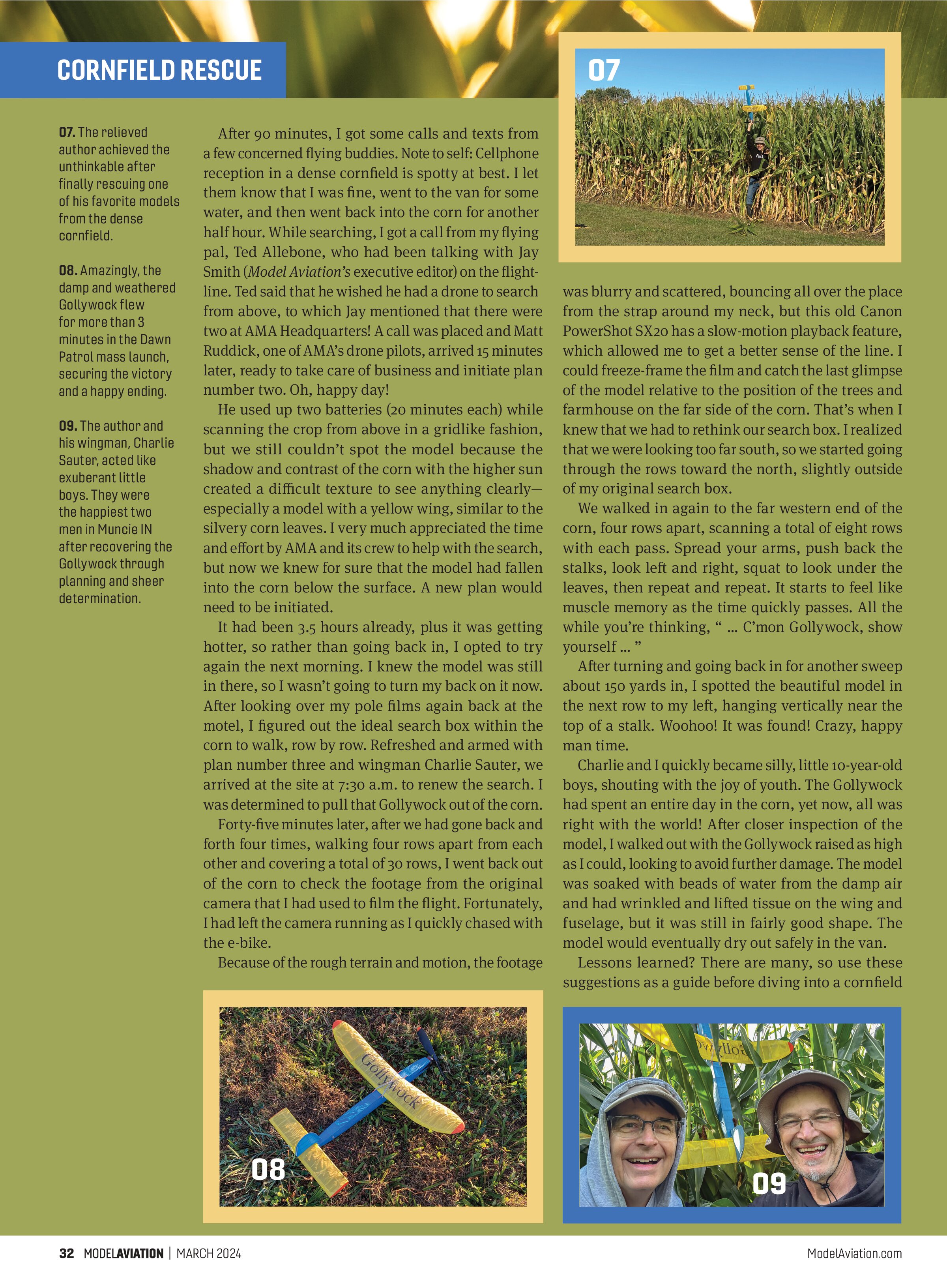
After turning and going back in for another sweep about 150 yards in, I spotted the beautiful model in the next row to my left, hanging vertically near the top of a stalk. Woohoo! It was found! Crazy, happy man time.
Charlie and I quickly became silly, little 10-year-old boys, shouting with the joy of youth. The Gollywock had spent an entire day in the corn, yet now, all was right with the world! After closer inspection of the model, I walked out with the Gollywock raised as high as I could, looking to avoid further damage. The model was soaked with beads of water from the damp air and had wrinkled and lifted tissue on the wing and fuselage, but it was still in fairly good shape. The model would eventually dry out safely in the van.
Lessons learned? There are many, so use these suggestions as a guide before diving into a cornfield because we should all be prepared for the unexpected.

• Wear long sleeves, long pants, boots, and gloves into the corn—we did. It’s easy to get brush burns from cornstalks and leaves.
• If it’s the next day, go in early, right after sunrise if you can, before the sun gets too high, because the textures will change, especially if the full sun is shining—we did.
• Wear glasses or goggles to protect your eyes—we did.
• Bring water—Charlie did—yay!
• Take frequent breaks. Walking through dense corn uses up a lot of energy, so exhaustion can happen quickly.
• Carry a cellphone—we did.
• Wear a floppy hat to help protect the face—I did, but also consider wearing a COVID mask to further protect your mouth and face—we didn’t. Corn leaves can be sharp, especially when spreading them aside as you try to walk through. I still used the cellphone pole to check where we were relative to the line. It helped to push back the corn.
Finally, and most importantly, stop the bike, golf cart, or yourself 50 yards away from the corn, film or photograph the model going in, and then mark the spot where you captured that image to absolutely hold the line. Drop your hat there if you have nothing else then come back and mark it with a stick and ribbon or cloth rag. Had I done that, we could have easily used the pole and phone method, where one flier stands on that mark (the spotter) and the other flier goes in with a pole raised 10 to 15 feet above the corn. It helps to have a small towel taped on top so that the spotter can easily see the pole.
Each of you communicates with your cellphones as the spotter guides you in to cross over the exact entry spot on the photograph. This will quickly put you in the general area so that you can lay the pole down as the point of reference inside of the corn. If you don’t immediately see the model, fan out in small circles from there. We have never lost a model using this method.
Additionally, if the model goes in closer to the flight-line or where there are other fliers nearby, give a loud shout that it’s coming down, and then have them hold a line from their viewpoint, which will lead to the beauty of cross-field triangulation. This first happened to me in Geneseo, New York, at the 2018 FAC Nats with my 35-inch Hodek HK-101 twin, where it went into the corn about 300 yards deep and 150 yards from one side of the crops. At the time, locating it felt like an impossibility, but with the help of my two new best friends who had watched the errant flight pattern, Pat Murray and George Bredehoft, along with George’s long, orange telescoping pole, I found my silver model 30 minutes later. I then made a beeline for Easy Built Models and bought one of those long orange poles at the company’s flightline store.
The model had been in the corn for more than 24 hours, although two mornings later, for the Dawn Patrol event at 8 a.m., the Gollywock asked to strut her stuff once again. I relented and replaced the weathered motor with a fresh one, cranked in 1,650 turns, and let it go against eight other fliers with OTR models. In the mild drift to the west, the model flew high and long with a somewhat floppy tissue covering, outlasting the others with a flight of more than 3 minutes.
Man, I love this airplane, and words can’t express how glad I am to have it back. I’ve become relentless when it comes to retrieving my lost models. They’ve given me so much joy and pleasure throughout the years that I feel that I owe it to them.
On the long drive home to eastern Pennsylvania, I thought about completing the Wally Simmers trio of vintage OTR designs. I figured that I could start selecting balsa for my first Jabberwock after our annual contest in Wawayanda, New York. Along with the Dyna-Moe and the Gollywock, this would become quite the nostalgic fleet, something my dad would have surely dreamed about as a youngster in the late 1930s. I’ve made a deal with each of them, promising to pay far more attention the next time they head toward the corn!